
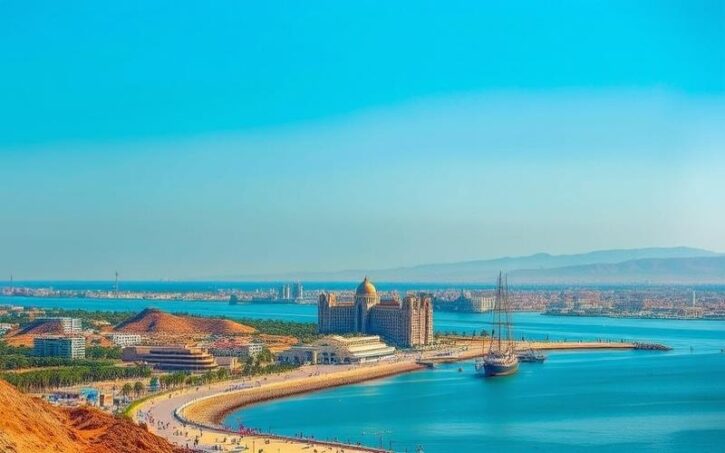
 Published on and written by Cyril Jarnias
Purchasing real estate abroad is rarely smooth sailing. In Oman, the legal framework is very specific, combines several property ownership regimes, and very clearly distinguishes what a foreigner can do… and what they absolutely cannot do. However, the country is sending multiple signals of openness: political stability, high security, favorable taxation, a growing market, and especially an increasingly attractive investment-based residency program.
This article details the complete process for buying property in Oman for non-residents. It covers authorized areas, types of property titles, practical steps, real costs, as well as benefits regarding profitability and visa acquisition. It also warns about common pitfalls to avoid.
A Real Estate Market in Full Repositioning
Oman is not a “second Dubai” and does not seek to be one. The stated strategy is different: a calmer, more exclusive market, betting on quality of life, natural landscapes (coasts, mountains, desert), and progressive growth rather than speculative spikes.
The capital, Muscat, is home to nearly 1.7 million people and concentrates most of the economic activity and residential real estate.
The government has made the real estate sector a pillar of the “Oman Vision 2040” strategy. Several objectives intersect:
– diversification away from oil and gas, via tourism, logistics, and industry;
– massive development of infrastructure and new planned neighborhoods;
– delivery of tens of thousands of residential units (over 60,000 additional housing units targeted by 2030 according to some plans);
– upscaling of projects with integrated complexes mixing resorts, marinas, golf courses, and residences.
In Muscat, prices for residential land and apartments have increased by about 17% year-on-year.
All within a stable monetary environment: the local currency, the Omani Rial (OMR), is pegged to the US dollar at a fixed rate of approximately 1 OMR to 2.60 USD. For an international investor, this is a factor of appreciable clarity.
The Legal Framework: What Foreigners Are Really Allowed to Buy
To understand the purchase process, one must first understand the types of property rights existing in Oman. Ownership rights are structured by a set of royal decrees and ministerial resolutions, which have progressively loosened restrictions for foreigners… while maintaining strictly protected areas.
A Basic Rule: The Land Belongs to the State
The foundation of the system dates back to Sultani Decree 5 of 1980 (Land Law), which establishes a simple principle: all land belongs to the State, except that transferred to Omani citizens by inheritance. From 1970 to 1980, outright foreign ownership was not even recognized.
From the 1990s, several decrees opened breaches:
– in 1995, Omani public joint-stock companies could acquire land, with foreign participation capped at 49%;
– in 2010, this cap was raised to 70% for certain real estate development companies;
– in parallel, a specific framework was created to attract foreign individuals through dedicated zones.
Integrated Tourism Complexes (ITC) and long-term usufruct rights are key concepts to understand in this context.
Freehold Ownership in ITCs
For a non-Omani, the most “comfortable” regime is freehold within an ITC. Sultani Decree 12 of 2006 precisely governs this system.
Concretely, an ITC is a large integrated urban project, developed by a promoter under contract with the State: marina, golf course, hotels, villas, apartments, shops, schools… Within these perimeters, a foreigner can acquire a residential or commercial property with a registered title that is transferable, mortgageable, assignable, and, most importantly, with no expiry date for the building. The land, legally, remains under the purview of the State or the promoter, but the buyer holds a right equivalent to freehold ownership over their unit.
The major names of these complexes are now well-known:
| ITC / Project | Approximate Location | Main Typology |
|---|---|---|
| Al Mouj Muscat | Near Muscat Airport | Marina, golf, residences, retail |
| Muscat Hills | Intra-urban in Muscat | Golf, villas and apartments |
| Muscat Bay | Between sea and mountains | High-end villas and residences |
| Jebel Sifah | Coast, 1 hour from Muscat | Resort, marina, golf |
| Hawana Salalah | Salalah region | Seafront, resort, residences |
| Saraya Bandar Jissah | Coast near Muscat | Resort and luxury villas |
| Yiti / Sustainable City | Bay south of Muscat | Eco-responsible project, villas/apts. |
In these complexes, freehold applies to apartments, villas, townhouses, and sometimes to vacant land plots for building. When it comes to vacant land, the foreign owner must nonetheless start construction within a four-year period. The Ministry of Housing and Urban Planning (MOHUP) can extend this deadline, but in theory, if it is not respected, the land can be repossessed and auctioned.
Usufruct and Leasehold: The Path for Buying Outside ITCs
Outside of ITCs, foreigners cannot in principle own land under freehold. Two schemes then dominate:
– leasehold (long-term lease, 25 to 99 years),
– usufruct as defined by Omani law (Sultani Decree 5 of 1981).
Usufruct is a real right, registered in the land registry, which grants its holder extensive prerogatives: to use the property, collect its income (rentals), lease it, transfer it, or pledge it as security. This right is exercised within a precise contractual framework, often for a duration set at 50 years renewable (up to 99 years maximum). At the end of the term, the property and its improvements revert to the original owner (often the State), sometimes with financial compensation.
Historically reserved for commercial projects (factories, industrial complexes), this regime was considerably expanded in 2020 with MOHUP Resolution 357. This authorizes foreigners to acquire apartments under usufruct in mixed-use buildings (residential + commercial) of four floors or more, located in licensed areas in and around Muscat. But with strict conditions:
To buy property in Oman, the expatriate buyer must be at least 23 years old and have resided in the country for at least 2 years. They are only authorized to acquire one single unit. Furthermore, expatriates collectively cannot own more than 40% of the units in a building, and no specific foreign nationality can represent more than 20% of the total units.
Minimum financial thresholds are also set: 45,000 OMR for a property in the Muscat region, 35,000 OMR in other governorates. The rights are renewable up to 99 years, transferable to heirs, and resaleable after four years of holding.
Zones Prohibited to Foreigners
The opening is not total. By another decree (Sultani Decree 29 of 2018), certain zones are expressly closed to foreign ownership (outside of complex structures via Omani companies):
| Zones / Governorates Prohibited or Restricted for Foreigners |
|---|
| Musandam |
| Buraimi |
| Dhahirah |
| Wusta |
| Certain areas of Dhofar (except wilayat Salalah) |
| Liwa, Shinas, Masirah |
| Jabal Akhdar, Jabal Shams, and other strategic mountainous areas |
| Land near military, security sites, or palaces |
| Archaeological, historical sites, designated agricultural land |
A non-Omani who already owned a property in one of these zones was ordered to transfer it to an Omani citizen within two years from the decree’s effective date.
Where and What to Buy: Property Types and Price Ranges
For a foreigner, the Omani real estate map is far from uniform. Between the coastal ITCs, the major urban projects, and usufruct buildings within Muscat, the options are varied.
Typology of Accessible Properties
The main categories of properties accessible to foreigners are the following: real estate, movable property, businesses, intellectual property rights.
Discover the main categories of properties available for investment or residence in Oman, from apartments to building plots.
From studios to large family units, often located in residences with pools, gyms, and 24/7 security within Integrated Tourism Complexes (ITC).
Row houses or detached homes, with or without seafront, available in prestigious areas like Al Mouj, Muscat Bay, Jebel Sifah, or Hawana Salalah.
Shops and office spaces available in certain ITCs or special economic zones, open to foreign investment when the project allows.
Building plots (typically 600 to 2,000 sq.m.) with the obligation to build within a four-year period.
The entry prices vary significantly, but the following order of magnitude emerges from available data:
| Property Type / Location | Indicative Price (in OMR) |
|---|---|
| Studio in an ITC or wider Muscat area | From 30,000 |
| 2-bedroom in Muscat (outside ultra-luxury) | From 50,000 |
| 2-bedroom apartment in Al Mouj | Approx. 115,000 – 120,000 |
| Villa in Al Ghubra (Muscat) | Around 200,000 |
| Coastal villa in Salalah | Starting from 150,000 |
| Residential plot in an ITC | From 150,000 to over 2 million depending on size |
| Luxury villas (seafront, golf, resorts) | Can easily exceed 500,000, even 1 million |
Per square meter, high-end neighborhoods in Muscat often show prices of 800 to 1,000 OMR/sq.m., with wider averages in the range of 500–1,000 OMR/sq.m. depending on the area.
Focus on Key Areas
– Al Mouj Muscat (formerly The Wave): arguably the most emblematic development, with a marina, an 18-hole golf course, a developed waterfront, restaurants, and international schools. Approximately 20,000 residents already live there.
– Muscat Hills: a golf community on higher ground, mixing villas and apartments, popular with expatriates.
– Muscat Bay and Saraya Bandar Jissah: projects nestled between sea and mountains, positioned in the high-end segment.
– Jebel Sifah: a resort an hour’s drive from Muscat, centered around a marina and golf course, targeting the second-home and seasonal rental market.
– Hawana Salalah: a large coastal development in Dhofar, highly tourism-oriented, particularly attractive during the Khareef season (local monsoon).
– Sultan Haitham City and The Sustainable City – Yiti: new planned “cities” or neighborhoods by MOHUP, often incorporating long-term usufruct rights (up to 99 years) and a sustainable dimension.
In addition to mega-projects, urban neighborhoods such as Qurum, Shatti Al Qurum, Madinat Al Sultan Qaboos, Al Khuwair, Ghubrah, or Bousher remain highly sought after for long-term rentals. This appeal persists even when foreign ownership takes the form of usufruct rather than freehold.
The Step-by-Step Purchase Process for a Foreigner
Once the framework is laid out, how does an acquisition in Oman actually proceed when you are not an Omani citizen or a GCC national?
1. Selection of Area and Type of Right
The first step, often underestimated, is to clarify:
– whether you are targeting an ITC (freehold, access to residency visa, higher entry price, strong resort dimension),
– or an apartment under usufruct in an eligible building outside an ITC (often more urban, lower entry price, foreigner quota constraints).
At this stage, it is highly advisable to rely on a licensed local real estate agent and a lawyer experienced in transactions with foreigners. Regulations are complex, the official language is Arabic, and not all legal documents are systematically available in English or French.
2. Property Search and Reservation
After defining the area, the investor views properties (physically or via virtual tours) and negotiates the price. Once the choice is made, the seller or promoter presents a reservation form or a Memorandum of Understanding (MOU).
A reservation deposit is then paid, most often ranging between 5% and 10% of the price, sometimes more for specific promotions. This deposit can take the form of an “Expression of Interest” (EOI) for off-plan programs.
3. Sale and Purchase Agreement (SPA)
Next comes the drafting of the Sale and Purchase Agreement (SPA), the actual sales contract detailing:
A complete real estate sales contract must notably specify: the total price, payment terms and schedule; the legal description of the property (area, location, plan, designated use); the seller’s or promoter’s guarantees (handover of keys, compliance, delivery deadlines for off-plan sales, construction warranties); usage rights (parking, common areas, beach access, etc.); as well as termination conditions and applicable penalties.
A local lawyer must absolutely review it, verify the project’s registration with MOHUP, ensure the existence of an escrow account for off-plan sales, and request a certified English translation if the original text is exclusively in Arabic.
4. Legal and Technical Due Diligence
This phase is critical. It involves verifying with the land registry and authorities:
– the authenticity of the seller’s title (Mulkhiya or sanad);
– the absence of liens, mortgages, seizures, or disputes on the property (certificate of clear title);
– compliance of building permits and municipal approvals;
– the property’s compatibility with foreign ownership (ITC, building covered by Resolution 357/2020, not located in a prohibited zone).
On the technical side, a property inspection (general condition, structure, equipment, air conditioning) is highly recommended, especially in a climate where heat and humidity can accelerate wear.
5. No Objection Certificate (NOC)
For transactions involving foreigners, a No Objection Certificate (NOC) is often required. It is issued either by:
For a non-Omani to legally buy property in Oman, they must obtain an official attestation. This must be provided either by the Ministry of Housing and Urban Planning (MOHUP) to confirm eligibility, or, in the case of property within a complex (ITC), by the promoter themselves. The promoter then attests that the seller is in good standing, notably that they have no unpaid service charges and that no disputes are ongoing.
Fees for the NOC vary but are generally between 500 and 1,000 OMR in the case of certain ITCs or specific procedures.
The processing time is around 2 to 4 weeks when the file is complete.
6. Payment and Financing
The payment follows the schedule specified in the SPA. For an already-built property, the process often resembles the following:
– 10% deposit at signing,
– 90% balance upon key handover and registration.
For off-plan projects, more detailed schedules are common (e.g., 20% upon reservation, 30% at mid-construction, 50% upon delivery), sometimes with payment plans extended after key handover.
Regarding financing, several scenarios exist:
To acquire property in Oman, several financing options exist, varying by residency status. Cash purchase is very common among non-residents, especially in Integrated Tourism Complexes (ITCs). Local credit is possible but more accessible for residents holding a residence visa, with local income, and a minimum salary varying between 500 and 750 OMR depending on the bank. Loan-to-value ratios can reach 70 to 80% of the property value for foreign residents and are generally lower for non-residents. International financing via a bank from the home country or private lenders is an alternative, though more expensive and legally complex. Finally, some promoters, including international players, offer “developer” financing in the form of staggered payment plans, akin to seller financing.
Local interest rates for foreigners are generally between 5% and 7% per annum, with terms up to 20–25 years for residents, but often shorter (10 years) for non-residents or specific Islamic products.
7. Registration and Title Deed
Once the final payment is made and the NOC obtained, the property transfer is registered with the Ministry of Housing and Urban Planning. At this stage, the buyer pays the transfer fees (stamp duty / registration fee), calculated as a percentage of the declared property value.
Once registration is complete, the ministry issues the title deed in the buyer’s name, locally called Mulkhiya (or sometimes sanad). This document serves as proof of ownership, to be presented to the bank in case of a mortgage, or used as supporting evidence for an investment-linked residency visa application.
The complete process, from reservation to receiving the title, generally takes 6 to 12 weeks, sometimes a bit longer in cases involving bank financing.
Real Costs: Beyond the Sticker Price
A classic trap for foreign investors is to underestimate the ancillary costs. In Oman, they remain reasonable compared to other markets but must be factored into the profitability calculation.
Main Transaction Costs
Several sources give slightly different figures depending on the period and property categories. Nevertheless, it can be summarized for a foreigner as follows:
| Cost Item | Indicative Amount or Percentage |
|---|---|
| Transfer / registration fees | In practice ~3% of property value (a recurring key rate) |
| Title deed fees (Mulkhiya issuance) | Approx. 10 to 112 OMR depending on typology |
| Lawyer fees | From 500 OMR to 2,000 OMR, or 1–2% of price |
| Real estate agent commission | Often ~5% of price (sometimes seller’s burden in off-plan) |
| NOC fees (ITC or ministry) | Approx. 500–1,000 OMR in some cases |
| Valuation reports (if financing) | 50–2,000 OMR depending on nature of valuation |
| Loan / bank processing fees | 0.5–1% of loan amount + 40–100 OMR registration |
| Translations and certifications | 15–50 OMR per document |
Aggregated, total transaction costs (excluding the purchase price itself) often range between 5% and 12% of the property’s value, depending on the transaction’s complexity (off-plan, bank financing, ITC, etc.).
Taxation: A Very Favorable Environment
From a tax perspective, the country remains extremely competitive:
For individuals, there is no capital gains tax upon resale, no real estate wealth tax, no annual property tax on residences, and no specific inheritance tax on transfers. A 5% VAT exists but generally does not apply to residential property sales (rather to services). A 3% municipal tax on gross rentals is due for leased properties. A 5% income tax on high earners (>42,000 OMR/year) is planned and could concern some landlords, but its application to rental income remains to be clarified.
In summary, for an investor renting out their property, the main direct local tax is this 3% on gross rentals, to which are potentially added tax obligations in their country of fiscal residence (declaration of rental income, double taxation treaties, etc.).
Recurring Holding Costs
Beyond taxes, you must budget for annual expenses:
| Type of Charge | Indicative Range |
|---|---|
| Service charges / HOA fees | 0.40–1.50 OMR/sq.m./year in residences, plus sometimes 0.10–0.40 OMR/sq.m. for reserve fund |
| Home insurance (often mandatory with mortgage) | 100–300 OMR/year |
| Electricity and water for a 2-bed apartment | 20–50 OMR/month (varies with A/C usage) |
| Property management by agency | Approx. 8–12% of annual rents |
| Lease registration | 5–20 OMR per contract depending on municipality |
These costs must be integrated into the yield calculation.
Rental Yields and Investment Prospects
For a foreigner, Omani real estate is not only a way to get a foothold in the sun. The yield rationale is very real.
Yields: Long-Term vs. Seasonal Rental
Available studies converge on gross yields (before charges and taxes) on the order of:
– 6 to 10% per annum for long-term rentals in sought-after areas (Muscat, coastal ITCs, Salalah);
– 12 to 13% per annum for short-term (vacation-type) rentals in beach complexes like Jebel Sifah or Hawana Salalah, well-managed and properly licensed according to tourism rules.
Simple numerical example: a 2-bedroom apartment in an ITC in Muscat, purchased for 115,000 OMR and rented for 500 OMR per month, generates 6,000 OMR in annual rent, representing a gross yield of 5.2%. If the property is acquired for 100,000 OMR and rented for 600 OMR, it exceeds 7% gross.
Rental income is subject to various charges (service, management, maintenance, municipal taxes). However, the absence of capital gains tax and annual property tax partially offsets these expenses.
Rental Demand and Tenant Profile
Demand is driven by several segments:
– skilled expatriates, notably in oil & gas, banking, services, administration, tourism;
– international tourists attracted by coastal complexes and the Khareef season in Dhofar;
– a young and growing local population, increasingly housed in modern apartments, especially in Muscat.
The city of Muscat, where over 60% of the population consists of expatriates, remains the core of year-round rental demand, while Salalah, Jebel Sifah, or Hawana Salalah lend themselves more to seasonal or hybrid strategies (mix of short-term rental and personal use).
Investment-Based Residency: The “Golden Visa” Advantage
A major argument for buying in Oman as a foreigner lies in the possibilities for residency visas linked to real estate investment.
The Main Investment Tiers
The country has established an Investor Residency Program (IRP), often nicknamed “Golden Visa,” which operates in tiers:
| Visa Type / Program | Required Real Estate Investment (OMR) | Indicative Visa Duration |
|---|---|---|
| Standard residency visa through property (ITC) | No officially fixed minimum value, but property must be eligible | 2 years renewable |
| IRP – intermediate level | 250,000 | 5 years renewable |
| IRP – higher level (“10 years”) | 500,000 | 10 years renewable |
Some sources also mention visas linked to investments around 100,000–200,000 OMR for intermediate durations, but the general structure remains the same: the higher the investment, the longer the residency duration.
Rights and Limitations of These Visas
The main features of the program are as follows:
The residency is renewable as long as the investment is maintained and typically covers the immediate family. The holder must maintain the minimum investment value, under penalty of visa revocation. They are subject to a limit on consecutive stay outside Oman (often 180 days) and the visa does not automatically grant the right to a salaried work permit, which remains subject to sponsorship rules.
Obtaining it generally occurs after full registration of the property (Mulkhiya title), by filing an application with the Ministry of Commerce, Industry, and Investment Promotion and the Royal Oman Police, often via online portals (Invest Oman, Invest Easy, Oman Residence Portal).
Announced processing times can vary from a few weeks to several months. This duration depends mainly on the complexity of each file and the workload of the processing services.
Financing: Realities for Non-Residents
Access to local credit is another crucial topic for foreigners.
Banks and Conditions
The main banks involved in real estate financing are:
– Bank Muscat (Beituna product),
– National Bank of Oman (NBO),
– Bank Dhofar,
– Oman Arab Bank,
– Sohar International,
– HSBC Oman,
– Ahli Bank, etc.
Common criteria for a resident expatriate:
To obtain a mortgage in Oman as a foreign resident, you must meet several essential conditions: hold a valid residence visa, prove a minimum monthly income (generally between 500 and 750 OMR, or more depending on the loan amount), not exceed the maximum repayment age set by the bank (often 60 or 65), and have a personal down payment of at least 20% of the property price, with the loan-to-value ratio capped at 80% by the Central Bank of Oman for non-nationals.
For a non-resident, the doors are narrower: most banks require local presence, and the few products open to non-residents are very selective (high net worth, approved ITCs, substantial guarantees). An example: a specific Islamic financing for expatriates with a 6% rate, 250,000 OMR cap, covering 50% of the property value, and a maximum 10-year term for units in approved ITCs.
Result: many foreign buyers opt for cash payment or developer payment plans, possibly supplemented by credit in their home country.
Risks, Frequent Mistakes, and Best Practices
A calmer market and attractive taxation do not mean absence of risk. Several pitfalls are regularly mentioned in specialized analyses.
Buying Outside Authorized Zones
This is arguably the most serious mistake: being seduced by a “cheap” plot or building in an area where foreign ownership is not permitted (prohibited zones or agricultural land), or where the promoter has not completed the steps to be part of a proper ITC or usufruct regime.
In this case, the buyer will not be able to register the property in their name, depriving them of legal protection and compromising any resale.
Underestimating Overall Costs
Many new investors base their plan solely on the listed price. Between the 3% transfer fees, 1–2% lawyer fees, up to 5% agent commission, a few hundred OMR in administrative fees, and annual charges in ITCs, the real bill can be significantly higher than expected if these items were not anticipated.
Ignoring Community Regulations and Construction Deadlines
In ITCs, community regulations can restrict certain uses (short-term rentals, visibility of signage, exterior extension or modification of villas). For building plots, the four-year construction deadline, coupled with the risk of auction by the State in case of non-compliance, should not be taken lightly.
Neglecting Due Diligence on the Promoter
Even though Oman remains relatively free from massive real estate scandals, caution dictates verifying:
Before any commitment, it is essential to verify three key elements regarding the real estate promoter: their track record (quality of delivered projects, respect for deadlines, finishes), the legal registration of the project with the Ministry of Housing and Urban Planning (MOHUP), and the existence of an escrow account to secure off-plan sales funds.
Using an independent lawyer – not the developer’s legal counsel – is essential here.
Forgetting Tax Obligations in the Home Country
The absence of capital gains tax in Oman does not exempt a tax resident of France, the UK, Canada, or elsewhere from declaring rental income and real estate capital gains at home, according to the applicable tax treaty. This point falls under international wealth planning and often justifies specialized consultation.
The Central Role of Local Professionals
To navigate this landscape, several types of actors can assist the foreign investor:
For a secure and successful real estate investment in Cyprus, surrounding yourself with the right experts is crucial. Here are the main professionals to call upon.
Licensed by the ministry, they know the projects, real market prices, and negotiation margins perfectly. They serve as the direct link with promoters.
Experts in Cypriot real estate law and transactions with non-residents. They handle due diligence, contract negotiation, and ensure the legal compliance of the transaction.
Indispensable for non-resident owners, they take care of marketing for rent, tenant screening, rent collection, and property maintenance.
Professional local management is practically indispensable for investors aiming for yields via seasonal or long-term rentals, especially in complexes like Jebel Sifah, Hawana Salalah, or Al Mouj, where customer experience and maintenance of equipment determine profitability.
In Summary: A Technical Market, but Rich in Opportunities
The real estate purchase process for foreigners in Oman is not improvised. It requires:
– understanding the distinction between freehold in ITCs and usufruct/leasehold elsewhere;
– knowing the prohibited zones and foreigner quotas in certain buildings;
– accepting a processing time of around 6 to 12 weeks, with mandatory administrative steps (NOC, registration, title);
– planning for additional costs representing 5 to 12% of the purchase price;
– and relying on competent local professionals.
The investor benefits from a safe environment, a stable currency, non-intrusive taxation on real estate, often solid rental yields, and potentially easier access to investment-based residency. In a region where some markets are saturated or speculative, Oman positions itself as a more measured and long-term alternative, intended for those ready to work within the regulatory framework.
For any foreigner ready to dive into it seriously, mastering the step-by-step purchase process is not just a matter of compliance: it’s the condition for turning a beautiful postcard into a true patrimonial asset, transferable and profitable.
Disclaimer: The information provided on this website is for informational purposes only and does not constitute financial, legal, or professional advice. We encourage you to consult qualified experts before making any investment, real estate, or expatriation decisions. Although we strive to maintain up-to-date and accurate information, we do not guarantee the completeness, accuracy, or timeliness of the proposed content. As investment and expatriation involve risks, we disclaim any liability for potential losses or damages arising from the use of this site. Your use of this site confirms your acceptance of these terms and your understanding of the associated risks.

Cyril Jarnias is an independent expert in international wealth management with over 20 years of experience. As an expatriate himself, he is dedicated to helping individuals and business leaders build, protect, and pass on their wealth with complete peace of mind.
On his website, cyriljarnias.com, he shares his expertise on international real estate, offshore company formation, and expatriation.
Thanks to his expertise, he offers sound advice to optimize his clients' wealth management. Cyril Jarnias is also recognized for his appearances in many prestigious media outlets such as BFM Business, les Français de l’étranger, Le Figaro, Les Echos, and Mieux vivre votre argent, where he shares his knowledge and know-how in wealth management.





