
 Published on and written by Cyril Jarnias
The market for second homes in Oman has scaled up in just a few years. Long under the radar, it has become one of the most dynamic segments in the Arabian Peninsula, driven by the rise of tourism, the gradual opening to foreign ownership, and a wave of major coastal and urban projects. Between the pristine beaches of Muscat, the lush coves of Salalah during the monsoon, and the new Integrated Tourism Complexes (ITCs) tailored for international investors, Oman is establishing itself as an increasingly strategic destination for buyers of vacation homes or residential “Plan B” properties.
A Market Driven by Vision 2040 and the Tourism Boom
The starting point is Oman Vision 2040, the national strategy that serves as a guiding thread for all public policies. The objective is clear: reduce dependence on oil, foster a diversified economy, and attract capital, talent, and visitors. Tourism and high-end residential real estate play a central role.
The numerical targets are telling: tourism’s share of GDP is set to rise to around 10% by 2040, compared to just over 2.5% in the mid-2010s. The country aims for 11 to 11.7 million annual visitors in the long term, versus about 3.9 to 4 million international tourists recently. Simultaneously, the contribution of non-oil sectors to GDP is expected to approach 90% by the end of the vision’s timeline.
Number of hotel rooms planned under state investments via Integrated Tourism Complex (ITC) licenses.
The result: tourist numbers are rebounding sharply, with nearly 3.9 million arrivals in 2023, double-digit growth in hotel revenues for the 3–5 star segment, and a rise in MICE events, eco-tourism projects, and adventure sports. It is in this context that demand for second homes – apartments, villas, resort-style units – is exploding, both for personal seasonal use and for rental investment.
Why Oman Appeals to Second Home Buyers
To understand Oman’s appeal to buyers of vacation homes, you need to look beyond postcard views. Several structural factors combine.
First, stability. The country is regularly cited as one of the safest in the region, with a calm political climate, low crime, and a currency – the Omani rial – solidly pegged to the US dollar. For European, Asian, or Gulf investors seeking a geopolitical safe haven, this is a decisive argument.
For comparable quality, the Omani real estate market is more affordable than those of Dubai, Abu Dhabi, or Doha. Waterfront apartments in Integrated Tourism Complexes (ITCs) typically cost between 800 and 1,100 OMR per square meter. For the high-end, the entry point for the luxury market in Muscat starts around 500,000 OMR. This price differential represents an interesting capital gain potential for a second-home buyer comparing Gulf destinations.
Add to that a remarkably light tax environment for real estate. No income tax, no recurring property tax on residences, no wealth tax, no capital gains tax on real estate. Only a municipal tax on rental income (3% of rental revenue) applies in case of leasing, while VAT does not affect residential rents. For an owner who alternates personal use in winter and seasonal rental in summer, the framework is particularly favorable.
The Dhofar region and Salalah attract over one million visitors each summer thanks to the Khareef monsoon.
A Very Specific Legal Framework: ITC, Freehold, and Usufruct
The second home market in Oman is inseparable from its legal architecture. Unlike other countries where foreigners can buy almost anywhere, Oman has opted for a regulated model.
The basic principle, established by the Land Law of 1980, is that land ownership is reserved for Omani citizens, with entire areas completely closed to non-Omanis (some border regions, military zones, archaeological sites, strategic agricultural land). It is the Integrated Tourism Complexes law (Sultani Decree 12/2006) that introduced a major exception: within clearly defined perimeters – the ITCs – foreigners can acquire freehold ownership or very long-term usufruct rights (up to 99 years, transferable and assignable).
Concretely, a foreign second home buyer has three main options:
For foreigners wishing to acquire property in Thailand, several options exist depending on the property type. In an ITC (Integrated Tourism Complex), purchasing freehold grants unlimited ownership of the land and building, with a registered land title, ideal for family inheritance. Purchasing usufruct rights in an ITC offers similar rights for durations up to 99 years, renewable, allowing resale and leasing, but the land remains subject to this regime. Outside ITCs, notably in buildings of 4 floors and above (according to resolution 357/2020), acquiring a usufruct right is possible under strict conditions: two years of residence, minimum age of 23, only one property per buyer, and quotas limiting the foreign ownership share in the building.
Freehold vs Leasehold: A Key Trade-off for Non-Residents
For buyers considering second use and a long-term horizon, the freehold / leasehold trade-off is crucial. Freehold offers:
Acquiring a freehold land title offers several major advantages. It grants the owner unlimited duration of ownership. They also benefit from full disposition of their property, which includes the right to occupy, lease, resell, gift, or bequeath it. Finally, this title facilitates access to credit from local financial institutions and can simplify obtaining residence visas.
In return, it requires a higher entry ticket, a concentration in the most sought-after ITCs (and therefore often more expensive), and full responsibility for maintenance.
Leasehold or long-term usufruct, widely used outside ITCs or for more affordable housing, offers a lower entry price and access to sometimes more central locations (Ruwi, Muttrah, certain neighborhoods in Sohar or Sur). However, the value tends to erode as the expiration date approaches, lease renegotiations can be sensitive, and resale becomes more difficult in the final years of the term.
For the second-home buyer with an inheritance planning mindset, most advice converges: prioritize freehold or very long-term usufruct in ITCs, even if it means adjusting the property size or betting on secondary cities (like Salalah) rather than downtown Muscat outside open zones.
Integrated Tourism Complexes, the Epicenter of Second Homes
ITCs are the beating heart of Oman’s second home market. These mega beach or golf projects combine hotels, residences, marinas, retail, golf courses, schools, and private beaches, with the unique feature of allowing foreign freehold ownership.
Among the most emblematic:
Several high-end residential projects offer varied investment opportunities. Al Mouj Muscat offers a full range of apartments and villas with an active secondary market. Muscat Bay stands out for its low-density environment. Jebel Sifah projects annual capital appreciation of 6 to 15%. Hawana Salalah capitalizes on monsoon tourism with accessible entry prices.
To provide a comparative overview of some entry points, it can be summarized as follows:
| ITC Development | Property Type (examples) | Indicative Price Range* |
|---|---|---|
| Al Mouj Muscat | 1-Bed Apartment | 90,000 – 130,000 OMR |
| 2-Bed Apartment | 140,000 – 210,000 OMR | |
| 3-Bed Townhouse | 240,000 – 320,000 OMR | |
| Muscat Bay | Residence / Compact Villa | starting from approx. 90,000 OMR |
| Jebel Sifah (Solaris, etc.) | Apartments / Villas | starting from approx. 250,000 OMR (villas) |
| The Sustainable City – Yiti | Apartments | 75,000 – 150,000 OMR |
| Townhouses / Villas | 200,000 – 350,000 OMR | |
| Hawana Salalah | Studio | 45,000 – 70,000 OMR |
| 1-Bed Apartment | 60,000 – 100,000 OMR | |
| Villa / Townhouse | 160,000 – 300,000 OMR |
*Prices for illustrative purposes based on available 2025 data, subject to change.
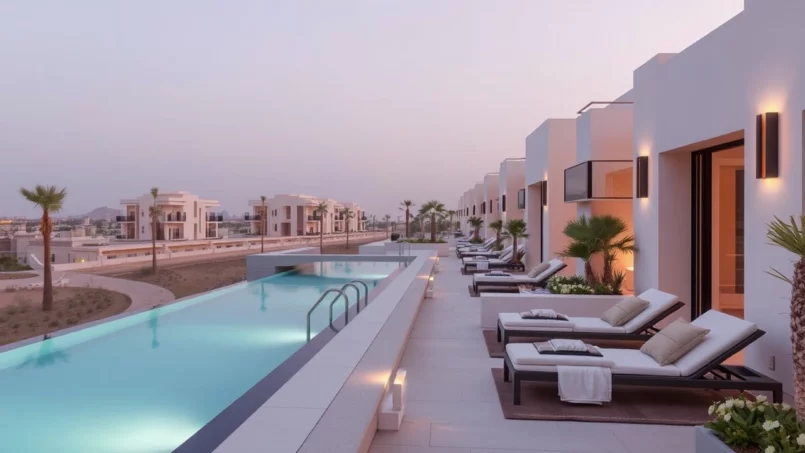
High-end real estate complexes are now marketing a “hotel-style” lifestyle, including pools, spas, restaurants, and various leisure amenities. This trend is intensifying with “branded residences” (Marriott, St. Regis, etc.) that offer hotel services like concierge and housekeeping, as well as rental programs. This offering comes with a 25 to 40% premium on the price per square meter compared to non-branded residences.
Residence Visas and Taxation: The Investor’s Dual Lever
For the international buyer, the prospect of a second home in Oman is not just about a sunny pied-à-terre. The country has implemented an arsenal of visas linked to real estate investment, which enhance the market’s appeal.
The Golden Residency Program thus allows an investor who purchases a property in an ITC worth at least 200,000 OMR to obtain a long-term 10-year renewable residence for themselves and their immediate family (spouse, children, first-degree parents). Lower thresholds, around 150,000–200,000 OMR, open the door to two- or five-year permits. Beyond that, more classic investor regimes exist for entrepreneurs or highly qualified executives.
This long-term visa does not impose a minimum annual stay requirement, which aligns well with the logic of a second home. It offers the possibility to spend the winter in Muscat, then rent out the property during the high tourist season, all within an ultra-light tax environment. For a European investor, accustomed to more restrictive schemes, the contrast is stark.
European Investor
Acquisition and Holding Costs
On the cost side, the main item is the property transfer tax of 3% of the price, due upon registration with the Ministry of Housing and Urban Planning. This is typically added to:
Approximate fees in OMR for issuing the land title deed during a real estate transaction in Oman.
In total, closing costs for a foreigner frequently fall within a range of 5 to 9% of the price. Subsequently, holding entails:
– homeowners’ association / service charges in ITCs, typically between 4 and 12 OMR per m² per year depending on the level of services and amenities;
– a possible contribution to a reserve fund (sinking fund), often 0.5 to 1 OMR / m² / year;
– home insurance (0.1 to 0.3% of the property value per year);
– operating costs (water, electricity, air conditioning, internet).
In the absence of an annual property tax on the residence itself, these items constitute the bulk of recurrent costs.
Rental Yield: From Seasonal Use to a Productive Asset
One of the most marked characteristics of the Omani second home market is the coexistence of personal use and investment logic. Many buyers – notably Europeans, Russians, or Gulf residents – occupy their villa or apartment from November to April, then entrust management to an operator for the high summer tourist season or for business stays.
In the main ITC zones, gross residential yields often fall within the following ranges:
– 5 to 8% for well-positioned apartments;
– 4 to 6% for villas and townhouses;
– 7 to 10% annualized for short-term rentals in very touristy resorts like Hawana Salalah.
This is the maximum projected net yield for an investment in a sustainable project like The Sustainable City Yiti in Muscat, driven by growing demand for eco-friendly housing.
Salalah, a Laboratory for Seasonal Rentals
The Salalah region, and in particular Hawana Salalah, illustrates the potential of second homes dedicated to tourism. A recent analysis of the short-term rental market there lists about 95 active listings, 95% of which are entire homes, mainly 1 to 2 bedroom apartments and houses.
Average monthly high-season revenue for properties in Salalah, reaching nearly 2835 USD at the absolute peak.
In the low season (May, June, November), average revenues fall back to around 1,000 USD per month, with 24.5% occupancy and rates close to 160 USD/night. The top 10% of properties exceed 3,700 USD in monthly revenue, occupancy rates above 64%, and rates well above 300 USD/night. In terms of yield, documented cases report gross ROIs of 20% and more, with net yields after expenses between 8 and 12% for well-managed one-bedroom units.
For an investor who accepts seasonal volatility, Salalah can therefore offer performances well above the regional average, especially in fully-equipped beachfront resort complexes.
Luxury, Branding, and Scarcity: The High-End Segment Accelerating
At the top of the pyramid, the luxury second home segment is evolving quickly, particularly in Muscat. Since the early 2020s, the definition of “luxury” has shifted: it is no longer just about large volumes, but about beachfront locations, signature architecture, landscape integration, and hotel services.
In Muscat, the ultra-luxury villa market is concentrated in a few exclusive zones (Al Mouj, Muscat Bay, AIDA at Yiti, Qurum). Supply is very restricted, with fewer than 50 new units >1 million OMR delivered annually, and fewer than 10 transactions per year in the ultra-prime segment >5 million OMR.
To give an order of magnitude, entry prices for “true” luxury assets in Muscat start around 500,000 OMR, while some beachfront villas, penthouses, or branded residences can far exceed 3 million OMR. We can distinguish sub-segments:
| Luxury Segment | Indicative Price Range (OMR) |
|---|---|
| Premium | 2 – 3 million |
| Super-Prime | 3 – 5 million |
| Ultra-Prime | > 5 million |
Residences signed by international hotel brands – St. Regis, Mandarin Oriental, Marriott, Trump, The Lux Collective – are proliferating, whether at Al Mouj (St. Regis Residences), Shatti Al Qurum (Mandarin Oriental Residences), or Yiti (Marriott Golf Residences, Trump-branded villas). They typically sell at a 25 to 40% premium compared to comparable non-branded assets, but attract an international clientele seeking a homogeneous service standard and improved resale liquidity.
Projected market value of the luxury real estate segment in billion USD by the early 2030s.
Muscat, Salalah and Others: A Multi-Speed Geography
For the second-home buyer, not all Omani cities present the same risk and yield profile.
Muscat: Capital of High-End and ITCs
Muscat concentrates nearly 28.5% of the country’s population and almost all of the branded residence stock and mature integrated complexes. The market is more liquid here, urban infrastructure – roads, international schools, hospitals, shopping malls – is already well established. Prices have increased by about 10% recently, with a projected cumulative increase of about 30% in the near to medium term in some neighborhoods.
The most sought-after areas for second homes are:
– beachfront ITCs (Al Mouj, Muscat Bay, Muscat Hills, Jebel Sifah);
– upscale neighborhoods like Shatti Al Qurum, Qurum, Madinat Al Sultan Qaboos for those who prioritize an “old-fashioned” neighborhood life over a closed resort.
For an investor seeking a compromise between personal use and year-round rental to expatriates (executives, employees of industrial and logistics zones), the Muscat market offers stable gross rental yield, typically between 5% and 7% depending on the property type.
Salalah: A Bet on Seasonality and the Khareef
Salalah, the capital of the Dhofar region, operates on a different logic: here, everything revolves around the monsoon. Over a million visitors flock there each summer, swelling hotel occupancy rates, prices, and demand for furnished rentals. Second homes here often take the form of apartments or villas in resorts like Hawana Salalah or, tomorrow, Amazi, a beachfront development where villas start at around 355,000 OMR.
For an investor accepting high monthly revenue volatility and intensive management, Salalah can offer cumulative returns of 35 to 65% over 5 years, thanks to capital appreciation (5-8%/year) and high seasonal rental income. This strategy, however, requires expertise in management (dynamic pricing, maintenance, international marketing) and vigilance regarding future regulatory risks for rental platforms.
Duqm, Sohar, Nizwa: More Industrial or Heritage Markets
Other cities like Duqm or Sohar are more driven by special economic zones, ports, and logistics. Residential demand there is fueled by the arrival of expatriate workers in the industrial sector. For second homes, these markets remain niche and are better suited to long-term rental investment than pure vacationing.
Nizwa, a historic inland city, is evolving more slowly: the price progression there is more moderate compared to coastal cities. Second homes there target more of a clientele of heritage and authenticity enthusiasts, with more modest yield prospects.
Finance, Credit, and Structuring Acquisitions
Access to local financing is one of the sensitive topics for non-residents. Technically, major Omani banks (Bank Muscat, NBO, Bank Dhofar…) can grant mortgages to foreigners for properties located in ITCs or under the urban usufruct regime. But in practice, conditions are stricter than for nationals:
– interest rates: generally in a range of 5 to 7.5% per annum for foreigners;
– loan-to-value ratio (LTV): capped between 60 and 70%, which requires a substantial down payment of 30 to 40% minimum;
– eligibility conditions: often reserved for residents with stable local employment and a minimum monthly income around 1,000–1,500 OMR.
For a non-resident buyer, financing options in Switzerland are limited. The dominant practice remains cash payment or using credit in one’s home country. This situation contributes to the stability of the luxury market, as a higher number of all-cash purchases reduces the risk of forced sales during an economic downturn.
Off-plan projects are typically structured around an initial payment of 10 to 20%, followed by staged payments (often 1% per month over several years) and a balance upon handover. A regulation mandates the establishment of escrow accounts to secure buyer funds until construction milestones are met, reducing the risk of unfinished development, although the risk of delivery delays is never zero.
Sustainability and New Cities: A New Generation of Second Homes
A striking feature of the Omani market, and one increasingly affecting the second-home segment, is the strong integration of environmental sustainability into new projects. Oman has set ambitious goals: achieve carbon neutrality by 2050, rank the country among the world’s top 40 in environmental performance by the 2030s, and increase the share of renewables to 20% then 35–39% of the electricity mix in the coming decades.
Concretely, this translates into:
The Sultanate of Oman is deploying several ambitious sustainable development projects. This includes **The Sustainable City – Yiti**, an 11 km² “net zero” beach city integrating over 3,000 homes, a marina, hotels, urban farms, solar panels, and optimized water management. The country is also developing sustainable mountain destinations, like the carbon-neutral destination project on Jabal Al Akhdar, powered by renewables. On the regulatory front, a new building code mandates better energy efficiency, reduced water consumption, and the use of low-carbon footprint materials. Finally, energy renovation programs for public buildings aim for a 26% reduction in their consumption.
For the second-home buyer, these commitments are not just a marketing argument. They can translate into lower operating costs (air conditioning, electricity), superior comfort (bioclimatic design, ventilation, insulation), and enhanced resale value in the long term, especially as the ESG requirements of international investors strengthen.
In The Sustainable City Yiti complex, the second home experience is reconfigured by a massive integration of solar panels, a greywater recycling system, community farms, and limited car traffic. The purchase is no longer just about a sea view, but corresponds to adopting a sustainable lifestyle where the environmental footprint of each stay is actively reduced.
Risks, Limitations, and Points of Caution
The dynamism of Oman’s second home market does not mean an absence of risks. Several areas require investor caution.
The first concerns tourism growth. The targets of 11–11.7 million visitors by 2040 are ambitious, while the country currently welcomes only about a third of that. Although investments in airports (targeted capacity of 50 million passengers by 2040), roads, and international promotion continue, there is no guarantee of a linear catch-up. Slower growth in tourist demand would weigh on the performance of second homes most dependent on seasonal rentals.
Tens of thousands of new residential units are under construction or planned across various projects. National projections indicate that approximately 340,000 additional units would need to be added by 2040 to maintain a 90% occupancy rate. The main danger is a temporary imbalance: certain sub-markets or housing types could face downward pressure on rents if supply outpaces local demand.
The third point is legal and regulatory. While the ITC framework is well-defined, the urban usufruct regimes outside ITCs are newer and may evolve. Similarly, the short-term rental market currently operates with a fairly low level of regulation, including in Salalah where, according to some sources, only a small minority of listings are formally licensed. It is likely that authorities will gradually tighten rules (licenses, safety standards, taxation), which could affect the yield of strategies based on Airbnb and the like.
Fluctuations in oil prices, regional tensions, and global monetary policy can slow real estate demand, even though the high-end segment, purchased mostly in cash, remains more resilient.
How to Proceed in Practice to Buy a Second Home in Oman
For a foreign buyer considering entering this market, a few practical steps are necessary.
First, clarify the objective: pure vacation home, mixed personal use / seasonal rental, long-term rental investment, or combination with a future tax residence project. This choice determines the location (Muscat vs Salalah, ITC vs downtown), the property type (apartment vs villa), the budget, and the ownership regime (ITC freehold is almost essential for a long-term inheritance strategy).
For a secure real estate investment, it is crucial to select a recognized ITC (Integrated Tourism Complex), allowing access to freehold ownership or long-term usufruct. Verify that the development is compliant and has officially approved ITC authorization. Ensure all contracts are registered with the Ministry of Housing and Urban Planning and that, for an off-plan purchase, payments go through dedicated escrow accounts.
Then, scrutinize the developer: delivery track record, construction quality, community management, structure of homeowners’ association fees, rental policies (some branded residences strictly limit Airbnb-style rentals). In a market where branded residences carry increasing weight, the reputation of the brand and the hotel operator counts as much as the developer itself.
Realistic targeted net yield on a rental real estate investment in Muscat, including all costs and charges.
A Market Still Young, But Already Structuring
The second home market in Oman is still far from reaching the maturity of Dubai or Abu Dhabi. But that is precisely what makes it interesting: positive demographic momentum, targeted opening policy via ITCs, lenient taxation, major structuring projects, rapid upscaling of supply, and strong differentiation based on nature (mountains, wadis, desert, Salalah monsoon) and sustainability.
Kuwait presents an attractive real estate market for two profiles: buyers seeking a winter pied-à-terre in a stable setting with advantageous taxation and the possibility of rental income, and investors targeting a growing, less saturated Gulf market. The country combines these arguments in a rare way.
It remains to approach this market methodically: understand the very particular legal framework well, distinguish between micro-markets (Muscat, Salalah, Yiti, Jebel Sifah…), measure the true depth of tourist and rental demand, and remain clear-eyed about risks of oversupply in certain segments. Under these conditions, a second home in Oman can be much more than a vacation house: a strategic asset at the crossroads of the Sultanate’s economic and tourist transformations.
Disclaimer: The information provided on this website is for informational purposes only and does not constitute financial, legal, or professional advice. We encourage you to consult qualified experts before making any investment, real estate, or expatriation decisions. Although we strive to maintain up-to-date and accurate information, we do not guarantee the completeness, accuracy, or timeliness of the proposed content. As investment and expatriation involve risks, we disclaim any liability for potential losses or damages arising from the use of this site. Your use of this site confirms your acceptance of these terms and your understanding of the associated risks.

Cyril Jarnias is an independent expert in international wealth management with over 20 years of experience. As an expatriate himself, he is dedicated to helping individuals and business leaders build, protect, and pass on their wealth with complete peace of mind.
On his website, cyriljarnias.com, he shares his expertise on international real estate, offshore company formation, and expatriation.
Thanks to his expertise, he offers sound advice to optimize his clients' wealth management. Cyril Jarnias is also recognized for his appearances in many prestigious media outlets such as BFM Business, les Français de l’étranger, Le Figaro, Les Echos, and Mieux vivre votre argent, where he shares his knowledge and know-how in wealth management.





