
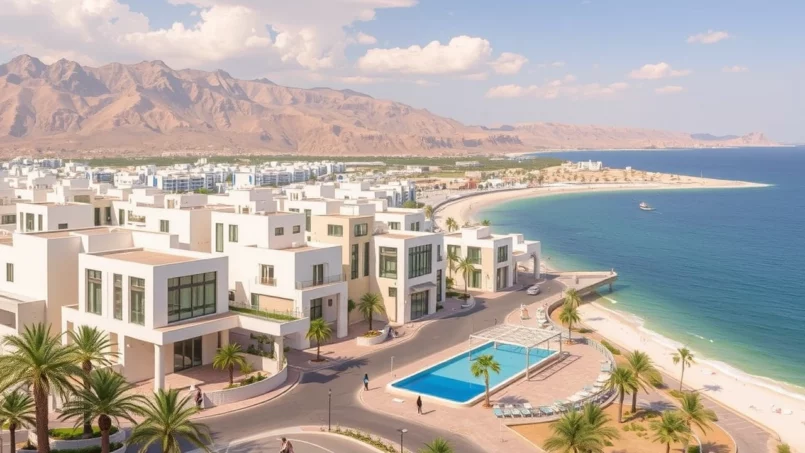
 Published on and written by Cyril Jarnias
Long overshadowed by its Gulf neighbors, the Sultanate is gradually establishing itself as a unique real estate market, more discreet than Dubai but driven by a stable economy, a long-term strategic vision (Vision 2040), and strong population growth. For a foreign investor, an expatriate, or an Omani hesitating between settling in Muscat, Salalah, Sohar, Nizwa, or Sur, the first question remains the same: where is real estate the most expensive, where is it the most affordable, and where does the potential for capital appreciation seem the most attractive?
Prices and rents vary considerably across Omani cities, with a marked gap between the coastal capital (Muscat), industrial cities, and inland centers. This precise mapping is based on recent data from banks, listing platforms, and national statistics.
A national market on a strong upswing, but highly uneven
Residential real estate across Oman is in a full catch-up phase. After several years of decline – prices in Muscat fell by about 30% between 2015 and 2021 – the country has shifted into a new growth cycle.
The indices published for 2024–2025 are unambiguous: the overall real estate price index is rising by about 17% year-on-year by the end of the third quarter of 2025, with an increase of nearly 19% for residential and over 14% for commercial. Apartments are the most dynamic asset class, soaring by over 20% year-on-year, while villas gain between 6% and 17% depending on the period and source. Overall, since 2020–2022, values have increased by approximately 60%.
The average price per square meter for an apartment in Oman ranges between 800 and 1,300 OMR, depending on location.
To provide a sense of scale, the national landscape can be summarized as follows: the country is characterized by significant regional diversity, with marked economic and social disparities between different areas.
| National Indicators (Oman) | Typical Values |
|---|---|
| Average Apartment Price – City (OMR/m²) | 836.79 (range 450 – 1,220) |
| Average Apartment Price – Outside Center (OMR/m²) | 525.82 (range 310 – 688.5) |
| Average Apartment Price – All Oman (OMR/m²) | 800 – 1,300 |
| Average Villa Price – All Oman | 150,000 – 300,000 OMR |
| Residential Market (Value 2025) | approx. $4.96 Billion USD |
| Residential Market (Projection 2030) | $6.7 – $7.4 Billion USD (CAGR 6.8% to 9.2%) |
| Typical Gross Rental Yield | 5.6% – 8.3% |
From this baseline, a comparison between cities reveals three main profiles: the premium capital (Muscat), the coastal regional hubs driven by industry or tourism (Salalah, Sohar, Duqm, Sur), and the more affordable inland cities (notably Nizwa).
Muscat, an expensive showcase but still a “discount” compared to Dubai
Muscat accounts for nearly half the value of residential transactions in the country (about 47.9% in 2024) and nearly 70% of the commercial market. It is also where prices per square meter reach the highest levels, even though the capital remains much less expensive than neighboring metropolises.
Price levels in the capital
According to the various compiled sources, the square meter for an apartment in Muscat is, on an updated average, between 800 and 1,900 OMR, with a tighter range of 1,200 to 1,700 OMR in sought-after neighborhoods. Houses and villas typically range from 220,000 to 420,000 OMR, with peaks exceeding one million OMR in luxury tourist complexes like Al Mouj or Muscat Bay.
The main price ranges can be summarized as follows:
| Muscat – Residential | Indicative Levels |
|---|---|
| Apartment – City Center (OMR/m²) | 600 – 1,220 (average 1,023.33) |
| Apartment – Outside Center (OMR/m²) | 459 – 688.5 (average 597.89) |
| Apartment – Overall Range (OMR/m²) | 1,200 – 1,700 in prime areas |
| Typical Apartment Price (Entire City, OMR) | 70,000 – 200,000 |
| Entry-Level Apartment Price (OMR) | from 30,000 – 35,000 |
| Typical Villa Price (OMR) | 220,000 – 420,000 |
| Prime Levels (ITC Al Mouj, Muscat Bay, Yiti) | 1,000 – 1,200 OMR/m² (apartments); 750 – 1,000 OMR/m² (villas) |
Regarding rents, market statistics indicate about 235 OMR per month for a 1-bedroom apartment downtown and around 160 OMR on the outskirts. For a 3-bedroom, the average is around 460 OMR downtown and 275 OMR outside the center. In highly sought-after neighborhoods (Qurum, Shatti Al Qurum, Al Mouj, Madinat Al Sultan Qaboos), these amounts rise quickly: a large 6-room property with a pool in Qurum can rent for 2,000 to 3,000 OMR per month, or even more for ultra-luxury villas, while a simple 1-bedroom in Al Mouj is often between 400 and 800 OMR.
A highly segmented market internally by neighborhood
The capital is not homogeneous. The price gap between neighborhoods is sometimes dramatic, even for identical square footage and number of rooms. The collected data reveals a fairly clear gradient between the “right” and “left” sides of the international airport.
Real estate in Muscat shows a marked geographical divide. Areas east of the airport, like Qurum, Shatti Al Qurum, Al Mouj, Muscat Bay, Madinat Al Sultan Qaboos, and Shatti, concentrate premium locations, characterized by seafront villas, gated communities with golf access, and diplomatic quarters. In contrast, sectors to the west, such as Seeb, Al Hail, Mabella, and Al Amerat, offer significantly more affordable prices, with a more typically Omani residential urban landscape and large-scale housing programs.
A few concrete examples illustrate these contrasts:
In Muscat, real estate prices vary considerably by neighborhood. In Qurum, a 6-bedroom villa with a pool rents for between 2,000 and 3,000 OMR per month, potentially reaching 4,000–5,000 OMR for luxury properties. In Mabella, for the same type of property, the rent is about half as much, making it one of the least expensive sectors, despite a more basic environment. In Al Khuwair, a convenient central district, a 1-room unit rents for 180 to 300 OMR, and large units up to 2,000 OMR, with an intermediate purchase price of 50–70 OMR per square foot. In Muttrah, the historic district, an apartment rents from 150–300 OMR, with a price per m² similar to Al Khuwair. In Seeb, which is growing strongly, villas rent for 500 to 1,500 OMR, 1-room units from 120–250 OMR, and land costs 700–900 OMR/m².
For investors, Al Mouj attracts a significant portion of foreign demand thanks to its ITC status allowing full ownership. An apartment of about 90 m² there is typically worth 120,000 OMR, a 400 m² villa exceeds 500,000 OMR, and a 1,000 m² plot can reach 800,000 OMR. Rental yields there are among the highest in the country, with rental increases on the order of 10–20% over 18 months.
Muscat remains inexpensive on the Gulf scale
Despite these relatively high prices within Oman, the capital remains very competitive compared to regional giants. The square meter there generally costs between $2,100 and $4,940 USD, which is 70% to 80% less than prime neighborhoods in Dubai, where prices often exceed $16,500–$17,300 USD/m².
In a broader regional comparison:
| City / Market | Typical Price (USD/m²) – High-End Residential |
|---|---|
| Muscat | 2,100 – 4,940 |
| Abu Dhabi | 3,200 – 5,800 |
| Doha | 2,860 – 3,888 |
| Riyadh | 1,327 – 1,647 |
| Dubai (Prime Areas) | 16,525 – 17,335 |
In other words, even in its most expensive neighborhoods, Muscat remains about three to four times less costly than prestigious locations in Dubai, while offering a very high level of security, light taxation (no annual property tax, no capital gains tax, 3% transfer fee), and gross rental yields ranging from 3–5% on apartments to 5–8%, even up to 10% on some well-rented premium properties.
Salalah, the rising tourist market
While Muscat dominates in volume and prices, Salalah plays a different tune: that of a booming tourist destination, whose dynamics directly influence real estate.
A monsoon city and a seasonal market
The capital of Dhofar in the south, Salalah combines a tropical climate, summer monsoon (Khareef), and lush landscapes that attract hundreds of thousands of visitors each year. Between June and August 2024, over one million tourists were recorded, an increase of 8.7% over the previous year. The high season sees an influx of families from the Gulf as well as European or Asian travelers. The result: short-term rentals and second homes are multiplying, and the pressure is reflected in prices.
On average, the square meter for an apartment in Salalah is around 900 OMR. Detailed purchase price per square meter figures give the following ranges:
| Salalah – Apartment Purchase | Indicative Levels |
|---|---|
| City Center (OMR/m²) | approx. 575 |
| Outside Center (OMR/m²) | approx. 290 |
| City Center (OMR/ft²) | 44.13 – 88.26 (average 72.58) |
| Outside Center (OMR/ft²) | 28.8 – 55.74 (average 43.66) |
Prices per property reflect this intermediate positioning: a 2-bedroom apartment in a decent neighborhood most often sells for between 50,000 and 75,000 OMR, while a 4 to 6-bedroom villa is around 100,000 to 200,000 OMR.
The average monthly rent for a one-bedroom apartment downtown, in OMR.
Yields and market indicators
These relatively modest rents compared to purchase prices lead to rather low gross yields if one sticks to classic long-term leases. Indicators like Numbeo give for Salalah:
| Salalah Indicators | Value |
|---|---|
| Price-to-Income Ratio | 5.39 |
| Mortgage as % of Income | 41.21% |
| Loan Affordability Index | 2.43 |
| Price-to-Rent Ratio – Center | 35.25 |
| Price-to-Rent Ratio – Outside Center | 26.68 |
| Gross Rental Yield – Center | 2.84% |
| Gross Rental Yield – Outside Center | 3.75% |
These figures describe a reality well: in classic long-term rental, Salalah is not the most profitable city in Oman, especially downtown. However, the equation changes when exploiting the tourist seasonality. Projects like Hawana Salalah explicitly target a short-term clientele and announce yields of 7% to 10% thanks to high rates during the Khareef.
Land prices in the region are currently lower than in Muscat, ranging from 30–60 OMR/m² for residential and 50–100 OMR/m² for commercial. Projections indicate a potential increase of 40% to 60% by 2030, which could push prices in ITC-type areas, like Hawana, to between 70 and 130 OMR/m², representing real room for growth for current acquisitions.
Comparison with Muscat and investor profile
Salalah is thus distinguished by several traits: 1. Its tropical climate, which contrasts with the rest of the Sultanate of Oman. 2. Its rich cultural heritage, reflecting ancient history and varied influences. 3. Its exceptional nature, with lush landscapes and beautiful beaches. 4. The celebration of the khareef, a monsoon season that transforms the region. 5. Its gastronomy, with unique specialties to discover.
– Entry-level is cheaper than Muscat for residential purchase.
– Lower rents, especially outside the high season, which mechanically pulls gross yields down over the long term.
– A very strong seasonal effect, with rental and service prices “exploding” during the Khareef, to the point that authorities have tried to better regulate rates.
– Long-term growth potential boosted by tourism (Vision 2040 plans massive investment in this sector) and the expansion of the port free zone.
Concretely, Salalah is more suited to an investor profile that accepts the more complex management of a “semi-touristic” property (rent variability, off-season vacancy), or to an individual seeking a second home or a holiday pied-à-terre on a reasonable budget.
Sohar, the industrial hub where prices are rising fast
Sohar holds a particular place in the country’s real estate geography. Located in the north, endowed with a major industrial port and a free zone, the city positions itself as a major logistics node, with direct impacts on land and residential property.
Rent levels and purchase prices
Market data indicates rents substantially higher than those in Salalah, without reaching those of Muscat:
| Sohar – Rental Market (Monthly Average) | Average Levels (OMR) |
|---|---|
| 1 Bedroom – City Center | 190 |
| 1 Bedroom – Outside Center | 147.5 |
| 3 Bedrooms – City Center | 294 |
| 3 Bedrooms – Outside Center | 260 |
For purchase, we observe:
| Sohar – Apartment Purchase | Indicative Levels |
|---|---|
| Price per m² – City Center (OMR/m²) | 450 |
| Price per m² – Outside Center (OMR/m²) | 300 |
| Average Price per m² – Whole Market (OMR/m²) | approx. 800 |
In other words, the price per square meter in Sohar’s city center is lower than in Salalah, but rents are higher. This differential translates into better potential rental yields for an investor, a priori more vulnerable to the industrial climate than to tourist seasons.
The average monthly net salary in Duqm, well above the 580-620 OMR in Salalah, supports solid housing demand.
Land and medium-term outlook
Sohar is among the markets where price growth is the fastest. Statistics mention an increase of nearly 18.8% for residential real estate by the end of 2024. For land, current ranges are as follows:
| Sohar – Land Prices | 2025 Levels (OMR/m²) |
|---|---|
| Residential Plots | 25 – 55 |
| Commercial / Industrial Plots | 40 – 90 |
| 2030 Projection (Residential + Commercial) | 40 – 150 (60–80% growth) |
This trajectory is closely linked to massive investments in the port and free zone, which have already attracted some $30 billion USD in capital with an 85% land occupancy rate. For a medium or long-term investor, Sohar positions itself as a bet on industrialization and logistics, with a high probability of capital appreciation on land and a rental market driven by employment rather than tourism.
Nizwa and the interior: truly affordable real estate
In contrast to port cities, Nizwa and the cities of the interior (Sumail, Manah, Bahla, Izki, Bidbid) illustrate a more traditional Oman, where prices remain well below those of the coast.
Very low rents and diverse supply
Listings recorded for Nizwa and its surroundings depict a market where one can find everything, from a small 30 m² apartment to a vast plot of several hundred thousand square meters, but at rents that seem derisory to a European or even Muscati eye.
A few examples:
Indicative monthly prices for different types of housing in several Omani cities.
50 OMR per month.
100 OMR per month.
160 OMR per month.
65–120 OMR per month.
250 OMR per month.
65–70 OMR per month.
At these levels, the housing cost in a household’s budget remains very moderate, which explains why Nizwa is cited as a possible destination for expatriates on a tight budget. A cost-of-living estimate places the housing item between $300 and $800 USD per month, with a typical rent of $400 USD for a 1-bedroom, again much less than in the capital.
Land prices and outlook
Land in the Al Dakhiliyah region (Nizwa and surroundings) is also significantly more affordable than on the coast. For 2025, residential land prices are estimated between 12 and 30 OMR/m², commercial plots between 20 and 50 OMR/m², with a projection for moderate growth (40–60% by 2030, i.e., 18–45 OMR/m²).
| Nizwa / Interior – Land | 2025 Levels (OMR/m²) | 2030 Projection (OMR/m²) |
|---|---|---|
| Residential Land | 12 – 30 | 18 – 45 |
| Commercial Land | 20 – 50 | 30 – 70 (order of magnitude) |
In practice, this means that a budget that would barely buy a modest apartment in Muscat could finance a house or a large inland plot. But the trade-off is obvious: the price dynamic is slower, and the rental market is less liquid, less internationalized than in coastal cities.
Nizwa is primarily suitable for people seeking to reduce their cost of living, benefit from a more peaceful environment, or implement a long-term land investment strategy with a very limited budget.
Sur, Duqm, and other secondary coastal cities
Other cities dot Oman’s coast and each present a particular character, notably Sur and Duqm.
Sur, a small coastal town between desert and beach
Sur, about a four-hour drive from Muscat, is located in an exceptional natural environment – close to the desert and the Ras al Jinz reserve. Yet, rents remain very low: a 3-bedroom apartment rents for around 150 OMR per month, less than in most Muscat neighborhoods and even some segments of Nizwa for comparable sizes.
Expected growth in residential land value in Sur by 2030, driven by tourism development and infrastructure projects.
Duqm, an industrial and logistics bet
In Duqm, on the central coast, the logic is similar to that of Sohar: the special economic zone (SEZAD) covers 2,000 km² and already concentrates over $14 billion USD in investment commitments, with a 55% jump in new projects in 2024. This rapid transformation into an industrial and port hub is driving demand for housing and commercial space.
Rents are rising there and commercial land is now trading around 30–50 OMR/m², with projections potentially reaching 40–150 OMR/m² by 2030. The residential market is still relatively poorly documented in detail, but everything indicates it is following the upward trend in land, with a risky but potentially very lucrative profile for those correctly anticipating the zone’s development.
Comparing cities: which is expensive, which is affordable?
To get a quick idea of the gaps, it is useful to juxtapose a few simple indicators – rent for a 1-bedroom, purchase price per square meter, and average land price – on a small sample of cities.
| City | 1 Bedroom Downtown (OMR/month) | 3 Bedrooms Downtown (OMR/month) | Apartment Purchase Downtown (OMR/m²) | Residential Land 2025 (OMR/m²) |
|---|---|---|---|---|
| Muscat | ~235.7 | ~460 | 600 – 1,220 | 90 – 150 (up to 250 in prime) |
| Salalah | ~98.3 | ~190 | ~575 | 30 – 60 |
| Sohar | 190 | 294 | 450 | 25 – 55 |
| Sur | (data for 3-bed. law) | ~150 (3-bed.) | (data per city not detailed, approx. 800 m² on coast) | 18 – 35 |
| Nizwa | ~160 (1-bed. 85 m²) | 65–120 (3-bed. depending on city) | (low documentation, house prices 30,000–70,000 OMR) | 12 – 30 |
This table gives a clear summary:
Comparison of purchase, rental, and yield dynamics in major Omani cities.
The most expensive for purchase and land, with average overall rents that remain comparatively moderate relative to other Gulf capitals.
Offers an interesting rent-to-price ratio, making it a preferred choice for rental investors.
Affordable to purchase with moderate annual rents, masking pronounced seasonal spikes that impact yields.
Offers very low rents and land prices, suited for a cost-reduction strategy or long-term land accumulation.
Rental yields: Muscat vs. the regions
In terms of yield, Oman as a whole offers competitive rates on the Gulf scale. Overall, the announced gross yields vary between 3% and 8%, with real differences depending on the segment:
Gross yields vary by city and property type. In Muscat, expect 3–5% for classic apartments, 5–8% for villas, and up to 10% for some premium products. The national average is between 5.6% and 8.3%. In Salalah, the yield is about 3–4% on annual rentals but can be higher with seasonal short-term management. Sohar, despite rapid price increases, maintains good yields, especially in 2–3 bedroom family properties.
On a regional scale, Oman sits in an interesting middle ground: lower gross yield than some popular neighborhoods in Dubai or Abu Dhabi on pure rental, but with lower entry prices, lighter taxation (no property tax, no capital gains tax on real estate, and a simple 3% transfer fee), which improves real net yields over time.
Impact of public policies and investor visas
A key element in comparing cities is the regulatory framework that applies to foreigners. Non-Omanis cannot purchase freely everywhere: in practice, their field of action is concentrated on Integrated Tourism Complexes (ITC) and some designated areas, mainly in major coastal cities.
ITCs located in Muscat (Al Mouj, Muscat Bay, Yiti, Jebel Sifah), Salalah (Hawana, Salalah Beach), or other governorates thus play a central role in the high-end market. Prices there are higher than in ordinary residential neighborhoods of the same city, but these projects open the door to full ownership and often provide access to long-term residency schemes.
Several investor visa schemes are in effect:
Discover the different residency programs in Oman open to international investors, with varied investment conditions.
Residency obtained with a minimum investment of 250,000 OMR in real estate, a company, or government bonds.
Residency granted for an investment of at least 500,000 OMR, including the possibility of acquiring a single property outside an ITC in some cases.
A program offering a renewable 10-year residency for qualified investors.
For a foreign buyer, this translates into a specific geographical map: in Muscat, the sectors Al Mouj, Muscat Bay, Jebel Sifah, and some Yiti projects concentrate most of the freehold opportunities, while in Salalah, complexes like Hawana Salalah constitute the main points of entry. Sohar, Duqm, and other cities are gradually developing special economic zones and attractive ownership schemes, but the ITC offering remains less developed than in Muscat or Salalah.
Which type of city for which buyer or investor profile?
By cross-referencing prices, yields, local salaries, and growth prospects, we can outline typical profiles for each city.
Muscat attracts above all those seeking a complete urban environment (international schools, private hospitals, restaurants, air connectivity) and market depth: prices are the highest there, but resale liquidity and rental demand are also the most robust. For an investor, ITCs like Al Mouj or Muscat Bay offer an almost “turnkey” product for an expatriate clientele, with decent yields given the risk profile and an announced annual valuation potential of 3% to 7% over five years.
Salalah is suitable for a tourist investment, with two-bedroom apartments between 50,000 and 80,000 OMR and villas up to 200,000 OMR. Gross yield can be significant in short-term rentals due to strong seasonality, but the market is more volatile. It is a coherent choice for investors believing in nature and climate tourism, while accepting this variability.
Sohar appears as an industrial bet, already well underway. Rents higher than those in Salalah, a residential price increase close to 19% in 2024, and high local salaries make it a solid rental market, less subject to tourism and more correlated to the country’s industrial and logistics cycle. For an investor, the appeal lies in relatively affordable land and a potential for land appreciation of 60–80% by 2030.
Nizwa and the cities of the interior offer a very low cost of living, with very affordable rents and residential land prices (a few tens of OMR/m²). It’s an ideal option for living comfortably on a modest budget or for a patient investor aiming for land accumulation over the very long term. However, it is not the preferred market for quickly maximizing rental yield.
Sur and other small coastal towns are in a middle ground: very affordable rents, cheap land but expected to rise, pushed by a combination of tourism and infrastructure projects. They are niche markets, often less liquid, but with an interesting risk/return premium for those correctly anticipating road alignments, ports, and tourist complexes.
In conclusion: one country, several markets
Speaking of “real estate prices in Oman” without distinguishing between cities makes little sense. Between Muscat, where the square meter can approach 1,700 OMR in the most sought-after neighborhoods, and Nizwa, where a large plot sells for a few thousand OMR, the gap is staggering. Salalah offers an accessible tourist entry, Sohar an exposure to industry and logistics, Sur and Duqm bets on coastal growth, while Muscat combines market depth, legal security, major urban projects, and valuation prospects.
For a foreign investor, the crucial step is to define which Oman to target (the premium capital, the industrial hub, the monsoon station, or the peaceful interior heartland) before comparing prices. This initial choice allows for calibrating a realistic project, aligned both with the local economy and the country’s transformation trajectory towards 2040.
Disclaimer: The information provided on this website is for informational purposes only and does not constitute financial, legal, or professional advice. We encourage you to consult qualified experts before making any investment, real estate, or expatriation decisions. Although we strive to maintain up-to-date and accurate information, we do not guarantee the completeness, accuracy, or timeliness of the proposed content. As investment and expatriation involve risks, we disclaim any liability for potential losses or damages arising from the use of this site. Your use of this site confirms your acceptance of these terms and your understanding of the associated risks.

Cyril Jarnias is an independent expert in international wealth management with over 20 years of experience. As an expatriate himself, he is dedicated to helping individuals and business leaders build, protect, and pass on their wealth with complete peace of mind.
On his website, cyriljarnias.com, he shares his expertise on international real estate, offshore company formation, and expatriation.
Thanks to his expertise, he offers sound advice to optimize his clients' wealth management. Cyril Jarnias is also recognized for his appearances in many prestigious media outlets such as BFM Business, les Français de l’étranger, Le Figaro, Les Echos, and Mieux vivre votre argent, where he shares his knowledge and know-how in wealth management.





