
 Published on and written by Cyril Jarnias
The sultanate long relied on black gold. But with Vision 2040, the game has changed: tourism is becoming one of the pillars of diversification, and real estate is on the front line. The result: more visitor arrivals, increased investment, new waterfront districts, a boom in short-term rentals, and a clear rise in prices, especially in tourist areas. The impact of tourism on Oman’s real estate market is now visible both in the numbers and in the urban landscape.
Tourism, the Acknowledged Engine of Vision 2040
In the Vision 2040 strategy, tourism is not just another sector. It is presented as a strategic lever to reduce dependence on hydrocarbons, alongside logistics, services, and industry. The goal is clear: increase tourism’s contribution to 5% of GDP by 2030 and to 10% by 2040, with a target of around 11 million visitors per year by that deadline.
The authorities have deployed a comprehensive architecture of public policies to support tourism and real estate development through 2040. This includes a National Tourism Strategy, a cultural strategy aimed at making the country a major heritage destination, and sectoral plans (aviation, ports, transport, urban planning) designed to facilitate tourist flows and stimulate real estate activity.
The numbers already show the scale of the shift. The non-oil sector represented over 35% of GDP in the first half of 2025, with growth of around 4% in these segments, while the overall economy grew around 2 to 2.3%. In this new balance, tourism is carrying increasing weight, and real estate is following the same trajectory.
| Key Indicator | Recent Value | Target / Horizon |
|---|---|---|
| Tourism Contribution to GDP | ~2.7% in 2024 | 5% in 2030, 10% in 2040 |
| Annual Visitors | 3.9 million in 2024 | 11 million in 2040 |
| Share of Non-Oil in GDP | >35% in H1 2025 | 90% targeted by 2040 (all non-oil sectors combined) |
| Total Real Estate Transactions | OMR 3.3 billion in 2024 | Projected annual growth 3–7% |
A Tourism Boom Driving Real Estate Demand
The link between tourism and real estate is first seen in the rapid growth in visitor numbers. After the pandemic low, the country welcomed around 4 million visitors in 2023, then 3.9 million in 2024, reaching levels close to or even exceeding the 2019 records. In just the months from January to July 2023, arrivals surged by 14%, placing Oman in the global top 20 countries for tourism growth according to the UNWTO.
In 2024, Oman’s three- to five-star hotels generated 243.4 million Omani rials in revenue, a 6% increase.
This dynamic is not only driven by foreign tourists. Domestic travel also plays a major role, with over 13 million internal trips in 2024. For the real estate market, this means joint pressure on hotel accommodation, seasonal rentals, and, in the longer term, on traditional residential properties in high-tourism areas.
Integrated Tourism Complexes: The Structured Meeting of Tourism and Real Estate
The core of the strategy linking tourism and real estate lies in the Integrated Tourism Complexes (ITCs). These large waterfront or iconic site developments mix hotels, residences, retail, marinas, golf courses, and leisure facilities. Crucially, they constitute the only areas where foreigners can acquire property under full freehold ownership.
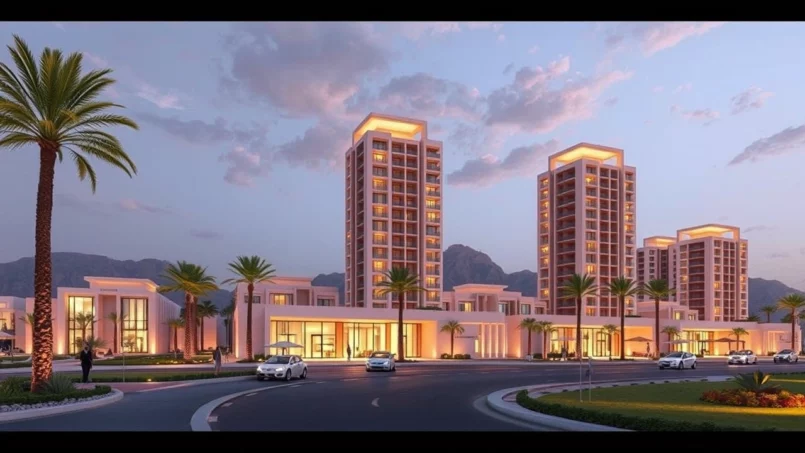
Among the iconic ITCs are Al Mouj (formerly The Wave) and Muscat Hills in the capital, Muscat Bay, Jebel Sifah, Hawana Salalah in Dhofar, as well as projects under development in Yiti or the future Sultan Haitham City. These districts are designed as destinations in their own right: marina, golf, private beach, international brand hotels, restaurants, and shopping centers, all with contemporary architecture.
Number of ITC licenses approved by the state in 2023, representing $11.37 billion in investments.
| ITC / Zone | Type of Development | Price Range (approx.) | Average Rental Yield |
|---|---|---|---|
| Al Mouj Muscat | Waterfront, marina, golf, residences, hotels | Apartments: ~OMR 800–1,100/m² | 5–8% for apartments |
| Muscat Hills | Golf, residences, airport proximity | 1–2 bed apartments around OMR 70–120k | 6–7% |
| Jebel Sifah | Beach resort, marina, golf, hotel | Apts. from about $115–150k | ~7% on small units |
| Hawana Salalah | Coastal resort, hotels, residences | Prices vary based on view/type | Yields strengthened during Khareef |
The combination of openness to foreign ownership, tourism growth, and very light real estate taxation (no property tax or capital gains tax) makes ITCs a privileged gateway for international investors. Tourism brings short- and medium-term tenant flows, and the ITC provides the suitable real estate vehicle.
A Real Estate Market Boosted by Tourist Flows
The dynamism of the real estate market directly reflects the rise of tourism. The total transaction value reached 3.3 billion rials in 2024 (about $8.6 billion), a 29.5% year-on-year increase. The number of transactions exceeded 68,000, nearly 4% more than the previous year. Mortgage loans themselves surged over 46% that same year, exceeding 2.2 billion rials.
Apartment prices have increased by about 60% in recent years.
Forecasts confirm this trend is not just a one-time catch-up. According to Mordor Intelligence, the residential market is set to grow from $4.78 billion in 2025 to $7.42 billion in 2030, representing a compound annual growth rate of about 9.2%. In the longer term, projections indicate price increases of around 3 to 5% per year until 2040, with an average cumulative increase of about 23% over the 2025–2030 period.
| Real Estate Indicator | Recent Situation | Trend / Forecast |
|---|---|---|
| Transaction Value 2024 | OMR 3.3 billion | +29.5% / year |
| Mortgages 2024 | >OMR 2.2 billion | +46.4% / year |
| Residential Prices (Q1 2025) | +7.3% over 1 year | 3–7% annual increase expected |
| Apartment Prices | +60% over recent years +17% in H1 2025 | Sustained rise in tourist areas |
| Residential Market (value) | $4.78 billion (2025) → $7.42 billion (2030) | CAGR ~9.19% |
This movement is far from uniform. Areas directly connected to tourism demand – the Muscat waterfront, integrated complexes, Salalah during Khareef, Duqm in full transformation – capture the largest part of the increase. Conversely, some inland neighborhoods or mid-range apartment sectors in Muscat face a risk of oversupply, with about 80,000 vacant housing units recorded in the 2020 census.
Muscat, Salalah, Duqm: Three Laboratories for the Tourism-Real Estate Pairing
The role of tourism in shaping the real estate market is particularly visible in three hubs: the capital Muscat, the coastal city of Salalah, and the developing hub of Duqm.
Muscat, the political and economic capital, concentrates nearly 30% of the country’s population and most of the high-end infrastructure: international airport, convention center, international chain hotels, iconic ITCs like Al Mouj, Muscat Hills, and Muscat Bay. This concentration attracts tourists, expatriates, and foreign investors. Expatriates represent over 60% of the city’s population, and demand for modern, secure housing close to services is strong.
The maximum price per square meter for an apartment in the most sought-after complexes in the capital.
Salalah offers another facet of this interaction between tourism and real estate. Driven by the Khareef season, this city in Dhofar attracts over a million visitors during the monsoon months (June-September), an 8.7% increase in 2024 compared to the previous year. Hotel occupancy rates there increased by 9% in 2023, with a more than 30% rise in guest numbers. This causes a peak in demand for hotels, but also for seasonal rentals and second homes, leading to a gradual increase in land values, especially for residential and commercial plots along the coast.
The under-construction city of Duqm, in Oman, illustrates how an industrial and logistics special economic zone can benefit from tourism dynamics. Driven by a deep-water port, a refinery, and energy projects, it attracts a rapidly growing expatriate population (+33% between 2022 and 2023) and business travelers. While leisure tourism is still secondary there, improved infrastructure (hotels, resorts), as well as ‘Airport City’ projects and railway links with the Emirates, are gradually broadening the demand base for its real estate market.
Seasonal Rentals and the Short-Term Stay Explosion
One of the most tangible transformations brought by tourism growth to Omani real estate is the boom in short-term rentals. Long confined to hotels, the accommodation landscape has opened up to “holiday homes” and other temporary rentals managed via platforms like Airbnb or Booking.com.
Omani authorities have structured the short-term rental market to avoid informality. The opening is gradual: first to professional operators and developers, then to SMEs, and finally to individuals, within a strict regulatory framework. A partnership with the Hospiria platform (UnderTheDoormat Group) and Visit Oman provides an official distribution channel, linked to major international platforms while complying with local legal requirements.
This structuring has several effects on real estate. First, it turns apartments located in ITCs and in certain attractive neighborhoods into hybrid assets, capable of being rented weekly or monthly to tourists, without losing their potential for long-term rental to expatriates. Second, it creates a new class of “investor-owners” seeking to optimize higher rental yields through short-term stays.
In Muscat, the median annual revenue for short-term rentals is about $7,200.
| City (STR – 2025) | Properties Tracked | Average Monthly Revenue (USD) | Average ADR (USD) | Average Occupancy Rate |
|---|---|---|---|---|
| Muscat | ~245 | ~$671 | ~$86 | ~35% |
| Salalah | ~93 | ~$812 | ~$157 | ~29% |
| Qantab | ~32 | ~$910–$951 | ~$112–$115 | ~34% |
| Hillat al Kaws | ~21 | ~$974–$1,014 | ~$207–$211 | ~23% |
For investors, these numbers translate into potential yields of 6 to 9% for well-positioned properties in Muscat, and 5 to 7% in other cities, with peaks during the winter high season on the north coast and the monsoon in the south. This contributes to making small apartments (studios, one or two bedrooms) the most profitable typology, far ahead of luxury villas which, despite higher rents, generally offer lower gross yields.
Demand Fueled by Expatriates and the Local Middle Class
While transient tourists hold a visible place in rental demand, the structural foundation of the real estate market remains driven by demographics and the long-term expatriate population. Oman today has about 5.3 million inhabitants, nearly 44% of whom are expatriates. This population is projected to reach about 7.7 million by 2040, with a very large youth segment (nearly two-thirds of residents are under 30).
The number of additional residential units needed by 2040 to support population growth and maintain a sustainable occupancy rate.
In this context, expatriates play a dual role. On one hand, they heavily fuel the rental market, especially in modern urban neighborhoods and ITCs where they seek furnished, secure apartments with services and good connections to workplaces and international schools. On the other hand, they represent a growing share of purchase demand: nearly 40% of them state they are considering buying a property within three years, and over a quarter of the residential stock in ITCs already belongs to them.
The authorities have eased restrictions on foreign ownership and permitted 100% ownership of companies. An investment residency program has been created: a 5-year permit for a real estate investment of at least 250,000 rials, and 10 years for 500,000 rials. By the end of 2023, over 3,400 investors from 60 countries had obtained these visas, and a ‘Golden Visa’-type scheme has been formalized.
Light Taxation, Attractive Yields: A Pro-Investor Cocktail
One of the major assets explaining the influx of tourism-related investors is the combination of a favorable tax environment and rental yields higher than in many international metropolises. Oman taxes neither personal income nor real estate capital gains, and there is no recurring property tax. Upon purchase, one must pay registration fees of about 3% of the price, plus agency fees typically between 2 and 3% and processing fees of 1 to 1.5% on mortgage loans.
For foreign investors, Oman offers a streamlined structure and no minimum investment threshold in Integrated Tourism Complexes (ITCs), making the market more accessible. Square meter prices there are competitive: waterfront apartments in ITCs trade between 800 and 1,100 Omani rials, significantly less than in Dubai where well-located properties start around AED 2,000 to 3,000 per square foot.
On the yield side, the observed range fluctuates between 3 and 8% depending on the type of property and its location, with the highest values in apartments in high-end integrated complexes and resorts. In prime neighborhoods of Muscat, gross yields between 6 and 8% on apartments are not uncommon, compared to 5 to 6% on villas. Residences intended for seasonal rental in resorts can, during the high season, approach or exceed 8 to 9% annual gross yields.
| Property Type / Area | Estimated Gross Yield Range |
|---|---|
| Studio / 1 bed – Muscat ITC | 7–8% |
| 2 bed – Muscat ITC | 5.5–7% |
| Villa / townhouse – Muscat ITC | 4–6% |
| Apartments – other major cities (Sohar, Salalah) | 5–7% |
| Luxury waterfront villa | 3.5–5.5% |
| Seasonal rental (short-term stays) | 6–9% depending on city |
Compared to places like London, Doha, Riyadh, or Istanbul, Oman positions itself in the upper range of residential yields, while offering a relatively contained perceived risk level thanks to a stable political situation, a dollar-pegged currency, and a sovereign rating consistently improving with international agencies.
The Key Role of Foreign Investment and Major Tourism Projects
The influence of tourism on real estate is not limited to rentals and resales: it is also manifested in the very structuring of supply through major mixed-use projects, designed as both tourist destinations and new residential neighborhoods. Foreign direct investment figures are revealing. The stock of foreign inflows reached about $56 billion at the end of 2023, over half of GDP, with an 18% rebound in 2024 to exceed 30 billion rials. The real estate, rental, and commercial projects sector alone captured nearly one billion rials.
The government is targeting $51 billion in tourism investments by 2040.
Flagship projects illustrate this upscaling: AIDA, a mixed $2.4 billion complex on cliffs overlooking the sea near Muscat, with Trump and Marriott-branded residences and an international golf course; Sustainable City – Yiti, a $1 billion urban development entirely focused on energy efficiency, comprising over 1,600 homes; Madinat Al Irfan, a new “city of the future” in the heart of the capital, valued at nearly $13 billion with offices, hotels, and residences; development of the Port Sultan Qaboos waterfront; and major mountain resorts in Jabal Al Akhdar.
New projects aim to both attract international tourism and develop the residential and commercial real estate market. The establishment of major global hotel brands (Four Seasons, Mandarin Oriental, Club Med, Nikki Beach, Anantara, Nobu, St Regis) serves this dual logic: they explore a still-preserved market, while their developments generate hundreds, even thousands, of homes directly exposed to tourism demand.
Transport Infrastructure and Real Estate Premium
Another dimension of tourism’s impact on real estate lies in the strengthening of transport infrastructure. The national strategy plans to build six new airports by the end of the decade, to bring the network to thirteen facilities and absorb a projected traffic of 50 million passengers by 2040. The “Airport City” program ($800 million) aims to transform the airports of Muscat, Salalah, and Suhar into true urban hubs, combining business zones, logistics, hospitality, and residential areas.
Over 40 new road projects were approved in 2024 to develop land connections.
For investors, these infrastructures are not decorative elements: they often constitute the trigger for significant revaluations in the years following their delivery, especially when projects are located at the junction of tourism, residential, and logistics functions.
Real Risks, but Robust Fundamentals
The enthusiasm surrounding tourism’s impact on Oman’s real estate market should not, however, obscure the risks. On a cyclical level, the budget’s still-strong dependence on hydrocarbon revenues (nearly two-thirds of budget revenues) casts uncertainty in case of a sharp drop in oil prices. Inflation on construction materials, fueled by import dependence (up to 70% of inputs), increases project costs and can weigh on profitability. In 2024, construction costs reportedly increased by about 9%, pushing developers to make more trade-offs.
Saudi Arabia aims for sustained growth in its tourist numbers, increasing from less than 4 million visitors in 2024 to 11 million in 2040. This goal must be achieved in a competitive environment, facing neighbors like the Emirates which are posting rapid growth, and despite risks of slowdown linked to external shocks (trade, health, or geopolitical tensions).
On the purely real estate front, the risk of oversupply exists, particularly in the mid-range apartment segment in Muscat, where a significant stock of vacant housing is already recorded. If the production of new projects, especially tourism-related ones, exceeds the real absorption capacity, some neighborhoods could experience phases of price correction or increased vacancy, even if prime areas linked to tourism seem better protected in the medium term.
Despite some points of caution, economic fundamentals remain robust. They are based on growing demographics with a very young population, a clear political will to diversify the economy, a well-managed openness to foreign investment, an improving regulatory framework, and tourism potential still largely under-exploited.
Towards a Real Estate Market Increasingly Shaped by Tourism
In a decade, the impact of tourism on Oman’s real estate market has moved from an emerging trend status to that of a structuring driver. From giant programs like Al Mouj, AIDA, or Yiti to the thousands of small seasonal rentals managed via professional platforms, the country is building an ecosystem where the traveler is no longer just a hotel client, but an indirect player in land value.
This transformation is manifested by several concrete indicators: the rapid increase in apartment values in integrated complexes, the accelerated development of Salalah and Duqm cities, the growing strength of ITCs (Integrated Tourism Complexes) where expatriates acquire ownership, the multiplication of new city projects combining tourism, residential, and offices, as well as the growth in revenue for the hotel and para-hotel sector.
For the authorities, the challenge is now to channel this dynamic without creating speculative bubbles or social exclusion. The equation is delicate: they must continue to attract high-spending tourists and international capital, while massively producing affordable housing for the local population, in a country that still boasts one of the highest homeownership rates in the world.
For investors, Oman’s tourism trajectory, aligned with Vision 2040, and the continuation of pro-investment reforms offer a rare risk/return profile in the region. Opportunities are particularly strong in segments where tourism and real estate reinforce each other: integrated complexes, quality seasonal rentals, and major mixed-use projects on waterfronts or exceptional natural sites.
Disclaimer: The information provided on this website is for informational purposes only and does not constitute financial, legal, or professional advice. We encourage you to consult qualified experts before making any investment, real estate, or expatriation decisions. Although we strive to maintain up-to-date and accurate information, we do not guarantee the completeness, accuracy, or timeliness of the proposed content. As investment and expatriation involve risks, we disclaim any liability for potential losses or damages arising from the use of this site. Your use of this site confirms your acceptance of these terms and your understanding of the associated risks.

Cyril Jarnias is an independent expert in international wealth management with over 20 years of experience. As an expatriate himself, he is dedicated to helping individuals and business leaders build, protect, and pass on their wealth with complete peace of mind.
On his website, cyriljarnias.com, he shares his expertise on international real estate, offshore company formation, and expatriation.
Thanks to his expertise, he offers sound advice to optimize his clients' wealth management. Cyril Jarnias is also recognized for his appearances in many prestigious media outlets such as BFM Business, les Français de l’étranger, Le Figaro, Les Echos, and Mieux vivre votre argent, where he shares his knowledge and know-how in wealth management.





