
 Published on and written by Cyril Jarnias
Settling in Bolivia means entering a religious universe of rare density. Here, Catholic mass coexists with Pachamama ceremonies, statues of the Virgin share the symbolic altar with coca leaf offerings, and biblical processions intersect with parades of masked dancers. For an expatriate, this layering of worlds can be fascinating… and sometimes bewildering.
This guide aims to clarify the Bolivian spiritual landscape to help you understand local practices, adopt appropriate codes of respect, and, if you wish, participate in major festivals and rituals without awkwardness.
Religious Overview: An Officially Secular, Deeply Believing Country
Since 2009, Bolivia has been constitutionally a secular state. The Constitution guarantees freedom of religion, separates the state from churches, and protects both individual and collective beliefs. A specific law (Ley n° 1161, 2019) governs religious freedom and clearly distinguishes religious organizations from NGOs.
Nonetheless, society remains very religious. Recent surveys converge: the vast majority of the population identifies as Christian, even if practices vary and are often blended with indigenous spiritualities.
Here are some general orders of magnitude from the main statistical sources.
| Religious Affiliation (general orders of magnitude) | Approximate Percentage |
|---|---|
| Catholic | 65–78% depending on the year |
| Protestant / Evangelical | 14–20% |
| Other Christians (Adventists, Mormons…) | 3–5% |
| Other religions (Bahá’ís, Islam, Judaism) | 1–2% |
| No religion / agnostics / atheists | 5–9% |
A Gallup poll also indicated that about 87% of Bolivians considered religion important in their daily lives. In other words, even if the state is secular, religion—broadly speaking, Christian and indigenous—is a serious matter at the heart of social bonds.
For an expatriate, this implies two very concrete things: avoid mocking beliefs, and understand that a large number of public events, holidays, and even political debates have an explicit religious dimension.
Indigenous Peoples and the Country’s “Other” Spiritual Pillar
Bolivia is one of the most indigenous countries in Latin America. Up to 62% of the population identifies with an indigenous people, with a strong presence of Aymaras and Quechuas in the Andes, but also Guaranis, Ayoreos, Chiquitanos, Moxeños, and about thirty other groups, especially in the eastern lowlands.
In the Andes, religion extends beyond institutions like the Church and is rooted in a specific worldview, the ‘Andean cosmovision’. This sees the universe as a whole where every natural element (mountains, rivers, etc.) possesses a spiritual and sacred dimension.
The key concepts to keep in mind are the following:
| Andean Concept | General Meaning |
|---|---|
| Pachamama | “Mother Earth / Mother of Space-Time”: a nourishing entity deserving respect, offerings, and reciprocity |
| Apus | Spirits of the mountains, protectors and collective ancestors |
| Ajayu | Soul or vital energy present in beings, places, natural elements |
| Ayni | Principle of reciprocity: mutual aid and balanced exchanges between people and with nature |
| Suma Qamaña | Ideal of “living well” in harmony with community and environment |
From this perspective, the boundary between religious, social, and environmental is blurred. A sowing festival, a healing ceremony, or a community decision often simultaneously involve rituals, consultation with spirits, sharing of food, and collective work.
For an expatriate, the crucial point is to understand that these practices are not “folklore” in the exotic sense of the term: they structure the lives of many families, especially rural ones, and continue to hold weight even among educated city dwellers.
Catholicism, Evangelicalism, and Indigenous Spiritualities: A Complex Syncretism
Officially, the country is secular. Statistically, it is majority Christian. But in daily life, it is the blend that dominates, especially between Catholicism and Andean worship.
Since the Spanish conquest in the 16th century, missionaries imposed the Gospel using often brutal methods, even building churches over former indigenous temples and launching campaigns of “extirpation of idolatry”. Indigenous peoples, far from abandoning their beliefs, often concealed them, then integrated them into the Christian framework.
The result today is a sophisticated syncretism:
Many Andean families combine Catholic practices and indigenous beliefs. They baptize their children and celebrate sacraments, while offering despachos (offerings) to Pachamama or consulting yatiris (shamans). Deep syncretism is also observed in the association of saints with ancient deities: the Virgin Mary is often conflated with Pachamama, Tunupa with Saint Bartholomew, and Illapa (god of lightning) with Saint James. In the mines, workers even worship “El Tío,” a protective demonic figure, while participating in Marian festivals.
This coexistence can bewilder expatriates from more exclusive religious traditions. It is common to meet Bolivians who attend Sunday mass and, the next day, a thanksgiving ceremony to the Earth with alcohol and coca leaves, without seeing a contradiction.
Many evangelical groups, like Pentecostal or neo-evangelical churches, categorically reject any syncretism with elements like Pachamama, saints, or Andean rituals, which they perceive as idolatry.
In summary, three main registers share the spiritual space:
| Religious Register | Position Regarding Andean Practices |
|---|---|
| Popular Catholicism | Strong integration, assumed syncretism |
| Institutional Catholicism | Desire to remain within dogma, but de facto tolerance of blends at the local level |
| Evangelical Churches | Principle-based rejection of fusion with indigenous worship |
For you, the challenge is not to judge this diversity, but to know where you are stepping. If you are invited to a ritual, ask what type of practice it is, who is organizing it (priest, pastor, yatiri), and adapt your attitude accordingly.
Major Religious Festivals: Highlights of the Bolivian Calendar
The local calendar is packed with religious, national, and regional events. Many of them combine Christian references, Andean rites, and local traditions. Understanding their logic will help you anticipate closures, crowds, and codes of conduct.
Main National Holidays with a Religious Dimension
Several official holidays correspond to Christian celebrations or Andean spiritual commemorations. Among the most significant:
The Bolivian calendar is punctuated by major festivals blending Catholicism and pre-Columbian traditions. The Oruro Carnival, a UNESCO heritage site, honors the Virgin of the Socavón and Andean forces through dances like the Diablada. Holy Week features processions and reenactments. Corpus Christi combines Eucharistic processions and folklore. All Saints’ Day and Day of the Dead (November 1-2) are marked by offerings to the deceased and friendly visits to the cemetery. Christmas combines masses, nativity scenes, and regional influences, especially musical ones in the former Jesuit missions.
Another Bolivian specificity: the Aymara New Year (Willka Kuti), dedicated to the Andean solar renewal, recognized as a holiday. Every winter solstice (June), celebrations take place in Tiwanaku and other sites, with ritualized sunrise, sacred fire, and offerings to the sun.
Regional and Patron Saint Festivals: Faith on Every Corner
Almost every department, city, town, or village has its patron saint, its protective Virgin, or its main pilgrimage. These festivals mix religious processions, dance, alcohol, fireworks, and community obligations.
Some emblematic examples:
– Oruro: besides the Carnival, the festival of the Virgin of the Socavón is a highlight of popular devotion.
– Copacabana (on the shores of Titicaca): the Virgin of Copacabana attracts pilgrims from across the country. Cars are also blessed there… in a surprising scene where priests, shamans, holy water, champagne, and coca leaves intersect.
– Cochabamba (Quillacollo): the Virgen de Urkupiña is the center of a huge pilgrimage in August, with promises, dances, and symbolic stone offerings believed to guarantee prosperity.
– Tarabuco (Chuquisaca): the Phujllay festival blends memory of an indigenous victory, Andean rituals, and mass in Quechua.
Most often, these events include a liturgical component (mass, blessing, procession of sacred images) and a festive one, sometimes quite rowdy. As an expatriate, it is well-regarded to respectfully attend the religious part if invited, and to be cautious regarding alcohol and festive behavior, especially in very traditional areas.
Daily Rituals: Pachamama, Ch’alla, and Offerings
Beyond the major festivals, it’s the small everyday gestures that best express the place of the sacred in Bolivia.
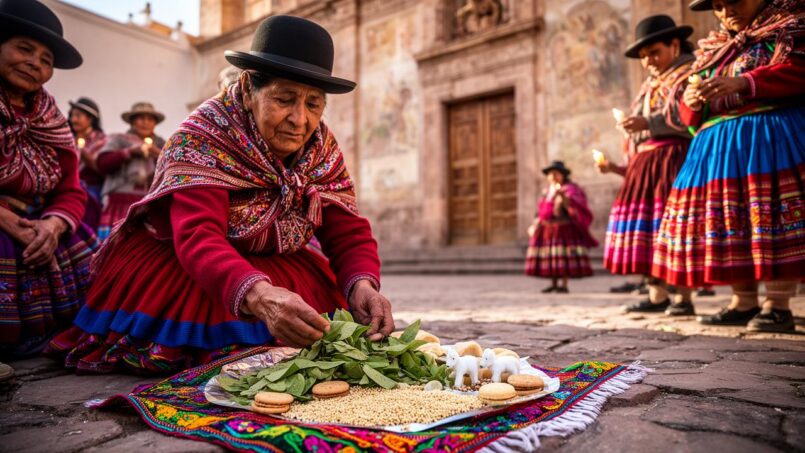
A gesture you will see very quickly, especially in the Andes, is the ch’alla: before drinking a beer or a glass of alcohol, you spill a few drops on the ground. It’s an offering to Pachamama, a thanks for what she gives. In some businesses, they “do the ch’alla” of offices or vehicles, with alcohol, petals, and sometimes a small improvised altar.
The despacho is an elaborate offering intended for Pachamama (Mother Earth) and the spirits (apus, ancestors). A ritual specialist (yatiri, kallawaya) arranges various symbolic elements like coca leaves, sweets, figurines, animal fat, and sometimes a llama fetus (symbol of fertility) on a large sheet of paper. The offering is then burned or buried to conclude the ritual.
These rituals aim to:
– thank the Earth and protective spirits
– ask for protection, prosperity, health
– “open the paths” before an important project (construction, travel, business venture)
For an expatriate, it’s not uncommon to be invited to a ceremony of this type for the inauguration of an office, a groundbreaking, or a neighborhood party. The best behavior is to observe, participate simply if you are handed a coca leaf or a glass, avoid inappropriate jokes, and refrain from taking photos without prior agreement.
Basic Religious Etiquette: How to Avoid Faux Pas
Even though Bolivia is very diverse, some general rules apply in most religious contexts, whether Christian or indigenous.
On the street, at work, on public transport, local politeness is quite formal, especially in the highlands. Starting an interaction with “Buenos días“, “Buenas tardes“, or “Buenas noches” is almost mandatory. Not greeting can be felt as an affront. Elders are spontaneously addressed as “señor”, “señora”, or even by a title (“doctor”, “licenciado”) if they have one.
Transposed to the religious sphere, this culture of respect implies:
A few basic principles to observe when visiting a church or sanctuary to respect the place and its faithful.
Greet discreetly when entering a church or sanctuary.
Stand up straight, avoid raising your voice, and put away your cell phone.
Observe first, imitate later: the best guide remains the behavior of local faithful.
Dress code is another sensitive element, especially in the Andes. A simple rule: shoulders and knees covered in religious spaces and events. Very torn, wrinkled, or sloppy clothing is frowned upon in general and even more so in sacred places.
Here is a useful summary to keep in mind:
| Context | Recommended Attire |
|---|---|
| Catholic mass, church, cathedral | Covered shoulders, pants/skirt to the knee, closed shoes |
| Patron saint festival / procession | Same, possibly more polished in the evening |
| Andean ceremony (Pachamama, despacho) | Clean, comfortable clothes, no very short shorts, avoid flashy religious symbols (ostentatious crosses, slogans) |
| Evangelical church service | Neat attire, often quite modest, avoid low necklines and tight-fitting clothes |
Photography is a minefield. Some people, especially in indigenous communities, view photography as an intrusion, even associating it with a symbolic capture of the soul. Others simply see it as a service to the tourist… for a few coins.
In all cases:
– ask for permission explicitly (“¿Puedo tomar una foto, por favor?”)
– accept a “no” without insisting
– avoid flash inside churches and during rituals
– ask before filming Andean ceremonies, even public ones
Regarding behavior, several Western habits can be poorly perceived: pointing a finger at someone, crossing your arms defensively during a discussion, raising your voice, showing impatience. In the religious sphere, these gestures quickly come across as disrespectful.
Entering a Community: Invitations, Homes, and Rites of Passage
If you stay several months or years, you will likely be invited to family events with strong religious overtones: baptisms, communions, weddings, wakes for a deceased person, fifteenth birthday parties (quinceañera), etc.
The implicit code is close to that of other Latin American countries, with some Bolivian nuances:
When invited, it is very appreciated to arrive with a small gift like flowers, chocolates, or a bottle of wine. Consider dressing a bit more formally than in daily life, a long dress or suit may be appropriate for major occasions. It is important to accept at least some of the food and drink offered by your hosts, as a categorical refusal might be interpreted as rejection. Finally, avoid broaching sensitive topics like politics, money, or religion head-on, unless your hosts themselves open the discussion on these themes.
In some homes, it is customary to remove shoes upon entry—a pile of shoes lined up will give you the answer. If you are unsure, simply ask. In any case, avoid putting your feet on furniture or leaving your jacket lying loose on a chair: these are etiquette details taken seriously.
During wakes or commemorations, the religious dimension is very present: Catholic prayers, offerings for the soul of the deceased, candles, sometimes coca and alcohol spilled on the ground. Again, your ideal role is that of a discreet, supportive guest, who follows along without trying to direct anything.
Discussing Religion and Politics: Sensitive Territory
In Bolivia, the border between religion and politics is porous. The place of the Catholic Church in public life, the official recognition of indigenous spiritualities, the rise of Evangelical Churches, and the memory of abuses from the colonial period fuel lively debates.
We have seen, for example:
A left-wing government, under indigenous and Catholic president Evo Morales, criticizing the colonial past of the Church and promoting Pachamama in official discourse, while right-wing governments stage “the return of the Bible” to the presidential palace as a symbol of rupture. These actions fuel open tensions between Catholics, evangelicals, and defenders of Andean rituals over each one’s place in school, public space, and law.
For an expatriate, caution is essential. It is better to avoid categorical statements about:
– coca (sacred leaf for many, an economic resource but also an international issue)
– the role of the Church in history (neither absolute heroine nor only oppressor)
– the legitimacy of Andean practices (neither naive superstition nor state doctrine)
If the subject comes up in conversation, adopting a posture of listening and curiosity rather than expertise is generally more appreciated. Bolivian religious history is complex, deeply linked to issues of power, racism, territory. It’s not a field where a newcomer will benefit from arguing.
Languages, Codes, and Small Keys for Integration
Religion in Bolivia is not expressed only in Spanish. In many rural areas, masses, prayers, and songs also use Aymara or Quechua, sometimes both. Even in cities, it is not uncommon for homages to patron saints to end with songs in an indigenous language.
Learning a few words of the local language is a sign of respect that can facilitate exchanges and open doors, especially when participating in local religious festivals. It is recommended to know a few basic expressions.
| Language | Expression | Meaning |
|---|---|---|
| Aymara | Kamisaraki | Hello |
| Aymara | Yuspagara | Thank you |
| Quechua | Napaykullayki | Hello (polite) |
| Quechua | Yusulipayki | Thank you |
| Spanish | Que Dios le bendiga | May God bless you |
| Spanish / Andean | Qhana pachamankama | (Andean well-wishing phrases, vary by region) |
In more traditional celebrations, social roles are very marked: the eldest is greeted first, elders are given a seat, one stands when a woman enters the room in certain circles. Transposing these markers of respect into religious contexts will show that you have made the effort to adapt.
Other Religions: Discreet but Real Diversity
Even though Christianity largely dominates, Bolivia is also home to other religious communities.
Among them:
– a large Bahá’í community, probably the largest in South America
– Muslims, mostly in large cities like Santa Cruz and La Paz, largely from Middle Eastern migration
– a small Jewish community, one of the smallest on the continent
– Buddhists, Sikhs, Hindus in limited numbers, often concentrated in large urban areas
Bolivian law guarantees freedom of worship and allows for the registration of religious groups. Expatriates may find, depending on the city, places of worship of their own faith (churches, mosques, Bahá’í centers) or interfaith communities, especially in major metropolises like La Paz, Cochabamba, or Santa Cruz.
Contact with these minorities requires the same reflexes as anywhere: inform yourself about specific codes (for example, covering your head in a mosque, removing shoes in a Buddhist temple), ask before photographing, avoid turning a service into a tourist attraction.
When Faith Rhymes with Solidarity: Social Works and Religious NGOs
Another often underestimated aspect of Bolivian religion is its very concrete social role. The Catholic Church, for example, administers a large majority of the country’s religious charitable works: schools, clinics, shelters for migrants or trafficking victims, housing programs in poor neighborhoods.
In disadvantaged neighborhoods, Evangelical Churches play a key role by offering listening, material aid, support for prisoners, and fighting addictions. They often operate in areas where state presence is limited.
For an expatriate, these religious networks can become work partners if they work in the development sector, or spaces for volunteer engagement. But one must keep in mind that these organizations constantly articulate social objectives and spiritual convictions. Collaborating with them implies accepting this dual horizon, without seeking to instrumentalize faith or erase it.
Practical Tips for Participating Without Appropriating
Participating in local ceremonies can be one of the great privileges of expatriate life in Bolivia, provided you avoid two pitfalls: touristic consumption and cultural appropriation.
A few simple guidelines:
When participating in intimate rituals, it is essential to come only by invitation or with a guide’s agreement. Avoid occupying visual or auditory space, accept not understanding every symbol and gesture, and participate seriously if invited to do so. If a practice clashes with your convictions, it is acceptable to politely decline and observe.
The most important thing is to keep in mind that you are a guest in a sacred space, not a spectator. This posture of a “humble visitor” is generally recognized and appreciated, whatever your own beliefs.
As a Compass: Three Key Attitudes for an Expatriate
At the end of this overview, we can summarize what Bolivian society implicitly expects from a foreigner regarding its religious practices:
– Humility: acknowledge the historical and spiritual complexity of the country, avoid quick judgments, admit what you don’t know.
– Respectful curiosity: ask open questions, inform yourself before participating, listen to the stories of residents about their festivals, their saints, their sacred mountains.
– Personal coherence: remain true to your own convictions, but without imposing them; know how to say no tactfully when active participation in a ritual deeply contradicts your faith or conscience.
Bolivia presents a complex and dynamic religious landscape, marked by the transformation of Catholicism, the expansion of evangelicalism, the revitalization of indigenous cosmovisions, and the presence of active religious minorities. For an expatriate, integrating here implies being open to re-evaluating one’s own benchmarks, but also offers the opportunity to discover a singular vision of the links between the human, the divine, and nature, in a context of inter-religious dialogue under construction.
By approaching this landscape with tact, you will not merely “tolerate” local religious practices: you will see in them a key to understanding your neighbors’ daily lives, the unspoken aspects of many conversations, and the deep motivations of a country that defines itself as a “plurinational state” – including, and especially, in the realm of the sacred.
Disclaimer: The information provided on this website is for informational purposes only and does not constitute financial, legal, or professional advice. We encourage you to consult qualified experts before making any investment, real estate, or expatriation decisions. Although we strive to maintain up-to-date and accurate information, we do not guarantee the completeness, accuracy, or timeliness of the proposed content. As investment and expatriation involve risks, we disclaim any liability for potential losses or damages arising from the use of this site. Your use of this site confirms your acceptance of these terms and your understanding of the associated risks.

Cyril Jarnias is an independent expert in international wealth management with over 20 years of experience. As an expatriate himself, he is dedicated to helping individuals and business leaders build, protect, and pass on their wealth with complete peace of mind.
On his website, cyriljarnias.com, he shares his expertise on international real estate, offshore company formation, and expatriation.
Thanks to his expertise, he offers sound advice to optimize his clients' wealth management. Cyril Jarnias is also recognized for his appearances in many prestigious media outlets such as BFM Business, les Français de l’étranger, Le Figaro, Les Echos, and Mieux vivre votre argent, where he shares his knowledge and know-how in wealth management.





