
 Published on and written by Cyril Jarnias
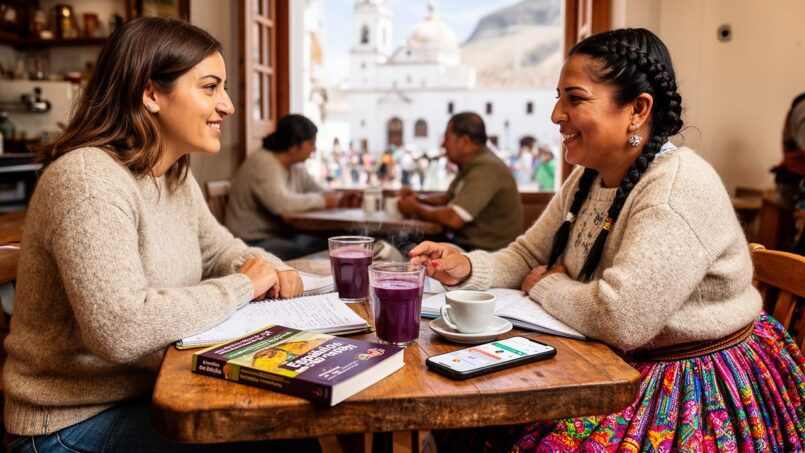
Moving to Bolivia means entering one of the world’s most linguistically fascinating countries. For an expat, mastering the local language is not just a practical asset: it’s the key to accessing daily life, building trusting relationships, and understanding a society where Spanish coexists with dozens of indigenous languages. Between the El Alto market, the valleys of Cochabamba, and the colonial alleys of Sucre, the soundscape changes, accents transform, and Quechua or Aymara words blend with Castilian Spanish.
In Bolivia, mastering ‘the local language’ involves becoming comfortable with Bolivian Spanish and, depending on your region and plans, acquiring some basics in an indigenous language like Quechua or Aymara. For expats, it is advisable to understand the linguistic context, choose suitable methods, identify the best schools and apps, and build a realistic learning plan, from arrival to long-term settlement.
Understanding the Bolivian Linguistic Landscape
Bolivia is officially a “plurinational” state that recognizes 37 languages. Spanish plays the role of a lingua franca, especially in cities, but it coexists with 36 indigenous languages, the most spoken being Quechua, Aymara, and Guaraní. More than half the population has an indigenous language as their mother tongue, and bilingualism is common: many children grow up first speaking Quechua or Aymara and then learn Spanish in school.
Figures vary by source and census year, but a table helps visualize the order of magnitude of the main languages:
| Language | Approximate share of the Bolivian population | Main remarks |
|---|---|---|
| Spanish | ~60% as L1 (and many more as L2) | Dominant language in urban areas |
| Quechua | 18–25% | Most spoken language in the central Andean zone |
| Aymara | 11–20% | Majority on the Altiplano around Titicaca |
| Guaraní | ~0.6% | Present in the east (Chaco, Santa Cruz) |
| Other languages | ~0.6% for 33 languages | Large number of small linguistic groups |
In practice, when you arrive in La Paz, Cochabamba, or Santa Cruz, Spanish will be enough initially to get by. But in rural areas, indigenous languages become central again: Quechua in the valleys and parts of the Andes (Cochabamba, Potosí, Chuquisaca, Oruro), Aymara on the Altiplano (Lake Titicaca region, El Alto, parts of Oruro and Potosí), Guaraní and other languages in the east and the Chaco.
A Clear Spanish… But Far from Uniform
Foreign Spanish speakers often highlight the clarity of Spanish in Bolivia: relatively slow pace, clear articulation, accent considered one of the most “neutral” in Latin America. This makes it a particularly attractive country for learning Spanish. But behind this apparent neutrality lie several distinct regional varieties, shaped by prolonged contact with indigenous languages.
The main varieties of Bolivian Spanish are:
| Variety of Bolivian Spanish | Main regions | Distinctive features |
|---|---|---|
| Andean | Central Andes (La Paz, Oruro, Potosí, etc.) | Influence of Quechua and Aymara, Castilian, Canarian, Andalusian heritage |
| Camba | Santa Cruz, Beni, Pando (eastern lowlands) | Dominant “voseo”, aspiration of final -s, borrowings from Chiquitano, Guaraní… |
| Chapaco | Tarija, areas of Chuquisaca and Santa Cruz | Intonation close to northern Argentina, well-established voseo |
| Valluno | Cochabamba, Chuquisaca | Spanish close to Andean, but intonation and expressions marked by Quechua |
A key point for any expat: in Bolivia, voseo (the use of “vos” with its specific verb forms) is much more widespread than tuteo (use of “tú”), even though institutions, advertising, or textbooks predominantly use “tú”. In daily practice, especially in Santa Cruz and large Andean areas, you will hear:
– « ¿Vos querés…? » instead of « ¿Tú quieres…? »
– « ¿De dónde sos? » instead of « ¿De dónde eres? »
To quickly decode conversations in Latin American Spanish, it is recommended to get used to voseo, even without using it yourself initially. This passive familiarity allows you to better understand interlocutors who use this verb form characteristic of certain countries.
Spanish, Quechua, Aymara: What Are the Priorities for an Expat?
For most expats, the immediate priority remains Spanish, essential for everything: administrative procedures, work, housing, health, school, transport. But learning phrases in Quechua or Aymara can make a huge difference in your integration, especially if you live or work in rural areas, in the social sector, or in development projects.
Some examples of useful phrases often cited:
| Language | Greeting / Key phrase | French translation |
|---|---|---|
| Spanish | ¿Cuánto cuesta? | How much does it cost? |
| Spanish | ¿Dónde está…? | Where is…? |
| Quechua | Imaynalla? | How are you? |
| Quechua | Sulpayki | Thank you |
| Aymara | Kamisaraki? | How are you? |
| Aymara | Yuspagara | Thank you |
Showing that you make the effort to learn even just a few greetings is greatly appreciated and facilitates relationships, especially in communities where linguistic identity is at the heart of local pride.
Choosing the Right Learning Strategy in Bolivia
Learning a language in a total immersion environment has nothing to do with a remote course. In Bolivia, English is very rarely used outside of tourist areas and hotels. This scarcity of English can be destabilizing at first, but it is precisely what makes learning so fast: your grocery shopping, bus trips, meals, and even market conversations become full-scale practice sessions.
Building a Plan Adapted to Your Expat Profile
Your situation determines your strategy:
For a corporate expat (often in Santa Cruz or La Paz), the priority is general and professional Spanish, with an understanding of local variations and possibly some basics of Guaraní or Aymara depending on the sector. A development worker, humanitarian, researcher, or development professional needs solid Spanish, then targeted learning of Quechua or Aymara depending on their intervention region. For a digital nomad, retiree, or expat spouse, everyday Spanish and integration via courses or language exchanges are essential, with optional discovery of an indigenous language. Finally, a student or PhD candidate requires academic and specialized Spanish, knowledge of Bolivian language policies, and possibly immersion in an indigenous language related to their field of study.
To avoid spreading yourself too thin, it’s useful to set a clear order of priority for the first 6 to 12 months:
1. Achieve a solid foundation in Spanish (A2-B1 level) for daily autonomy. 2. Understand the main features of voseo and Bolivian specifics. 3. Gradually introduce an indigenous language if your living or working context justifies it.
Exploring Self-Study Resources Before and After Arrival
Even if you plan to take courses on-site, investing in a few resources beforehand significantly speeds up your progress. Among the many textbooks and methods available, several stand out for their effectiveness and complementarity.
Textbooks and Grammar Guides to Structure Your Spanish
The great classics for building a grammatical and lexical base exist in print and digital formats. An overview of some frequently recommended references:
| Tool | Targeted Level | Strengths |
|---|---|---|
| Complete Spanish Step-by-Step | Beginner to intermediate | Clear progression, 150 exercises with audio |
| Madrigal’s Magic Key to Spanish | False beginner | Unconventional approach focused on patterns |
| Gramática de uso del español B1-B2 | Intermediate | >400 exercises, explanations 100% in Spanish |
| The Ultimate Spanish Review and Practice | Intermediate to advanced | Over 400 exercises + audio |
| Barron’s 501 Spanish Verbs | All levels | Detailed conjugation + online audio |
| Mastering Spanish Vocabulary | Intermediate and up | 13,000 entries, ~10h of audio |
These textbooks are not specific to Bolivia, but they provide the structure you’ll need to then adapt your Spanish to local realities.
Deepening Everyday Vocabulary and Expressions
To go beyond the basics, some resources focus on conversation, idiomatic expressions, or specialized vocabulary:
| Resource | Main Usefulness |
|---|---|
| Practice Makes Perfect: Spanish Conversation | Dialogues + audio for oral practice |
| Hablar por los codos | Colloquial expressions from European Spanish |
| Palabra por Palabra | Thematic vocabulary (work, media, description…) |
| Vocabulario en uso / Uso interactivo del vocabulario | Lexical enrichment from B1 level |
Coupled with podcasts or videos, these resources will help you move from basic phrases to more nuanced language, essential for managing a team, talking with a landlord, or negotiating a contract.
Reading in Spanish: Books for Every Level
Reading remains a very powerful accelerator. Many works are adapted for intermediate levels (B1-B2), while beginners can turn to bilingual version texts.
Some examples of recommended readings:
| Title | Genre / Use |
|---|---|
| First Spanish Reader (bilingual book) | 41 short stories with facing-page translations |
| La casa en Mango Street (Sandra Cisneros) | Coming-of-age novel, accessible style |
| Cuentos de la selva (Horacio Quiroga) | Short stories, narrative vocabulary |
| ¿Me voy o me quedo? (Juan Fernandez) | Story designed for B1–B2 learners |
| Climate change (Olly Richards) | Short chapters in conversational Spanish |
Even if these books are not Bolivian, they allow you to solidify your general Spanish. Once on-site, you can supplement them with readings produced in Bolivia or neighboring countries, or with blog articles on Bolivian slang, such as lists of swear words and expressions edited specifically for Bolivia.
Audio and Video Approaches: From Pimsleur to FluentU
Audio methods like Michel Thomas or Pimsleur remain interesting for very busy expats, especially during commutes or exercise. Pimsleur, in particular, relies on spaced repetition and active listening to automate oral structures.
The FluentU platform uses authentic videos (clips from shows, music videos, vlogs) with interactive subtitles for learning. It offers a two-week free trial. To prepare specifically for the Latin American accent, it is advisable to choose the “Latin American Spanish” versions when this option is available.
Working on the Bolivian Accent and Local Slang
Several resources specifically target Bolivian speech:
– A simple guide dedicated to Bolivian Spanish presents vocabulary, pronunciation, and usage peculiarities.
– An audio course “Learn Bolivian Spanish: A Spanish Course for Bolivia” offers ten 40-minute sessions on vocabulary, grammar, customs, gastronomy, and slang, with even an overview of common Quechua words.
– Blogs like Baselang’s list dozens of street expressions heard in La Paz.
– An entire book is devoted to Bolivian swear words and slang, with cultural explanations in English.
These tools are valuable for avoiding faux pas (some very common words elsewhere in Spanish can be vulgar locally) and for decoding, for example, the very Bolivian use of suffixes like the diminutive in “‑ingo” or the augmentative in “‑ango” in the eastern part of the country.
On-Site Courses: Taking Advantage of Low Cost and Immersion
Learning on the ground remains the most effective solution. Bolivia is one of the most affordable countries in the world for private or small-group classes: hourly rates are around $4 to $6 for a school class, $7 to $10 for a private tutor.
Why Sucre Has Become the “Capital” of Spanish for Foreigners
For an expat who can choose their base, Sucre is often recommended as a location for a language stay. This colonial city, a UNESCO World Heritage site, is known for its relative calm, pleasant microclimate, and modest cost of living.
Price indices compared to New York illustrate this advantage:
| Cost of Living Indicator in Sucre | Value (base New York = 100) |
|---|---|
| Cost of Living Index Excluding Rent | 33 |
| Cost of Living Index Including Rent | 44 |
Several schools there welcome expats, backpackers, and volunteers:
– Sucre Spanish School
– Me Gusta
– Spanish Friends School & Hostel
– Open Spanish School
– Academia Latinoamericana de Español
– All About Spanish Sucre
The programs offered range from intensive mini-group courses to fully individual coaching. They are often combined with homestay accommodation, allowing for maximum linguistic and cultural immersion.
An example of a typical structure offered by Sucre Spanish School well illustrates the intensive model:
| Component of a Typical Day | Duration |
|---|---|
| Grammar and Exercises (morning) | 4 hours with a teacher |
| Conversation (afternoon) | 2 hours with another teacher |
At this pace, the school estimates a beginner could achieve good fluency in 8 to 10 weeks. These promises are often optimistic, but this type of volume undeniably allows for very rapid progress.
Other Cities and Schools: La Paz, Cochabamba, Santa Cruz
Expats settled for work don’t always have the flexibility to spend two months in Sucre. Fortunately, major cities have solid structures.
In La Paz, several schools and tutors share the market:
– Instituto Exclusivo
– Pico Verde
– Ayni Spanish Institute
– ABC Spanish Tuition
– Me Gusta (online courses possible)
– 1on1 AYMARA Spanish School
– Other local schools, sometimes linked to organizations like Sustainable Bolivia
In Cochabamba, you can find, among others:
– Escuela Runawasi
– La Escuela Carmen Vega
– Sustainable Bolivia (combines courses and volunteering)
In Santa Cruz:
– La Lengua Jodanga
– 1on1 AYMARA Spanish School (also present in the east)
– Other independent teachers via platforms like TUTOROO or italki
Schools often offer:
– Standard courses (approx. 20h / week)
– “Super-intensive” formulas (group class + private lessons)
– Programs for travelers focused on language survival
– Social activities (cooking, salsa, cultural outings)
– Accommodations with host families or student residences
A point to keep in mind: in most of these schools, the use of English in class is strongly limited, if not prohibited, which reinforces immersion.
The University Option: Structured Programs and Academic Recognition
For expat students or those on academic mobility, institutions like the Universidad Privada Boliviana offer intensive language and culture programs:
– Courses divided by level (beginner, intermediate, advanced)
– 4 hours per day in class
– Modules of 120 hours
– Possibility to attend regular university courses from B1 level
This formula is particularly suitable for those who wish to earn credits or prepare for a degree, but it requires more time and availability.
Leveraging Online Platforms and Tutoring
Even when settled in Bolivia, you are not limited to local resources. International platforms ideally complement in-person courses and allow you to work on specific points (pronunciation, exam preparation, business Spanish) with teachers chosen to fit your needs.
italki, Preply, Verbling, Baselang: What Uses for an Expat?
Several platforms are mentioned as particularly effective:
Discover a selection of online platforms that offer Spanish courses with tutors from Bolivia, ideal for working on the accent and local culture.
Very popular for private video conferencing lessons. Filter teachers by country to choose a Bolivian instructor. Advantages: schedule flexibility and reasonable costs, sometimes with free credits upon registration.
Comparable operation, with a free replacement policy if the first tutor doesn’t suit you.
Atypical “unlimited” one-on-one lesson plan with Latin American teachers for a fixed monthly fee. Ideal for intensive learning.
Verbling, TUTOROO, Strommen, Linguaviva: other platforms offering teachers from Latin America and Bolivia, sometimes specialized in DELE/SIELE exams.
The table below gives a rough idea of the prices mentioned for online courses:
| Platform / Profile | Indicative Rate (individual lesson) |
|---|---|
| Bolivian teacher on Verbling | ~$6.5–9 USD / 50 minutes |
| TUTOROO tutors in La Paz | ~$7.9 to $15 USD / hour |
| Speechling (unlimited coaching) | $19.99 USD / month after free version |
The ideal use for an expat already immersed in Bolivia is to: engage in the local culture, build relationships with locals, and learn the Spanish language to better integrate and fully enjoy the experience.
To optimize your Spanish learning for professional purposes, adopt a structured approach. Prioritize continuity by keeping the same online teacher over time, ensuring consistent follow-up, especially useful if you frequently change your place of residence. Define concrete and measurable goals, such as preparing professional presentations, simulating interviews, or writing formal emails. Finally, if your work involves communicating with people from different geographical areas, devote time to working on your understanding of regional Spanish varieties (like Latin American Spanish) to facilitate communication.
Generalist Apps: Duolingo, Babbel, Memrise…
Apps like Duolingo, Babbel, or Memrise are not sufficient on their own for linguistic integration in Bolivia, but they are useful for:
– Building basic automaticity (conjugations, common vocabulary).
– Ensuring daily practice even on busy days.
– Introducing a bit of “gamification” into your routine.
Combined with a flashcard tool like Anki or with the vocabulary decks on Memrise, they help permanently anchor new words encountered at the market, office, or during your outings.
Learning Quechua, Aymara, and Other Indigenous Languages
For many expats, the idea of learning Quechua or Aymara can seem intimidating. These languages are indeed distant from Indo-European languages, with different sounds, logics, and structures.
Why Start Despite the Apparent Difficulty?
Using a few local phrases fosters respect and trust in communities. In social work and NGOs, mastery of the local language is often more crucial than English for projects. Furthermore, indigenous languages are essential for understanding unique cultural perspectives, particularly on nature, time, community, and spirituality.
Thus, Aymara, for example, organizes its logic around three values (true, false, uncertain), which influences how speakers categorize reality. Getting introduced to these languages, even partially, is also exploring other ways of thinking.
Applications and Digital Tools Dedicated to Indigenous Languages
Despite weak internet infrastructure in some rural areas, the digital ecosystem around indigenous languages is developing. Several free or low-cost apps explicitly target Quechua, Aymara, and other languages:
| Application / Resource | Languages Covered | Main Features |
|---|---|---|
| Simi | Bolivian Quechua | 4 units, 15 lessons (greetings, family, animals, professions…) |
| Quechua Bolivia / Lite | Quechua | >13,000 words, useful phrases, grammar, customizable favorites |
| Lenguas de Bolivia | Aymara, Quechua, Guaraní, Uru-chipaya, Mojeño-trinitario | Interactive flashcards, playful challenges |
| Ñawpa Pacha | Quechua | Android dictionary |
| Aymara Dictionary | Aymara | iOS dictionary |
| SimiDic | Quechua–Spanish | Android dictionary |
| Rimasun | Quechua | Podcast (NYU), available on iTunes |
| Rimay.org | Quechua | Poems, songs, audio stories via SoundCloud |
The Lenguas de Bolivia app, supported by an Ibero-American organization, already has nearly 20,000 registered users and was designed to maximize memorization through games, balancing oral comprehension, reading, and writing.
Online Courses and Hybrid Initiatives
Certain initiatives bridge the gap of formal courses by offering Quechua or Aymara classes remotely:
Virtual Aymara courses are offered via WhatsApp and Zoom, particularly targeting the diaspora and young people of Aymara origin abroad. The use of lightweight tools like WhatsApp helps overcome frequent high-speed internet connection issues in Bolivia.
In parallel, a few language schools and organizations like Sustainable Bolivia offer individual lessons in rarer languages (Cavineño, Chacaobo, Esse Ejja), which may interest expats involved in Amazonian projects.
Immersing Yourself in Local Life: Language Exchange, Events, Expat Communities
Grammar and apps don’t replace real conversations. In Bolivia, several formal or informal setups facilitate language exchanges.
Conversation Groups and Tandems
In major cities, you will find: shops, restaurants, museums, parks, public transportation, cultural centers, events and festivals.
– Weekly events like “Parlana” (La Paz, Cochabamba, Santa Cruz) in bars, where Bolivians and foreigners exchange in Spanish, English, and sometimes other languages.
– “Spanglish Conversation” clubs that alternate moments in Spanish and English.
– Groups on platforms like Tandem, HelloTalk, or MyLanguageExchange, with hundreds of Bolivian speakers ready to practice online.
The example illustrates a mutually beneficial language exchange: you help a Bolivian practice English or French, and in return, they help you perfect your Bolivian Spanish. This includes understanding grammatical nuances, like the difference between voseo and tuteo, and the ability to distinguish regional accents, such as those from La Paz, Cochabamba, and Santa Cruz.
Expat Networks: Social Support and Practice Opportunities
Networks like InterNations or Facebook expat groups in La Paz, Cochabamba, or Santa Cruz regularly organize:
– Themed dinners
– Cultural outings and hikes
– Afterwork events and “happy hours”
– Lunches for newcomers
Even if these meetings often take place in English, they allow you to forge connections with bilingual Bolivians, local spouses, or Spanish-speaking expats from other Latin American countries.
To make progress, the challenge is not to completely avoid English speakers, but to create a balance: for an aperitif in English, commit yourself to a class, a language exchange, or an evening 100% in Spanish.
Integrating Learning into Your Expat Daily Life
No resource, however complete, will replace one thing: consistency. The good news is that in Bolivia, everything pushes you to practice.
Turning Daily Tasks into Micro-Lessons
A few examples of easy habits to adopt:
To progress in the language and better understand local culture, adopt these daily practices: do your shopping at the market rather than the supermarket and systematically ask questions about prices, product origins, or dish preparation. On public transport, ask the driver for details about stops and rephrase to check your understanding. Engage in conversation with your colleagues about topics like local news, politics, soccer, or traditional festivals. Finally, keep a notebook or an Anki file to note new words encountered each day, along with example sentences.
Even 10 to 15 minutes of daily targeted review is worth more than sporadic two-hour grammar sessions.
Managing Immersion Fatigue
Total immersion is exhausting, especially at the beginning. Many expats report a “saturation” after a few hours of meetings, errands, or family life in Spanish. It’s important to anticipate:
To progress efficiently, it is recommended to schedule a daily “off” time without active learning to rest the brain. It is also beneficial to vary activities (grammar, podcasts, reading, audiovisual content) over several days. Finally, one must accept the “plateau” phases, where progress seems to stall, as perseverance eventually pays off.
Setting Measurable Goals
Rather than “becoming bilingual”, concrete goals over 3 to 6 months are more motivating:
– Hold a 10-minute conversation with a neighbor without switching to English.
– Manage a doctor’s or bank appointment alone.
– Follow a work meeting without interpretation and take comprehensible notes.
– Read one Bolivian newspaper article a day, noting new vocabulary.
This type of visible milestone reinforces the feeling of progress and helps maintain long-term motivation.
Conclusion: Making Language a True Life Project in Bolivia
Learning the local language in Bolivia is not just about accumulating conjugations: it’s about inserting yourself into a history, a diversity, and an ongoing debate around identity and linguistic rights. Bolivian Spanish, slow and clear but laced with regionalisms and Quechua or Aymara words, will already open immense doors for you. Adding a few phrases in an indigenous language is crossing an additional threshold in building trusting relationships with your interlocutors.
Numerous resources are available for learning the language, such as textbooks, apps, podcasts, intensive courses in cities like Sucre or Cochabamba, online teachers, language exchanges, and conversation groups. Bolivia also offers unique advantages: low learning costs, an environment where English is seldom present, and a local population often patient and supportive towards those attempting to speak their language.
For an expat, the winning strategy generally combines:
– A structured base via textbooks and some intensive courses upon arrival.
– Online follow-up with a Bolivian teacher once your lifestyle is stabilized.
– Assumed daily immersion, turning every interaction into a learning opportunity.
– A step, however modest, towards the indigenous languages of the country you live in.
By adopting this approach, the language ceases to be an administrative or professional obstacle and becomes what it really is in Bolivia: a living link between worlds, generations, and multiple cultures at the heart of the same territory.
Disclaimer: The information provided on this website is for informational purposes only and does not constitute financial, legal, or professional advice. We encourage you to consult qualified experts before making any investment, real estate, or expatriation decisions. Although we strive to maintain up-to-date and accurate information, we do not guarantee the completeness, accuracy, or timeliness of the proposed content. As investment and expatriation involve risks, we disclaim any liability for potential losses or damages arising from the use of this site. Your use of this site confirms your acceptance of these terms and your understanding of the associated risks.

Cyril Jarnias is an independent expert in international wealth management with over 20 years of experience. As an expatriate himself, he is dedicated to helping individuals and business leaders build, protect, and pass on their wealth with complete peace of mind.
On his website, cyriljarnias.com, he shares his expertise on international real estate, offshore company formation, and expatriation.
Thanks to his expertise, he offers sound advice to optimize his clients' wealth management. Cyril Jarnias is also recognized for his appearances in many prestigious media outlets such as BFM Business, les Français de l’étranger, Le Figaro, Les Echos, and Mieux vivre votre argent, where he shares his knowledge and know-how in wealth management.





