
 Published on and written by Cyril Jarnias
Moving to Bolivia also means learning a new culinary language. Between the icy mountains of the Altiplano, the fertile valleys, and the tropical Amazon, each region places a piece of its landscape on the table. For an expatriate, understanding this cuisine, its codes, and its rhythms is one of the fastest ways to integrate, build connections, and better read society.
This guide offers a complete immersion into local cuisine, covering markets, street food, contemporary restaurants, religious festivals, and cooking classes. It also addresses practical aspects like health and allergies. The goal is to give you the keys to safely discover Bolivian gastronomy at your own pace, without trying to experience everything at once.
Understanding the Logic of Bolivian Cuisine
Before discussing specific dishes, it’s helpful to grasp the forces that structure cuisine in Bolivia: geography, history, and population composition. Bolivia is a landlocked but extremely diverse country: a high plateau over 3,500 meters above sea level, temperate valleys around Sucre, Cochabamba, or Tarija, and tropical lowlands near Santa Cruz and the Amazon. Each strip of territory produces its own foods, and the table reflects this mosaic.
Bolivian cuisine is a historical blend of traditions. Its indigenous base (Aymara, Quechua, other Andean and Amazonian peoples) uses corn, potatoes (with over 200 local varieties), quinoa, beans, ají chili peppers, peanuts, yuca, and plantains. Spanish colonization added wheat, rice, meats (beef, pork, chicken), dairy products, and wine. More discreet influences come from German, Italian, French, Arab, African, or Chinese migrants, and neighboring countries like Peru, Brazil, or Argentina have also contributed to this composite gastronomic heritage.
The result is not a uniform cuisine but a patchwork. On the Altiplano, dishes are hearty, based on chuño (dehydrated potato), quinoa, and llama or sheep meat. In the valleys, led by Cochabamba, plates are more varied, generous, and often spicier. In the lowlands, rice, yuca, fish, and grilled meats dominate, accompanied by tropical fruits.
In many cultures, cuisine is both heritage and a social and spiritual act. It serves to feed the family but also to honor entities like the Pachamama (Mother Earth) during rituals where food is offered, shared, and blessed. For an expatriate, participating in these moments—such as accepting a dish, raising a glass, or sharing a community meal (like the Andean “apthapi”)—is a key to entering this language and integrating into the community.
Meal Rhythms: Learning to “Eat Bolivian”
Integration also involves timing and codes. In Bolivia, lunch is the main meal and structures the day. It is generally taken between noon and 2 p.m., sometimes later, and can stretch for a good hour, often followed by a siesta, especially in Altiplano and valley cities where businesses close midday.
A typical rhythm emerges: a simple breakfast, sometimes supplemented around 10 or 11 a.m. by the famous “salteña” break—this saucy empanada deserves attention—then a hearty lunch, an afternoon snack or tea in a tea room, and finally a lighter dinner around 8–9 p.m., or even later in the Andean west.
At the table, European cutlery etiquette is used, even for pizza or fruit. You only start eating after the host says “¡Provecho!” to which you reply “¡Gracias!”. Avoid grimacing at an unfamiliar dish and do not comment on leftovers. Expressing admiration for a dish during the meal can be interpreted as a request for seconds; it’s better to save compliments for the end if you are full.
Meals are also occasions for toasts. The host usually makes the first toast by raising their glass, often with a “Salud”. The way wine is served is highly codified: no serving with the left hand, nor holding the bottle by the bottom, gestures seen as insulting or bad omens. These details may seem minor, but respecting them signals a genuine willingness to adapt.
Three Bolivias on the Plate: Highlands, Valleys, and Tropics
The simplest way to grasp the local gastronomy is to read it region by region, with a menu in hand. For an expatriate moving between La Paz, Cochabamba, Sucre, Santa Cruz, or Tarija, these reference points are valuable.
On the Altiplano: High-Altitude Cold-Weather Cuisine
On the Altiplano, the air is dry, the cold biting, and distances long. Dishes are built to stick to your ribs, based on potatoes in all their forms (fresh, chuño, tunta), quinoa, and sheep or llama meat. A bowl of chairo, that rustic soup with sheep or beef, vegetables, wheat, and chuño, can warm a freezing evening in La Paz or Oruro. Fricasé, a spicy pork stew served with chuño and corn, is a classic remedy for the morning after a celebration.
The “plato paceño,” an iconic La Paz dish, consists of tender corn on the cob, potatoes, fava beans, and cheese, served with llajua, an omnipresent tomato-chili salsa. In the evening, anticuchos—grilled beef heart skewers slathered in peanut sauce—are typically enjoyed on sidewalks, sitting on plastic stools among families.
Llama meat, often dried as charque, features in many dishes. Charquekan, for example, rehydrates these salted strips and serves them over potatoes and corn, with egg and cheese. For an expatriate used to beef or pork, it’s a chance to discover a lean, quintessentially Andean meat.
In the Valleys: Cochabamba, Sucre, Tarija and “XXL” Dishes
The valleys offer an abundance of vegetables, fruits, meats, and grains. Cochabamba has built its reputation as the “gastronomic capital” on generous portions and hearty dishes. This is where pique macho was born, a culinary “challenge” made of chunks of beef, sausages, mountains of fries, onions, local locoto chilies, and hard-boiled eggs drowned in a spicy sauce. Served in the city’s popular restaurants, it’s easily shared by two or three people.
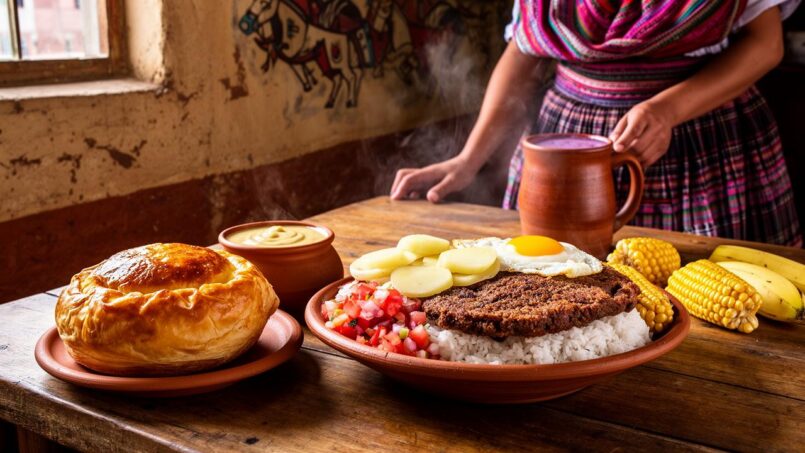
Silpancho is a complete typical dish from Cochabamba, consisting of layers of rice, potatoes, a breaded beef cutlet, and a fried egg, all topped with a raw salsa of tomato and onion. It perfectly illustrates the cuisine of the Bolivian valleys, combining richness and a balance between grains, tubers, meat, and vegetables.
Soups hold a special place here, particularly sopa de maní, a creamy peanut soup with vegetables, potatoes, chicken or beef, vermicelli, and a handful of crispy fries added at the last moment. This dish even appeared on a show like MasterChef, helping to bring it back into the national spotlight. In markets, you can find it in simpler or even vegetarian versions.
Sucre and Tarija bring their own touches: Chuquisaca chorizos, mondongo in paprika sauce, corn soups, high-altitude wines around Tarija, served with dishes like locro (thick corn and meat soup). For a wine-loving expatriate, Tarija is worth a visit, if only to understand how vineyards over 1,800 meters high produce wines very different from those of the Argentine plains.
In the Lowlands: Santa Cruz, Amazonia and Tropical Cuisine
To the east, towards Santa Cruz and the Amazon, the heat and humidity call for a different palette: yuca, plantain, rice, river fish like surubí or pacú, and a multitude of tropical fruits. The watchwords are simplicity: grilled meats, creamy rice, cheese fritters, nourishing soups.
Majadito, an emblematic dish from the Santa Cruz region, is a mixture of rice, dried meat (charque), onions, tomatoes, and annatto (urucú) which gives it an orange color, served with a fried egg and fried plantains. Other specialties include masaco, a mash of plantain or yuca mixed with dried meat, often eaten for breakfast, and cuñapés, small round breads made from yuca flour and local cheese, ideally accompanied by coffee.
The rivers provide grilled fish, often served with boiled yuca and salad. Game meats like peccary or agouti belong to an older tradition, now controversial for conservation reasons. But stuffed yuca, sonso (mashed cassava with cheese grilled on a stick), or locro de gallina bear witness to this tropical culinary culture.
Discovering Gastronomy Through Street Food and Markets
For an expatriate, markets and street food are unbeatable observatories of daily life. Bolivia is full of them, and some are true institutions.
In La Paz, the Mercado Rodríguez, open from dawn until late at night, stretches for several kilometers of stalls largely run by cholitas, women in pleated skirts and bowler hats who carry their goods in striped blankets (frazadas). Here you can buy countless varieties of potatoes, chuño, herbs like huacatay, ají chilies, Amazonian fruits like cupuaçu or açaí, but also ready-made dishes in small corridor “comedores”: soups, stews, fried foods.
In La Paz, the Lanza and Central markets offer salteñas, tucumanas, api morado with pastel, and cheese empanadas. In El Alto, the vast 16 de Julio market offers, among other things, quinoa soups and chola sandwiches (bread stuffed with roast pork, raw vegetables, and herbs like quirquiña).
Markets aren’t just for food. At the Mercado de las Brujas (Witches’ Market) in the heart of La Paz, coca leaves, amulets, herbs, and traditional remedies are sold. You may encounter yatiris, spiritual guides, who sometimes offer coca leaf readings. Some stalls also prepare food, and shops like Doña Rosa’s Salteñas or La Casa de las Brujas have become landmarks for sampling street food between purchases of offerings for the Pachamama.
Bolivia has several notable markets that illustrate its cultural and culinary diversity. La Cancha in Cochabamba is one of the largest open-air markets in South America, where you find stalls of tropical fruits and vegetables as well as food stalls offering typical dishes like silpancho or pique macho. In Sucre, the Mercado Central gathers regional products, and an hour’s drive away, the Sunday market in Tarabuco combines the sale of traditional weavings with local dishes. Finally, in Tarija, the Mercado Bolívar and Mercado Campesino supply fresh produce to the surrounding vineyards.
To get a better overview, it can be useful to visualize some key places.
| City / Region | Main Market Mentioned | Specifics for a Food-Loving Expatriate |
|---|---|---|
| La Paz | Mercado Rodríguez, Lanza, Central, Mercado de las Brujas, Ayni Market | Andean vegetables, soups, street food, crafts and rituals |
| El Alto (La Paz) | Mercado 16 de Julio | Overwhelming quantity, street food, popular atmosphere |
| Cochabamba | La Cancha, Feria de Artesanías | Great diversity of dishes, tropical products |
| Sucre | Mercado Central | Valley dishes, charcuterie, mondongo, chorizos |
| Tarija | Mercado Bolívar, Mercado Campesino | Fruits, wines, locro, valley cuisine |
| Santa Cruz | Neighborhood markets, Mercado de las Flores | Tropical cuisine, yuca, plantain, edible flowers |
| Potosí | Local market | Miner’s dishes, rich soups, kalapurka |
Visiting these markets early in the morning allows you to observe deliveries, see the freshest products, and enjoy maximum activity. It’s better to have cash, a reusable bag, a few basic Spanish phrases, and accept the principle of haggling, generally practiced in a good-natured way.
Essential Dishes to Start With
The abundance of specialties can be intimidating. For a newly arrived expatriate, the important thing isn’t to try everything, but to build a small repertoire of reference points. Certain preparations are found everywhere and make good entry points.
Considered the national dish, salteñas are oven-baked empanadas with a slightly sweet dough colored with annatto. They are filled with a gelatinized stew of meat (beef, chicken, sometimes pork) with vegetables and condiments (potatoes, peas, olives, raisins, hard-boiled egg). During baking, the gelatin melts and creates a burning-hot sauce inside. They are traditionally consumed mid-morning, accompanied by coffee or tea, and are bought in specialized salteñerías, open only for a few hours, in main cities like La Paz, Cochabamba, Potosí, or Oruro.
Pique macho, mentioned earlier, helps you understand the generous, financially accessible portions in Bolivia. On a limited budget, ordering this dish for two or three often represents a good deal, especially since the meat, eggs, potatoes, and vegetables offer a complete meal.
Sopa de maní illustrates the richness of soups in the local diet. It combines indigenous ingredients like peanuts, potatoes, and yuca with European contributions such as pasta, beef, or chicken. In many market “comedores,” it is served as a starter for the daily set menu, before a main course, rice, and sometimes a simple dessert.
Among snacks, anticuchos are very representative of nighttime street food, especially in Andean cities. Pieces of marinated beef heart in vinegar, garlic, and spices, grilled over charcoal and served with a boiled potato and peanut sauce, make for a quick, cheap, and filling meal.
A table can summarize the appeal of these dishes for an expatriate.
| Dish | Interest for a Newcomer | Where to Find It Easily |
|---|---|---|
| Salteñas | Discovery of local flavors without too much spice, inexpensive | Salteñerías, markets, cafes |
| Pique macho | Convivial sharing, generous portions, good value for money | Valley restaurants, Cochabamba |
| Sopa de maní | Comforting dish, good introduction to Bolivian soups | Daily set menus at markets, comedores |
| Anticuchos | Typical street food, nighttime immersion in local life | Street stalls in the evening, La Paz, Oruro |
| Api con pastel | Andean breakfast or snack, original corn-based drink | Markets, early morning street stands |
To explore further, humintas (sort of tamales of corn and cheese cooked in a corn husk), papas rellenas (fried stuffed potatoes), the chola sandwich (roast pork sandwich), or dishes of llama, charque, or quinoa each add another face to Bolivian cuisine.
Festivals, Rituals and Gastronomy: When Eating Becomes Ceremony
In Bolivia, the table and celebration are not easily separated. Major religious or cultural celebrations are also times of collective cooking. For an expatriate, following the festival calendar also means following the appearance of seasonal dishes.
The Oruro Carnival, a UNESCO Intangible Cultural Heritage site, is obviously known for dances like the Diablada, its costumes, and processions dedicated to the Virgen del Socavón and the Pachamama. But in the streets, stalls sell salteñas, chicharrón de porc, anticuchos, api, chicha, picante de pollo, or pique macho into the wee hours. For several days, the same dishes structure the meals of dancers, musicians, and spectators.
This number represents the apostles, symbolized by the twelve small portions in which some Holy Week dishes are presented.
The Festival of the Virgin of Candelaria, around February 2nd in Copacabana, brings together pilgrims who, between processions and car blessings, come to enjoy fish from Lake Titicaca, soups, and festive dishes in comedores. The Day of the Dead, November 2nd, sees the making of tantawawas—breads shaped like children’s faces—placed on domestic altars with fruits, drinks, and the favorite dishes of the deceased to welcome them for a day.
Bolivia organizes several festivals dedicated to its cuisine, such as the Cheese and Wine Festival in Tarija, the Culinary Fair of Cochabamba, the Gastronomic Festival of Chuquisaca in Sucre, or the Llama Festival in La Paz. These events highlight specialties such as llama stews and grills, cooking demonstrations, and tastings of traditional dishes like chicha, api, locro, charque, pampaku (meats cooked in the ground), and preparations based on corn, peanuts, or quinoa.
Even less well-known festivals, like the achachairú festival in Porongo (centered on the national fruit), the miners’ festival in Potosí (with charque and papa rellena), or wine-focused events in Tarija, offer opportunities to connect the plate with local history.
Cooking Classes and Immersive Experiences
For expatriates who wish to go beyond being a taster and understand the cuisine from the inside, cooking classes are a fantastic gateway. Bolivia is not yet as structured as Peru or Argentina in terms of cooking schools for tourists, but the offer is growing.
In Sucre, the restaurant La Boca del Sapo offers 2 to 3-hour culinary workshops. Its owner-chef, originally from the local countryside, grows some of the ingredients himself and combines agricultural know-how with gastronomic training. Participants learn to prepare typical dishes like mondongo chuquisaqueño (pork in paprika sauce), sopa de maní, or papas rellenas, accompanied by llajua and sometimes desserts with chocolate and singani. The workshop concludes with a shared meal, and instruction is given in a pedagogical atmosphere, in Spanish or English.
Also in Sucre, associations like Adelante Mujer organize workshops where women from the neighborhood teach their recipes. The transmission here is not only culinary, it’s social: meeting these cooks, listening to their stories, is confronting another face of Bolivia beyond trendy restaurants.
In La Paz, culinary experiences with local chefs like Clara can take place in outdoor kitchens with mountain views. They often combine a market visit, sourcing ingredients, and preparing Andean dishes, accompanied by singani cocktails or non-alcoholic drinks with seasonal fruits. Other programs combine a visit to the Mercado de las Brujas, participation in an Andean ritual like an offering to the Pachamama, and an apthapi meal. This community picnic involves each participant bringing an item (potatoes, cheeses, corn, meats) to compose a ‘tapestry of abundance’ shared directly on the cloth.
These classes have several advantages for an expatriate. They allow you to get familiar with product names in Spanish, understand techniques like using the batán (traditional stone mortar) to grind ají and llajua, learn to dose chili and herbs, but also leave with recipes adapted for a home kitchen. They also serve as a social bridge: you meet other newcomers, passing travelers, curious Bolivians.
Even though some of these experiences are offered via international platforms, the setting often remains intimate: a few participants, a family kitchen, a local market as a starting point. For an expatriate settling in long-term, regularly attending the same class or with the same chef can become a habit, almost a ritual.
From Market Stalls to Fine Dining
Bolivia is both the country of market comedores at 10 bolivianos and of contemporary gastronomy driven by chefs who champion 100% national ingredients. For an expatriate, moving between these two worlds is a formative experience.
These small family restaurants are essential for discovering everyday Bolivian cuisine. They offer daily set menus (“almuerzo” or “cena”) generally including a soup, a main course, sometimes a dessert and a drink. Typical dishes include sopa de maní, caldo de res, ají de fideo, meat stews, rice, and potatoes. Portions are generous, prices affordable, and the atmosphere is noisy and convivial.
In parallel, La Paz in particular has seen the emergence of an ambitious gastronomic scene. Establishments like Gustu, Mi Chola, Phayawi, Ancestral, Popular Cocina Boliviana, or La Rufina work exclusively or mainly with Bolivian products, in contemporary forms.
Several restaurants in Bolivia, such as Gustu, Phayawi, Mi Chola, and Popular Cocina Boliviana, embody a culinary movement that values local products and traditions. Gustu offers a 100% national menu with Andean ingredients. Phayawi highlights Aymara and Quechua narratives and techniques. Mi Chola pays homage to chola women and their struggles through its cuisine. Popular Cocina Boliviana revisits the traditional repertoire with an accessible approach.
These addresses offer another way to understand Bolivian gastronomy: instead of experiencing it on the street or in the market, you see it reflected upon, deconstructed, reconstituted. For an expatriate wanting to invite friends, colleagues, or mark an occasion, it’s good ground for accompanying this discovery. However, it would be a shame to frequent only these recognized tables without ever sitting on a plastic stool in a market hall. The richness of the Bolivian experience lies precisely in this assumed wide spectrum.
Eating Street Food While Staying Healthy
Sampling street food is part of Bolivia’s charm, but unacclimated stomachs can suffer. Cases of traveler’s diarrhea, salmonella, or giardia are not uncommon among foreigners. This doesn’t mean you should avoid stalls, but rather adopt a cautious strategy.
A few simple reflexes help limit risks. Observing customer flow is crucial: a stall very frequented by local families, with quick turnover of dishes, is statistically safer than a solitary vendor without customers. Seeing if the food is cooked in front of you, served piping hot, if utensils seem clean, if the person handling money doesn’t handle food without washing their hands also provides clues.
Favor fruits you can peel yourself (oranges, bananas, papayas) over pre-cut fruit salads. Avoid tap water and prefer sealed bottles or filtered water. Be wary of ice from unknown sources. Fruit juices in sealed plastic bags are generally safer than those prepared with tap water, but the quality of water used for dilution can remain uncertain.
In high-altitude areas like La Paz or Potosí, water boils at a lower temperature than at sea level, requiring extended boiling time if you want to make it drinkable by heating. For an expatriate cooking at home, investing in a filter or jugs of mineral water is simpler in the long run.
For a smooth adaptation, first favor dishes cooked through and served very hot, like soups, fried foods straight from the oil, anticuchos, or grilled meats. Avoid raw salads and initially limit homemade sauces, which can sit at room temperature for a long time. The use of llajua (spicy sauce) is almost systematic; if you are sensitive to chili, start by tasting a very small amount before increasing doses.
Finally, having basic medication for diarrhea on hand and, after medical advice, possibly a standby antibiotic can prevent a gastric incident from keeping you bedridden too long. Some travelers swear by a sugary Coca-Cola to “sanitize” the stomach, an anecdotal but widespread practice. The best defense, however, remains hygiene: washing your hands or using hand sanitizer before eating, especially at the market or on the street.
Allergies, Specific Diets and Communication
The issue of food allergies and specific diets also arises in Bolivia, even if sensitivities are not always as visible as in Europe or North America. International recommendations, including the country’s nutritional guidelines, emphasize a diversified diet rich in fruits, vegetables, dairy, lean meats, and water, with moderation on sugar, salt, and alcohol. But on the ground, information on allergens is not systematically displayed.
For an expatriate allergic to gluten, nuts, milk, eggs, or other foods, the first rule is communication in Spanish. Knowing how to say “Soy alérgico(a) a…” followed by the ingredient, asking “¿Qué ingredientes lleva?” and “¿Lo preparan por separado?” can make a difference. Carrying a card written in Spanish clearly explaining the allergy and its severity, to present to servers or cooks, is strongly advised.
It is crucial to verify the server’s understanding of the risks and to forgo the dish if in doubt. For celiac disease, beware of hidden ingredients like wheat flour in common sauces (soy, marinades).
For vegetarians and vegans, Bolivia can represent both a challenge and an opportunity. Many traditional dishes rely on plant-based foundations—corn, potatoes, quinoa, beans—but meat is often omnipresent in the form of broths, small pieces in soups, or fat used for cooking. In “comedores,” asking for a dish “sin carne” often means removing the visible meat, without guaranteeing the total absence of animal products in the broth or sauces.
In major cities like La Paz, the rise of vegetarianism has led to the appearance of dedicated restaurants and many meat-free options, especially in expatriate neighborhoods. Establishments like The Local Dish, certain cafes, or contemporary restaurants offer dishes based on quinoa, vegetables, and ancient grains, sometimes with a sustainable approach. To find them, international apps and sites listing vegetarian options are useful tools.
For religious diets (halal, kosher) or specific ones (ketogenic, lactose-free), logistics are more complex. Anticipating by identifying specialty supermarkets or grocery stores in your neighborhood, cooking more at home, and using cooking classes to learn how to adapt local recipes without certain ingredients are effective strategies.
In all cases, consulting a doctor or allergist before departure, bringing your medications (epinephrine in case of anaphylactic risk, for example), wearing a bilingual medical alert bracelet or card, and checking customs regulations for importing certain foods or medications are part of a personal safety plan.
Sitting at the Table: Etiquette and Integration
Beyond what you eat, how you behave at the table matters a lot in how Bolivians perceive an expatriate. Most codes involve common sense, but some points deserve clarification.
Arriving slightly late—fifteen to thirty minutes—to an informal dinner is common and often more polite than strict punctuality which might catch the host off guard. Coming empty-handed is frowned upon: a bottle of wine, flowers, chocolate, or a small gift for the children are appreciated gestures.
During the meal, keep your hands visible on the table (without placing your elbows) and wait to be invited before serving yourself. Avoid interrupting abruptly and checking your phone. Do not start eating before everyone is served. Remain seated until the last person has finished, then extend the evening by chatting for a while with your host, which is part of the politeness ritual.
Sharing dishes follows certain implicit rules. Taking the last piece of a dish without it being explicitly offered is not well regarded; the host offers it, the guest initially refuses out of politeness, the host insists, the guest accepts. This dance, typical of many cultures, exists here too. Similarly, avoid asking for a “doggy bag” in a formal context, even though the practice is starting to become common in some urban restaurants.
In Bolivian restaurants, it is customary for the local host to ask for the check and pay the bill. The tip is generally 5 to 10% for residents, and can be higher for foreigners. To share costs without going against this habit, it is elegant to offer to pay next time or leave the tip. However, whistling or snapping fingers to call a server is considered rude; a simple hand gesture is sufficient and appropriate.
For an expatriate, being invited to a family kitchen for a complete “Bolivian-style” meal—appetizers, soup, salad, main course, dessert—is often a sign that you have moved from the status of foreigner to that of friend. It is in these moments, even more than in renowned restaurants, that you realize how much gastronomy is a vector of recognition and integration.
Becoming an Actor in the Local Gastronomy
As you get used to life in Bolivia, food stops being a curiosity and becomes a possible field of engagement. Movements for food sovereignty, farmers’ markets, festivals like Posoka, or initiatives led by organizations like MIGA, which document and promote regional culinary heritages, invite city dwellers—locals and expatriates alike—to reflect on what they put on their plate.
In the face of challenges like junk food, obesity, loss of biodiversity, and climate change, conscious food choices make a difference. Favoring local products (quinoa, potatoes, fruits), supporting cafes sourcing from small producers in the Yungas or Amazonia, and frequenting fair trade markets like the Ayni Market in La Paz are committed gestures that go beyond mere consumption.
The story of McDonald’s closure in the country in the early 2000s made headlines worldwide as a symbol of a food culture that privileges slow time, home preparation, and conviviality over standardized speed. Whether sometimes idealized or not, this story reminds us that Bolivia places its cuisine at the heart of a national imagination, linked to resistance, identity, and memory.
For the expatriate, diving into this gastronomy is therefore much more than tasting exotic dishes. It’s learning to read a country through its markets, its 10 a.m. salteña breaks, its long family lunches, its soups shared at fairs, its toasts raised in honor of the Pachamama or a local Virgin. It’s accepting an invitation to a table whose codes you don’t fully master, but where you can, little by little, become an expected guest.
By taking the time to discover regional dishes, frequent comedores, explore a gastronomic festival in Tarija, a cooking class in Sucre, or an avant-garde restaurant in La Paz, an expatriate ends up weaving a deep bond with Bolivia, one that passes through the stomach but also touches on the way of living together. And sometimes, it’s a simple salteña, enjoyed standing in a market early in the morning, that gives birth to this sense of belonging.
Disclaimer: The information provided on this website is for informational purposes only and does not constitute financial, legal, or professional advice. We encourage you to consult qualified experts before making any investment, real estate, or expatriation decisions. Although we strive to maintain up-to-date and accurate information, we do not guarantee the completeness, accuracy, or timeliness of the proposed content. As investment and expatriation involve risks, we disclaim any liability for potential losses or damages arising from the use of this site. Your use of this site confirms your acceptance of these terms and your understanding of the associated risks.

Cyril Jarnias is an independent expert in international wealth management with over 20 years of experience. As an expatriate himself, he is dedicated to helping individuals and business leaders build, protect, and pass on their wealth with complete peace of mind.
On his website, cyriljarnias.com, he shares his expertise on international real estate, offshore company formation, and expatriation.
Thanks to his expertise, he offers sound advice to optimize his clients' wealth management. Cyril Jarnias is also recognized for his appearances in many prestigious media outlets such as BFM Business, les Français de l’étranger, Le Figaro, Les Echos, and Mieux vivre votre argent, where he shares his knowledge and know-how in wealth management.





