
 Published on and written by Cyril Jarnias
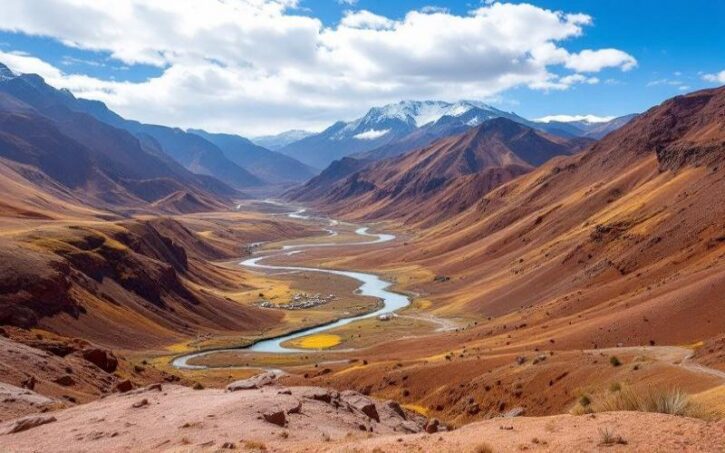
Land of altiplano, Andean summits, and the Amazonian jungle, Bolivia is an extraordinary sporting playground. Here, football coexists with high-level racquetball, ascents of icy giants over 6,000 meters, mountain biking on the dreaded “Death Road,” and kayaking on tropical rivers. Sport here is simultaneously a popular passion, a social driver, an international calling card, and an adrenaline factory for travelers.
In Bolivia, sport is not confined to stadiums. It is practiced in various public spaces like streets, plazas, covered coliseums, outdoor racquetball courts, sand dunes, and even in hot springs in the middle of the salt desert. This diversity reflects popular local sports and influences the visitor experience on the ground.
Football, national religion and street sport
In Bolivia, football is not just the number one sport; it’s a kind of common language. It is estimated that approximately one million people play it regularly, from a shapeless ball on a dusty altiplano pitch to the lawns of professional clubs. Over 2,000 clubs are recorded in the country, and the top-flight league, the División Profesional de Fútbol Boliviano, is considered one of the continent’s major competitions.
The championship, contested since 1950, has seen 16 different clubs lift the trophy. Bolivar, the great club from La Paz, is the historic giant with 31 titles, rivaling The Strongest, Jorge Wilstermann, Oriente Petrolero, Blooming, and even Always Ready, crowned in the 2025 tournament. The map of professional football mirrors that of the major cities: La Paz, Cochabamba, and Santa Cruz largely dominate the honors, although clubs from smaller cities, like Real Potosí or Universitario de Sucre, have managed to shake up this hierarchy.
Bolivian football is organized around the Bolivian Football Federation (FBF), which oversees the national league, departmental associations like the AFLP in La Paz, the AFC in Cochabamba, and the AFO in Oruro, as well as the men’s, women’s, and youth national teams. Academies, such as the famous Tahuichi Academy, play an essential role in developing young talent.
On the streets and in gyms, one variant also reigns: “fútbol de salón”, the local futsal, sometimes called “fulbito.” It is played on a reduced court, on concrete or hardwood, with a smaller, less bouncy ball, with five or six players per team. A discipline so established that it has its own elite league, the Liga Nacional de Futsal, organized by the National Futsal Committee within the FBF. Sixteen teams, divided into groups, contest a season marked by a regular phase followed by playoffs, with a ticket to the Copa Libertadores de futsal as a bonus. Here too, modern coliseums — Julio Borelli in La Paz, Eduardo Leclere Polo in Oruro, Jorge Revilla Aldana in Sucre — fill their stands to follow clubs like San Martín de Porres, CRE, Proyecto Latín, or Petrolero.
The Bolivian national team, although modest on the international stage, has achieved feats at home thanks to the high altitude of its stadiums (3,600 to 4,000 meters), the physical commitment of its players, and the passion of its supporters, as evidenced by landmark victories against Brazil and Argentina.
For the visitor, playing football in Bolivia often means joining an impromptu game on a neighborhood square, at a school, or on municipal lawns. Friendly matches are frequent, sometimes with female players present, as women’s participation is growing, even if recognition remains unequal depending on the region. The ball is everywhere, and a pair of cleats is enough to find a game.
Key facts about Bolivian football
| Indicator | Approximate Value |
|---|---|
| Football players in the country | ~1,000,000 |
| Recorded football clubs | > 2,000 |
| Bolivar’s top-division titles | 31 |
| World Cup participations (A) | 3 |
| First national championship organized | 1950s |
Racquetball: The country’s second sport and national pride
Behind football, another sport has taken an unexpected but central place: racquetball. In Bolivia, it has become the second most popular sport, far ahead of established disciplines like basketball or tennis. The number of regular players is estimated at around 1,500, which may seem modest, but the intensity of practice and high-level density make it a unique case in Latin America.
The Bolivian Racquetball Federation (FEBORA), founded in 1982, has patiently structured the discipline. Seven of the nine departments now have dedicated associations and complexes. The first major center in La Paz was inaugurated in 2008, following the first international successes of Bolivian players. The model is deliberate: access to training is free for youths aged 8 to 16, with the explicit goal of offering a serious alternative to football and developing talent.
A local peculiarity is that all levels train together: juniors, national elite, prospects. This constant mixing raises the level of play and allows the youngest to face the speed and precision of the best very early on. Equal treatment between women and men is also a pillar of this system, with the same training sessions and requirements.
Bolivia is now reaping the rewards of this work. Conrrado Moscoso, a national phenomenon, became world number one, winning the first Grand Slam held on Bolivian soil. Three gold medals at the South American Games in Cochabamba, a title at the American Iris Open, a series of podiums: his motto “always gold” has become a slogan echoed in the media. In 2018, Yazmine Sabja and Valeria Centellas won the women’s doubles at the World Championships, giving Bolivia its very first world title in any sport. This has turned these players into media figures, appearing even on billboards.
This is the approximate world ranking of the Bolivian national racquetball team, despite several of its players being in the world top ranks.
This sporting dynamism also fuels the economy. Imposing infrastructure, sometimes outdoors and free, has been built, even hosting the IRF Junior World Championships on outdoor courts with stands for thousands of spectators. A market for racket sports equipment has taken shape, with a moderate but steady annual growth in sales, driven by racquetball, tennis, and badminton. The combination of open public facilities and private clubs, albeit costly relative to the average Bolivian salary (around 500 dollars), fosters a complete ecosystem, from discovery to high performance.
Racquetball in numbers
| Aspect | Key Data |
|---|---|
| FEBORA founding | 1982 |
| Estimated regular players | ~1,500 |
| Departments with complexes | 7 out of 9 |
| Youth access (8–16 years) | Free training at public centers |
| First world title (any sport) | Women’s doubles Sabja–Centellas in 2018 |
For a sporting traveler, Bolivia is one of the few countries where you can play racquetball on world-class facilities, sometimes for free, and then watch a world champion warming up on a neighboring court. The experience is both athletic and sociological: you get a firsthand feel for an emerging sport that, unlike in the United States where its growth declined, is on the rise.
Cycling and MTB: From altiplano asphalt to the “Death Road”
It’s hard to imagine a more spectacular backdrop for pedaling than Bolivia. The altiplano, a vast plateau wedged between two Andean ranges, rises to over 3,600 meters, while the valleys plunge toward the cloud forests of the Yungas or toward the Amazon. The Department of La Paz alone gathers nearly 284 routes referenced on cycling tourism platforms, totaling nearly 98,000 kilometers of trails recorded by the community.
La Paz, nestled in a gorge carved by the Choqueyapu River, is the gateway to this world by bike. Its topography is extreme: a 460-meter elevation difference separates the plateau of El Alto from downtown over just three kilometers. The urban cable car, the Teleférico, has become a cyclist’s ally, allowing one to climb the slopes with a bike for a few cents. The dry season, from May to October, is the most favorable for riding, particularly due to stable weather.
Among the iconic routes, the descent from La Cumbre to the Yungas remains a legend. Better known as the “Camino de la Muerte” or “Death Road,” the old Yungas Road connected La Paz to the eastern plains until a safer new route was opened. Today, this 64-kilometer ribbon, clinging to the mountain, is used almost exclusively by mountain bikers. You lose over 3,000 meters in altitude, starting from a pass perched between 4,650 and 4,700 meters and ending around 1,200 meters, in the humidity of the tropical forest.
La Cumbre to the Yungas (Camino de la Muerte)
La Paz agencies offer this descent surrounded by a heavy context: in the past, 200 to 300 people lost their lives there each year under the wheels of buses and trucks. Steep cliffs, narrow road, fog, rain, waterfalls cascading onto the track: the historical danger is very real, as evidenced by the crosses still lining the route. Today, the route is secured for guided groups, with full-suspension bikes, hydraulic disc brakes, full-face helmets, protective gear, support vehicles, experienced bilingual guides, and a snack at the end of the trip, often complemented by access to a hotel pool in the Yungas.
The Death Road is just one facet among others. Other spectacular descents connect, for example, Chacaltaya to La Paz or follow the Zongo Valley. Routes also include sections of pre-Hispanic trails like the Takesi, where you ride on ancient Inca paving stones. Farther south, the tracks of the Salar de Uyuni offer a supernatural experience: pedaling on a salt desert, with the horizon lost in white, possibly linked to major circuits like “Lagunas y Salares,” a 700-plus kilometer loop connecting Uyuni to Chile’s Atacama Desert, nearly 90% on unpaved tracks.
For long-distance, cross-country, or bikepacking cyclists, routes like the “Gira de Sur Yungas” (approximately 373 kilometers, mostly on tracks, with over 12,000 meters of elevation gain) show what it truly means to ride in Bolivia: long climbs on wind-swept altiplano, dizzying descents toward the jungle, nights spent in small Aymara or Quechua villages, constant interactions with local culture.
Examples of cycling routes in Bolivia
| Route | Approx. Distance | Cumulative Elevation Gain | Terrain Type |
|---|---|---|---|
| Yungas Road (La Cumbre – Yungas) | ~64–65 km | -3,000 to -3,600 m | Narrow track, gravel, jungle |
| Achumani – Paitini (La Paz) | 18 km | ~805 m D+/- | Urban + paths |
| La Paz – Coroico | ~103 km | +1,996 / -3,881 m | Road + mountain track |
| “Gira de Sur Yungas” (loop) | 373 km | ~12,283 m D+ | 95% unpaved |
| “Lagunas y Salares” (Uyuni–Atacama) | 734 km | ~6,074 m D+ | 89% unpaved |
Pedaling in Bolivia, however, requires serious acclimatization to the altitude. The 3,600 meters of La Paz, the 4,000 meters of El Alto, or even higher on some passes put the cardio-respiratory system to the test. Taking time to walk, get used to it, and ride progressively is essential, as is paying attention to hydration and visibility on the road, day and night.
Hiking and trekking: In the footsteps of the Incas, from high plateaus to tropical valleys
The geographical diversity of Bolivia makes walking one of the best ways to discover the country. East of La Paz, the Cordillera Real concentrates the most popular routes. This range, about 125 kilometers long, lines up over 600 peaks above 5,000 meters and seven above 6,000 meters. Ancient Inca trails, paved with stone, cross its passes before plunging toward the humid valleys of the Yungas.
Main hiking routes across the mountain ranges, from La Paz to the edges of the Amazon.
The classic Choro, Takesi, and Yunga Cruz routes, crossing glacial ridges before descending into dense forest.
Starting point for exploring wilder trails and accessing the imposing massifs of Illampu and Ancohuma.
Remote circuits like the Trans-Apolobamba, discovering high-altitude landscapes, Quechua villages, and views over the Amazon.
Hikers less drawn to extreme altitude also find their place around Lake Titicaca, particularly on Isla del Sol, where trails wind through agricultural terraces, pre-Columbian ruins, and viewpoints. Other regions, like the mountains around Sucre, the Sama Biological Reserve near Tarija, or Torotoro National Park, combine karst landscapes, canyons, caves, and traditional villages.
Near La Paz, sites like the Achocalla lagoon and the Valle de la Luna, famous for its erosion-sculpted fairy chimneys, offer hiking possibilities. These outings also allow for preparation for more committed adventures, such as mountaineering.
Mountaineering and ice: The high-altitude school of the Cordillera Real
For high-mountain enthusiasts, Bolivia is considered one of the best “schools” for very high altitude in the world. Far from the crowds of some neighboring Andean massifs, the Cordillera Real and the western ranges offer a full spectrum of glacial peaks, snow and ice slopes, and volcanoes, often accessible with reasonable logistics from La Paz.
Huayna Potosí, located near La Paz in Bolivia and rising to 6,088 m, is considered one of the most accessible 6,000-meter peaks in the world. Agencies offer 2 to 3-day ascents, including a day of training in mountaineering techniques (crampon use, ice axe, etc.) and a night ascent from a refuge at 5,130 m to reach the summit before snowmelt.
Main Bolivian Andean peaks for mountaineering
| Mountain | Altitude (m) | Main Characteristics |
|---|---|---|
| Sajama | 6,542 | Country’s highest peak, extinct stratovolcano |
| Illimani | ~6,438 | Giant overlooking La Paz, 4 main summits |
| Ancohuma | 6,427 | Large massif in the north of the Cordillera Real |
| Illampu | ~6,368 | One of the most technical in the range |
| Chachacomani | 6,074 | Varied glacial peaks, still less frequented area |
| Huayna Potosí | 6,088 | Classic initiation to very high altitude |
| Chearoco | ~6,120 | Isolated, less-traveled peak |
| Condoriri | 5,700 | Group of 13 summits, ideal for ice school |
| Pequeño Alpamayo | ~5,350 | Beautiful glacial pyramid, very popular |
| Tarija | ~5,320 | Training peak for ice and cramponing |
Around the Condoriri base camp and Chiar Khota lagoon, a group of peaks like Tarija, Pequeño Alpamayo, Pirámide Blanca, or Pico Austria allows for building real mountaineering training stages: first moderate glacial hikes, then sharper ridges, before tackling faces that can reach 50 to 55 degrees of slope.
Illimani, visible from La Paz, is an Andean colossus rising over 6,400 meters.
Further west, in Sajama National Park, the volcanoes Sajama, Parinacota, Pomerape, or Acotango depict another face of Bolivian high mountain: volcanic landscapes, more regular slopes, border summits with Chile, sometimes approached as part of bike or 4×4 itineraries.
All of these ascents, of course, require careful acclimatization. La Paz, perched around 3,650 meters, constitutes an ideal stage to start, combining cultural visits — Witches’ Market, museums, viewpoints — and high-altitude walks like at Chacaltaya (~5,300 m) or around Laguna Charquini. Local agencies also emphasize sobriety (limiting alcohol), hydration, and listening to your body to prevent altitude sickness.
Outdoor sports and extreme adventures: Bolivia as a natural amusement park
Beyond cycling and mountaineering, Bolivia readily defines itself as a major destination for adventure sports. The range of activities is wide, often backed by surreal landscapes.
Motorized descent enthusiasts opt for ATV (quad) excursions in the lunar valleys near La Paz, like Valle de la Luna, Valle de las Ánimas, or around the spectacular rock formation of Muela del Diablo. These semi-arid environments, carved with spires and canyons, lend themselves to technical and highly photogenic routes.
The cliffs of Sucre and its surroundings, notably the La Resbalosa site, have seen the development of a sport climbing community with hundreds of equipped routes. Other areas, for example around the Santos refuge in the Qala Uta community, also offer bouldering and rock climbing routes.
Several sites in Bolivia offer whitewater and boating experiences. For river rafting and kayaking, there’s the río Coroico (Class II to IV rapids, day descents), the río Tuichi (more challenging and isolated, in Madidi National Park), and spots near Villa Tunari. Lake Titicaca, the world’s highest navigable lake, is suitable for kayak touring, with possible crossings.
Not far from Santa Cruz de la Sierra, the Las Lomas de Arena protected reserve houses large dunes, ideal for sandboarding. Surfboards replace skis, sand slopes serve as pistes. You slide down facing panoramas of lagoons and tropical forest. Other vertical practices are added, like the so-called “Vertical Route” via ferrata, advertised as the highest in the Americas, or waterfall rappelling in Amboró National Park, with 60 and 90-meter descents in dense jungle settings.
For thrill-seekers, paragliding sites offer flights over La Paz, in the valleys around Sucre, and even over the Salar de Uyuni. The latter site is particularly remarkable for the striking visual contrast between the colorful paraglider canopy, the deep sky, and the immense white surface of the salt flat, creating spectacular images.
Finally, Bolivia offers a series of motorized or family-friendly experiences like 4×4 crossings of the Salar de Uyuni, horseback riding integrated into trekking circuits, or even altitude golf on what is presented as the highest course in the world. These activities don’t necessarily require extensive technical skills but allow for a physical immersion in the landscapes.
Water sports and pools: From tropical kayaking to ultramodern aquatic centers
A landlocked country without sea access, Bolivia nonetheless offers a wide range of aquatic activities, thanks to its numerous lakes, lagoons, and rivers. Some areas have even specialized in nature sports in aquatic environments.
The El Palmar dunes host lagoons with clear waters edged by white sand, where you can swim, paddle, and cool off in a quasi-island setting. In Bermejo, near the Argentine border, it’s sport fishing enthusiasts who find their paradise, also enjoying natural hot springs.
The río Coroico region, already mentioned for its rafting and kayak descents, allows for combining physical activity and bivouacs in a tropical forest ambiance, far from urban bustle. On the banks of the Mamoré, in Varador, swimming, light sailing, and fishing intermingle, while in Almacén, going upriver by canoe or kayak allows for observing a great variety of fish and even river dolphins.
Near Tarija, the San Jacinto dam allows for swimming, kayaking, and fishing. To the east, near Puerto Suárez, the Cáceres lagoon is a tourist site for boating and wildlife watching, not far from Tacural, renowned for fishing. On the altiplano, Lake Poopó and its Panza island offer water’s-edge relaxation spots.
The “wellness” dimension is not forgotten. In the southwest, the Polques hot springs, fed by geothermal activity, allow you to immerse yourself in waters at 28–30 °C, amidst the lunar landscapes of the Uyuni region. The thermal water is renowned for its soothing properties, in a setting where flamingos and colorful lagoons complete the postcard.
Bolivia offers public and private aquatic infrastructure. In San Borja, the municipal pool offers swimming, aqua aerobics, water polo, diving, and event rentals, with relaxation areas. In Cochabamba, an Aquatic Club offers programs for all ages, including cryotherapy, with registration subject to a medical visit and appropriate equipment (cap, goggles, sandals). The goal is to promote swimming as a personal development activity at all stages of life.
The city of Cochabamba has also seen the birth of a large-scale international aquatic center at Mariscal Santa Cruz Park, equipped with three heated indoor pools. Two of them, built with Myrtha Pools technology, are certified for competition according to International Federation (FINA) standards: a 50 x 25 x 3-meter pool with 10 lanes and a 25 x 16-meter diving pool, 3 to 5 meters deep, also usable for swimming. This complex, located at 2,570 meters altitude, was conceived as a future major hub for Bolivian sport, with a reduced carbon footprint, extensive green spaces, play areas, and dining. It even served as the venue for the South American Games in Cochabamba.
La Paz is not left behind, with clubs like the Club Alemán or the Automóvil Club Boliviano equipped with pools, in addition to several public indoor or outdoor pools. The altiplano climate makes heated pools particularly appreciated, especially for those wanting to train for competitive swimming year-round.
Volleyball and basketball: Team sports on the rise
While football and racquetball dominate the landscape, volleyball solidly occupies second place among the most practiced sports. Introduced under the influence of neighboring countries like Brazil, it has established itself in schools, universities, clubs, and even on street courts, in both indoor and sand versions. More than 350 teams are officially registered, and the National Volleyball Championship, organized annually since the 1960s, structures the top level.
The city of Cochabamba is a nerve center for volleyball in Bolivia. The Departmental Association there has ten courts and a large coliseum, used for competitions like the ‘Torneo Garra Sport,’ which hosts youth categories (U11/U12) and top-level teams like La Paz Bolívar Vóley. The region also organizes stages of the South American beach volleyball circuit, including qualifying tournaments for the Junior Pan American Games and stages of the World Protour. National teams from Brazil, Argentina, Chile, Colombia, and Paraguay regularly come to face the Bolivian team on the sand of the Club San Martín, demonstrating the country’s integration into continental circuits.
More broadly, volleyball benefits from an active federation, institutional support (Ministry of Health and Sports, Vice-Ministry of Sports), and increased media presence. The combination of mass events, like South American circuits, and departmental development programs helps anchor this sport in popular culture.
Number of people playing basketball in Bolivia, a sport with steady growth.
Martial arts, boxing, and combat sports: A surprising scene
Behind the team sports, Bolivia has seen the structuring of a solid pool of martial arts and combat sports. The Bolivian Karate Federation claims about 40,000 members and organizes about ten tournaments per year between Sucre, Cochabamba, and Santa Cruz. The judo federation has some 8,000 registered members, while the boxing federation gathers around 25,000. The MMA federation oversees about forty clubs.
Bolivia regularly hosts major continental competitions, such as the South American Karate Championships (seniors, juniors, and para-kata) in Santa Cruz and the first Pan American Cadet and Junior Sambo Championships, followed by a national championship in Potosí gathering over 150 athletes. These events strengthen its position in the regional combat sports landscape and contribute to the development of sports tourism.
Added to this modern scene are more hybrid manifestations, like the famous “Tinku”, a ritual combat practiced by Quechua and Aymara communities in certain Andean regions. While not an organized sport in the Western sense, it is sometimes described as a form of physical competition, overseen by local authorities, integrated into large festivals where dances, music, and chicha consumption mix. The Tinku illustrates how certain forms of ritualized physical confrontation continue to mark Bolivian culture.
Traditional sports, spectacles, and identity
Bolivia also stands out for a range of traditional games and sports that remain alive, particularly in the countryside and during festivals. Games like trompo (spinning top), palo ensebao (greased pole), waca waca (ancient ball game akin to football), tejo (throwing a metal disc at a target), or even urukum and chuspas (team skill games) extend ancestral practices.
At the heart of major Bolivian celebrations like the Oruro Carnival, the Fiesta del Gran Poder in La Paz, the Pujllay de Tarabuco, or the Aymara New Year in Tiwanaku, dance plays an almost athletic role. Thousands of dancers rehearse and perform for hours, over several days, demanding choreographies. Iconic dances like the Diablada, the Morenada, or the Caporales intensely engage cardio, coordination, and endurance. These performances can be seen as ‘cultural sports,’ where physical prowess is entirely put at the service of ritual and celebration.
In a more contemporary but equally symbolic register, the lucha libre of the “cholitas” emerged in the early 2000s in El Alto. These Aymara female wrestlers, in pleated skirts (pollera) and bowler hats, perform weekly at the Multifunctional Center before over a thousand spectators. Championed by figures like Carmen Rosa, this form of sporting spectacle has contributed to revalorizing the term “cholita,” long pejorative, into an emblem of indigenous pride and female empowerment. International tours have even taken these wrestlers to Europe.
A cross-cutting sporting culture
This overview shows one thing: in Bolivia, sport is not limited to football. From high-level racquetball to Andean summits, from Cochabamba’s ultramodern pools to neighborhood square volleyball matches, via mountain bike descents above the jungle and festivals where dance and combat intersect, physical practice is omnipresent.
In Bolivia, sporting activities, from impromptu football to mountaineering, are a privileged way to discover the country’s diversity of landscapes and cultures. They transform travel into an active immersion, far beyond simple leisure.
Disclaimer: The information provided on this website is for informational purposes only and does not constitute financial, legal, or professional advice. We encourage you to consult qualified experts before making any investment, real estate, or expatriation decisions. Although we strive to maintain up-to-date and accurate information, we do not guarantee the completeness, accuracy, or timeliness of the proposed content. As investment and expatriation involve risks, we disclaim any liability for potential losses or damages arising from the use of this site. Your use of this site confirms your acceptance of these terms and your understanding of the associated risks.

Cyril Jarnias is an independent expert in international wealth management with over 20 years of experience. As an expatriate himself, he is dedicated to helping individuals and business leaders build, protect, and pass on their wealth with complete peace of mind.
On his website, cyriljarnias.com, he shares his expertise on international real estate, offshore company formation, and expatriation.
Thanks to his expertise, he offers sound advice to optimize his clients' wealth management. Cyril Jarnias is also recognized for his appearances in many prestigious media outlets such as BFM Business, les Français de l’étranger, Le Figaro, Les Echos, and Mieux vivre votre argent, where he shares his knowledge and know-how in wealth management.





