
 Published on and written by Cyril Jarnias
Moving to Bolivia, whether for a few months or several years, is attracting more and more students, digital nomads, retirees, and families. The country is one of the most affordable destinations in South America, with a cost of living roughly 1.6 times lower than the global average and significantly lower rents than in most countries. However, this favorable picture doesn’t mean you can let your guard down: the Bolivian rental market has its own codes, specific practices, and a legal framework that is best understood before signing anything.
This article gathers the main price benchmarks, available types of housing, useful platforms, key legal rules, and practical advice for negotiating, checking a landlord or property, and avoiding scams.
Understanding the Housing Context in Bolivia
Bolivia is ranked among the cheapest countries in the world: costs are lower than in 92% of countries, and it is one of the most affordable markets in South America, generally cheaper than Colombia, Peru, or Chile. The country is officially classified as “Affordable” in terms of standard of living.
This is the estimated minimum monthly budget for a particularly frugal person, including housing.
The residential rental market (apartments, houses, condominiums) represents a significant volume, with revenues projected at over US$7 billion in 2025. In other words, it’s a structured market with a varied supply and numerous online platforms.
Cost Differences Between Cities
Real estate and rental prices vary significantly from one city to another. A useful indicator for comparing living costs is the price index, which takes Prague as a reference (100). Here are some basic figures:
| City | Price Index (Prague = 100) |
|---|---|
| Trinidad | 75 |
| Riberalta | 74 |
| Santa Cruz de la Sierra | 60 |
| La Paz | 55 |
| Cochabamba | 48 |
The main trends are clear: Santa Cruz de la Sierra and La Paz are generally more expensive, while Cochabamba or Sucre remain more affordable. Small towns and rural areas offer even lower rents, but also a less diverse supply.
How Much Does Housing Cost in Bolivia?
Even in major cities, rents remain low by European or North American standards. Amounts depend on the city, neighborhood, square footage, and comfort level (furnished, amenities, building standard, etc.).
National Ranges
The average ranges observed in major urban areas can be summarized as follows:
| Type of Housing | City Center (USD/month) | Outskirts (USD/month) |
|---|---|---|
| Studio / bedsitter | 150 – 300 | 100 – 250 |
| 1-bedroom apartment | 200 – 400 | 150 – 350 |
| 2-bedroom apartment | 300 – 600 | 250 – 500 |
| 3-bedroom apartment | 450 – 900 | 350 – 700 |
In practice, a one-bedroom apartment in the center of a major city often ranges between $270 and $405. More precise estimates give an average rent of around $339 for a 40 m² in the city center, with “budget” options around $232. An 80 m² 3-room apartment in the center costs on average $558, and the cheapest versions in this category are around $425.
In local currency, the boliviano (BOB), rents typically fall within these ranges:
| Type / Location | Average Rent (BOB/month) | Observed Range (BOB) |
|---|---|---|
| 1-bedroom city center | 2,484 | 1,500 – 5,000 |
| 1-bedroom outside center | 1,747 | 1,200 – 2,800 |
| 3-bedrooms city center | 4,557 | 3,000 – 8,000 |
| 3-bedrooms outside center | 3,092 | 2,000 – 8,289 |
| Furnished 45 m² studio, “normal” area | 2,789 | – |
| Furnished 45 m² studio, “expensive” area | 3,683 | – |
| Furnished 85 m², “normal” area | 2,870 | – |
| Furnished 85 m², “expensive” area | 3,803 | – |
In practice, a single person spends on average $314 per month on rent + basic utilities, while a family of four spends around $504 for housing and essential services.
A Closer Look at Some Major Cities
Exact figures change with the neighborhood and demand, but typical ranges are found.
In La Paz, you generally find: colorful markets, restaurants offering local cuisine, historical monuments, street artists, and breathtaking views of the surrounding mountains.
– shared room / small hostel: around $100 to $200 per month,
– studio: $200 to $400,
– 1-bedroom apartment: $300 to $500,
– 3-bedroom house: $600 to $1,000.
Standard furnished studios of about 45 m² are around $245 per month, and a furnished 85 m² in a standard area costs around $358.
Santa Cruz de la Sierra is a bit more expensive:
– shared room: $150 to $300,
– studio: $300 to $600,
– 1-bedroom: $400 to $700,
– 3-bedroom house: $800 to $1,500.
Sucre shows more moderate prices, close to those in La Paz but with a downward trend for larger spaces:
– shared room: $100 to $200,
– studio: $200 to $400,
– 1-bedroom: $300 to $500,
– 3-bedroom: $500 to $1,000.
Cochabamba, on the other hand, generally remains cheaper than Santa Cruz for comparable standard housing.
Roommates, Private Rooms, and Long-term Airbnb
“Coliving” in the European sense is still underdeveloped, but renting a private room in a local’s home is extremely common. Monthly rents for a furnished room in a shared apartment or house most often range between $216 and $519, depending on the city and comfort level.
Preferred number of nights for long-term stays on Airbnb, allowing for monthly discounts.
Hotels and Short-Term Alternatives
For those arriving without fixed housing, a hotel or hostel remains a transitional solution. In La Paz, a mid-range hotel generally costs between $75 and $120 per night, which amounts to $2,250 to $3,600 for a full month—much more expensive than an apartment. Backpackers and those on a tight budget tend to opt for local guesthouses and pensions, or for studios on seasonal rental platforms.
Where to Look: Platforms, Listings, and Word of Mouth
Looking for housing in Bolivia isn’t done solely on the ground. Most candidates start online today, although more traditional methods remain very effective.
International and Local Platforms
On the international side, several big names are present:
– Airbnb, widely used for short and medium stays, with about 5,000 hosts listed in the country, especially in La Paz, Cochabamba, and Santa Cruz;
– Vrbo, for vacation rentals and monthly stays;
– Booking.com, for hotels, aparthotels, and sometimes apartments;
– Flatio, specialized in mid-term furnished rentals for digital nomads and students;
– Re/Max and Century 21, large international agencies with local offices and listings.
At the same time, a set of major portals specifically for Bolivia or the region centralize a large part of the supply:
– Infocasas, which publishes profitability reports and lists a large volume of ads;
– MercadoLibre, very popular for real estate as well as all kinds of classifieds;
– Agentiz.com, described as one of the major real estate marketplaces in the country;
– Inmobiliaria.com and Inmuebles Bolivia, which aggregate listings from thousands of agencies or allow direct transactions without commission;
– Properstar or other price analysis sites, useful for getting an idea of market levels.
For rentals in Santa Cruz de la Sierra, some platforms mention several hundred, even over 2,600 properties available, ranging from studios to luxury villas.
Local Listings, Newspapers, and Signs
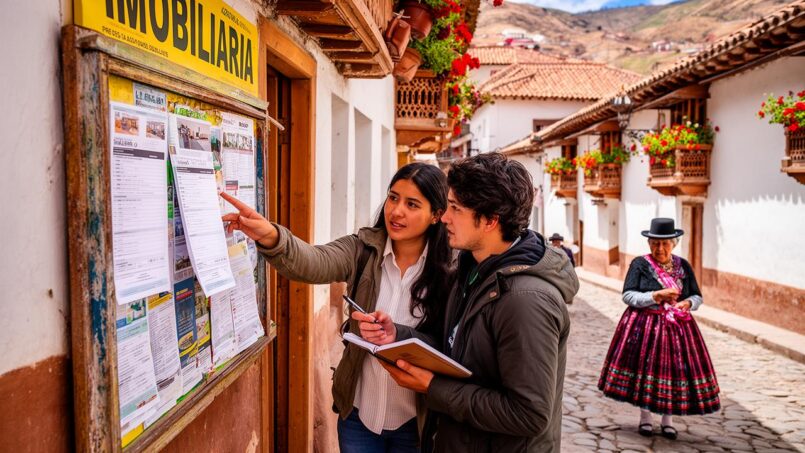
On the ground, more “analog” methods remain very effective, especially if you speak a little Spanish. Many houses and buildings display a simple ” Se Alquila” (For Rent) sign with a phone number. Local newspapers still publish thick classified sections, where it’s useful to scan both the “for rent” and “for sale” columns. Some owners listing a property for sale actually also accept rentals but don’t specify it.
Listings on platforms like Craigslist, Expat.com, or local Facebook groups can be sources for finding housing, but it’s essential to verify the authenticity of offers to avoid scams.
Why to Avoid “Solo para extranjeros” Listings
A common warning: listings mentioning “Solo para extranjeros” (“only for foreigners”) should be avoided. They deliberately target non-Bolivians to charge rents significantly above the local market. With a little searching and comparing, you can often find similar, if not better, alternatives at much more reasonable prices.
Different Types of Contracts: Classic Lease, Anticrético, and Purchase
One of the most confusing points for a newcomer is the diversity of legal mechanisms. It’s not just about signing a classic lease: Bolivia has its own system, the anticrético, very widespread, in addition to traditional renting.
The Classic Lease (Common Law Lease)
The residential lease is governed by the Bolivian Civil Code (articles 685 to 722), the 1959 Tenancy Law (Ley del Inquilinato), as well as a 2020 law on exceptional leasing. On paper, a contract can be verbal, and a simple payment receipt can prove the existence of a rental. But for a landlord as well as for a foreign tenant, this type of informal agreement is extremely risky.
Specialists therefore recommend a written contract, drawn up by a lawyer, signed by both parties, then given a “reconocimiento de firmas” (signature authentication) before a notary. The maximum level of protection is obtained when the lease is ” elevated to a public deed,” which gives it evidentiary value that is difficult to challenge in court.
The Civil Code sets a maximum duration of 10 years for a lease. Beyond that, a new contract is needed. For certain properties (commercial, large estates), if no duration is specified, the law generally presumes a duration of one year. In practice, residential leases are often concluded for a firm one year, which can be extended for an additional year by mutual agreement.
A key concept in Bolivian law is “usucapion”, the acquisition of property through prolonged possession. If an occupant remains in a dwelling for more than five years without a formal contract, they can – under certain conditions – claim ownership of the property. For the landlord, a solid contract is therefore essential for protection. For the tenant, it is vital to always demand a clear lease to avoid finding themselves in a legally gray area.
The Anticrético System: Living Rent-Free, But Tying Up Capital
The anticrético is a Bolivian peculiarity that surprises many foreigners. Instead of paying monthly rent, the tenant gives the landlord a significant sum at the beginning of the occupancy period. In exchange, they live in the property without paying rent for the entire agreed period (often several years). At the end, the landlord must return the full amount. If the landlord doesn’t repay, the texts and practice provide that the tenant can assert very strong rights over the property, sometimes even leading to transfer of ownership.
For the landlord, the main advantage is a large, interest-free loan without bank paperwork, usable to pay off debt or invest. For the occupant, the benefit is living rent-free, but it involves tying up capital and risk in case of conflict. It’s crucial to note that the law prohibits contracts combining anticrético and rent payment, such an arrangement being partially voidable by the courts.
This tool is still mainly used by Bolivians with available cash. For a foreigner who doesn’t master the local legal system well, it’s prudent to only enter into an anticrético with serious legal assistance, thorough verification of the property title, and a properly notarized contract.
Property Purchase: Price Levels and Constraints
Some expatriates consider buying directly, especially in fast-growing cities like Santa Cruz de la Sierra, which shows an estimated average rental yield between 6% and 8%, higher than metropolises like Buenos Aires or Rio de Janeiro (4% to 7%).
Overview of indicative price ranges by type of service for your construction or renovation projects.
Between €40 and €90 / m². Price varies depending on the complexity of foundations and walls.
Between €70 and €150 / m². Depends on the type of material (tiles, slate, zinc…).
Between €20 and €80 / m². Notable difference between wall, roof, or floor insulation.
Between €15 and €40 / m². Includes installation of drywall and finishing.
Between €60 and €120 / m². Includes installation of the panel and outlets to code.
Between €50 and €100 / m². For installation of water and drainage networks.
| Location of Property for Purchase | Average Price (USD/m²) | Typical Range (USD/m²) |
|---|---|---|
| City Center (apartments) | ~1,214 | 1,500 – 3,000 |
| Suburb / Outskirts (houses/apts) | ~1,217 | 1,000 – 2,000 |
| Rural Areas | – | 500 – 1,500 |
In bolivianos, studies indicate average prices around 7,921 BOB/m² in the city center and 6,220 BOB/m² on the outskirts. The average interest rate for a 20-year loan is around 7.28%.
However, legislation imposes an important limitation for foreigners: they cannot buy land within a 50 km band along international borders, nor in certain sensitive rural areas. In standard urban areas, foreign ownership is possible, but it’s essential to check each case and be assisted by a local lawyer.
The Legal Framework for Renting: What You Absolutely Need to Know
Bolivian law precisely regulates the rights and obligations of both parties, with fairly strong protection for the tenant in the 1959 Tenancy Law. But, in practice, everything depends on the specific contract signed.
Formalizing the Lease: Lawyer, Notary, and Costs
A “good” rental contract in Bolivia combines four qualities:
– it is drafted by a specialized lawyer;
– it is entirely written (not just a verbal agreement);
– the signatures of the parties are authenticated before a notary (“reconocimiento de firmas”);
– it is, ideally, turned into a public deed.
Costs remain reasonable on the scale of a relocation project: a lawyer often charges around 150 BOB (about $21) to draft a lease, and signature authentication costs about 50 BOB. For a complete public deed, the lawyer + notary bill generally ranges between 150 and 350 BOB. In practice, many landlords require the tenant to cover these fees.
Duration, Termination, and Notice
Regarding duration, the texts allow great freedom, provided it doesn’t exceed ten years. In the absence of a specific clause, jurisprudence and the Civil Code consider that a commercial or “large estate” lease is valid for one year. Residential leases frequently provide for a firm one-year commitment, sometimes supplemented by an additional year renewable by mutual consent.
A tenant can unilaterally terminate by returning the property, but contracts often impose a minimum duration. Notice is generally 30 days in writing. At the lease’s expiration, without a formal termination request, tacit renewal may apply, which is risky. It is advisable to sign a new contract rather than let the old one continue.
Eviction after the contract ends is regulated by a legal period: the law provides 90 days to vacate a dwelling used for residential purposes, which may seem long compared to other countries. In case of non-payment of rent, the landlord must initiate an eviction procedure through the courts.
Security Deposit, Rents, and Taxes
In practice, landlords almost always require:
The security deposit often represents two months’ rent, and can go up to three for furnished properties.
The amount is negotiable, but it’s not uncommon for the landlord to ask for the equivalent of two months, even three months, especially in large cities or for very well-located properties. The deposit must be returned at the end of the lease, once the property is inspected. Many tenants negotiate the deposit refund just before leaving the country, leaving an estimated amount to cover upcoming water and electricity bills. This kind of arrangement should ideally be spelled out in black and white in the contract.
On the tax side, legislation imposes payment of 13% VAT (IVA) on rents received. The landlord who rents should in principle:
As a self-employed person in Spain, you must register in the taxpayers’ registry, issue an official invoice (factura) for each payment received, declare VAT monthly (Form 200) and income tax (Form 400), and periodically file the RC-IVA form (Form 610).
For the tenant, requesting the invoice strengthens their position: it legally proves they are a legitimate occupant, which can be useful in case of a dispute over a supposed squatter status.
Repairs, Maintenance, and Subletting
Bolivian law clearly distinguishes responsibilities. The landlord must deliver the property in good habitable condition and ensure major repairs (structure, water, sewage, electrical networks, etc.). The tenant, on the other hand, is responsible for damages caused and bears the cost of minor repairs resulting from normal use (minor plumbing, painting, etc.).
Any permanent improvement or extension must be pre-authorized by the landlord and, if necessary, accompanied by a clause indicating whether expenses will be reimbursed or not.
By default, subletting and assignment of the lease are prohibited by the Civil Code. Nevertheless, the contract can provide the opposite, with the express agreement of both parties. It’s therefore necessary to carefully read the clauses relating to the possibility of hosting other people, renting a room on Airbnb, or sharing the premises.
Steps and Checks Before Signing
In a country where only 4% of the population speaks English and administrative procedures remain complex, good preparation avoids many pitfalls.
Documents Requested and Tenant Profile
Most serious landlords ask for at minimum:
– a copy of passport or ID card;
– proof of income or employment, to ensure payment capacity;
– sometimes a Bolivian guarantor;
– occasionally a reference from a previous landlord.
Some even ask to check the tenant’s criminal record, which involves providing a copy of identification to make the request with the police. This may be surprising, but it’s a common practice to build trust, especially when the lease is concluded directly, without an agency.
Checking the Property and the Landlord
On the tenant’s side, several basic checks are essential before transferring a single boliviano:
Before any real estate purchase, it is crucial to verify the legality of the property and the seller’s identity. This involves asking the owner for the Folio Real or Testimonio de Propiedad, then obtaining an Informe Rápido at the Derechos Reales office to confirm registration, the owner’s name, and the absence of mortgages or disputes. You must then compare these two documents and request a copy of the owner’s ID, and even check their criminal record for greater caution.
The costs for these steps remain reasonable: an Informe Rápido generally costs between 70 and 150 BOB, and a criminal record extract around 100 BOB. Compared to the risk of a poorly managed rental, the investment is very modest.
Inspecting and Documenting the Condition
Before taking the keys, it’s wise to photograph every room, every wall, every ceiling, every floor, as well as all appliances and furniture included. These photos, dated, can then be attached to the contract or kept in a shared file between the parties. Upon moving out, a new set of photos allows comparison of the property’s condition and limits disputes over the security deposit.
To avoid any dispute, a furnished rental contract should precisely list the equipment provided (e.g., sofa, bed, refrigerator) and not just use the vague term “furnished.” It should also specify which utilities are included in the rent (like water or common area maintenance) and which are the tenant’s responsibility (like electricity or internet). For example, the lack of explicit mention of an oven or washing machine may mean their absence, even in a so-called furnished property.
Negotiating Your Rent in Bolivia: Room for Maneuver and Strategies
Unlike some very tight markets, rent is not always an untouchable price in Bolivia. Especially when a property has been vacant for weeks, many landlords are willing to discuss.
When and How to Negotiate
The room for negotiation depends mainly on two factors:
– demand in the neighborhood and for this type of property;
– how long the property has been empty.
It is almost always more effective to contact the landlord directly than to go through an agency paid a percentage of the rent. Agencies generally receive between 50% and 100% of one month’s rent as a placement commission, which gives them little incentive to push for a lower price.
A strategic approach is to send a polite message to the landlord briefly introducing yourself, explaining your situation (long stay, stable profile, solid income) and explicitly asking if the price is negotiable. Stating your intention upfront avoids misunderstandings and saves everyone time. If the landlord refuses, you can keep in touch, leaving the door open in case they reconsider later.
Supporting Negotiation with Comparisons
Asking for a reduction “because it’s expensive” isn’t enough. It’s much more convincing to rely on comparable listings in the same neighborhood, with similar sizes, numbers of rooms, and equipment levels, but at lower rents. Showing the landlord two or three printed examples or listings on screen demonstrates that you know the market.
A small monthly reduction of $50 can represent $600 in savings per year, not counting potential additional discounts in subsequent years if the lease is renewed.
Highlighting Your Profile as a “Good Tenant”
Some landlords hesitate to rent to foreigners for fear of instability or communication difficulties. Patiently showing your assets can make a difference. Effective arguments include:
To increase your chances of securing a property, here are the key elements that landlords and agencies carefully examine during a rental application review.
Having regular and easily provable income, as well as sufficient savings in a bank account.
Providing written references from previous landlords and presenting a clean criminal record.
Being a non-smoker, not having pets (or demonstrating proven good management of pets in a rental).
Having a plan to stay several months or even years in the property.
The more the landlord perceives you as a reliable tenant, the less they will fear lowering the rent a bit or agreeing to a slightly reduced security deposit.
Offering Trade-offs
If the landlord resists a direct rent reduction, it is sometimes possible to negotiate valuable trade-offs:
– taking on small maintenance or gardening tasks;
– prepaying several months (or a year) of rent in exchange for an overall discount;
– committing to a longer lease term (18 or 24 months);
– slightly increasing the security deposit in exchange for a lower monthly rent.
The goal is to find common ground where both parties win: the landlord secures their income and limits vacancy risk, the tenant gets medium-term savings.
Cost of Utilities, Internet, and Daily Life
One of Bolivia’s major assets is the low cost of basic utilities. Electricity, water, gas, and phone bills weigh much less than in Europe or North America.
Basic Utilities
For a studio or small apartment occupied by a single person, a bill of $30 to $50 per month for all basic services (electricity, water, gas, etc.) is common. For an average-sized household, the bill often remains below $80–$150 per month, even with more comfortable usage.
The observed ranges are as follows:
| Type of Expense | Approximate Range (USD/month) |
|---|---|
| Electricity | 15 – 40 |
| Water | 5 – 10 |
| Gas (cooking / heating) | 5 – 20 |
| Total utilities, single person | ~30.5 |
| Total utilities, family | ~47.5 |
In some reports, a 45 m² studio in La Paz consumes on average around 196 to 359 BOB in monthly utilities, while an 85 m² for two people ranges between 260 and 487 BOB.
Businesses pay about three times more for electricity than households.
Internet and Telephony
Internet access is widely available in urban areas, although quality and stability sometimes leave something to be desired. Domestic offers are generally as follows:
| Type of Connection | Average Price (USD/month) |
|---|---|
| Internet 8–20 Mbps | ~20–30 |
| Internet 20–50 Mbps | ~25–35 |
| Internet 50 Mbps and above | ~30–50 |
| 8 Mbps (specific example) | ~147 BOB |
| 300 Mbps in Santa Cruz | ~350 BOB |
Prepaid or entry-level mobile plans are around $5 to $10 per month, while more comprehensive offers range between $10 and $20. International comparisons show that broadband internet is often cheaper than in Canada or several European countries, though sometimes with performance below what the advertised speed suggests.
Setting Up Services and Paying Bills
In most rentals, the water, electricity, and gas meters remain in the landlord’s name, and the tenant simply takes over the payments. The lease should specify whether these utilities are included in the rent or paid separately.
In some cities like Santa Cruz, the CRE sends paper payment notices. Payment must be made in person, each month, at the counter, in a bank or partner supermarket, exclusively in cash. Mailing a check is not accepted. A two-month delay in payment generally leads to an electricity cutoff.
Choosing Your City and Neighborhood: Some Benchmarks for Expats
The choice of location isn’t limited to price. Climate, air quality, safety, expatriate community, and infrastructure are all parameters to consider.
La Paz
La Paz is an administrative capital perched at high altitude, with a cool climate year-round. Altitude variations within the city itself have direct consequences on living standards: the lower neighborhoods, especially in the Zona Sur, are generally more affluent, better equipped, and more expensive.
Some neighborhoods are particularly popular with expatriates:
Discover the most appreciated areas for staying or living in La Paz, combining safety, amenities, and atmosphere.
An old residential neighborhood, very lively and reputed to be safe. It offers a strong cultural vibe with many cafes and restaurants, often described as one of the safest for tourists.
Family-friendly areas with a range of housing, parks, schools, and easy access to the rest of the city. Rents generally range between $250 and $600 for an apartment or small house depending on the standard.
A neighborhood hosting several embassies and diplomatic residences, known for its calm and high standard.
La Paz offers a rich urban life (art, music, museums) but has some challenges: permanent cold, altitude, air pollution regularly above health thresholds, and little English spoken. Infrastructure has improved in recent years, notably thanks to the urban cable car network, but roads remain sometimes dangerous and public hospitals are of uneven quality.
Santa Cruz de la Sierra
Santa Cruz de la Sierra, with its tropical climate, has become a major economic hub in the country. The city is even presented as the second most profitable in South America for real estate investment, with average rental yields between 6% and 8%.
Neighborhoods like Equipetrol or the area around San Martín Avenue concentrate shopping malls, restaurants, offices, and upscale residences. You’ll find modern buildings with pools, gyms, coworking spaces, private movie theaters, and 24/7 security. Rents there reflect this comfort level, with studios starting at $300 and large apartments easily exceeding $700.
The city attracts many expatriates (entrepreneurs, international school students, retirees) thanks to its mild climate, but it is considered one of the least safe cities in Bolivia. Particular vigilance is required regarding transportation (taxis, night buses, bus terminal areas).
Cochabamba and Sucre
Cochabamba is known for its more temperate climate and a cost of living lower than Santa Cruz. It’s an appreciated compromise between a big city, comfort, and a controlled budget. Rents are generally lower for equivalent square footage, making it an interesting destination for students and remote workers.
Sucre, a colonial city known for its quality of life, is also highly appreciated by expatriates for its calmer atmosphere, heritage, and moderate real estate costs. Long-term Airbnb offers there are often very competitive, allowing you to test the city at lower cost before signing a traditional lease.
Safety, Scams, and Daily Life: What a Foreign Tenant Must Understand
Even though rents are low, Bolivian social reality remains complex. The country faces a fragile economic situation, recurring political tensions, and a non-negligible level of crime, especially in large cities and transport hubs.
Crime and Basic Precautions
Most crimes targeting foreigners involve opportunistic theft (pickpocketing, bag snatching, etc.), especially in tourist areas, markets, buses, and bus terminals. More violent assaults, “express kidnappings” (short-term kidnappings to empty bank accounts), or thefts by fake police officers are documented, though they remain less frequent.
To limit risks, it’s recommended to avoid showing valuables, to split money and cards on your person, and to use a money belt. Never accept food or drinks from strangers. For accommodation, prefer rooms that can be locked. For travel, use official taxis or known apps like Uber, where the service is available.
Vigilance in the Housing Search
In the housing market, the main risks are more about fraud and lack of contract clarity than violence. A few simple principles significantly reduce problems:
– never pay a significant deposit without having seen the property and met the landlord;
– demand proof of ownership and verify it with Derechos Reales;
– refuse to leave original documents (passport, deeds, etc.) on deposit with an agency or landlord;
– ensure that any financial commitment (deposit, discount, appliances provided, promised work) is written in the contract signed by both parties.
For greater security, prefer serious agencies and recognized platforms like Airbnb, Flatio, Re/Max, or Century 21. They offer additional guarantees such as customer reviews, established internal procedures, and for Airbnb, 24/7 customer support.
—
Finding housing in Bolivia is far from mission impossible—on the contrary. The country combines low rents, wide variety of housing, and negotiation possibilities, within a relatively structured legal framework. But to fully benefit from these advantages, you must take the time to understand local mechanisms: the anticrético, lease clauses, the notary’s role, the importance of checks with Derechos Reales, and the reality of hidden costs like deposits or legal fees.
Armed with these benchmarks, a foreigner can approach the Bolivian market with a useful mix of confidence and caution, build a realistic budget, and choose the city, neighborhood, and type of contract that truly match their life project.
Disclaimer: The information provided on this website is for informational purposes only and does not constitute financial, legal, or professional advice. We encourage you to consult qualified experts before making any investment, real estate, or expatriation decisions. Although we strive to maintain up-to-date and accurate information, we do not guarantee the completeness, accuracy, or timeliness of the proposed content. As investment and expatriation involve risks, we disclaim any liability for potential losses or damages arising from the use of this site. Your use of this site confirms your acceptance of these terms and your understanding of the associated risks.

Cyril Jarnias is an independent expert in international wealth management with over 20 years of experience. As an expatriate himself, he is dedicated to helping individuals and business leaders build, protect, and pass on their wealth with complete peace of mind.
On his website, cyriljarnias.com, he shares his expertise on international real estate, offshore company formation, and expatriation.
Thanks to his expertise, he offers sound advice to optimize his clients' wealth management. Cyril Jarnias is also recognized for his appearances in many prestigious media outlets such as BFM Business, les Français de l’étranger, Le Figaro, Les Echos, and Mieux vivre votre argent, where he shares his knowledge and know-how in wealth management.





