
 Published on and written by Cyril Jarnias
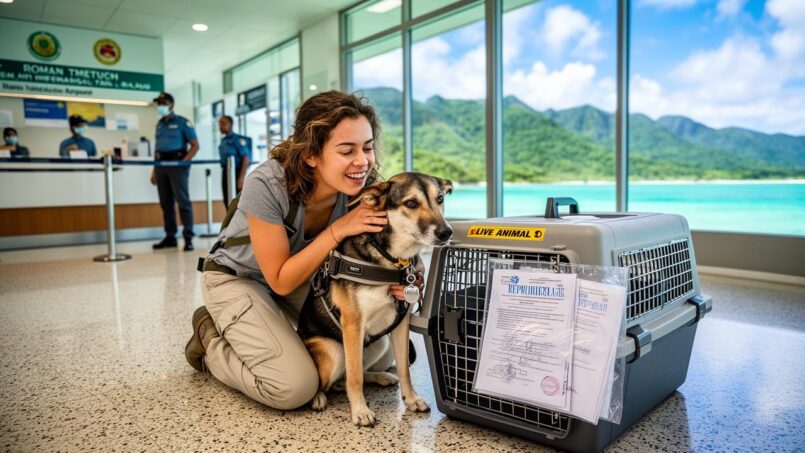
Expatriating to Palau with a dog or cat is not simply a “trip with a pet.” The archipelago is officially rabies-free, and the authorities therefore enforce particularly strict rules to prevent any introduction of the disease. Between veterinary preparation, paperwork, and transport constraints, moving with a four-legged companion here requires meticulous organization.
This guide details the mandatory administrative procedures, based on official regulations. It also covers practical aspects to anticipate on the ground: adapting to the local climate, cost of living, availability of veterinary services, and pet-friendly accommodation conditions.
Understanding the Legal Framework and Competent Authorities
Before even thinking about plane tickets and dog boarding, you need to understand who decides what regarding animals in Palau.
The regulation of animal imports is based on the Plant and Animal Quarantine Regulations, adopted under the Plant and Animal Control Act. The competent authority is the Bureau of Agriculture (BOA), also known as the Division of Agriculture and Mineral Resources. At its head, the Chief of Agriculture has central authority: they issue import permits, define authorized entry points, and validate health conditions.
The management of health measures (quarantines, isolations) falls under the Ministry of Health, while the Ministry of Justice is responsible for their enforcement and may impose criminal penalties, such as fines or imprisonment, for non-compliance.
Two key elements shape all of Palau’s policy:
– The archipelago considers itself a rabies-free territory, with no recorded cases.
– Quarantine rules are modeled on the requirements of the State of Hawaii, known for its among the strictest protocols in the world.
Direct consequence: importing a dog or cat requires at least six months of preparation when coming from a country not classified as “rabies-free” by the World Organisation for Animal Health (WOAH).
Which Animals Can Enter Palau… and Which Are Prohibited?
The standard import rules apply to domestic dogs and cats, including assistance or service animals. But not everything is allowed.
Dogs, Cats, and Specific Breeds
Palau does not publish an official list of banned dog breeds. A secondary document mentions a possible restriction on certain fighting dogs (such as pit bulls or Rottweilers), but this information remains inconsistent with the official position: no “blacklist” is published. In practice, health and behavioral criteria take precedence, and the owner’s responsibility is total in case of an incident.
Importation of hybrid animals such as wolf hybrids, Savannahs, and Bengals is only permitted if they are at least the 5th generation removed from their wild ancestor. Below this threshold, importation is prohibited.
Totally Prohibited Animals
Certain animals cannot enter Palau under any circumstances, regardless of any guarantees provided:
– Snakes
– Parrots and mynah birds
– Mongooses
– Mink
– Monkeys
– American gray squirrel
– Any venomous species (insects or other animals)
Birds other than parrots and mynahs are theoretically allowed, but subject to very strict conditions. Any species potentially protected under CITES (turtles, certain exotic bird species, etc.) requires additional permits from the wildlife protection authorities in the country of departure.
Rabbits and Other Small Pets
Rabbits may be imported, but with a separate and tightly regulated health protocol:
To travel with your pet, a veterinary health certificate must be issued within 24 hours before departure. Treatment against internal and external parasites must be administered within three days before travel. A dewormer (anthelmintic) must be given twice over a 21-day period, with the last dose given 48 hours before departure. Additionally, the animal must have been born or have lived continuously for at least the last six months in a rabies-free or officially rabies-controlled area.
For all other pets (turtles, non-prohibited birds, etc.), you need to combine local regulations, CITES requirements, and sometimes very technical specific conditions. For a typical family expatriation, authorities recommend prioritizing dogs and cats, which are much better integrated into the regulatory channels.
In Palau, the Only Gateway: Roman Tmetuchl Airport
The country gives no flexibility on the entry point: all animals must arrive via Roman Tmetuchl International Airport, sometimes called Palau International Airport or Airai Airstrip. Arrival by private boat was also suspended in 2020, with quarantine imposed for human crews.
For animals, transport rules are equally strict:
– Travel only as air cargo (manifest air cargo), under Air Waybill
– Entry as accompanied baggage is prohibited, whether in the hold or cabin
– Direct flight strongly recommended; an itinerary with a layover requires prior authorization if the route is not standard
If a layover is necessary, authorities recommend it be carried out under the conditions they advocate.
– Short, without changing airlines
– In a rabies-controlled country, or a European Union member state
As soon as a layover occurs in the EU, additional European requirements may apply (documents, vaccinations, passport compliance, etc.).
The airline United Airlines is noted as regularly transporting animals to Palau as cargo, although certain routes were suspended during the COVID-19 pandemic. In any case, each airline has its own policies (accepted animals, crate types, temperature limits, veterinary documents dated within 10 to 14 days, etc.). It is therefore essential to carefully check the carrier’s conditions.
The “Passport” for Palau: A Complete File to Prepare
A “pet passport” is often mentioned to refer to all the documents needed for importation. Caution: this is not the European passport, but a file specific to Palau. For a dog or cat, this file must include:
List of essential documents required for importing a pet, in accordance with health regulations.
Official document issued by the Chief of Agriculture of the destination country, authorizing the animal’s entry.
Proof of microchip implantation for unique and permanent animal identification.
Complete vaccination history, with mandatory proof of up-to-date rabies vaccination.
Certificates of recent treatments against internal (deworming) and external (fleas, ticks) parasites.
Official veterinary certificate issued and signed in the country of origin, attesting to the animal’s good health.
The entire set must be prepared in the country of departure, in a specific order, with strict deadlines to be met. For any animal from a country not rabies-free, preparation takes at least six months, including vaccinations, serological test (FAVN), and waiting period.
Electronic Identification: The Microchip, First Key to Entry
Identification by microchip is mandatory for all dogs and cats. A few points are non-negotiable:
The microchip must be a 15-digit chip compliant with ISO standards 11784 or 11785 (Annex A). Its implantation must be performed exclusively by a veterinarian, a clinic, or a trained veterinary nurse. Once implanted, it is crucial that its number be correctly recorded on all the animal’s official documents (vaccination record, health certificate, permit, etc.). Finally, information about the chip manufacturer and registration procedures in the national database must be provided to the owner.
If your animal is already identified with a non-ISO chip, you can avoid re-chipping by providing a compatible reader. But beware: if the chip is not readable upon arrival, the animal is automatically placed in quarantine for 120 days. So it’s better to check the chip’s readability with your vet before starting the procedure.
Vaccinations: Rabies at the Heart of the System
Palau imposes a rigorous vaccination schedule, with a particular focus on rabies.
Rabies: Two Mandatory Injections
For dogs and cats:
– Two mandatory rabies vaccinations
– The second must be administered between 30 days and 12 months before entry into Palau
– Proof must be provided in original form (vaccination certificate, official record, or EU passport)
Puppies and kittens cannot be vaccinated against rabies before 3 months. Considering the double vaccine, FAVN test, and waiting periods, the animal must be at least 7 months old to enter the country.
Other Vaccinations for Dogs
Dogs must also be vaccinated against: rabies, parvovirus, coronavirus, Rubarth’s hepatitis, and leptospirosis.
– Distemper
– Infectious hepatitis
– Parvovirus
These vaccines must be administered at least one month before travel, and no later than three months before departure.
Other Vaccinations for Cats
For cats, Palau requires:
– Feline panleukopenia vaccine: at least 1 month and at most 12 months before shipping
– Feline viral rhinotracheitis / calicivirus vaccine: between 1 and 6 months before departure
All these vaccines must be recorded, stamped, and signed by the veterinarian on the international health certificate.
Rabies Serological Test (FAVN): The Scientific Barrier
No dog or cat enters Palau without a valid rabies antibody test (FAVN).
The rules are precise:
To be valid, the blood sample to check the rabies antibody titer must be taken more than 30 days after the last vaccination. The analysis must be performed by an approved laboratory. A mandatory waiting period of 30 days from the date the sample is received by the laboratory must then be observed. This 30-day period must be fully completed before the planned departure date.
If you ship the animal before the end of these 30 days, the remaining days will be completed in quarantine upon arrival. So it’s better to plan ahead to avoid a long and costly deprivation of freedom for the dog or cat.
The FAVN result is valid for 36 months, but it does not replace the proof of rabies vaccination: both documents remain mandatory.
Parasite Treatments: Internal and External
Before entering Palau, the animal must be treated against:
– Internal parasites, especially the tapeworm Echinococcus multilocularis
– External parasites (fleas, ticks)
The choice of the most suitable internal antiparasitic treatment for your animal depends on two main factors: its country of origin and the proven presence of the parasite in your region. Only a veterinarian can recommend the appropriate molecule and establish the exact treatment schedule to follow.
External treatments must be administered shortly before entry (just before departure, in practice). For animals arriving from Australia, authorities insist on internal and external treatments performed very close to the travel date.
This information can appear on the health certificate or on a separate attestation.
International Health Certificate: The Vet’s Final Word
The “Certificate of Veterinary Inspection” or international health certificate is the centerpiece of the file. It must:
The official veterinary certificate for importing an animal into Palau must: be completed by an authorized veterinarian in the country of origin; be issued no later than 14 days before entry (some airlines require 10 days); contain a precise description of the animal (species, breed, sex, age, color, microchip number); list all vaccinations and antiparasitic treatments with their dates, products, and doses; attest to the absence of signs of contagious disease and fitness for transport; and confirm that the animal does not come from a rabies-restricted area.
Once completed by the attending veterinarian, this certificate must be signed or endorsed by an official veterinarian from the public authority of the country of departure (state veterinary service, Ministry of Agriculture, etc.). Without this official endorsement, the document may be deemed inadmissible.
Import Permit: The Key from the Chief of Agriculture
No shipment should be initiated without an import permit, called the Plant and Animal Quarantine Entry Permit. This document is issued by the Chief of Agriculture, upon prior request.
Key points:
– Application must be submitted at least 60 days before the planned arrival
– Processing time can take up to two weeks
– Permit valid for a single entry, for a duration of 30, 60, or 90 days
– Limit of two pets per person, except in duly justified exceptional circumstances
The quarantine office can be contacted:
– By email: [email protected]
– By phone: +680-587-2504
Also, the animal must be declared to customs via a pre-arrival form, and the authorities must receive, no later than one business day before landing:
– Estimated arrival date and time
– Airline and flight number
This information is crucial if the arrival occurs outside regular business hours: an official veterinarian must be present to inspect the animal upon disembarkation.
Quarantine: The Price to Pay for a Rabies-Free Country
Quarantine is a central component of Palau’s health policy.
120 Days for Non-Rabies-Free Countries
For dogs and cats arriving from any country not recognized as “rabies-free” by the WOAH, the basic rule is simple: mandatory 120-day quarantine.
One exception: if the animal fully meets the import requirements of the State of Hawaii (vaccinations, FAVN test, 120-day waiting period before departure, etc.), the 120-day quarantine in Palau can be avoided. The Bureau of Agriculture considers full compliance with the Hawaii protocol as “equivalent.”
Palau considers the following as rabies-free countries, among others:
– Hawaii
– Guam
– Australia
– New Zealand
– Japan
– Taiwan
– United Kingdom
For travelers from certain territories, quarantine may be reduced or even waived, provided all applicable requirements are met.
Consequences of Non-Compliance
If, upon arrival, the documents are incomplete, or if an element does not meet the requirements (illegible microchip, vaccine timing not respected, missing FAVN, etc.), the authorities have three options:
– Place the animal in quarantine (duration determined by the situation, up to 120 days)
– Return it to the country of origin
– Euthanize it in extreme cases, if return is not possible and the health risk is deemed too high
All costs (quarantine, additional tests, returns, euthanasia) are entirely the owner’s responsibility.
The Role of Specialized Pet Transport Companies
Given the complexity of procedures, it may be wise to rely on a company specializing in pet relocation.
Several international companies offer this type of service, some of which have specific experience with Palau. Air Animal Pet Movers, for example, founded by an American veterinarian and active since the 1970s, claims to handle:
Set of essential services for the legal and safe importation of animals to Palau, ensuring compliance with health regulations.
Provision of identification microchips compliant with Palau’s specific standards and requirements for animal traceability.
Management and procurement of required veterinary health certificates, both in the country of origin and according to Palau’s acceptance protocols.
Full assistance in preparing and submitting import permit applications to the competent authorities in Palau.
Organization and booking of suitable air transport for animals, in coordination with specialized airlines.
Support and guidance through all quarantine procedures imposed upon arrival in Palau.
Other pet relocation companies (Happy Tails Travel, Continental Pet Relocation, Pet Travel Advisors, WorldCare Pet, Pet Air Carrier, Tailwind Global Pet, etc.) offer:
– Door-to-door services
– Advice on sequencing procedures (chip, vaccines, FAVN, certificate, permit)
– Management of IATA-compliant crates
– Real-time tracking of shipments
These services come at a significant cost (often several thousand dollars for a full international relocation), but can greatly reduce the risk of regulatory error leading to extended quarantine or denial of entry.
Adapting to Palau’s Tropical Climate with a Pet
Beyond administrative procedures, a successful expatriation involves anticipating the climate shock for your pet. Palau has a hot and humid tropical climate:
– Average temperature around 28 °C, with very little annual variation
– Relative humidity between 77% and 84%
– Abundant rainfall year-round (120 to 160 inches annually, i.e., about 3,000 to 4,000 mm)
– Wettest season from July to October, drier from February to April
Climate projections indicate continued warming over the century, with more very hot days and more frequent extreme rainfall.
For a dog or cat from a temperate or cold climate, this means:
During summer, animals, especially flat-faced breeds, are at increased risk of heatstroke. It is imperative to ensure they have constant access to shade and fresh water, to prioritize outings during cooler hours (morning and evening), and to increase surveillance against ticks, fleas, and other parasites favored by heat and humidity.
El Niño and La Niña events influence patterns of drought or intense rainfall, which can impact:
– Availability of drinking water
– Environmental quality (mud, standing water, mosquitoes)
– Animal comfort and health (vector-borne diseases, dermatitis, etc.)
For expats, it is wise to budget for regular parasite control (spot-ons, tablets, collars) and to arrange their housing accordingly (ventilation, air conditioning if possible, cool resting areas).
Access to Veterinary Care: A Precious but Limited Resource
Veterinary services in Palau remain limited. The archipelago has only one veterinarian who works mostly voluntarily for spaying/neutering and preventive medicine, with strong involvement from associations like the Palau Animal Welfare Society (PAWS).
PAWS, founded in 2000, does essential work:
Over 2,000 dogs and cats have been sterilized in the past three years through regular campaigns.
The organization now has a permanent clinic in Topside, Koror, and regularly organizes mobile clinics. Foreign veterinary teams (universities, U.S. military) occasionally come to reinforce services, with free vaccination, spay/neuter, and basic care campaigns.
For an expatriate with pets, this reality implies:
When expatriating with a pet, do not expect veterinary care as specialized as in major European or North American cities. It is recommended to prepare a complete veterinary file including recent blood tests to facilitate the local practitioner’s work. Maximum anticipation is necessary: vaccinations, pre-departure health checks, and building an initial stock of the animal’s routine medications are essential steps.
Contacting PAWS
To get in touch or learn about available services:
– Phone: 775-PAWS (7297)
– Email: [email protected]
– Website: https://pawspalau.org/
– Facebook: facebook.com/PAWSPALAU
– Instagram: instagram.com/paws_pw
The association relies heavily on volunteering and donations. New arrivals who own pets can both benefit from its services and support it, financially or through volunteering.
Cost of Living in Koror: Impact on the “Pet” Budget
Settling in Palau means dealing with a cost of life marked by dependence on imports. This also applies to pet food and care.
Household expenditure surveys in Palau show that:
– 35% of spending goes to food and non-alcoholic beverages
– 24–26% goes to housing, water, electricity, and gas
– Just over 10% is spent on transport and communications
In Koror, estimates indicate: economic and demographic trends in the region.
| Monthly Cost Indicator | Approximate Amount in $US |
|---|---|
| Total cost of living (family of 3, rent included) | ~3,652 |
| Total cost of living (single person, rent included) | ~1,715 |
| Average monthly net salary | 623 to 788 |
| Rent 1-bedroom apartment in city center | 450 to 1,200 |
| Rent 3-bedroom apartment in city center | 1,000 to 2,500 |
Imported products are expensive, especially food and fuel. The same logic applies to pet food, often imported, and accessories (clumping litter, toys, technical harnesses, supplements).
It is essential to anticipate and budget comfortably to cover all planned and unexpected expenses, to ensure the peace of mind and success of your project.
– Quality kibble or specialized diet
– Dewormers, external parasite treatments, collars
– Occasional vet visits (booster vaccines, check-ups)
– Possible transportation (taxis or vehicle rental) to the clinic or airport
The table below gives some common price references, useful for assessing the overall impact on the household budget, pet included:
| Product / Service (human, but indicative for overall budget) | Price range ($US) |
|---|---|
| Milk (1 L) | ~2.64 |
| Eggs (12) | 4.50 to 8.40 |
| Chicken (fillets, 1 kg) | 10.12 to 17.64 |
| Unlimited internet (60 Mbps+) | 60 to 199 |
| Gasoline (1 L) | 1.47 to 2.11 |
| Simple restaurant meal | 8 to 25 |
An expatriate family with pets will therefore need to factor this context into their decisions, especially between importing some pet food in luggage initially, then adapting to local availability.
Finding Pet-Friendly Accommodation: Options and Precautions
The “pet-friendly” housing supply is not unlimited in Palau, but there are several establishments in Koror and the surrounding area that accept pets, at least temporarily.
Among the identified examples:
| Accommodation (Koror / surroundings) | Pets Accepted | Main Services | Indicative Price Range |
|---|---|---|---|
| Sun’s Villa Palau | Yes | Free parking, shared kitchen, some rooms with Wi-Fi | Varies by season |
| Palau 8090 Dream House | Yes | Free Wi-Fi, restaurant, BBQ, bar on site | ~$140/night (example) |
| Island Paradise Resort Club | Not specified, more classic tourism oriented | Pool, sea view, breakfast | ~$209/night (example) |
| Tachukal Beach Loft By The Sea | Yes | Seaside apartment, very well rated | ~$158/night (example) |
These establishments are often tourism-oriented, but can serve as a temporary solution upon arrival while finding long-term pet-friendly housing. However, you must clearly negotiate the conditions:
Essential information on conditions for accommodating pets in the housing and on the property.
Specify the maximum number of pets allowed during the stay.
Indicate restrictions on size (e.g., small pets only) and accepted species (e.g., dogs, cats).
Mention if an additional security deposit is required for pets and its possible amount.
List areas where pet access is prohibited (e.g., certain rooms, garden, private beach).
In the standard rental market (apartments, houses), having a dog or cat can affect the rent or require a higher deposit, in a context where rents are already significant.
After Settling In: Health Obligations and Steps for Possible Returns
Once settled, the owner remains responsible for keeping vaccinations up to date, especially against rabies, even if the country considers itself free of it. Updated documents will be valuable if you ever need to leave with your pet to another country.
Exporting an Animal from Palau
The rules differ depending on the destination:
Requirements vary by destination. For the Mainland US, a rabies vaccination (30 days prior) and a health certificate (10 days prior) are required. For Hawaii or Guam, a full protocol with local quarantine is applied, even after quarantine in Palau. For Australia, New Zealand, or the EU, national rules apply, generally with stricter requirements, as Palau is not recognized as rabies-free.
In practice, living in Palau with a pet often makes subsequent travel more complicated from a regulatory standpoint. It’s better to anticipate this from the initial expatriation, especially if you plan for significant international mobility in the following years.
Practical Tips for a Smooth Expatriation with a Pet
Summarizing all the constraints, expatriating with a dog or cat to Palau is not impossible, but it requires a few basic principles:
For a successful pet relocation to Palau, start the process at least six months in advance, especially if your country of origin has a rabies risk. Ensure perfect consistency in the identification and vaccination chain (chip, vaccines, FAVN test, certificates). Adopt strict standards equivalent to Hawaii’s requirements to minimize the risk of long quarantine on site. Systematically verify the microchip works and all documents are accurate. Budget generously for veterinary tests, permits, air freight, and relocation services. Acclimate your pet to the tropical climate (breed choice, ventilation, parasite protection) and quickly integrate into the local network by contacting PAWS and a veterinarian on site for health follow-up.
—
Palau, a rabies-free country, imposes a rigorous health protocol for importing pets. Meticulous administrative and logistical preparation is essential. In return, your dog or cat will be able to enjoy with you a unique tropical environment (islands, warm climate, spectacular nature), making the expatriation enjoyable for the whole family.
Disclaimer: The information provided on this website is for informational purposes only and does not constitute financial, legal, or professional advice. We encourage you to consult qualified experts before making any investment, real estate, or expatriation decisions. Although we strive to maintain up-to-date and accurate information, we do not guarantee the completeness, accuracy, or timeliness of the proposed content. As investment and expatriation involve risks, we disclaim any liability for potential losses or damages arising from the use of this site. Your use of this site confirms your acceptance of these terms and your understanding of the associated risks.

Cyril Jarnias is an independent expert in international wealth management with over 20 years of experience. As an expatriate himself, he is dedicated to helping individuals and business leaders build, protect, and pass on their wealth with complete peace of mind.
On his website, cyriljarnias.com, he shares his expertise on international real estate, offshore company formation, and expatriation.
Thanks to his expertise, he offers sound advice to optimize his clients' wealth management. Cyril Jarnias is also recognized for his appearances in many prestigious media outlets such as BFM Business, les Français de l’étranger, Le Figaro, Les Echos, and Mieux vivre votre argent, where he shares his knowledge and know-how in wealth management.





