
 Published on and written by Cyril Jarnias
Settling in Palau means entering a world where the sea, family, tradition, and religion form an almost inseparable whole. For an expatriate, the question is not just about finding housing or a job, but also understanding how spirituality structures daily life, social relationships, and even the way nature is used.
The Palauan Constitution protects religious freedom without recognizing an official religion. Churches, beyond worship, are key community centers for socialization, conflict resolution, and solidarity. Christianity dominates, but coexists with Modekngei (a unique syncretic religion), Islam, Buddhism, the Baha’i faith, and other beliefs, against a backdrop of traditional spirituality focused on respect for ancestors and nature.
For an expatriate, living well in daily life in Palau requires a fine understanding of these local religious practices. Not to become a specialist in Palauan theology, but to know how to behave, how to greet, how to dress, how to participate in a religious festival or enter a bai (traditional meeting house) without making a misstep.
This guide offers a concrete dive into this religious and cultural landscape, with a simple guiding thread: how to respect, participate, and, if desired, practice one’s own faith while living in harmony with Palauan society.
A Very Christian Religious Landscape… But Far from Monolithic
The first thing that strikes you in Palau’s religious statistics is the overwhelming presence of Christianity. But behind this word lies a mosaic of traditions, denominations, and syncretisms.
Who Believes in What in Palau?
Recent data shows a clear majority of Christians, but percentages vary slightly depending on the source. The 2020 census, often cited, provides a fairly detailed snapshot.
Here is a comparative summary of some key figures:
| Religious group | Share of population (2020) | Other estimates / ranges |
|---|---|---|
| Roman Catholic | 46.9% | 45.3% to 49.4% |
| Protestant (mainly evangelical) | 25.9% | 25–35% |
| Seventh-day Adventist | 5.0% | 5–7% |
| Modekngei | 5.1% | 5.1–8.8% |
| Muslim | 4.9% | 2–5% |
| LDS (Mormons) | 0.9–1.5% | ≈ 0.9–1.5% |
| Other religions | 11.4% | 9–11% |
| No religion / agnostics / atheists | — | ≈ 5% |
In practice, three features dominate religious life:
Palau’s calendar and social life are heavily marked by Catholicism and Protestantism, with their Sunday Masses and services as well as the celebrations of major holidays. Modekngei, a syncretic religion unique to the archipelago, plays a singular role by integrating elements of the Old and New Testaments with cults rendered to local deities and spirits. Finally, minority religious communities, such as Muslims, Buddhists, or Baha’is, often resulting from labor immigration (from the Philippines, Bangladesh, China, etc.), are discreetly but truly present.
For an expatriate, this means both a very familiar environment if coming from a Christian country, and at the same time deeply local practices and symbols, especially when it comes to Modekngei or traditional rituals.
The Place of Religion in Society
The Palauan Constitution explicitly guarantees freedom of conscience and prohibits the state from restricting the exercise of religions. No church is a state religion, even though the government:
The state partially funds the non-religious aspects of private denominational schools (Catholic, evangelical, Adventist, Modekngei). It also organizes an annual National Day of Prayer open to all faiths and frequently collaborates with religious organizations to implement social or educational projects.
Places of worship are not simple buildings: they are nodes of community life. People get married there, make collective decisions, sometimes resolve tensions, and organize collections for families in need. Religious leaders play roles as intermediaries, advisors, and sometimes mediators.
For an expatriate, joining a religious community—even without being very devout—can be a privileged entry into the social fabric, provided it is done with tact and humility.
A Culture of Respect and Community: The Spiritual Foundation of Daily Life
In Palau, religion and culture are not two separate spheres. They intertwine in a set of key values that structure both worship and neighborly relations.
Uluang, Rechuodel, and Matrilineality: The Words That Explain Everything
Two Palauan concepts come up constantly to understand this society:
– Uluang: respect. Respect for elders, traditional chiefs, sacred places, nature, and community rules.
– Rechuodel: community. The individual is defined primarily by their family, clan, and village ties.
Palauan society is matrilineal and largely matriarchal. Lineage, inheritance, lands, and clan finances are managed by women. Although chieftaincies are male, high-ranking women choose them and can remove them. Mixed councils also advise the president on customary matters.
For an expatriate, this has very concrete implications:
– in religious or traditional ceremonies, high-ranking women often have a visible place and real authority, even if men are at the microphone;
– one does not interrupt an elder who is speaking; one listens;
– one avoids discussing very sensitive topics (gender, family, inheritance) with a purely Western lens: Western concepts of militant feminism, for example, can be perceived as aggressive if imposed.
Spirituality and Nature: The Spirits Are Never Far Away
Beyond statistics, Palauan spirituality is intimately linked to nature through several notions:
Main concepts illustrating the sacred bond between the community, ancestors, and the natural environment, along with the resulting rules.
Represents both certain sacred areas and the idea of a sacred bond between all living beings. Harming the environment is potentially offending spiritual forces.
The spirits of ancestors, believed to watch over their descendants and maintain the balance of the community.
The spiritual essence that connects the individual to their ancestors and natural environment, the foundation of identity and respect.
Taboos and prohibitions (dietary, behavioral, environmental). For example, certain fish may be sacred at certain times, and some sites must remain untouched.
This web of beliefs does not necessarily oppose Christianity; it often overlaps with it. It is not uncommon for the same person to attend Mass on Sunday and scrupulously observe prohibitions inherited from traditional religion.
As an expatriate, this translates into an implicit expectation: respect the rules even if you do not fully understand them. For example, if your guide asks you not to swim near a particular rock or not to pick a plant, there may be a meda taboo behind it as much as an ecological imperative.
Modekngei, a 100% Palauan Faith
It is impossible to talk about religion in Palau without mentioning Modekngei, sometimes translated as “united sect” (Ngara Modekngei) but now recognized as a full-fledged religion.
A Religion Born from the Forced Encounter Between Traditions and Colonization
Founded around 1915 on the island of Babeldaob by a Palauan named Temedad, Modekngei emerged in a context of Japanese colonization, active Christian missions, and identity tensions. Several accounts exist about its birth, but two threads stand out:
– a need to peacefully resist Japanese acculturation and foreign missions;
– the desire to reconcile the figure of Christ with Palauan goddesses and spirits, without renouncing either.
Modekngei is a monotheistic religion that recognizes the Christian God and Jesus as the Messiah.
In some localities, especially the village of Ibobang, these rules structure all of daily life. Children must return before dark, noise is limited in sacred areas, and above all, a very strict taboo weighs on alcohol and tobacco consumption.
A well-known popular belief holds that:
– bringing alcohol or tobacco within village limits attracts persistent torrential rains, interpreted as the anger of the Modekngei goddess;
– the elders may try to appease this anger by hanging fruits and sweets from trees, symbolically offered to the deity.
For an expatriate, this means it is not just “folkloric customs” but a **living religious system**, not to be mocked.
Advice for an expatriate
One Religion, One School, One Community
Modekngei is not limited to worship. It has its own school, the Belau Modekngei School (BMS), where they teach:
– standard academic subjects,
– religious courses on Modekngei,
– traditional medicinal plant agriculture,
– customary knowledge.
The stated goal: ensure the transmission of the religion to younger generations.
For the expatriate, working or interacting with a Modekngei community means being attentive to these dimensions:
– no alcohol or tobacco in certain territories;
– strong participation in rites and ceremonies;
– great importance placed on preserving cultural identity.
If you are invited to a Modekngei ceremony or a community event, adopt an attitude very similar to what you would have in a church: modest attire, calm behavior, listening, no mockery, photos only with permission.
Christianities in Daily Life: Churches, Rhythms, and Practices
Even though Modekngei is typically Palauan, the daily religious life of most residents takes place in Catholic, evangelical, or Adventist churches.
Catholics, Protestants, Adventists: How Is It Lived?
Palauans are predominantly Catholic or Protestant, with a strong evangelical current and a notable presence of Seventh-day Adventists. Places of worship are plentiful in Koror, the largest city, and in the villages of Babeldaob.
In practice:
– Sunday is largely a day of worship and rest, marked by services, family meals, and sometimes parish events;
– Christian holidays like Christmas and Easter are celebrated fervently, blending processions, songs, communal meals, and in some cases, elements of Palauan custom (costumes, dances, storytelling of associated legends).
Churches function almost as social centers: they organize collections, food distributions, educational activities, and youth clubs.
For an expatriate, attending a service is often one of the simplest ways to understand how Palauans live their faith.
Concrete Example: Attending Mass in Koror
The Sacred Heart Parish in Koror illustrates the multicultural character of Catholic faith in Palau well. Located on Main Street, opposite Maris Stella School, this parish offers:
– a Saturday evening Mass in English,
– an early Sunday morning Mass in Palauan,
– a Sunday Mass with homily in English, but readings and songs in Tagalog, led by a Filipino choir.
The priest, francophone or not but proficient in English, delivers accessible homilies for English-speaking expatriates.
A few good practices if you go:
To attend Mass in a respectful way following local customs, it is recommended to arrive a bit early and greet with a simple “Alii” (hello). Dress modestly, covering shoulders and knees. During the ceremony, follow the movements of the congregation (stand, sit, kneel) without feeling obliged to receive Communion if you are not Catholic. At the end of Mass, a word of thanks like “Mesulang” (thank you) to the priest or a parishioner is always appreciated.
Evangelical and Adventist Churches: Atmosphere and Codes
Evangelical churches—for example, the Church of the Foursquare Gospel in Koror—are often characterized by:
– very present praise music,
– fervent sermons,
– a warm and welcoming atmosphere for newcomers.
Adventists, for their part, hold their main service on Saturday, with a strong emphasis on Bible study (Sabbath School) and sometimes a stricter lifestyle (diet, alcohol, etc.). The Palau Filipino SDA Church, for example, offers several meetings:
| Religious activity | Approximate time |
|---|---|
| Weekday prayer meeting | 7:00 PM – 8:30 PM |
| Vespers (Friday evening) | 7:00 PM – 8:30 PM |
| Sabbath School (Bible study) | 9:00 AM – 10:50 AM |
| Main Sabbath service | 10:50 AM – 12:00 PM |
Again, expatriates are generally welcome, especially if they adopt an attitude of respect and sincere curiosity.
Religious Minorities and Interfaith Relations: Relatively Peaceful Coexistence
Despite the Christian predominance, Palau’s religious landscape includes a discreet but real diversity.
Islam in Palau: Small Community, Visibly Integrated
In Palau, there is a Muslim community of about 2 to 5% of the population, made up largely of migrant workers (notably around 400 Bangladeshis) and some refugees (notably Uyghurs).
Two mosques exist, including Masjid Al Iman in Koror, which also serves as a cultural center.
Muslims practice the five daily prayers, observe Ramadan, and celebrate major Islamic holidays. Prayer times are established according to standard calculations (Muslim World League, etc.), and the usual structure is found: Fajr, Dhuhr, Asr, Maghrib, Isha.
For a Muslim expatriate, this means: the need to reconcile one’s faith with the demands of life in a foreign country. They must often navigate between their religious practices and local cultural norms, while maintaining their identity and values. This situation can create challenges, but also opportunities for integration and intercultural dialogue.
There is a real possibility of practicing one’s faith within a community structure, even if it remains modest in size. It is also necessary to keep in mind that the surrounding culture is overwhelmingly Christian, while benefiting from a legal framework that is generally respectful of religious freedom.
For non-Muslims, the rule remains simple: mosques are places of prayer, to be respected as such. Do not photograph worshippers during prayer without permission, dress modestly, and if you wish to visit, inquire beforehand about conditions of welcome.
Buddhists, Baha’is, Chinese Religions, and Other Minorities
Other groups exist, often on a small scale:
– Buddhists,
– Baha’is,
– adherents of Chinese traditions,
– people with no religion or agnostics.
Coexistence is generally peaceful. International indices of religious freedom rank Palau among countries where government restriction and religion-related tensions are low.
Sacred Sites, Bai, and Natural Spaces: How to Behave
In Palau, religion manifests not only in churches or mosques. Many places are charged with spirituality, often at the intersection of history, custom, and religion.
The Bai, Spiritual and Political Heart of the Village
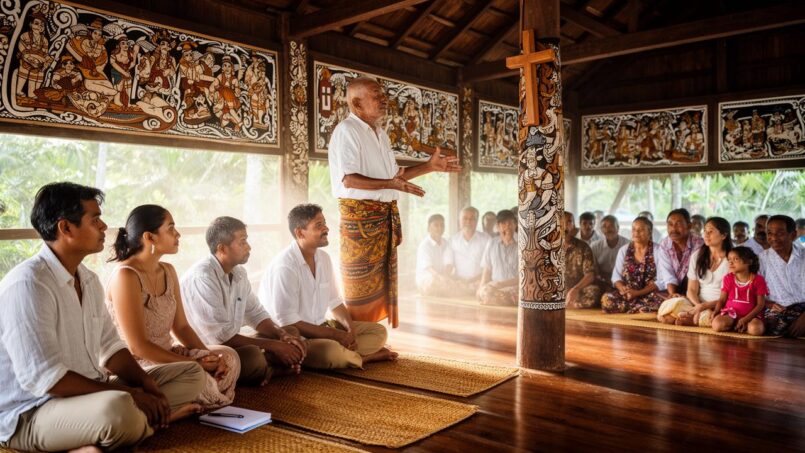
The bai is the traditional Palauan meeting house. It is where village councils once convened, where certain customary decisions are still made, and where rituals, sometimes religious ceremonies, take place.
Architecturally, the bai is distinguished by:
– its raised wooden structure,
– its beams carved with symbolic motifs (mythological scenes, animals, historical episodes),
– its multifunctional purpose: political, social, spiritual.
For the expatriate, it is essential to know and respect the basic rules when entering a bai or any other traditional space considered sacred.
– remove your shoes before entering,
– dress modestly (shoulders and knees covered),
– maintain a calm attitude, avoid speaking loudly,
– do not touch ritual objects without permission,
– ask permission before taking photos.
Stone Monoliths, Ancient Villages, Waterfalls: Nature as Sanctuary
Several natural or archaeological sites are considered sacred: ancient stone monoliths, old villages such as Bai ra Ngaruau, certain waterfalls like Ngardmau Waterfalls, and specific marine areas.
Every visitor to Palau must sign the Palau Pledge upon arrival. This official commitment, which is part of a very strict environmental policy and a sacred conception of nature, binds the traveler to the protection of local environment and culture.
Concretely, this implies:
– staying on marked paths;
– not collecting coral, shells, sand, or any other natural element as a “souvenir”;
– not touching or trampling coral reefs;
– using only “reef-safe” sunscreen;
– never littering in nature.
Beyond the law, these rules have a spiritual dimension: damaging a reef, polluting a site, or desecrating a monolith is also showing disrespect to ancestors and spirits.
Essential Codes of Conduct for an Expatriate: Between Religion, Custom, and Politeness
Understanding religion in Palau also means mastering a few social reflexes related to respect for beliefs and elders.
Greetings, Language, and Manner of Communicating
Greetings are simple but important:
– “Alii”: hello, usable in almost any situation;
– “Mogethin”: hello / good day;
– “Mesulang”: thank you;
– “Ke ua ngerang?”: how are you?
During first encounters, prioritize:
– a light handshake,
– a polite tone,
– use of titles such as “Mr,” “Mrs,” “Ms” or their local equivalent, until invited to use first names.
Direct eye contact is accepted, but a too-intense gaze may be poorly perceived. Communication can be more indirect than in the West: silences are not awkward; impulsiveness or insistence can be.
Dress Code: Modest by Default, Especially in Religious Contexts
Even in a tropical environment, dress culture remains relatively conservative, especially outside beach areas. Some clear rules apply:
It is important to adapt your attire to the context to respect local customs. In town and villages, avoid clothes that are too short or very low-cut. In places of worship like churches, temples (bai), and traditional villages, systematically cover shoulders and knees. For women, a skirt or sarong below the knee paired with a top covering the shoulders is appropriate attire for ceremonies. Finally, swimwear is reserved exclusively for the beach, diving, or swimming spots; remember to cover up with a sarong or t-shirt as soon as you leave the sand.
For field activities (hiking, exploring forests or rivers), long clothing is recommended, both for practical reasons (insects, thorny plants) and for modesty in some village areas.
Home Visits, Meals, and Gifts
Entering a Palauan home often means stepping into a world where religious, customary, and family aspects blend. Basic politeness requires that:
– you always remove your shoes upon entering,
– you greet everyone present,
– you remain modest in your posture (avoid spreading out or occupying all the space).
Bringing a small gift – fruits, snacks, possibly an item from your country – is a welcome gesture, even if not strictly mandatory.
The family Sunday lunch is a typical example of a moment that is both communal and ritual. It often brings together several generations around a more elaborate meal than other days. This weekly ritual strengthens family bonds, transmits culinary traditions, and creates a dedicated time and space for conversation and sharing, thus illustrating the social and symbolic dimension of the meal beyond mere nutrition.
– dishes are shared in the center of the table;
– you wait for elders to be served first;
– wasting food is very frowned upon: it is better to take a second serving than to take too much at first.
In an explicitly religious context (meal after a service, Christmas celebration, etc.), you should respect opening prayers, even if you are not a believer, by keeping silent and maintaining a dignified attitude.
Photos, Social Media, and Respect for People
In a naturally photogenic country, the urge to capture everything is strong. But certain places and moments have a sacred dimension that must be respected:
– always ask permission before photographing people, especially children and elders;
– be particularly careful in churches, mosques, bai, or sacred sites: some do not wish to be photographed during prayer;
– avoid posting images of traditional or religious rituals on social media without explicitly asking if it is acceptable.
When in doubt, refrain is often the best option.
Participating in Festivals and Events: Integrating the Religious Dimension
Life in Palau is punctuated by a set of festivals where religion is omnipresent, explicitly or in the background.
Major Christian Holidays: Beyond the Official Calendar
Christmas, Easter, Holy Week, as well as local celebrations around the parish or a patron saint give rise to:
– special Masses or services,
– processions,
– dance and song performances,
– community meals.
For the expatriate, these festivals are a perfect opportunity to participate in community life, even without being a believer. Volunteering to help (logistics, food distribution, cleaning) often opens social doors faster than months of discreet networking.
Traditional Ceremonies and Festivals with Religious Undertones
Some Palauan festivities combine:
– religious elements (prayers, blessings, invocations),
– traditional rituals (dances, songs, highlighting ancestors, taboos),
– celebration of nature (sea, reefs, forests).
One might think, for example:
– of birth ceremonies (omengat), weddings, or funerals (kemeldiil), where Christian prayers, symbolic offerings, and ancient gestures intersect;
– of events like the Pilgrimage of Ngeremlengui, an internal pilgrimage to the villages of that area, blending songs, dances, and religious rites;
– of cultural festivals (Olechotel Belau Fair, national museum festivals, etc.) where the identity and sometimes spiritual dimension is strong.
Again, the watchword for the expatriate is simple: observe first, participate later, and always ask a trusted local for advice before engaging in a ritual.
Working, Educating, Advocating: The Discreet but Strong Influence of Religion
For an expatriate who does not just stay but works or studies in Palau, religion also influences more institutional aspects.
Schools, NGOs, Government: Who Does What?
Denominational schools (Catholic, evangelical, Adventist, Modekngei) play an important role in the education system. The state provides them with funds for non-religious activities, provided that spiritual teaching remains separate within the school framework.
Concretely, you can:
– work in a church-run school while teaching secular content;
– collaborate with NGOs or institutions where religious actors have weight in governance.
Traditional and religious authorities actively participate in social life, notably through interfaith councils, tolerance campaigns, environmental cleanup actions, and food distributions. Their interaction with the state is frequent, but this does not turn the country into a theocracy.
Sensitive Issues: Gender, Sexuality, Morality
While the Constitution guarantees freedom of religion, it also reflects, on certain issues, a conservative moral framework, partly inspired by the Christian majority:
– same-sex marriage is constitutionally prohibited;
– there are no specific anti-discrimination laws regarding sexual orientation or gender identity;
– the former criminalization of homosexual relations has been repealed, but social norms often remain traditional.
For an expatriate, especially if they belong to a sexual or gender minority, this requires a certain caution in expressing these aspects of private life, particularly in very religious circles.
Integrating Without Renouncing Yourself: Some Markers for the Believing or Non-Believing Expatriate
Upon arriving in Palau, an expatriate often asks two questions:
1. How to respect and possibly participate in local religious life? 2. How to continue living one’s own spirituality, or lack thereof, without conflict?
If You Are a Believer
Whether it is Christianity, Islam, another faith, or even a minority belief, several paths exist:
– Join a community compatible with your tradition (English-speaking church, mosque, informal prayer group) to keep familiar markers.
– Participate in interfaith or community events (National Day of Prayer, environmental cleanup projects, food distributions).
– Calmly explain your practice when it raises questions, without trying to convert or provoke debate.
Palauans do not expect foreigners to adopt their religion, but they greatly value an attitude of mutual respect. They may react negatively if they perceive contempt for their beliefs.
If You Are Non-Believing or Discreet About Your Faith
You will be neither the first nor the last non-practicing expatriate to live in a highly religious country. The keys to a peaceful balance:
– respect the rites (prayer before a meal, blessing at an event) by keeping silent and adopting a respectful posture, without being obliged to actively participate;
– avoid condescending comments about faith or apparent superstitions;
– if you do not wish to take part in a particular ritual, simply explain that you prefer to observe without participating, without judgment.
Most Palauans will pay more attention to your respect for forms (dress, attitudes, politeness) than to your inner convictions.
In Case of a Misstep: The Importance of a Sincere Apology
Even while being attentive, an expatriate can commit a gaffe:
– entering a bai without removing shoes,
– being a bit too insistent with a camera,
– awkwardly joking about a local belief.
In Palauan culture, foreigners are not expected to know everything. What matters is :
To handle a mistake effectively, it is important to acknowledge it as soon as you realize it. Then, offer a simple and sincere apology to the person concerned. Finally, show that you have learned from the situation, for example by saying: “I didn’t know, I’ll be careful from now on.”
Most of the time, this is enough to defuse the tension. On the other hand, persisting, downplaying, or mocking can quickly alienate your interlocutors.
Conclusion: Practicing Respect as a Common Spirituality
Living in Palau means coexisting with a rich religious universe: Christian dominance, the presence of Modekngei, Muslim and Asian minorities, and a deep heritage of ancestor worship and nature spirits.
For an expatriate, it is neither necessary nor realistic to master everything. However, three cross-cutting principles almost always allow you to get it right:
For a respectful immersion, adopt attire and behavior appropriate to the places (churches, bai, homes, nature). Show humility by observing, asking questions, and inquiring about customs. Participate in invitations and ceremonies with moderation, while remaining faithful to your personal conscience.
In Palau, the values of uluang (respect) and rechuodel (community) permeate both religion and daily life. Adopting them is not only honoring local spirituality, but also giving yourself the best chance to build, on these islands, a peaceful expatriate life, rich in encounters, and deeply rooted in your new environment.
Disclaimer: The information provided on this website is for informational purposes only and does not constitute financial, legal, or professional advice. We encourage you to consult qualified experts before making any investment, real estate, or expatriation decisions. Although we strive to maintain up-to-date and accurate information, we do not guarantee the completeness, accuracy, or timeliness of the proposed content. As investment and expatriation involve risks, we disclaim any liability for potential losses or damages arising from the use of this site. Your use of this site confirms your acceptance of these terms and your understanding of the associated risks.

Cyril Jarnias is an independent expert in international wealth management with over 20 years of experience. As an expatriate himself, he is dedicated to helping individuals and business leaders build, protect, and pass on their wealth with complete peace of mind.
On his website, cyriljarnias.com, he shares his expertise on international real estate, offshore company formation, and expatriation.
Thanks to his expertise, he offers sound advice to optimize his clients' wealth management. Cyril Jarnias is also recognized for his appearances in many prestigious media outlets such as BFM Business, les Français de l’étranger, Le Figaro, Les Echos, and Mieux vivre votre argent, where he shares his knowledge and know-how in wealth management.





