
 Published on and written by Cyril Jarnias
Moving to Palau means gaining a turquoise lagoon, tropical rainforests, and… a table of unexpected richness. Yet, many expats miss out on this unique gastronomy, stuck between hotel restaurants and shelves of imported goods. In a country where nearly 86% of food is imported, learning to eat “like the locals” is both a pleasure, a health choice, and an act of support for the local economy and environment.
This guide offers a deep dive into Palauan cuisine, designed for those living here: understanding ingredients, decoding dishes, choosing where to eat, shopping at the market, and above all, finding a realistic balance between expat habits and local gastronomy.
Understanding the “land of food”: sea, roots, and coconut
In Palau, everything starts with geography. The archipelago, set in the western Pacific, revolves around the lagoon and reefs. The sea provides most of the protein: tuna, mahi-mahi, parrotfish, snappers, groupers, shellfish, mangrove crabs, coconut crabs, giant clams, octopus, and even sea cucumber. On land, the dietary foundation consists of tubers and breadfruit, complemented by a wealth of coconuts and tropical fruits.
Historically, this diet is primarily plant-based, rich in fiber, micronutrients, and healthy fats. Researchers describe it as protective against chronic diseases. It rests on three fundamental pillars.
– the sea as a source of lean protein
– roots (taro, cassava, sweet potato, yam, tapioca) as the energy base
– the coconut as a universal binder (water, milk, cream, flesh)
Add to that leafy greens (taro leaves, kangkung / water spinach, chayote, long beans, gourds), spices (ginger, garlic, chili, turmeric, lemongrass), and fruits (mango, papaya, pineapple, pandanus, dragon fruit, rambutan, passion fruit, soursop, jackfruit…).
For an expat, the key is to recognize these ingredients on menus and at stalls: it’s the gateway to a cuisine that is both distinctive and, very often, healthier than imported alternatives.
Roots of the culture: taro, breadfruit, and other starches
In Palau, taro is not just a starch; it’s a symbol. Palauans will tell you that taro, or mesei, is the foundation of the meal. Its cultivation is deeply tied to women’s status: for a long time, only women were allowed to grow it, and the quality of a taro patch reflected a woman’s worth and skill in the eyes of the community. The harvest is slow (about nine months) and the preparation demanding, but it is precisely this slowness that gives it social importance.
Taro is a versatile staple throughout the Pacific. It can be made into mash, soups, cakes, crispy rösti, leaves braised in coconut milk, or chips. It accompanies other essential tubers like cassava (often as tapioca), sweet potatoes, yams, and breadfruit. These are typically boiled, roasted, fried, or cooked in a traditional underground oven called *um*.
Here are some starches you’ll often see, along with their role on the plate:
| Ingredient | Primary Use | Common Forms for Expats |
|---|---|---|
| Taro (root) | Meal base, symbol of prosperity | Mash, soup, rösti, cakes, chips |
| Taro leaves | Leafy green, saucy dishes | Demok soup, stews, palusami |
| Cassava / tapioca | Dessert and energy snack | Cakes, puddings, billum, pichi-pichi |
| Sweet potato | Side dish, gratin dishes | Boiled, roasted, sweet potato–pineapple gratin |
| Breadfruit | Supplementary starch, symbol of fertility | Baked, chips, mash |
| Rice | “Modern” accompaniment | Plain, coconut rice, fried rice |
For an expat used to bread or pasta, gradually replacing these with taro, cassava, or breadfruit is a simple way to get closer to the local model, while diversifying nutritional intake.
The sea as a pantry: fish, shellfish, crabs, and… fruit bats
Fish here is not a luxury but a daily staple. Tuna, mahi-mahi, parrotfish, snapper, grouper, and surgeonfish are grilled, served as sashimi, in soups, or in creamy coconut milk preparations.
Palauans use the term cheled for a range of seafood eaten raw or barely cooked: clams, various shells, sea cucumber, even sea cucumber entrails, and also chiton and trochus. Served with soy sauce, lime, and chili, these are highly prized dishes, especially during celebrations or in certain specialty restaurants.
Another star of the sea and mangroves: crab (mangrove or coconut). It appears in coconut milk curry, *ukaeb* (minced crab meat creamed and served in the shell), sautéed with garlic and chili, or simply boiled and served with rice.
Finally, one ingredient fascinates and sometimes frightens expats: the fruit bat, prepared in soup. Long a symbol of abundance, it is served in a broth with coconut milk, ginger, and spices. Today it remains more of a gastronomic curiosity than an everyday dish, especially given conservation and health concerns (zoonotic risks).
From a practical standpoint, for an expat it is easier to start with:
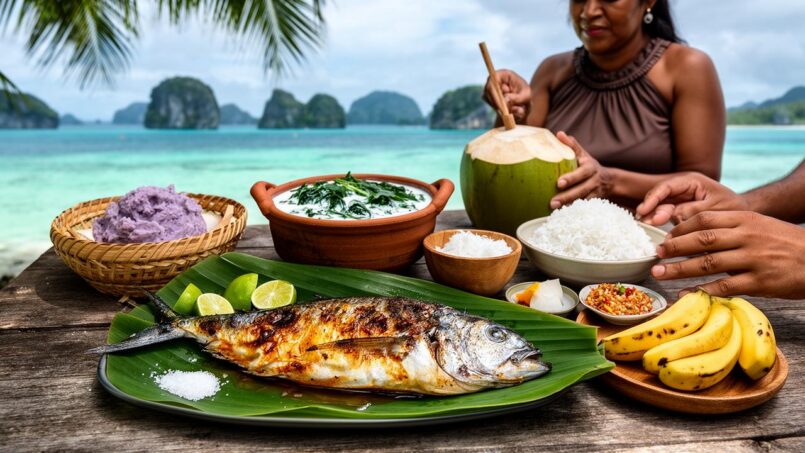
– grilled fish on banana leaves
– tuna or giant clam sashimi
– crab curry or soup
and approach cheled and fruit bat soup once more comfortable with local cuisine.
The classics every expat should know
Palauan cuisine has a few iconic dishes that appear in restaurants, at markets, and on special occasions. Spotting them on a menu helps you order while staying true to local flavors.
Demok, the national soup
Often described as the national soup, demok is a dish made from taro leaves slowly simmered in coconut milk, sometimes enriched with land or mangrove crab. It’s a very representative plate of the Palauan balance: plant-based, nourishing, fragrant yet simple.
Served with boiled taro or rice, this dish is an excellent entry point for discovering local gastronomy without leaving your comfort zone.
Tinola, fasul, and other soups
Under names like tinola, fasul, or simply “Palauan soup,” you’ll find rich broths with chicken or fish, ginger, garlic, vegetables (green papaya, leaves, sweet potato, squash) and sometimes coconut milk. The Filipino influence is clear, but the result is fully Palauan.
These soups accompany both breakfast and dinner, offering a balanced option for anyone looking to limit fried foods.
Ukaeb, ulkoy, tama: the trilogy of snacks
– Ukaeb: crab meat mixed with coconut milk or cream, cooked and served in the shell. Rich, fragrant, best shared rather than eaten alone.
– Ulkoy: crispy shrimp and squash or pumpkin fritters, often served with a vinegar or sweet-and-sour sauce. Ideal as an appetizer or market snack.
– Tama: small sweet fritters, a legacy from the Japanese period, like doughnut holes often flavored with vanilla or banana (tama tuu).
You’ll often find them at street stalls, markets, or as appetizers in small family restaurants.
Raw and fresh: cheled, sashimi, poke, umai
The freshness of the fish naturally leads to serving it raw or nearly so. Four main forms stand out:
| Dish | Brief Description | Where to Find It Easily |
|---|---|---|
| Cheled | Assortment of raw seafood (clams, sea cucumber…) | Traditional dinners, local restaurants |
| Sashimi | Sliced raw fish (tuna, giant clam…) | Koror restaurants, Carp, Tori Tori |
| Poke | Marinated raw tuna cubes (sesame, lemon, chili) | Kramer’s, beach bars, cafés |
| Umai | Salmon or tuna “ceviche” with lemon and chili | Local eateries, fusion restaurants |
For an expat, these dishes offer both cultural immersion and an option very consistent with public health recommendations: more fish, less processed meats.
The influence of neighbors: Japanese, Filipino, American fusion
You can’t understand what you’ll find on the menu without keeping in mind the foreign influences. Spanish colonization, the Japanese period, American administration, the Filipino presence, and recent Asian flows have all left their mark. The result is a blended cuisine, where adobo, sushi, and Spam musubi coexist with demok and roasted taro.
On menus in Koror, this translates into a very wide offering:
Discover a selection of restaurants in Palau, representing a diversity of Asian cuisines and international influences.
Discover sushi, ramen, and an izakaya vibe. Addresses: Tori Tori, Carp, Fuji, Palau Umi, B’s Izakaya Yume.
Try specialties like tinola, halo-halo, or spam fried rice. Address: Emaimelei Restaurant & Kumangai Bakery.
For burgers, fries, and a casual atmosphere. Addresses: Drop Off Bar & Grill, Hungry Marlin, Wahoo, Bem Ermii Burgers & Fries.
Explore Chinese, Thai, and Korean flavors. Addresses: Suriyothai, FC Restaurant, HK Lucky, Kim’s, CC TaiYo.
Savor Indian cuisine with many vegetarian options. Address: The Taj.
So, in Palau, “eating local” doesn’t mean giving up culinary diversity; the challenge for an expat is rather to avoid sticking exclusively to imported burgers and ramen, which are everywhere and easy, at the expense of Palauan products.
Where to eat in Palau as an expat
Daily expat life often centers on Koror, the economic heart and main dining hub. The offerings range from food trucks near the baseball field to upscale restaurants with lagoon views.
Overview of restaurants in Koror
The table below summarizes some regularly mentioned addresses with their dominant culinary style:
| Restaurant / Place | Main Cuisine Type | Interest for Discovering Local Food |
|---|---|---|
| Elilai Seaside Restaurant & Bar | Seafood, Asian fusion | Refined dishes, finely worked local products |
| Kramer’s Café | Bar & seafood | Poke, sashimi, fish in banana leaf |
| Drop Off Bar & Grill | American, bar, seafood | Fresh fish, seafood tacos, diver atmosphere |
| Carp Restaurant | Japanese & seafood | Fruit bat soup, authentic Palauan dishes |
| Penthouse Hotel Restaurant | Seafood, Asian | Accessible cuisine, good fish |
| Palm Bay Bistro | Seafood | Renowned for quality products |
| Tori Tori Restaurant | Japanese & seafood | Excellent fish, local Japanese influence |
| The Taj | Indian, vegetarian options | Healthy alternative (vegetables, lentils) |
| Rock Island Café | American, café | Breakfasts, comfort food |
| Bem Ermii Burgers & Fries | Fast food, burgers | Go-to for a “Palauan-style” burger |
| Red Rooster Café | Pizza, Japanese bowls, halo-halo | Good summary of local culinary fusion |
| Emaimelei Restaurant & Kumangai Bakery | Filipino, bakery | Generous portions, very popular with locals |
| Canoe House | Bar & international cuisine | Lagoon ambiance, some Palauan dishes |
| Marina Café VITA | International cuisine, sea view | Careful cooking, sometimes local seafood |
| Jungle Bar, chapter one, Yokohama Inn… | Palauan and international cuisine | Ideal for trying homemade versions of local dishes |
In practice, for an expat wanting to settle in, alternating between these “mixed” restaurants and small neighborhood eateries is often the best strategy: you keep the comfort of bilingual menus and familiar standards, while gradually adding demok, mangrove crab, or taro to your habits.
Eating “like the locals” without fine dining
Many of the most authentic places have neither polished decor nor great online visibility. Think instead of:
Small roadside restaurants, stalls near markets, stands by sports fields or schools, and simple buffets like King’s Minute Mart are typical examples of informal fast-food outlets. These establishments, often characterized by their accessibility and simplicity, cater to a local demand for quick, affordable meals.
These places serve the most everyday version of Palauan cuisine: taro soups, portions of grilled fish, coconut rice, tama fritters, pork stews in coconut milk. Often, the best indicator is local patronage at lunchtime.
Markets, farms, and short supply chains: learning to shop
To truly find your bearings, it’s hard to skip the “market” step. In Palau, the best-known is in Koror, complemented by farmers’ markets on Babeldaob.
Markets to know
Two main events are particularly useful for expats:
| Market | Location | Days / Approximate Hours | What You’ll Find Mainly |
|---|---|---|---|
| Day / Morning Farmer’s Market | Ernguul Park, Koror | Thursday morning until noon | Fruits, vegetables, fish, fried snacks |
| Kokusai Local Market | Ngatpang | Weekdays, 8am–3pm | Varied fresh produce, fruits and fish |
Add to that occasional stalls or mini-markets around cultural festivals, fairs (PCC Trade Fair, Olechotel Belau Fair), or the monthly Night Market in Koror, which is much more focused on street food and crafts.
At Ernguul Park, you can buy papayas, mangoes, pineapples, coconuts, bananas, taro, okra, as well as freshly caught fish, even fried fish ready to eat for breakfast. Vendors are generally very chatty and happy to explain how to cook a vegetable or give recipe ideas.
A few useful tips:
For an optimal market experience, it’s recommended to arrive early to avoid produce damaged by heat. Bring cash, as most vendors don’t accept card payments. Feel free to negotiate prices lightly, keeping a respectful attitude. Finally, don’t hesitate to ask vendors questions, for instance on how to cook certain products like taro, or what accompaniments are served with others, like crab.
On Babeldaob, some farms supply vegetables year-round. Small grocery stores run by Bangladeshi owners sometimes sell the same products as supermarkets, but at slightly lower prices, which can make a difference on an expat budget.
Shopping between imports and local production
The numbers are clear: about 82% of the value of food available in the Palauan economy comes from imports. Supermarket shelves reflect this reality: cans of corned beef, Spam, instant noodles, sodas, imported beers, refined flours, white rice, biscuits, and candies fill the aisles.
A specific aisle called ‘Mantekang’ is dedicated to ultra-processed foods, pointed to as responsible for the surge in non-communicable diseases.
In response, authorities promote “Grow Local, Eat Local” and the “Keled a Ngercheled” (“Our food is our responsibility”) program. Agricultural training, seed distributions, and community gardens aim to boost local supply. For now, production capacity remains modest, but markets and some grocery stores increasingly display labels highlighting Palauan products.
For an expat, a simple rule can guide choices:
– prioritize, when possible, unprocessed local foods (fish, taro, fruits, vegetables)
– reserve highly processed products from the “Mantekang” aisle for occasional consumption
– look for restaurants that advertise use of local products (some hotels and restaurants are starting to communicate about it)
Health, diet, and daily reality
Palau is often presented as a paradise, but health statistics tell another story: about 65% of deaths are linked to non-communicable diseases (cardiovascular diseases, cancers, diabetes, obesity). Diabetes affects more than 20% of adults, placing the country among the most affected in the world.
The causes are well identified:
More than 90% of Palauans consume fewer than five servings of fruits and vegetables per day.
For an expat, who often has more financial means than the average local, the risk is double: eating out frequently (generous portions, fried foods, sugary desserts, alcohol) and relying heavily on easy imported products (ramen, snacks, sodas) for convenience.
The upside is that the solution is largely culinary: getting closer to traditional Palauan cuisine usually means eating healthier.
Among the widely disseminated recommendations from the Ministry of Health:
To maintain a stable weight, it is recommended to eat a varied diet prioritizing fiber-rich foods like taro, breadfruit, vegetables, and fruits. Also reduce consumption of added fats and sugars, increase fish and lean protein intake, and limit salt and alcohol.
For an expat, a realistic strategy could be:
– reserve burgers, pizzas, and fried foods (including local ones like ulkoy or tempura) for 1–2 meals per week
– choose soups (demok, tinola, fasul) and grilled fish as “go-to dishes”
– make the weekly market a ritual for stocking up on fruits and vegetables
– use coconut milk as a pleasure ingredient, but don’t overdo it in all dishes, especially if watching your cholesterol
The “Go foods” campaigns in Palau promote foods like taro, breadfruit, fish, sea cucumber, brown rice, and carrots, indicating they are the best allies to break out of the NCD cycle.
Table manners and customs: avoiding faux pas
Beyond ingredients and dishes, local gastronomy is also a matter of social codes. The core value of Palauan culture is respect (omengull), omnipresent at the table.
When eating with Palauans or at a village event:
To show respect during a traditional meal, it’s important to greet elders, sometimes with a slight bow. Wait for your host to indicate your seat and to start eating before you serve yourself. Try all the dishes offered if possible, as refusing food can be seen as disrespectful, while eating with appetite is a compliment. Dress appropriately, avoiding overly revealing clothing, which is considered rude in a family or ceremonial setting.
Many meals are still eaten with the hands, especially for roots, fish, grilled pork, or taro pieces. Utensils are often offered, but gradually adopting local customs is appreciated.
At large chelilai (communal feasts) – for a wedding, birth, chief installation, or funeral – the quantity and variety of food serve to show the family’s generosity and prosperity. Participating as an expat is an excellent way to understand what, in Palauan cuisine, goes far beyond simple nutrition: exchange, hierarchy, memory, kinship ties.
Drinks, alcohol, and health precautions
On the beverage side, expats will find all their usuals: coffees, teas, sodas, industrial juices, international beers, hard liquors in hotel bars. But Palau also has its liquid specialties.
These include:
– fresh coconut water, ubiquitous and ideal for hydration
– freshly squeezed juices from local fruits (mango, papaya, pineapple, soursop)
– the local beer Red Rooster, a light lager brewed on site
– tuba, fermented coconut sap, a traditional drink with varying alcohol content depending on fermentation
– drinks made from kava root, known throughout the region for their relaxing effects
The law sets the legal drinking age at 21. Additionally, alcohol consumption in public spaces is restricted to establishments with a specific permit.
On the health front, several points are important for anyone settling in:
In Koror and Airai, tap water is not always potable: prefer bottled water (seal intact). Be cautious with ice and raw vegetables, frequent sources of gastroenteritis or hepatitis A. It’s recommended to have rehydration salts and hand sanitizer on hand to prevent traveler’s diarrhea.
The local recommendations align with well-known principles: hand hygiene, thorough cooking, caution with raw products in questionable contexts.
Finally, an important point for expats: Palau has banned toxic sunscreens for reefs (only sunscreens based on zinc oxide or titanium dioxide are allowed) and e-cigarettes (import, advertising, sale, and use). This isn’t directly culinary, but it conditions how you enjoy beaches, bars, and terraces.
Living here, cooking here: how to adapt your expat kitchen
Moving to Palau doesn’t mean giving up your culinary habits, but accepting to reshape them. The good news is that with a little curiosity, daily home cooking can quickly incorporate local products.
A few concrete ideas:
To illustrate a local and healthy diet: for breakfast, replace some white bread with roasted taro, sweet potato, or homemade *tama*, accompanied by fresh local fruits. For lunch, compose bowls with grilled fish, coconut rice or taro, and a mix of leafy greens sautéed with ginger and garlic. For dinner, prepare a tinola-type soup (chicken, green papaya, ginger, leaves) or a simplified demok, slightly reducing the amount of coconut milk if watching fat intake.
The markets and mini-markets allow you to buy taro, breadfruit, cassava, leafy greens, and fruits; supermarkets round things out with spices, oils, rice, legumes. You can also get inspired by dishes you’ve had at restaurants: taro rösti is easy to recreate at home (grated taro, egg, a little flour, pan-fried), as are fish curries in coconut milk.
The key for an expat is often not to get trapped in a very narrow circuit (hotel – office – supermarket – fast food), especially when Palauan cuisine offers options that combine pleasure, health, and cultural immersion.
Gastronomy as a gateway to Palauan culture
Over the months, you realize that eating in Palau is about taking part in a broader story: that of an archipelago that has gone through colonization, war, rapid modernization, a tourism boom, and is now seeking to reconcile public health, preservation of its marine environment, and valorization of its traditions.
Attending a large chelilai, watching women lay out baskets of cooked taro during a ceremony, observing fishermen prepare an underground oven to cook a whole pig, sharing a bowl of demok in a simple home on Babeldaob, chatting with a market vendor about the best way to fry ulkoy… all this is part of integration.
For an expat, prioritizing local and sustainable products (like local fish, taro, market produce) over imported or processed items supports local agriculture, reduces pressure on ecosystems like coral reefs, and contributes to better health in the face of rising chronic diseases.
In Palau, food is described in government programs as “our responsibility” (Keled a Ngercheled). For expats too, adopting local cuisine is not just about satisfying curiosity: it’s accepting a share of that responsibility, while fully enjoying what the country has most generous to offer.
Disclaimer: The information provided on this website is for informational purposes only and does not constitute financial, legal, or professional advice. We encourage you to consult qualified experts before making any investment, real estate, or expatriation decisions. Although we strive to maintain up-to-date and accurate information, we do not guarantee the completeness, accuracy, or timeliness of the proposed content. As investment and expatriation involve risks, we disclaim any liability for potential losses or damages arising from the use of this site. Your use of this site confirms your acceptance of these terms and your understanding of the associated risks.

Cyril Jarnias is an independent expert in international wealth management with over 20 years of experience. As an expatriate himself, he is dedicated to helping individuals and business leaders build, protect, and pass on their wealth with complete peace of mind.
On his website, cyriljarnias.com, he shares his expertise on international real estate, offshore company formation, and expatriation.
Thanks to his expertise, he offers sound advice to optimize his clients' wealth management. Cyril Jarnias is also recognized for his appearances in many prestigious media outlets such as BFM Business, les Français de l’étranger, Le Figaro, Les Echos, and Mieux vivre votre argent, where he shares his knowledge and know-how in wealth management.





