
 Published on and written by Cyril Jarnias
Expatriating to Palau, this small archipelago in the western Pacific, is far more than a simple change of tropical scenery. You discover a compact island society, marked by a strong cultural identity, an almost sacred relationship with the environment, and a way of life that challenges many habits from Europe or North America. Before packing your bags, it’s best to understand how this society functions, what it values, and what that means on a daily basis for a newcomer.
In Palau, social, family, and professional codes, as well as the concept of time, differ significantly from many other cultures. Respect is a paramount value. Ignoring these specificities can lead to being marginalized by society or offending local sensibilities, despite general tolerance.
Understanding the Big Picture: A Highly Structured Micro-Island State
Before diving into cultural subtleties, you need to set the scene. Palau is an archipelagic republic in Micronesia, Oceania, composed of several hundred islands (about 340 to 500 depending on the source), with a population of around 18,000 to 21,000 people. The official capital is Ngerulmud, on the island of Babeldaob, but economic and social life is largely concentrated in Koror, the former capital and main urban hub.
About 70% of Palau’s population is of Palauan origin, a blend of Melanesian and Austronesian.
A few useful reference points for an expatriate: the currency is the US dollar, driving is on the right, English and Palauan are the official languages for the entire country (with specific variations in some states), and American influence is strong, notably through the Compact of Free Association with the United States, which still governs part of the politics, economy, and public services.
A Community-Based, Matrilineal, and Highly Hierarchical Society
The first culture shock for many expatriates comes from the social organization. Palau is not just a small island society: it is also a deeply community-based, matrilineal, and hierarchical society, where the individual weighs less than the clan and the community.
The Weight of the Clan and the Maternal Family
Unlike strongly individualistic Western societies, the basic structure here is not the individual, but the clan. Descent, inheritance, social identity, and land rights pass through the maternal line. In other words, it is the mother’s family that establishes belonging, and through her that land power and prestige are transmitted. Major family decisions are discussed and decided at the clan level, not behind closed doors within a nuclear couple.
For an expatriate joining a local family, it is crucial to recognize the central role of the in-laws, especially maternal aunts. They can decisively influence decisions regarding housing, major expenses, children’s education, and even career choices. Adopting a strictly nuclear view of the couple and family, without considering this network of influence, risks creating tension.
A Dual Chieftaincy System: Men as Politicians, Women as Guardians of Resources
Traditional power rests on a sophisticated chieftaincy system. Villages were historically organized around a set of clans, each with a rank and role. A Council of male chiefs governed the community, but this council was—and still is—assisted by a council of women, which handles land and clan financial matters and has a decisive role in selecting and deposing chiefs.
In Palau, women hold real power through control of land and resources, even though the public figures of power are often male. It is crucial for an expatriate not to analyze this system using Western frameworks of gender debate. Importing certain feminist discourses without nuance can be poorly perceived, not because Palauan women are submissive, but because their authority operates through different traditional forms.
Respect, Hierarchy, and Reputation: The True Social Drivers
Two values structure this system: respect and cohesion. Respect extends in all directions: toward elders, chiefs, parents, and nature. Cohesion comes from the constant concern to avoid open conflict and preserve the balance of the village, clan, and family.
One does not rise in general esteem by putting oneself forward, but by showing oneself useful to the community, sharing resources and time, and participating in ceremonies and collective tasks. A foreigner seen as arrogant, too direct, or too quick to criticize will quickly be excluded from important circles, including professionally. Conversely, a humble, attentive posture, willing to “do one’s part” in community life, opens many doors.
A Culture of Indirect Speech and Face-to-Face Connection
In daily life, this community logic translates into a very particular way of communicating, sometimes disconcerting for an expatriate used to brutal frankness or written communication.
The Importance of Physical Interaction and Slow Time
In Palau, trust is not earned through well-written emails or a polished LinkedIn profile. You build your credibility through direct contact, by showing up, participating, and coming back. A professional project, a nonprofit collaboration, or a job offer is rarely sealed based on a simple online exchange. It requires meetings, shared meals, invitations to village festivals, and informal discussions.
In a country where the permanent expatriate community numbers only a few hundred people and everyone knows each other more or less, reputation spreads very quickly. It will be positive if you are seen as respectful and genuinely interested in the local culture, but disastrous if you are viewed as condescending or a know-it-all.
Polite, Non-Confrontational Communication
The way of speaking illustrates this search for harmony. Communication is often indirect: people avoid blunt “no’s,” face-to-face reproaches, and open conflict. There are many unspoken things, nuances, implications, and silences. Pauses in conversation are not awkward gaps to fill but normal thinking time. The logic of “island time” also applies to speech.
Humor, song, and sometimes even sung parody can be used to convey a message that one wouldn’t dare express directly. For an expatriate coming from a very direct culture, this can give the feeling of never really knowing what people think of you. Yet the signals are there: a repeated invitation to participate, a reserved seat, a task entrusted to you—all are signs of integration.
Expatriate from a direct culture
Language, Politeness, and Non-Verbal Codes
On paper, the language barrier seems limited. English is widely used in administration, business, and tourism. But in practice, ignoring Palauan means missing a whole part of social life.
An Officially Bilingual Country, But Mentally Palauan
Palauan is the dominant native language, spoken at home by over four-fifths of the population. English is often well mastered, especially by young people, the educated, and those working in services, but it remains a language of work and schooling, not necessarily that of emotions and family discussions.
A few essential expressions for expatriates wishing to show respect and facilitate their integration in Palau.
The word for ‘Hello.’ A sincere greeting is an important first step.
The word for ‘Thank you.’ A mark of gratitude that is appreciated.
Using these basic phrases shows an effort to integrate and respect for the local culture.
These simple words help relax the atmosphere and dispel any latent mistrust.
Good Communication Practices
Beyond words, certain body codes matter. Avoid pointing your finger at someone, touching children’s heads, speaking too loudly, or being intrusive. Public displays of affection between partners are seen as inappropriate, while close gestures between same-sex friends are not shocking.
In a professional setting or when interacting with elders, maintain a rather formal, polite, calm register. Outbursts of anger or aggressive criticism in meetings are very poorly perceived. In this context, an expatriate is well advised to moderate their style, even if it means appearing a bit more reserved than in their home country.
Religion, Traditions, and the Role of Ceremonies
Social life in Palau is punctuated by a mix of Christianity (especially Catholic and Protestant), ancestral beliefs, and village customs that are still very much alive.
A Very Present Christian Faith, Intertwined with Traditions
Sunday services, religious holidays, and church activities structure the calendar. The church is a major socializing place. Yet this religiosity is closely intertwined with pre-Christian beliefs: ancestor worship, respect for spirits associated with places, and the spiritual dimension of natural sites.
Traditional ceremonies (births, constructions, funerals) mobilize clan networks and rely on codified exchanges of goods, money, or food to reinforce social cohesion. As an invited expatriate, it is advisable to remain discreet, observe, and imitate other participants. It is also welcome to make a small contribution, such as a dish, logistical help, or financial participation, provided it is done in a clear and intentional manner.
A Dense and Codified Social Calendar
National holidays, cultural festivals, women’s conferences, traditional canoe races, night markets… the social agenda is richer than one might imagine for such a small country. Here again, a foreigner’s participation is seen positively, provided the protocol is respected: appropriate attire, respectful attitude, photos requested before being taken at sensitive sites or of people in traditional dress.
For an expatriate, these are valuable opportunities to understand the culture from the inside. It’s also in these settings that many bonds of trust are woven, including with important interlocutors from the economic, nonprofit, or political worlds.
Relationships to Time, Work, and Money
Another major source of misunderstandings: how people approach time, salaried work, and money. As in many island societies, the Palauan perspective differs significantly from the strict productivist model.
“Island Time”: Flexibility or Slowness?
Island time manifests as a certain flexibility in schedules, deadlines, and non-essential commitments. A 10:00 AM appointment doesn’t always start on time, projects take time to get off the ground, and decisions can be postponed based on family or community discussions.
In Palau, priority is given to social relationships and informal conflict management rather than strict efficiency. For a foreigner, it is crucial to distinguish genuinely non-negotiable deadlines (administrative, health-related) from those that are socially negotiable.
Salaried Work, Career, and the Role of the State
Palau’s economy relies on a mix of tourism, fishing, subsistence agriculture, and public jobs heavily supported by external aid. The government is a major employer, and the formal economy is relatively narrow.
In many families, the life project does not resemble the highly individualistic narrative of a Western-style career. People work to support the clan, finance the education of the younger generation, and participate in ceremonies, sometimes at the cost of compromises on individual career choices. This logic can surprise an expatriate expecting highly “meritocratic” trajectories or a culture of direct competition.
Living in a Country That Knows Its Vulnerability: Environment, Climate, and Identity
It is impossible to understand Palau without considering the place of the environment in the collective imagination—and in public policy. The inhabitants are deeply aware of the fragility of their archipelago in the face of climate change and tourism pressure.
A Tropical Climate Both Generous and Threatening
The climate is hot and humid year-round, with average temperatures between 23 and 28°C (74 to 83°F) and abundant rainfall, around 3,800 mm per year. Two main seasons structure the year: a pronounced wet season and a drier season, interspersed with transition periods. The country is exposed to typhoons and strong storms, which have already damaged infrastructure and fisheries.
Palauans live with this instability. It is now compounded by tangible impacts of global warming: sea level rise, coastal erosion, soil salinization, threats to freshwater, and massive coral bleaching events—including the one in the late 1990s, which destroyed about a third of the corals, with mortality rates of 90% in some reefs.
For the inhabitants, these changes are not abstractions: they affect fishing, local crops, and housing. Expatriates who downplay or mock these ecological concerns hit a wall, as environmental protection has become a pillar of national identity.
A Political Culture of Climate “No-Regret Policy”
The authorities have adopted an ambitious climate policy, with a strategic framework covering adaptation, disaster risk management, loss and damage, emission reduction, and concrete implementation in sectors like agriculture, infrastructure, health, education, and tourism. The stated goal is to strengthen the resilience of ecosystems, the economy, and society, following a precautionary approach: better to act too early than too late.
In the eyes of many Palauans, the survival of their country depends on radical choices: development of renewable energy, strict tourism management, adaptation programs in agriculture (such as introducing salt-tolerant taro varieties), creation and strengthening of marine protected areas, and a moratorium on mangrove destruction.
The ‘bul’ is a traditional taboo practice, decreed by chiefs, which temporarily suspends activities like fishing or harvesting to allow resource regeneration. For an expatriate, respecting these rules, even if they limit certain activities, is an important gesture of loyalty toward the host community.
The Palau Pledge: A Required Commitment for All Visitors
All visitors must sign the “Palau Pledge,” a commitment stamped directly into the passport upon arrival, by which they promise to protect the environment and respect the local culture. This is not a marketing gimmick: it reflects a deliberate political will to control the impact of tourists and remind them that they are guests in a fragile ecosystem and a dense cultural fabric.
For a long-term expatriate, this philosophy is lived daily: no collecting coral, feeding fish, walking on reefs, or leaving trash behind. The use of sunscreen not friendly to reefs, for example, is discouraged. Those working in diving, tourism, or education must integrate these messages into their professional practice.
Living Conditions, Isolation, and the Small Expatriate Community
Beyond the big principles, daily life in Palau has its own reality, with strengths and limitations that need to be carefully assessed before leaving.
A High Cost of Living, Especially for Housing and Imported Food
For a middle-income country, the cost of living is relatively high: most consumer goods and building materials are imported, which drives up prices. Rentals are particularly tight in and around Koror, with limited long-term supply. Expatriates often have to choose between a modern apartment in town, more expensive, and a simpler house on Babeldaob, knowing that a car then becomes almost essential.
Bills for electricity, water, and internet, especially with heavy bandwidth usage, can be high. Although connectivity has improved thanks to the submarine cable and 4G, access to reliable high-speed internet is costly. For a remote worker, installing a reliable fixed connection is almost indispensable.
Decent Healthcare for Daily Needs, Limited for Serious Cases
The public healthcare system, organized around the Belau National Hospital in Meyuns (Koror) and about ten community health centers spread across several islands, handles routine care adequately: basic emergencies, general medicine, simple surgery, maternity, pediatrics, lab tests, and basic imaging. The country even has a hyperbaric chamber, essential for a diving destination.
However, for serious conditions (cancers, complex heart surgeries, certain psychiatric disorders), Palau relies on medical evacuations to the Philippines, Taiwan, Hawaii, Guam, or India. These evacuations are expensive, and international insurance with evacuation coverage is strongly recommended for expatriates; otherwise, a single serious accident can become a financial nightmare.
Geographic Isolation and the Small Size of the Foreign Community
Geography is not on the side of convenience: air connections are limited, expensive, and concentrated on a few regional hubs. Returning regularly to Europe, North America, or even Australia represents a significant budget and inflexible logistics. This isolation affects morale: the feeling of distance and the difficulty of hosting loved ones can weigh heavily, especially over time.
The permanent expatriate community in Palau is small, numbering only a few hundred people, mainly active in tourism, education, technical services, and environmental projects. There are no large structured associations; networks are created through Facebook groups, informal gatherings, chamber of commerce events, or via NGOs and volunteer programs. For a stable social life, it is therefore crucial to develop ties with the local population, the Palauans.
Living in Harmony with Local Social Norms
For an expatriate, the difference doesn’t only lie in the big political or climatic structures: it also plays out in daily details.
Dress, Attitude, and Respect for Spaces
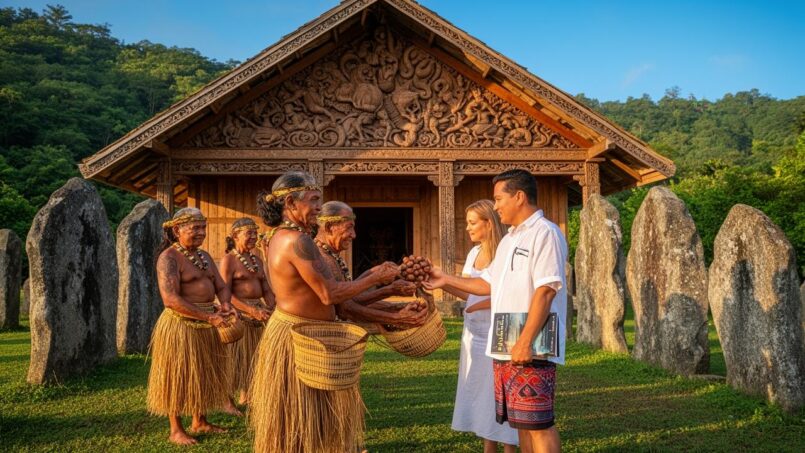
Palau is not a giant “resort” where you wander in swimwear from morning to night. The beach has its codes; the village and town have others. Wearing clothing that covers shoulders and knees outside of swimming areas, removing shoes before entering a house, a traditional meeting house (bai), or a sacred site, and avoiding overly revealing outfits when visiting villages or churches are all markers of expected respect.
It is essential to respect local social codes regarding the occupation of space. This means not crossing central areas of villages inappropriately, always asking permission before entering a cultural site or taking photographs in sensitive places. Generally, simply looking around you and observing the behavior of residents allows you to understand the right practices to adopt.
Eating, Sharing, Participating
Meals have a strong community dimension. Dishes are shared, elders are served first, and food waste is avoided. Being invited to a table is an honor; bringing a dish or some appreciated products is always well received. The Western obsession with “each his own plate, each his own bill” is not the norm here.
In neighborly relations, participating in collective activities (helping out, lending equipment, chores) is seen as a gesture of goodwill. Conversely, strictly staying home, systematically refusing invitations, and adopting the posture of a mere consumer can be interpreted as ingratitude.
Managing Cultural Misunderstandings
Despite all precautions, awkward moments will occur. A word deemed too blunt, a photo taken without permission, a joke misinterpreted… In most cases, a simple and sincere apology is enough to smooth things over, provided it is accompanied by a real effort to understand what caused the problem.
The pitfall for an expatriate is to become defensive, blaming the locals’ “sensitivity” or retreating into the small circle of fellow foreigners. Yet, in such a small society, the ability to admit one’s mistakes and adjust one’s behavior is seen as a sign of maturity and respect—two qualities that, in the long run, weigh far more than perfect mastery of codes on day one.
Successful Expatriation: A Few Key Principles to Keep in Mind
Bringing all these elements together, we can see what expatriation to Palau really involves.
First, accept that you are arriving in an ancient, structured society that did not wait for the West to define itself. Palau is not a tropical blank slate for personal projects or exotic business ventures, but a country with its own history, laws, institutions, internal debates, wounds, and priorities, where environmental protection and culture are now major axes.
To succeed in your integration, prioritize the quality of relationships over professional performance. Learn a few words of the local language, participate in community events, respect taboos, and adjust to local rhythms. This approach will allow you to be ‘adopted’ by strong networks, thereby easing your professional and personal life.
Finally, recognize that this expatriation plays out on a delicate balance between two worlds: that of globalization (remote work, international NGOs, digital infrastructure, global tourism) and that of an island that firmly holds onto its reefs, its lands, its language, and its ceremonies. It is neither a sanitized beach resort nor a frozen museum of traditions. It is a living, vulnerable, proud country that asks those who join it for a few years to accept its implicit rules as much as its postcard scenery.
Expatriating to Palau represents much more than a job in the tropics. It is an immersion into a societal model that invites you to adjust your certainties, prioritize listening, and think about the future on the scale of a reef and a clan as much as on that of a career. This cultural difference, which goes beyond the landscapes, is essential to know before settling there.
Disclaimer: The information provided on this website is for informational purposes only and does not constitute financial, legal, or professional advice. We encourage you to consult qualified experts before making any investment, real estate, or expatriation decisions. Although we strive to maintain up-to-date and accurate information, we do not guarantee the completeness, accuracy, or timeliness of the proposed content. As investment and expatriation involve risks, we disclaim any liability for potential losses or damages arising from the use of this site. Your use of this site confirms your acceptance of these terms and your understanding of the associated risks.

Cyril Jarnias is an independent expert in international wealth management with over 20 years of experience. As an expatriate himself, he is dedicated to helping individuals and business leaders build, protect, and pass on their wealth with complete peace of mind.
On his website, cyriljarnias.com, he shares his expertise on international real estate, offshore company formation, and expatriation.
Thanks to his expertise, he offers sound advice to optimize his clients' wealth management. Cyril Jarnias is also recognized for his appearances in many prestigious media outlets such as BFM Business, les Français de l’étranger, Le Figaro, Les Echos, and Mieux vivre votre argent, where he shares his knowledge and know-how in wealth management.





