
 Published on and written by Cyril Jarnias
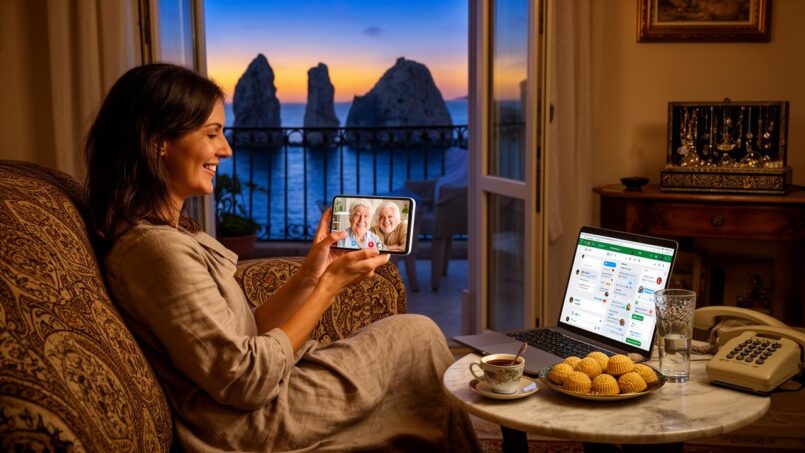
Staying close to family when living in Lebanon — or traveling there — has never been simpler on paper, but the local context quickly complicates things: high data costs, power outages, variable network quality, and occasional internet shutdowns during political tensions. Yet, between messaging apps, prepaid SIM cards, VoIP, social networks, and solutions to bypass outages, it’s entirely possible to maintain a strong connection with loved ones, both at home and abroad.
This article provides a practical guide, based on the most recent data, for staying connected in Lebanon. It presents the tools available and the right habits to adopt.
Understanding Lebanon’s Digital “Playing Field”
Before choosing the right tools to stay in touch, it’s important to understand the Lebanese digital context: connection level, cost, strengths and weaknesses of the infrastructure.
Lebanon is paradoxical: internet access is widespread, but the infrastructure remains fragile and uneven.
On one hand, internet penetration is very high:
| Indicator (end of 2025) | Approximate Value |
|---|---|
| Internet usage rate among population | 91.8% |
| Internet users | 5.38 million |
| Share of population completely offline | 8.2% (≈ 483,000 people) |
| Social media users (active identities) | 4.58 million |
| Share of population using at least one social network | 78.1% |
In other words, almost all the people you want to stay in touch with, in Lebanon and the diaspora, have the digital tools to do so.
On the other hand, the infrastructure remains unstable:
Power outages, recurring and potentially lasting several hours a day, force the population to rely on expensive private generators or solar systems, with public electricity providing only a few hours daily on average. This energy instability contributes to the low resilience of the internet network (score of 40–46/100), compounded by inadequate physical infrastructure and limited fiber optic deployment.
In terms of speeds, the country is not entirely lagging, but far from world leaders:
| Connection Type (2025) | Median Download Speed | Approximate Global Ranking |
|---|---|---|
| Mobile internet | ~44–46 Mb/s | Around 90th place |
| Fixed internet (broadband) | ~15–19 Mb/s | Between 140th and 144th place |
In practice, this means that audio and video calls generally work decently, especially on mobile, but the quality can drop sharply during periods of high load or political tensions.
Choosing the Right Strategy: Wi‑Fi, Local SIM, or International eSIM?
To stay reachable and call abroad from Lebanon, three main levers combine: Wi‑Fi, a local SIM (or local eSIM), and possibly an international eSIM if you’re coming from abroad with an unfavorable roaming plan.
Rely on Wi‑Fi Whenever Possible
Many cafes, restaurants, and public places offer free Wi‑Fi access, especially in Beirut (Hamra, Gemmayzé, Badaro, Verdun, downtown…). Some initiatives by the Ministry of Telecommunications have even equipped several public gardens with Wi‑Fi.
You can easily find free Wi‑Fi:
– In cafes (Urbanista, Cafe Younes, Kalei Coffee Co., Starbucks, B Hive Café, etc.).
– In some parks and gardens (Sioufi, René Moawad, Jesuit garden in Geitawi…).
– In universities (AUB, LAU, USJ) or museums.
– In coworking spaces, very numerous in Beirut.
For a short stay, this Wi‑Fi + messaging app strategy is often enough to stay in touch. Just remember that:
– Public networks are rarely secure.
– Power outages can interrupt Wi‑Fi unpredictably.
– Quality varies greatly from place to place.
It is recommended to use a reliable VPN for browsing the internet. However, as a precaution, it is advisable to avoid transmitting very sensitive information, such as banking passwords, over this connection.
Buying a Local SIM: Best Value for Data
For stays longer than a few days, buying a local SIM is almost always more cost-effective than an international eSIM, especially if you plan to make VoIP calls or send many messages.
The two main mobile operators are Alfa and Touch.
Data prices are high compared to international standards, but bundled offers reduce the bill. Some international estimates placed the gigabyte of data at over $20 in certain analyses, but that figure reflects poorly optimized plans. With well-chosen local offers, you can get around $1.30/GB (e.g., 10 GB for $13 on a Touch visitor line), which is still expensive but quite acceptable for a stay.
On Alfa’s side, offers are very numerous. To give an idea:
| Example Alfa Data Offers (prepaid) | Volume | Validity | Approximate Price |
|---|---|---|---|
| Weekly Data Bundle 500 MB | 0.5 GB | 7 days | $1.67 |
| Weekly Data Bundle 1.5 GB | 1.5 GB | 7 days | $2.34 |
| Weekly Data Bundle 5 GB | 5 GB | 7 days | $5 |
| Mobile Internet 1 GB | 1 GB | 30 days | $3.50 |
| Mobile Internet 7 GB | 7 GB | 30 days | $9 |
| Mobile Internet 22 GB (prepaid) | 22 GB | 30 days | $14.50 |
| Mobile Internet 44 GB (prepaid) | 44 GB | 30 days | $21 |
For a month, 7 to 22 GB is plenty for most uses (messaging, audio calls, some video), provided you prioritize Wi‑Fi when available.
The cost of a prepaid SIM card typically ranges between $5 and $20, depending on the operator and chosen options.
Important point: it is strongly discouraged to buy a SIM at the airport, where some resellers charge exorbitant rates (for example, we’ve seen an offer at $44 for only 500 MB from an intermediary). It’s better to go to an official store in the city or a shopping mall.
International eSIMs: Handle with Care
Many international eSIM providers claim to cover Lebanon, but prices vary dramatically, and some offers reach unrealistic amounts (several hundred, even thousands of dollars for a few gigs). These options are only useful in very specific cases — for example, for a short stay without the desire to search for a local SIM.
Among the reasonable options, we find for example:
| eSIM Provider (examples) | Volume / Validity | Approximate Price |
|---|---|---|
| Airalo “Salbeh” (Alfa network) | 1 GB – 7 days | $9.50 |
| LinkeSIM “Africa Plus 10 GO” | 10 GB – 31 days (voice/SMS included) | $19.90 |
| EtravelSIM “Travel eSIM Lebanon” | 1 GB – 30 days | $24.99 |
But many other offers are far beyond reasonable, with prices far exceeding the cost of a local SIM. So it is crucial to compare and check prices before any activation.
For a traveler, the best strategy is often:
– Reasonable eSIM (1 GB) only for the first few hours/1–2 days;
– then buy a local SIM for the rest of the stay.
Staying in Touch via the Most Used Messaging Apps
With over 4.5 million identities on social networks and internet penetration close to 92%, the vast majority of Lebanese — and a good part of the diaspora — use messaging apps and social networks to stay connected.
WhatsApp, King of Family Communications
WhatsApp is, by far, the most used app for daily communication in Lebanon and the diaspora. As of end of 2025, the app had over 3.4 million active users in the country, with massive use for:
– Family groups (parents in Lebanon, children abroad).
– Voice and video exchanges, considered more reliable than traditional international calls.
– Sharing photos, videos, voice notes.
The advantage is twofold: the app is end-to-end encrypted by default, and most relatives, wherever they live, already use it. Even businesses are getting on board via WhatsApp Business, which exceeds one million active users in Lebanon.
To stay in touch from Lebanon:
Practical tips to improve the experience and security of your calls
Prefer audio calls over video when bandwidth is limited.
Set the app not to automatically download all videos to control data consumption.
Enable two-step verification to effectively protect your account.
Telegram, a Robust Alternative in Case of Blockages or Slowness
Telegram is very established in Lebanon, with up to 1.7 million active users recorded in some quarters. The app is appreciated for:
– Its ability to work well even on weak connections.
– Its cloud storage, allowing easy retrieval of files.
– Its giant groups and channels, used to follow news, road conditions, shortages, etc.
– Its “secret chats” with end-to-end encryption and self-destructing messages.
During times of tension or protests, when certain apps are slowed down or briefly blocked, Telegram often remains accessible. Using it as a backup solution is therefore wise, especially if you need to pass on important information to relatives abroad.
Signal, Threema, Wire, Briar: More Privacy for Sensitive Exchanges
For more sensitive communications (activists, journalists, people fearing surveillance), apps like Signal or Threema offer a higher level of privacy:
Signal is an open-source app, end-to-end encrypted by default, with no ads or trackers, donation-funded, and highly regarded for security. Threema, developed in Switzerland, allows registration without a phone number or email, and its data passes through servers subject to strict data protection laws. Wire allows creating an account with a simple identifier, without necessarily linking a phone number, limiting traceability. Briar works even in near-offline mode, directly connecting devices via Bluetooth or Wi-Fi Direct, which is valuable in case of an internet outage.
NGOs often recommend never relying on a single app, especially in unstable political contexts. Installing two or three different messaging apps provides extra flexibility if one becomes unusable.
Snapchat, Messenger, imo, etc.: Apps That Complete the Landscape
Beyond WhatsApp and Telegram, the Lebanese communication ecosystem is very rich:
– Snapchat surpasses one million active users, appreciated for its playful dimension and exchanges among young people.
– Messenger (Meta) reaches over one million active users, and remains a practical complement for those already very active on Facebook.
– imo is widely used for international audio/video calls, especially by certain communities, thanks to its smooth operation on weak networks and support for many languages.
Uses overlap: many families use both WhatsApp for serious groups, Snapchat for fun, and Telegram for news.
Calling Abroad from Lebanon at Low Cost
Beyond messaging, sometimes it’s necessary to directly call landlines or mobiles abroad: elderly relatives who don’t master apps, administrations, banks, etc. Traditional international calls remain expensive from Lebanon, but a multitude of VoIP services or “phone card 2.0” options can drastically reduce the bill.
Services like CallingCards.com and KeepCalling
Platforms like CallingCards.com, with their “KeepCalling” app, allow you to make international calls from Lebanon over the internet (Wi‑Fi, 4G, 5G). The principle:
1. Create an account and buy voice credit (minimum $5). 2. Choose a rate plan (e.g., “Clear Choice” or “Simple Calls” for certain destinations). 3. Call via the app or using a local access number, then dial the number to reach with the country code.
Highlighted advantages:
– Very low rates for calls to landlines and mobiles.
– No contract, no hidden fees.
– Instant top-up via credit card or PayPal.
– Convenient mobile app (integrated contacts, one-click top-ups).
– Calls possible over Wi‑Fi, 4G/5G, or even in “offline calling” mode via local access numbers.
– 24/7 customer support.
This type of solution is particularly useful for calling relatives in countries where data is expensive or where they don’t master messaging apps.
International Telephony Apps: Yolla, Rebtel, DialAnyone…
Several apps position themselves as “calling cards 2.0” for calling abroad:
– Yolla promises up to 90% savings on international calls, with an intuitive interface, no contract or service fee, and a credit system with no expiration.
– Rebtel, well-known in the diaspora, routes calls through local lines rather than the internet, allowing calls even without data or Wi‑Fi and improving audio quality.
– DialAnyone offers a 100% browser-based WebRTC model, where you call from your computer using prepaid credit.
For use from Lebanon, the relevance of these services depends on your profile:
– If you have good Wi‑Fi or comfortable mobile data, VoIP apps (Yolla, KeepCalling, Rebtel in data mode) are often the most economical.
– If data is expensive or unstable but you can use local access numbers, solutions like Rebtel or certain access number services can be more reliable.
The promotional rates mentioned primarily target calls to Lebanon from abroad. However, the same principle of VoIP infrastructure pooling applies to reduce the cost of international calls in the other direction.
Modernized Classic Prepaid Cards (Amantel, Talk Home…)
Companies like Amantel or Talk Home sell virtual phone cards for calling internationally:
– Buy credit online.
– Receive the access number and PIN via email or SMS.
– Call via a local number, enter the PIN, then the international number.
Amantel, for example, offers:
– No activation fees.
– Online accounts, easy top-ups.
– Cards valid for 6 to 12 months depending on the amount.
– Bonus minutes or discounts.
More “traditional” operators like Talk Home work on the same principle, with different access numbers (sometimes paid, sometimes free).
In practice, these solutions remain useful if:
– You are not comfortable with apps,
– Or you regularly call the same country and benefit from a known fixed rate.
But for most connected users, modern VoIP apps are more flexible and transparent.
Dealing with Power Outages and Network Fragility
It’s impossible to talk about communication from Lebanon without mentioning the major obstacle: the electricity crisis.
During the worst periods of the crisis, some households had only a few hours of electricity per day, sometimes barely three hours in certain areas. Even though the situation fluctuates, the uncertainty remains constant:
– Mobile networks disrupted when cell towers lose power.
– Modems and routers cut off in homes and cafes.
– Network congestion when power is temporarily restored, as everyone connects simultaneously.
To remain reachable despite this context, a few reflexes are essential:
To maintain contact in regions where power and network outages are frequent, it is advisable to use multiple messaging apps and an alternative calling service. Equip yourself with backup power solutions like power banks or a UPS. Schedule important communications during stable network hours, download apps and maps in advance for offline use, and favor written messages or short voice notes to save bandwidth.
Many families have, for example, established a weekly ritual for a family video call, communicated in advance, so everyone can organize around foreseeable outages.
Involving the Elderly: The Challenge of Digital Literacy
The digital divide is not only about infrastructure, but also about skills. In Lebanon, the elderly are increasingly connected, especially since the COVID-19 pandemic, during which many used social networks to stay in touch. But this trend remains fragile:
– High cost of subscriptions.
– Lack of training adapted to the needs and abilities of those over 60.
– Interfaces poorly designed for visual or motor impairments.
– Dependence on help from children or grandchildren, which can mask real gaps.
Studies conducted in Lebanon show a “moderate” level of digital health literacy among adult internet users, with strong disparities according to age, education level, and gender. In other words, many people know how to use WhatsApp, but struggle to distinguish reliable information from rumors or scams.
Studies on digital health literacy in Lebanon
So that elderly individuals can stay in touch autonomously and securely, several approaches have proven effective:
Digital literacy workshops are organized in various places like universities or community centers, offering practical support (installing apps, managing contacts, identifying fake messages). Intergenerational programs allow young people to help seniors with adapted materials and demonstrations. Finally, simplified modules focus on concrete uses like family video calls, sending photos, or checking medical appointments.
Several programs in the country have already reached hundreds of participants — Lebanese and refugees — by teaching basic skills (email, browsing, online security), often with testimonials from participants explaining that they can now help their own children with homework or stay in touch with emigrated family.
For a family, helping an elderly parent set up a simple tablet or smartphone, with just two or three icons (WhatsApp, Telegram, photo gallery), can radically transform the quality of daily connection.
Relying on Social Networks to Nurture Emotional Bonds
Beyond voice or video calls, a large part of long-distance relationships today goes through social networks. Lebanon stands out for its very intense use of these platforms.
At the end of 2025, there were:
| Platform | Users in Lebanon (approximate) | Share of total population |
|---|---|---|
| TikTok (18 years and older) | 4.58 million | >100% of 18+ (multiple accounts) |
| 3.45 million | ~59% | |
| 2.95 million | ~50% | |
| Snapchat | 1.46 million | ~25% |
| Messenger | 1.65 million | ~28% |
| 1.40 million | ~24% | |
| X (Twitter) | 0.55 million | ~9.5% |
These figures suggest two things:
– Almost everyone uses at least one social platform in Lebanon.
– Many Lebanese have multiple accounts, sometimes on several platforms.
For the diaspora, these networks have taken a central place. After the Beirut port explosion, for example, it was live videos, Instagram stories, and X (Twitter) threads that served as the emotional and political link with the country, far more than television news.
To stay close despite the distance, it is essential to establish a regular communication routine, use various technological means (video calls, messaging, social networks), plan activities to do together remotely (watch a movie simultaneously, play online), and occasionally send surprise messages or gifts to show you care.
– Sharing daily “stories” (a coffee in Hamra, a sunset at Manara, a family meal in Saïda) nurtures a sense of continuous presence.
– Following the accounts of loved ones in Lebanon and reacting (comments, private messages) maintains a dialogue, even if calling times don’t align.
– Using family, village, or high school alumni Facebook or WhatsApp groups helps keep a foot in the local social fabric.
The figures also show that usage growth is strong: between end of 2024 and end of 2025, TikTok’s potential advertising audience increased by over 13%, Instagram by over 13%, Snapchat by about 11%. The trend is clearly upward, especially among those over 30, who were less present for a long time.
Digital Security: Protecting Your Conversations and Those of Your Loved Ones
In the Lebanese context, it is not uncommon for authorities to slow down or temporarily disrupt the internet during protests or tense periods. Furthermore, fake accounts, phishing attempts, and scams abound on WhatsApp, Telegram, or Facebook.
A few simple principles, inspired by recommendations from specialized organizations, help keep in touch without unnecessary exposure:
To secure your communications, prioritize end-to-end encryption (WhatsApp, Signal, Threema), avoid sharing sensitive information in large groups, enable two-factor authentication, use an app independent of your phone number (Threema, Wire) for more anonymity, and be wary of suspicious links even from known contacts.
For less tech-savvy people, like some seniors, it can be helpful to:
– Explain that “no one will ever ask you for your WhatsApp code via message”.
– Show them how to block and report a contact or account.
– Limit privacy settings so only registered people can see their status and photo.
Weaving a Lasting Bond Despite the Distance
Staying in touch from Lebanon is not just about technology; it’s also a matter of rhythm, rituals, and adaptation.
The tools are indeed there:
– High internet coverage (over 90% of the population).
– A rich app ecosystem (WhatsApp, Telegram, Signal, Snapchat, Messenger, imo, etc.).
– Solutions to reduce the cost of international calls (VoIP, virtual calling cards, access numbers).
– Local SIMs and data offers more affordable than some global figures suggest, if you know where and how to buy.
The challenges are real:
– Chronic power outages, sometimes prolonged.
– Uneven connection quality, heavy financial burdens for the poorest households.
– Digital divide for some elderly, rural residents, and the poorest households.
But local practices also show a remarkable capacity for adaptation: rise of solar power, proliferation of Wi‑Fi spaces, growth of digital literacy programs, creativity of the diaspora on social networks to document, testify, and support.
To maintain frequent and secure contact with family abroad, adopt these reflexes: choose a suitable local SIM, use dual messaging, opt for VoIP for international calls, anticipate possible outages, and support the elderly in using the tools. This allows you to control costs and security, regardless of where your loved ones reside.
Lebanon remains a country where connection is not a given, but it’s also a country where, as soon as a signal gets through, conversations resume, stories keep coming, and the invisible threads between families scattered across the globe are immediately re-tightened.
Disclaimer: The information provided on this website is for informational purposes only and does not constitute financial, legal, or professional advice. We encourage you to consult qualified experts before making any investment, real estate, or expatriation decisions. Although we strive to maintain up-to-date and accurate information, we do not guarantee the completeness, accuracy, or timeliness of the proposed content. As investment and expatriation involve risks, we disclaim any liability for potential losses or damages arising from the use of this site. Your use of this site confirms your acceptance of these terms and your understanding of the associated risks.

Cyril Jarnias is an independent expert in international wealth management with over 20 years of experience. As an expatriate himself, he is dedicated to helping individuals and business leaders build, protect, and pass on their wealth with complete peace of mind.
On his website, cyriljarnias.com, he shares his expertise on international real estate, offshore company formation, and expatriation.
Thanks to his expertise, he offers sound advice to optimize his clients' wealth management. Cyril Jarnias is also recognized for his appearances in many prestigious media outlets such as BFM Business, les Français de l’étranger, Le Figaro, Les Echos, and Mieux vivre votre argent, where he shares his knowledge and know-how in wealth management.





