
 Published on and written by Cyril Jarnias
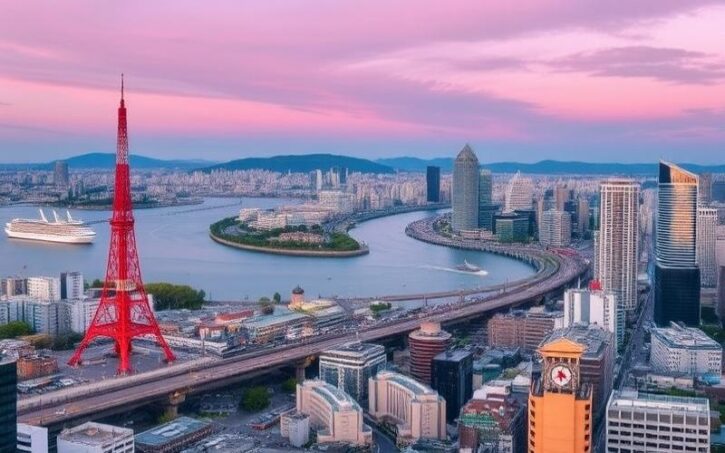
Nestled on the shores of Tokyo Bay, the city of Yokohama has established itself as one of Japan’s most compelling real estate markets for investors. As the country’s second-largest city, home to approximately 3.77 million residents, located in one of Japan’s wealthiest prefectures, and benefiting from exceptional transportation links and a vast urban renewal program, Yokohama combines solid rental yields, capital appreciation potential, and a high quality of life.
Good to know:
This article analyzes the Yokohama real estate market by integrating data, ongoing development projects, and the legal framework, providing a comprehensive understanding of the investment opportunities and procedures in the city.
A market rooted in a powerful metropolis
Yokohama lies about 19 miles (30 km) southwest of central Tokyo, in Kanagawa Prefecture. The city spans 169 square miles (438 km²), has a population density of roughly 8,600 residents per square mile (22,300/km²), and is home to more than 120,000 foreign residents. It is part of the vast Tokyo metropolitan area, where residential demand remains structurally strong.
33.9
Kanagawa Prefecture’s nominal GDP is approximately 33.9 trillion yen.
Yokohama has also cemented its reputation as a highly livable city. It ranked first in Japan’s “most desirable places to live” surveys for six consecutive years between 2018 and 2023. For an investor, this popularity translates directly into sustained rental demand, particularly around Yokohama Station and the Minato Mirai waterfront.
Accessibility and transportation: a decisive advantage for rental demand
One of the strongest arguments for real estate investment in the city of Yokohama is the quality of its transportation network. The city is served by several JR lines (Tokaido, Keihin-Tōhoku, Yokosuka, Shōnan-Shinjuku, Yokohama, Negishi), private railways (Tokyu Tōyoko, Keikyū Main, Sotetsu), two municipal subway lines (Blue Line, Green Line), and the Minatomirai Line.
From Yokohama Station, travel times to Tokyo’s major business hubs are highly competitive:
| Route (from Yokohama) | Approximate travel time |
|---|---|
| Tokyo Station | ~25 minutes |
| Shinagawa | ~20 minutes |
| Shibuya | ~27 minutes |
| Shinjuku | ~30 minutes |
| Ikebukuro | ~35 minutes |
The JR Tokaido Line connects Yokohama to Tokyo Station directly with very few stops, while the Tokyu Tōyoko and Shōnan-Shinjuku lines provide direct links to Shibuya, Shinjuku, and Ikebukuro. For a working professional commuting to Tokyo, living in Yokohama means an average daily trip of 30 to 40 minutes, putting the city in direct competition with Tokyo’s 23 wards, yet with rents 20% to 40% lower.
Attention:
Yokohama is well connected to international airports—a major plus for executives and expatriates: approximately 30 minutes to Haneda Airport (via Keikyū Main Line or express bus) and about 1 hour 30 minutes to Narita Airport (via JR Yokosuka Line or Narita Express).
This first-rate accessibility directly helps limit rental vacancy risk for well-located properties, especially near major stations (Yokohama, Shin-Yokohama, Minato Mirai, Kannai, Sakuragichō).
A living environment appreciated by residents and expatriates
The city of Yokohama is more than just profitability figures. It offers a living environment often perceived as more relaxed than Tokyo, while still being highly urban. Historic port districts, large parks like Yamashita Park, the shopping streets of Motomachi, and the Minato Mirai waterfront avenues create a landscape blending heritage and contemporary architecture.
20
Grocery prices are on average up to 20% lower than in Tokyo.
| Expense item (city center) | Yokohama (index) | Tokyo (index) | Comment |
|---|---|---|---|
| Groceries | 80–90 | 100 | 10–20% cheaper in Yokohama |
| Restaurants | 75–85 | 100 | 15–25% cheaper in Yokohama |
| 1-bedroom rent in city center (USD) | ~$701 | ~$1,001 | Approx. –30% vs Tokyo |
| 3-bedroom rent in city center (USD) | ~$1,167 | ~$1,794 | Even larger gap |
For families and expatriates, Yokohama also offers a wide range of international schools (Yokohama International School, St. Maur, Horizon Japan, etc.), hospitals with foreign-language services, and municipal support centers for foreign residents. The presence of these facilities creates a stable demand base for upscale housing, particularly in the Naka, Minato Mirai, Yamate, and Honmoku districts.
Prices, rents, and yields: Where does Yokohama stand?
From a strictly financial standpoint, investing in real estate in the city of Yokohama offers a fairly rare combination of decent yields and appreciation potential, while remaining more affordable than Tokyo.
Market studies indicate an average gross rental yield of approximately 4.4% in Q1 2025, up from 3.97% one year earlier, while the national average hovers around 4.2%. Yields in Yokohama generally exceed those in Tokyo’s 23 wards by 0.2 to 0.5 percentage points, thanks to acquisition prices 20%–30% lower combined with sustained rental levels.
Rental levels by property type
Average monthly rents in Yokohama show significant variation depending on property size and location (city center vs. residential wards):
| Size (approx.) | Central Yokohama | Residential wards (Aoba, Tsuzuki…) |
|---|---|---|
| Studio / 1R | ¥60,000–100,000 | ¥50,000–80,000 |
| 1LDK / 2DK | ¥95,000–140,000 | ¥80,000–120,000 |
| 2LDK / 3LDK | ¥135,000–210,000 | ¥110,000–170,000 |
Citywide averages are around ¥68,000 for a studio, ¥95,000 for a one-bedroom, ¥123,000 for a two-bedroom, and ¥158,000 for a three-bedroom.
Focus by ward: rents and accessibility
Each ward presents a different risk/return profile. For instance, central wards near the bay command higher rents and better liquidity, while outlying districts offer lower entry prices.
| Ward (samples) | Studio (¥/month) | 1-bedroom (¥) | 2-bedroom (¥) | 3-bedroom (¥) |
|---|---|---|---|---|
| Nishi (Yokohama Station) | 53,000–66,000 | 62,000–74,000 | 88,000–120,000 | 125,000–162,000 |
| Naka | 52,000–65,000 | 60,000–75,000 | 85,000–117,000 | 112,000–164,000 |
| Kanagawa | 54,000–58,000 | 60,000–74,000 | 80,000–106,000 | 100,000–134,000 |
| Hodogaya | 45,000–50,000 | 57,000–67,000 | 75,000–89,000 | 88,000–99,000 |
| Minami | 51,000–52,000 | 59,000–69,000 | 78,000–90,000 | 97,000–116,000 |
Some areas of Nishi-ku offer studios around ¥40,000, which can appeal to budget-conscious investors, while a 1LDK in Hodogaya starts around ¥80,000. At the other end of the spectrum, luxury apartments in Minato Mirai frequently exceed ¥200,000 per month, and some high-end properties can command rents of ¥900,000.
Sales prices for apartments and houses
The resale condominium market is especially active. As of late 2024, the average price of a pre-owned apartment in Yokohama was about 65.4 million yen, up 14.6% year-on-year. New single-family homes averaged around 47.2 million yen in early 2025.
Example:
In Paris, real estate prices vary significantly from one district to another. For instance, for a 753 sq ft (70 m²) apartment or a 1,076 sq ft (100 m²) house, the cost can double or triple depending on location, highlighting the importance of geography in property valuation.
| Ward (selected) | Condo 70 m² (M¥) | House 100 m² (M¥) |
|---|---|---|
| Nishi | 49.03 | 54.88 |
| Naka | 42.62 | 51.24 |
| Kohoku | 39.92 | 53.11 |
| Aoba | 38.76 | 56.71 |
| Hodogaya | 26.42 | 38.75 |
| Isogo | 27.33 | 40.44 |
These levels remain significantly lower than those observed in Tokyo’s 23 wards, where the average price of a new 70 m² apartment often exceeds 85 million yen, and the entry ticket for a new condo in central areas can be around 110 million yen.
Major investment hubs in the city of Yokohama
Investing in real estate in Yokohama means different things depending on whether you target Minato Mirai, the Yokohama Station area, Kannai/Bashamichi, or Shin-Yokohama. Each zone has its own yield, risk, and appreciation profile.
Minato Mirai 21: the constantly (re)developing waterfront
The Minato Mirai 21 district, a vast 460-acre (186-hectare) waterfront redevelopment project, is Yokohama’s contemporary showpiece. Built largely on reclaimed former industrial land, it features office towers, hotels, shopping centers, cultural facilities, and a number of high-end residences. The area is entirely zoned as commercial under Japan’s urban planning law, with a notable share of green space (about 114 acres / 46 hectares).
From an urban and economic perspective, Minato Mirai 21 is largely complete (nearly 96% developed in the central district), but several major projects continue beyond 2026, such as Linkage Terrace (Blocks 60/61), the Harbor Edge complex, and new luxury hotels (Four Seasons, Conrad).
The area houses more than 1,770 companies, approximately 100,000 daily workers, and attracts between 76 and 81 million visitors annually. The cumulative economic impact of construction investment is estimated at over 3,000 billion yen, with an annual urban operation effect of about 2,000 billion yen. For a real estate investor, this translates into several advantages:
– Sustained demand for office space,
– A robust market for high-end residences,
– Significant tourist flows favorable to short-term furnished rentals (where regulations permit).
Tip:
Gross rental yields for residential properties in this area generally range from 3.5% to 4.5%, slightly lower than other parts of Yokohama due to higher acquisition prices. However, this sector benefits from a stronger capital appreciation outlook, driven by its official designation as a green, connected “FutureCity” project supported by the municipality and the national government.
Unsurprisingly, rent levels are among the highest in the city. For reference:
| Minato Mirai area (apartments) | Area | Monthly rent (¥10,000) |
|---|---|---|
| 1 bedroom | 50 m² | 19–35 |
| 2 bedrooms | 80 m² | 25–73 |
| 3 bedrooms | 120 m² | 50–90 |
For investors focused on “prime” assets seeking an iconic property in a flagship district, Minato Mirai 21 is the most emblematic area in Yokohama, provided you accept a slightly compressed yield and greater sensitivity to new supply (temporary office vacancy above 10% in the central district).
Yokohama Station area: stability and liquidity
Around Yokohama Station, primarily in Nishi-ku, the urban landscape is undergoing transformation. The major renovation plan for the west exit (“Yokohama Station West Exit Grand Remodeling Plan”), led notably by the Sotetsu Group, is part of a broader redevelopment program, “Excite Yokohama 22”, launched in 2009 and envisioned through the 2030s.
The area already hosts large shopping centers (Takashimaya, JOINUS, More’s, Vivre, Sogo, Lumine, Bay Quarter) and new towers, such as the JR Yokohama Tower and THE YOKOHAMA FRONT TOWER (43 stories, 459 units, delivered in 2024). Land prices reflect this dynamism: some parcels, such as the Yokohama More’s site, reach 13 million yen per square meter, far ahead of the second-highest location in Kanagawa.
For an investor, this area offers several distinct advantages:
Investment in Tokyo
Key strengths of the residential and office real estate market in the Japanese capital.
Accessibility and demand
Excellent access to Tokyo and the rest of the Kantō region, limiting vacancy risk. Strong demand for small units suited to singles.
Rent dynamics
Firm rent levels and a moderately upward trend in the residential market.
Office market
Very low office vacancy (around 3.6%, improving toward pre-pandemic levels).
Expected yields for investment in this area typically range from 4% to 5% gross. This represents an interesting compromise between stable rental income and land appreciation potential, especially very close to the station or in new mixed-use developments (residential, hotel, retail).
Kannai and Bashamichi: historic charm and higher yields
Southeast of Yokohama Station, the Kannai/Bashamichi area is the city’s administrative and judicial heart, but also a zone of rich architectural heritage, where Western-style Meiji-era buildings stand alongside modern office blocks and cultural facilities.
The area is subject to several major redevelopment projects, such as the renovation of Kannai Station’s forecourt, with mixed-use towers (offices, housing, retail, nightlife venues, cultural spaces) and a restructuring of the station plaza. The BASEGATE Yokohama Kannai project, on the former city hall site, illustrates the municipal ambition to create a hub blending entertainment, innovation (new industry creation center), hotel, and dining.
For investors, the appeal of the Kannai/Bashamichi area lies in several factors:
– Strong demand from office workers, lawyers, civil servants, etc.,
– Short-term rental potential due to numerous tourist sites (Chinatown, Yamashita Park, baseball stadium, red-brick warehouses)
– Slightly lower acquisition prices than the station area or Minato Mirai, enabling higher yields.
Good to know:
Gross yields for residential or mixed-use investments in this area typically range from 4.5% to 5.5%. Note that building quality varies widely, with many older properties potentially requiring renovation. Additionally, rent levels fluctuate significantly based on micro-location—for example, between a busy street and a quieter area.
Shin-Yokohama: a bet on a transportation node
Shin-Yokohama is best known for its Shinkansen station, placing the city on the Tokyo–Nagoya–Osaka corridor. The area is strengthening its role as a transport hub with the development of office buildings and hotels, such as the “Suite Shin-Yokohama” building (14 stories, delivered in 2025). However, office vacancy is higher here (around 8.5%), partly due to recently vacated large spaces.
For an investor, this zone offers a more “mid-risk/mid-return” profile: expected yields range from 4.5% to 6%, with vacancy risk higher than around the main station or Kannai. It may suit those willing to accept a bit more volatility in exchange for higher returns, particularly on well-located small units near the station.
Peripheral wards: higher yields, lower budget
Around the metropolitan core, several Yokohama wards offer lower-entry investment opportunities, with modest rents but stable demand from families and households seeking a more residential setting.
Wards such as Seya, Isogo, Asahi, Sakae, Kanazawa, Totsuka, and Konan stand out for their particularly affordable rents:
| “Affordable” ward | Studio (¥) | 1K/1DK (¥) | 1LDK/2K/2DK (¥) | 2LDK/3K/3DK (¥) |
|---|---|---|---|---|
| Seya | 38,000 | 64,000 | 78,000 | 83,000 |
| Isogo | 40,000 | 71,000 | 81,000 | 98,000 |
| Asahi | 45,000 | 65,000 | 81,000 | 82,000 |
| Sakae | 47,000 | 66,000 | 67,000 | 85,000 |
| Kanazawa | 48,000 | 66,000 | 85,000 | 101,000 |
| Totsuka | 52,000 | 65,000 | 87,000 | 101,000 |
| Konan | 65,000 | 68,000 | 85,000 | 98,000 |
These areas can offer attractive gross yields, especially for family-sized units, provided you carefully select locations (proximity to a station, limited slope topography, absence of major natural risks such as landslides or flooding). Some wards like Sakae also boast low crime rates, a reassuring argument for family tenants.
A city driven by vast redevelopment projects
A key structural element in understanding Yokohama’s real estate dynamics is the scale of its urban renewal projects. Beyond Minato Mirai 21, the city is deploying a veritable patchwork of major projects that will durably affect property asset values.
Around Yokohama Station, the transformation of the west exit (including THE YOKOHAMA FRONT) and soon the south exit is part of a master plan aiming to make the area a “gateway to an international city”. The “Excite Yokohama 22” project includes mixed-use towers, infrastructure improvements, and upgraded public spaces.
In the Kannai district, the station forecourt overhaul, the conversion of the former city hall into the BASEGATE Yokohama Kannai complex, and waterfront projects (Yamashita Pier transformed into a “Harbor Resort” by 2030) are part of a strategy to better connect the city to its bay, focusing on culture, tourism, and innovation.
Kannai Urban Development Strategy, Yokohama
Looking ahead to 2030, the extension of the Blue Line subway to Shin-Yurigaoka, the redevelopment of large brownfields like the former Kamiseya base, and the development of new port terminals (Shin-Honmoku) will also reshape the map of accessibility and centrality. For an investor, tracking these development axes is crucial to anticipate future land value increases.
Comparison with Tokyo: Why take a close look at Yokohama?
In the Japanese context, Tokyo remains the star market, with record investment volumes, sustained price increases, and global appeal. But this premium comes at a cost. For illustration, the average price of a new apartment in central Tokyo’s 23 wards exceeds 110 million yen, with per-square-meter rents among the highest in the country. Yields are consequently compressed.
Yokohama, on the other hand, offers several advantages:
Advantages of real estate investment in Tokyo’s suburbs
Key financial and strategic strengths of investments in central Tokyo’s 23 wards vs. the periphery.
Attractive acquisition prices
Prices approximately 20% to 30% lower than in central Tokyo’s 23 wards.
Higher gross yields
Gross yields on average 0.2 to 0.5 percentage points higher.
Broader rental demand base
More affordable rents and cost of living, expanding the pool of potential tenants.
Capital appreciation prospects
Value growth potential linked to significant development margins, notably from ongoing redevelopment projects.
Moreover, the travel time to Tokyo’s main business districts is relatively short, making Yokohama a credible substitute for some more peripheral Tokyo wards, while offering a more comfortable living environment (larger homes at equivalent prices, more green spaces, a calmer atmosphere).
For an investor seeking a balance between yield and safety, the city of Yokohama thus emerges as a “prime suburb” of Tokyo, with its own economic and cultural growth drivers.
Rental market: demand profile and winning strategies
The key to a successful investment in the city of Yokohama is understanding its rental demand structure. Several strong trends emerge.
First, the proportion of single-person households is rising, even as the working-age population (15–64) is expected to decline over time. This means demand for studios and small 1LDK units near stations will remain solid, especially around Yokohama Station, Shin-Yokohama, Kannai/Bashamichi, and university hubs like Hiyoshi.
4-6.5
Typical gross yields for studios targeting single-person households in Yokohama range from 4% to 6.5%.
Second, family-oriented demand exists in residential wards such as Aoba, Tsuzuki, Totsuka, and Kanazawa, often attracting households seeking a green environment, good schools, and reasonable access to Yokohama Station or the Tokyu network. For these markets, 2LDK/3LDK apartments or single-family homes can offer attractive yields with limited vacancy, provided they are within a reasonable walking distance of a station (under 15 minutes) and in areas with reduced natural risks.
1500000
Monthly rent can reach 1.5 million yen for a large villa over 200 m² in Yokohama’s premium neighborhoods.
Legal framework for foreign investors
One of the attractions of the Japanese market, and therefore of the city of Yokohama, is the absence of major restrictions on property acquisition by foreigners. Non-residents can buy apartments and houses with the same property rights as Japanese citizens. There is no time limit: ownership is perpetual and transferable.
However, a few practical points are worth knowing.
Property rights and procedures
Real estate transactions follow the same process for a foreign buyer as for a Japanese buyer:
1. Property search with an agency,
2. Viewing, offer, and negotiation,
3. Delivery of the “Important Matters Explanation” document,
4. Signing of the purchase agreement and deposit payment (typically 5%–10% of the price),
5. Securing (if applicable) bank financing,
6. Signing the final deed, paying the balance, and registering the transfer of ownership.
Tip:
The property purchase process in Japan typically takes 60 to 90 days. All documents are in Japanese, the only legally binding language; translations are for reference only. It is highly recommended to use an agency experienced with foreign clients, and possibly an interpreter or legal advisor. In Yokohama, several specialized agencies and platforms offer support to international buyers, often in English, Chinese, or Korean.
Non-resident foreigners are generally required to report their acquisition under the Foreign Exchange and Foreign Trade Act (FEFTA) within 20 days of purchase, except for personal residences or other specific cases. Additionally, since 2024, the names of foreign buyers must be recorded in both Japanese characters (kanji/kana) and the Latin alphabet in the land registry.
Financing and banking constraints
Obtaining a mortgage in Japan is possible for foreigners, but significantly more difficult for non-residents. Banks prefer borrowers with long-term resident status, ideally permanent residency, a stable income, and several years of employment history in Japan.
Good to know:
Mortgage conditions in Japan vary greatly depending on your status. A permanent resident or someone married to a Japanese national with a stable full-time job for several years may obtain terms similar to those for Japanese borrowers. Conversely, a non-resident will generally need a larger down payment, accept higher interest rates, and turn to a limited number of banks, such as Suruga Bank or SMBC Trust Bank PRESTIA, known for being more open to foreign clients.
Banks typically cap the annual debt service at 25%–35% of gross income. Fixed rates for 20-year loans currently stand around 2% in Japan, slightly less in Tokyo, which remains low by international standards, though with an upward trend due to the Bank of Japan’s monetary policy shift.
Real estate taxation in Yokohama
Investing in real estate in the city of Yokohama requires understanding the tax structure on property, which breaks down into three main areas: acquisition taxes, annual taxes, and income/capital gains taxation.
The main annual taxes are the fixed asset tax and the city planning tax. The former is generally 1.4% of the assessed value, recalculated every three years and often below market value. The latter, applicable in urbanized areas under the Urban Planning Act, typically adds 0.2%–0.3% (0.3% in Tokyo, similar in Yokohama). In total, the annual burden represents about 1.7% of the assessed value.
Attention:
Yokohama City issues fixed asset and city planning tax notices in spring, with payment options of a single lump sum or four installments. Non-resident property owners must appoint a tax representative in Japan to make these payments and handle rental income declarations.
At purchase, several levies apply:
– Registration and license tax, around 2% for a property transfer,
– Real estate acquisition tax, generally 3% of land and residential building value,
– Stamp duty on the sales contract, depending on the price,
– Agency fees, capped at 3% of the price + ¥60,000 + consumption tax,
– Judicial scrivener fees for registration.
In total, budget about 5%–10% of the purchase price for fees and taxes.
Rental income received by a non-resident is subject to withholding tax at a rate of approximately 20.42%. Upon resale, capital gains are taxed differently depending on the holding period: about 39.63% for properties held 5 years or less (short term), versus 20.315% for longer holdings (long term). Again, it is advisable to work with a tax specialist.
Risks, cautionary notes, and property selection
Like any dynamic market, the city of Yokohama also presents risks that investors must consider.
Geographically, some sloping areas or locations more than 15 minutes’ walk from a station suffer from weaker rental demand. The hilly topography of certain zones, distance to transportation, and exposure to natural hazards (landslides in hill neighborhoods, tsunamis or storm surges on some waterfronts) should be carefully examined using official hazard maps.
Tip:
Gross rental yields exceeding 7% in the Japanese real estate market should be viewed with caution. They may hide significant flaws such as poor location, very old construction, or high costs (renovation, management, condominium fees). A significant portion of the housing stock was built before major revisions to earthquake resistance standards (before 1982 for buildings, before 2000 for wooden houses). In Yokohama as elsewhere, it is advisable to avoid older buildings not meeting these standards, especially in areas with soft soil or near water.
The macroeconomic context must also be considered: Japan is gradually emerging from decades of near-zero interest rates, construction costs have risen by nearly 30% since 2020, and the Bank of Japan signals a gradual increase in its policy rates. These factors can weigh on development projects and the profitability of new schemes, even if mortgage rates remain low by international comparison.
Good to know:
Faced with Japan’s rapid aging and demographic stagnation, major metropolitan areas like Tokyo remain the most attractive for residents and businesses. Yokohama, integrated into this metropolis, benefits from a favorable position thanks to its large population, solid economy, and recognized residential appeal.
How to build an investment strategy in Yokohama?
To build a solid investment strategy in the city of Yokohama, several analytical axes are essential.
First, clarify your primary objective: stable rental income, capital appreciation play, or a combination of both. Depending on the desired profile, the preferred zones differ:
Real estate investment opportunities in Yokohama
Three distinct strategies for investing in real estate in Yokohama, tailored to different investor profiles.
Stable rental income
Invest in the Yokohama Station area and its immediate surroundings, benefiting from heavy commuter traffic and low vacancy for regular income.
Capital appreciation potential
Target the Minato Mirai waterfront and major redevelopment corridors, where land values are expected to rise as projects complete.
High yield & moderate entry price
Focus on historic districts undergoing renewal (Kannai/Bashamichi) or well-served peripheral residential wards, for good yields with a more accessible entry price.
Next, analyzing the supply/demand balance is critical: area vacancy rate (ideally below 5%), new construction projects, rent trends, quality and quantity of competing properties. In Yokohama, market reports show, for example, that office vacancy rates around Yokohama Station and Kannai remain below the critical 5% threshold, while the central Minato Mirai district saw vacancy temporarily exceed 10% due to an influx of new supply.
Attention:
For an accurate projection, it is essential to calculate a net yield by deducting all fees and expenses from the gross yield, rather than relying solely on the latter.
– Fixed asset and city planning tax (about 1.7% of assessed value per year),
– Property management fees (often 5%–10% of rent),
– Provisions for repairs, considering the building’s age,
– A reasonable future vacancy allowance, ideally above the area average to maintain a safety margin.
Finally, it is crucial to have a reliable management system, especially for non-resident investors. In Yokohama, as in Tokyo, numerous management companies can handle tenant search, rent collection, routine maintenance, and communication with condominium associations, for a fee.
Conclusion: Yokohama, a market at the crossroads of stability and potential
Investing in real estate in the city of Yokohama means betting on a major Japanese city that has successfully combined port heritage, economic dynamism, and large-scale redevelopment projects to position itself as a credible—and often more rational—alternative to central Tokyo.
With more accessible purchase prices, slightly higher yields, sustained rental demand from commuters, families, and a growing international community, and a packed calendar of urban projects through the 2030s, Yokohama offers fertile ground for diverse investment strategies.
Good to know:
Whether for a studio, a upscale apartment, or a family home, successful investment in Japan hinges on a fine understanding of each neighborhood, integration of specific risks (topography, natural hazards, building age), and guidance from professionals familiar with local market peculiarities.
In a Japan where the value of the yen, the return of tourists, corporate reforms, and pressure on housing supply are redrawing the real estate investment map, the city of Yokohama emerges as a strategic link in the greater Tokyo region, offering an interesting balance between yield, risk, and quality of life. For investors willing to take a serious look, the port of Yokohama is not just a postcard: it is a full-fledged market, in motion and far from having exhausted its potential.

Cyril Jarnias is an independent expert in international wealth management with over 20 years of experience. As an expatriate himself, he is dedicated to helping individuals and business leaders build, protect, and pass on their wealth with complete peace of mind.
On his website, cyriljarnias.com, he shares his expertise on international real estate, offshore company formation, and expatriation.
Thanks to his expertise, he offers sound advice to optimize his clients' wealth management. Cyril Jarnias is also recognized for his appearances in many prestigious media outlets such as BFM Business, les Français de l’étranger, Le Figaro, Les Echos, and Mieux vivre votre argent, where he shares his knowledge and know-how in wealth management.





