
 Published on and written by Cyril Jarnias
Moving to Pakistan is increasingly attracting professionals, entrepreneurs, and families seeking a lower cost of living, economic opportunities, and a rich cultural environment. But the country remains associated with an image of high risks: terrorism, political instability, crime, dangerous roads. The reality is more nuanced. Yes, the security context is demanding, but an expatriation can go smoothly provided you carefully prepare your project and follow a few strict rules.
This article offers an honest overview of safety, focusing on major cities like Islamabad, Lahore, Karachi, Rawalpindi, and Skardu. It details the public and private measures available to reduce daily risks.
Understanding the security landscape before you go
The first step, even before thinking about housing or schooling, is to properly situate Pakistan on the risk scale as defined by Western governments.
The United States classifies the country at Level 3: “Reconsider Travel”, due to terrorism, crime, kidnappings, and other risks. Canada advises to “exercise a high degree of caution,” and the United Kingdom formally advises against certain areas while limiting its advice to “essential travel only” in others.
Although foreign presence (companies, NGOs, embassies) is possible, an expatriation in this area requires above-average preparation. The situation is described as “fluid, unpredictable, and volatile,” capable of changing rapidly due to attacks, political tensions, or border clashes.
Areas to strictly avoid and areas to prioritize
Official advisories are very clear on certain regions: Balochistan and Khyber Pakhtunkhwa (KP) (including the former FATA tribal areas) are classified as “Do Not Travel” by the United States and advised against by other countries due to terrorism, kidnappings, and insurgency. Areas near the Afghan border and the Line of Control (LoC) with India are also to be avoided by foreigners.
The major cities in Pakistan where expatriates are concentrated, such as Islamabad, Lahore, and Karachi, offer contrasting but generally better levels of safety. Islamabad is considered the safest city in the country thanks to significant public investment. Lahore offers a stable and comfortable urban environment. As for Karachi, despite a high crime rate, it has highly secured residential neighborhoods sought after by expatriates and local elites.
For a quick overview:
| Zone / Region | Overall risk level (trend) | Recommendation for expatriates |
|---|---|---|
| Islamabad | Moderate (strong security setup) | Possible with strong precautions |
| Lahore | Moderate, some episodes of violence | Possible in secure neighborhoods |
| Karachi | High (crime, terrorist risks) | For experienced expatriates only, highly secure neighborhoods |
| Balochistan | Very high (insurgency, kidnappings) | Avoid |
| Khyber Pakhtunkhwa (outside enclaves) | Very high | Avoid |
| Proximity to LoC and Afghanistan border | Very high / military risk | Avoid |
| Gilgit‑Baltistan | Variable security + natural hazards | Strictly supervised professional travel only |
This is not enough to make a decision, but it sets the framework: a peaceful expatriation in Pakistan is first thought of in terms of geography. Living in Islamabad is nothing like investing in an isolated project in Balochistan.
Living safely in Pakistan: choosing the right city and neighborhood
Once the question of “where not to go” is settled, you need to delve into the details of “where to live” to minimize daily risks. The good news is that major cities have seen the emergence of a series of planned neighborhoods and gated communities designed to offer a highly controlled environment, with guards, access control, and video surveillance.
Islamabad: the safest capital in the country
A city built from scratch to be the capital, Islamabad stands out for its very organized urban planning and reinforced security measures. Wide avenues, well-defined residential sectors, proximity to federal institutions and embassies: everything makes it the preferred landing spot for a first expatriation.
Among the recommended sectors:
Overview of the main residential sectors in the Pakistani capital, suited to the needs of diplomats and expatriate families, combining security, amenities, and quality of life.
F-6 (Blue Area), F-7 (Jinnah Super), and F-8/F-10 are affluent central or semi-central areas, mixing upscale homes, shops, cafes, and restaurants. Very popular with embassy staff.
E-7 (Margalla Road) and E-11 are appreciated for their tranquility. E-7 notably offers remarkable views of the Margalla Hills National Park.
Ultra-protected area housing many embassies, surrounded by checkpoints. Security is extreme, but rents are high and the environment can feel confined.
Bahria Town Islamabad, Gulberg Islamabad, and Bahria Enclave are gated residential suburbs, offering schools, shops, parks, and 24/7 security, ideal for families.
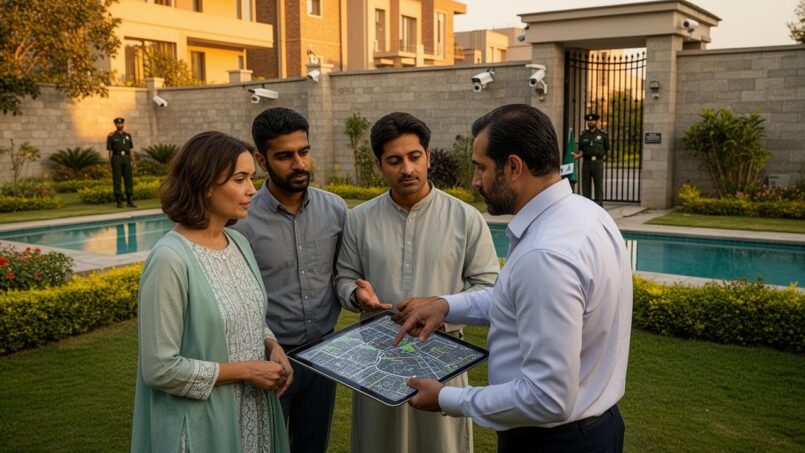
A notable example of securing is Gulberg Islamabad, where you find multiple cameras, automatic license plate recognition (ANPR), entry control, regular patrols, and formalized emergency protocols. Residents are encouraged to add a layer of private security (CCTV, smart locks), while neighborhood associations and mutual surveillance programs strengthen the sense of community.
Lahore: cultural city and large planned neighborhoods
In Lahore, the country’s cultural capital, most expatriates concentrate in a few neighborhoods offering a good compromise between comfort, services, and safety.
The most sought-after areas are: coastal regions, dynamic urban areas, and popular tourist destinations.
Overview of the main residential sectors in Lahore, known for their quality of life, infrastructure, and safety.
Originally intended for military personnel, this vast complex now offers a modern setting, quality infrastructure (roads, parks, schools, hospitals), and renowned security.
Central and dynamic neighborhood, with many shopping centers, offices, restaurants, and high-end housing.
Established, leafy residential sectors, relatively quiet and well-serviced.
Large gated community on the outskirts, highly secure, with its own facilities and services.
In these areas, police presence is stronger, and the combination of private guards, barriers, and video surveillance significantly limits the risks of burglary and assault.
Karachi: port city and economic capital under high vigilance
Karachi remains the most delicate city security-wise due to a high level of crime (armed robbery, carjacking, gangs, kidnappings). Nevertheless, many expatriates and local executives live there, concentrated in a few highly protected enclaves.
Key neighborhoods:
– Clifton and DHA Karachi (especially phases 6 and 8): affluent coastal areas with modern infrastructure, very popular with expatriates. Streets are more monitored, neighborhoods are largely fenced, with guards screening entries.
– PECHS, Boat Basin, Karachi Cantonment: mixed residential-commercial sectors with a relatively structured environment and good connections.
– Bahria Town Karachi, Malir Cantt, North Nazimabad (blocks A to H): secure projects or cantonments, with clear legal status, favored by families and upper-middle classes.
– AA Waterfront: newer project targeting a high-end clientele wanting to live by the sea, in a highly controlled setting.
In this city, it is common for expatriate executives and business leaders to use private drivers. For certain sensitive trips, using a close protection team is also a widespread practice.
Rawalpindi, Skardu, and other cities
Islamabad’s neighbor, Rawalpindi, is often considered an extension of the capital. You find secure areas like Bahria Town Rawalpindi or Scheme III – Chaklala, appreciated for their planning and security.
Further north, Skardu, in the Gilgit‑Baltistan region, enjoys a reputation as a very safe city, with spectacular surroundings and a population described as warm. But the context is different: more touristy, more dependent on weather conditions, and subject to travel restrictions imposed by some governments that now advise against all non-essential travel in the region.
What these neighborhoods have in common
Setting aside the specifics of each city, the areas recommended for expatriates share a number of characteristics:
| Common features of sought-after neighborhoods | Concise description |
|---|---|
| Enhanced security | Guards, barriers, access control, video surveillance, sometimes private patrols or police coordination |
| Planned urban planning | Wide roads, residential zoning, better managed electricity and water networks than other areas |
| Wide range of housing | Apartments, houses, villas, often with furnished options for expatriates |
| Local services | Schools, private clinics, shopping centers, restaurants, cafes, parks |
| International or affluent population | Presence of diplomats, business executives, local upper-middle classes |
| Relatively stable resale value and rents | Sustained attractiveness, high demand for rental and purchase |
For an expatriate, these neighborhoods are not only safer; they also allow you to reduce exposure to the rest of the city, thanks to a more “self-contained” daily life: you live, shop, school your children, and consult doctors and dentists there.
Crime, terrorism, kidnappings: measuring the real risks
Once the urban setting is established, the key question remains: what are you actually afraid of in Pakistan? The risks are on several levels, which do not all affect expatriates in the same way.
Terrorism: diffuse threat, but statistically low in cities
Pakistan has long been marked by terrorist attacks, with the presence of groups like Tehrik‑e‑Taliban Pakistan (TTP), Al‑Qaeda, the Islamic State (ISKP), and Baloch separatist movements. Targets vary: government buildings, security forces, places of worship, markets, transport infrastructure, sometimes schools or hospitals.
Major metropolises are not completely spared – attacks have been recorded in Islamabad and Karachi – but statistically, they remain rare given the size of the cities. The most affected areas remain Balochistan and Khyber Pakhtunkhwa, where insecurity is chronic.
For expatriates in Islamabad or Lahore, prevention relies mainly on avoiding sensitive places and times. This includes large gatherings, demonstrations, sectors known to be targets (such as certain official buildings or highly publicized places), as well as periods of political or religious tension, such as Ramadan or elections.
Ordinary crime: theft, assault, scams
Common crime is high, especially in major cities: pickpocketing, bag or phone snatching in markets and transport, various scams, armed attacks, carjacking. In Karachi, these phenomena are frequent; in Islamabad and Lahore, they exist but to a lesser extent.
To limit exposure, the recommendations are standard but must be applied with rigor:
– avoid walking alone at night;
– do not display jewelry, luxury watches, computers, or latest smartphones on the street;
– prefer taxis or ride-hailing from reliable companies rather than random vehicles;
– constantly monitor your personal belongings;
– limit discussions about your financial or professional situation with strangers.
To avoid risks of bank card fraud and ATM cloning, it is recommended to prioritize withdrawals from well-established banks rather than isolated locations. Opt for withdrawals of significant amounts (e.g., around 100,000 PKR) to limit the number of transactions and potential fraud exposure.
Kidnappings: a risk concentrated in certain regions and professions
The risk of kidnapping for ransom is real, especially in the provinces of Balochistan, Punjab, and Sindh. “Express” kidnappings (release after cash withdrawal) are also reported. Foreigners, particularly aid workers, journalists, or isolated entrepreneurs, have been targeted.
However, in major cities and especially within secure neighborhoods, this risk is significantly reduced, provided you:
– vary your routes and travel times;
– maintain a low profile, without an overly obvious routine;
– avoid nighttime long-distance road travel;
– stay away from risk zones flagged by authorities or your employer.
Large organizations and international companies often set up crisis management plans and very strict protocols for employee travel, with, if necessary, armed escort or armored vehicles.
Getting around safely: roads, public transport, taxis, and domestic flights
Mobility is one of the most sensitive points for expatriates. The dominant risk here is less about attacks than road accidents, assaults, or carjackings.
Driving yourself: possible, but rarely recommended
Most expatriates choose not to drive. The road network alternates between modern highways (M‑1, M‑2…) and very deteriorated secondary roads, especially in mountainous or rural areas. Add to that often aggressive local driving, approximate adherence to traffic rules, overloaded vehicles, massive trucks, and a lack of lighting.
Although an International Driving Permit (1968 format) accompanied by a national license is theoretically valid for driving, many companies on the ground practically require renting a vehicle with a driver or exclusively using internal drivers, who are trained in local security procedures.
Taxis, ride-hailing, and urban travel
In major cities, taxis and ride-hailing are ubiquitous, but not all are equal in terms of safety. Some reference points:
– Prioritize well-known apps like Careem or other services recommended by your employer or trusted expatriates.
– Avoid hailing random taxis on the street, especially at night; better to order by phone or app.
– Always sit in the back, never in the front.
– For women, some cities like Karachi offer women-only taxi services, identified by their color.
Using public transport (buses, minibuses, metro‑bus, trains) is discouraged for expatriates for security reasons (overcrowding, theft, risk of attacks) and comfort. Intercity buses and trains have historically been targets of attacks or sabotage, and accidents are frequent.
Intercity travel: prioritize flying
To connect major cities, flying remains the safest and most efficient means. Airlines like airblue and other domestic carriers operate main routes between Islamabad, Lahore, Karachi, and some northern cities. However, you must factor in the possibility of delays or cancellations, especially for flights to mountainous areas like Gilgit or Skardu, subject to weather conditions.
Road trips between major cities are possible, but should be done during the day and with an experienced driver. At night, the accumulation of obstacles (reduced visibility, local driving, risks of carjacking or improvised checkpoints) makes it much more risky.
Health, hospitals, and insurance: a pillar of personal safety
Safety is not limited to attacks or crime. For an expatriate, access to a reliable and responsive healthcare system is just as crucial, especially in a country where public emergency services are considered very insufficient.
A two-tier system: public overloaded, private essential
The Pakistani healthcare system relies on a dual network:
– Public: free for citizens, but often overcrowded, under-equipped, with highly variable hygiene and training levels. Not accessible to foreigners for most services, and anyway not recommended for a serious emergency.
– Private: concentrates most consultations, especially in major cities. Hospitals like Aga Khan in Karachi, Shifa International in Islamabad, or Doctors Hospital in Lahore enjoy a good reputation, with modern equipment and English-speaking doctors.
Outside major urban centers, access to quality care drops sharply: in many rural areas, facilities are described as “very poor” or even “virtually non-existent.”
Emergency care: plan ahead, because an ambulance is not a given
Emergency services are a weak link:
– few ambulances;
– poorly equipped vehicles, sometimes without medical staff;
– unpredictable response times.
In an emergency, it may be faster to go directly to the hospital by taxi or private car than to wait for an ambulance. However, in major cities like those in Sindh province, the free SIEHS‑1122 service offers 24/7 ambulances, complemented by a national telemedicine line.
For an expatriate, the practical strategy is to:
– identify in advance the reference private hospitals near your home and workplace;
– keep emergency numbers on you (police, ambulance 1122, hospital, employer, insurance);
– plan for the possibility of getting to the hospital yourself or with a colleague’s help in urgent need.
Health insurance: a non-negotiable investment
Expatriates are not eligible for major Pakistani public health insurance programs. Subscribing to international private health insurance with coverage for serious care, access to private facilities, and, above all, medical evacuation abroad if needed, is therefore not a luxury but a prerequisite for a peaceful expatriation.
This is the estimated average annual cost of international health coverage, varying by age, health, and benefits.
Pakistani private hospitals generally require cash payment, not always accepting credit cards. The insured pays, then gets reimbursed by their insurance. Having a cash reserve, or at least the ability to quickly receive funds from abroad, is part of the security plan.
Underestimating the importance of Pakistani social and religious norms is a sure way to expose yourself to dangerous situations, even without initial ill intent. The country is an Islamic republic where religion strongly structures public space, behaviors, and certain criminal laws.
Dress code and behavior in public
The basic rule is modest dress for everyone:
For attire respectful of cultural codes in Pakistan, it is recommended to cover shoulders and legs, including for men (shorts are frowned upon outside sports contexts). For women, avoid tight, short, or low-cut clothing. Jeans with a long tunic may be acceptable in more liberal neighborhoods of major cities, but the salwar kameez (traditional outfit) remains the best way to blend in. It is also recommended for women to cover their head with a scarf when entering mosques, holy sites, and in rural areas.
Public displays of affection, signs of intoxication, an excessively loud tone of voice, or gestures perceived as aggressive can trigger very negative reactions. Homosexuality is illegal, and drug use and possession are extremely repressed, with the death penalty theoretically applicable for certain offenses.
Religion and sensitive topics
The laws on blasphemy are extremely severe. Sometimes a rumor or misunderstanding about a comment deemed offensive to Islam or the Prophet can trigger tensions, even mob violence. Concretely, this means:
It is imperative to refrain from any jokes or comments about religion, avoid political or sectarian debates with strangers, and be very cautious on social media, even with a limited audience.
For an expatriate, safety also comes from learning simple codes: greeting with “Salam Alaikum,” removing shoes when entering someone’s home, showing marked respect to elders, adapting behavior during Ramadan (not eating or drinking openly in public during the day, for example).
Expatriate women: relative safety, but enhanced precautions
Testimonies converge on one point: in theory, assaulting a foreign woman shocks a large part of society and can be seen as a double or triple crime. In practice, women traveling or living in Pakistan report both a lot of kindness and episodes of verbal harassment or unwanted contact, especially in crowded places.
To limit risks, several strategies are combined:
For greater safety, it is advised not to travel alone at night, especially on public transport or long distances. Prioritize recommended taxis or ride-hailing, sit in the back, and inform someone of your route. Adopt very modest attire, close to local style, especially in working-class neighborhoods. Avoid dense crowds (demonstrations, large evening markets) where the risks of harassment and groping increase. As much as possible, travel with colleagues, trusted friends, or a recommended local guide.
Some regions like the Hunza Valley or affluent neighborhoods of Islamabad are reported as particularly safe and welcoming for women, but this does not exempt from vigilance.
Private security services, official systems, and mutual aid networks
For companies and individuals with substantial means, hiring private security companies is an integral part of risk mitigation strategy, especially in Karachi or for missions in more isolated areas.
Private security: guards, drivers, escorts
The country has many security companies, some highly structured, employing former military personnel, with 24/7 control centers, video surveillance systems, armored transport services, and even rapid intervention capabilities. Local and international players operate in major cities and offer:
Our professional security and protection services to ensure your peace of mind in all circumstances.
Discreet and continuous surveillance and protection of your home or office by trained agents.
Driving provided by professionals specially trained in security and defensive driving techniques.
Secure accompaniment for your personal or professional travel in high-risk areas or contexts.
Comprehensive vulnerability assessment of your sites and installation of custom systems (video surveillance, access control, alarms).
For an isolated expatriate, these services may seem disproportionate. They become relevant in three cases: if the employer requires it, if the mission involves recurring travel to more sensitive areas, or if you hold a highly exposed position (e.g., visible company director).
In parallel, the Pakistani state has tightened its security protocols around foreigners, especially since it systematically regulates the presence of foreign workers outside major infrastructure projects. Upon arrival, some visitors receive a security briefing and written instructions; tracking apps are sometimes mandatory.
Embassies provide security information and consular assistance (for arrest, loss of documents, serious medical issue or death). However, their action is very limited in high-risk areas or if the country does not recognize dual nationality. It is therefore essential to have an autonomous evacuation plan and not rely solely on potential government repatriation.
Cost of living, infrastructure, and daily life: safety also has a price
In the overall equation, you must factor in that life in Pakistan is very cheap for many items – housing, food, urban transport – but safety comes at a cost.
Some illustrative ballpark figures:
| Expense item (average values) | Indicative amount (USD / month) | Comment |
|---|---|---|
| Expatriate cost of living (excluding luxury) | ~ 500 | Excluding international school and high-end health |
| 1-bedroom studio in city center | ~ 325 | In Islamabad or Lahore in a decent neighborhood |
| Hotel (monthly median) | ~ 495 | Temporary option at start of expatriation |
| Airbnb (monthly median) | ~ 1,139 | Often in very central or upscale neighborhoods |
| Coworking office (hot desk) | ~ 81 | Internet infrastructure often modest (3 Mbps avg.) |
| Simple meal at local restaurant | ~ 2 | Very affordable |
| Taxi for 3 km | ~ 1 | Provided you use a reliable service |
| Mobile data (10 GB) | ~ 1 | Very low cost, useful for navigation and safety |
Add to this specific costs related to safety:
Settling in a high-risk country requires a specific budget for security. This typically includes higher rent for a residence in a gated community or secure neighborhood, the salary of a dedicated driver or guard, the additional cost of international health insurance with medical evacuation coverage, as well as investment in protective equipment like cameras, alarm systems, and safes.
Even with these expenses, life often remains much cheaper than in most Western capitals, but you must avoid the illusion of “saving money” to the point of skimping on critical aspects like housing, health, and travel.
Ten daily habits for a more peaceful expatriation
Without being exhaustive, certain habits make a real difference in the experience of safety in Pakistan:
For a safe stay in Pakistan, it is imperative to follow local news and embassy alerts, avoid any gatherings, and carry identification. Vary your routes, limit nighttime travel, and maintain a low profile on social media. Building a trusted local network, preparing an emergency plan, anticipating health risks, and strictly respecting local laws are also essential precautions.
Conclusion: a demanding environment, a possible expatriation but never “light”
Safety in Pakistan cannot be summed up by either anxiety-inducing images or reassuring speeches. The country combines real, sometimes serious, risks and fairly effective safety bubbles in which many expatriates lead a relatively stable professional and family life – especially in Islamabad and certain neighborhoods of Lahore or Karachi.
A peaceful expatriation therefore rests on a clear triptych:
A successful and safe expatriation relies on three pillars: a rigorous choice of location (city and neighborhood) avoiding high-risk regions, the implementation of appropriate protection infrastructure (secure housing, reliable transport, identified private hospitals, solid insurance), and strict personal discipline in applying safety instructions, respecting cultural norms, and monitoring local news.
This is not a country for an improvised expatriation or for a very adventurous lifestyle outside major cities. On the other hand, for those who accept this framework, surround themselves with reliable partners, and prepare seriously, it is possible to enjoy the advantages of Pakistan – cost of living, hospitality, economic opportunities – without sacrificing a minimum of daily serenity.
Disclaimer: The information provided on this website is for informational purposes only and does not constitute financial, legal, or professional advice. We encourage you to consult qualified experts before making any investment, real estate, or expatriation decisions. Although we strive to maintain up-to-date and accurate information, we do not guarantee the completeness, accuracy, or timeliness of the proposed content. As investment and expatriation involve risks, we disclaim any liability for potential losses or damages arising from the use of this site. Your use of this site confirms your acceptance of these terms and your understanding of the associated risks.

Cyril Jarnias is an independent expert in international wealth management with over 20 years of experience. As an expatriate himself, he is dedicated to helping individuals and business leaders build, protect, and pass on their wealth with complete peace of mind.
On his website, cyriljarnias.com, he shares his expertise on international real estate, offshore company formation, and expatriation.
Thanks to his expertise, he offers sound advice to optimize his clients' wealth management. Cyril Jarnias is also recognized for his appearances in many prestigious media outlets such as BFM Business, les Français de l’étranger, Le Figaro, Les Echos, and Mieux vivre votre argent, where he shares his knowledge and know-how in wealth management.





