
 Published on and written by Cyril Jarnias
Staying close to your family when you live far away has never been simpler… nor more complex. Simple, because tools abound. Complex, because Pakistan combines technical constraints (network, cost, power outages), cultural ones (family weight, modesty, hierarchy), and sometimes a digital divide between generations. The challenge, then, isn’t just about finding “an app to call,” but building a real family connection strategy tailored to the Pakistani reality.
In this article, we cross three dimensions: how to stay well connected in Pakistan (local SIM, eSIM, networks), how to reach your loved ones abroad at the best cost, and above all how to maintain a living bond with a often very extended family, sometimes uncomfortable with digital tools and spread across multiple time zones.
Building a Solid Foundation: Getting Connected in Pakistan
Before thinking about video calls and WhatsApp groups, you first need a reliable connection. Pakistan has over 143 million mobile broadband users and 147 million internet users, but network quality varies widely by region, carrier, and even… which floor of your building you’re on.
Choosing Your Local Mobile Carrier
Four major players dominate the market: Jazz, Zong, Telenor, and Ufone. Each has its strengths and limitations, and the “best” depends mostly on where you live and how you use it.
The table below summarizes the key points for everyday use (frequent calls, video calls, WhatsApp, social media):
| Carrier | Main Advantage | Typical Coverage | Average 4G Speed | Best For |
|---|---|---|---|---|
| Jazz | Nationwide coverage, video streaming | Excellent in major cities, good in many rural areas of Punjab and Sindh | ~17.5 Mbps | Best all-around choice for those traveling a lot within the country |
| Zong | Speed, stability, data | Very good in cities, strong in Punjab and Khyber Pakhtunkhwa, more limited in Balochistan and very remote areas | ~21.4 Mbps | Ideal for frequent video calls, gamers, remote work |
| Telenor | Good presence in the North and KPK | Excellent in KPK and mountainous areas, good in cities, sometimes slower in congested metro areas | ~15.2 Mbps | Perfect if you live or travel in the northern regions, reasonable budget |
| Ufone | Low prices, voice/SMS packages | Good in urban areas of Punjab and Sindh, weaker in rural areas and the North | ~10.7 Mbps | For those who make a lot of calls and use little data |
The regulator (PTA) ranks Zong first for 4G coverage in cities, with 100% compliance with signal standards in 15 major metropolitan areas. In practice, user reports paint a more nuanced picture: some swear Zong is “unusable” in their neighborhood in Islamabad or Khyber Pakhtunkhwa, others find Ufone unbeatable in Peshawar, and in the Kaghan Valley or Gilgit-Baltistan, Telenor or Zong sometimes clearly outperform their rivals.
Don’t rely solely on carriers’ national coverage maps. To choose the best network at your home, test it physically if possible—for example, ask a friend or neighbor who is already a customer. Complement this check by using independent measurement apps like nPerf or Opensignal to evaluate the actual signal quality on your street and in your rooms.
Local Plans: Data, Minutes, and SMS to Stay in Touch
To stay in daily contact (local calls, WhatsApp, short international calls), the major carriers offer relatively affordable all-in-one monthly plans.
Some ballpark figures from the report:
| Carrier | Example Monthly Plan | Data | Minutes / SMS Included | Indicative Price |
|---|---|---|---|---|
| Jazz | Monthly Super Duper | 30 GB | 3000 min, 3000 SMS | ~PKR 1,200 |
| Zong | Monthly Premium | 40 GB | 5000 min, 5000 SMS | ~PKR 1,000 |
| Telenor | Monthly Easy Card | 20 GB | 2000 min, 2000 SMS | ~PKR 800 |
| Ufone | Super Card Plus | 25 GB | 2500 min, 2500 SMS | ~PKR 749 |
These volumes are more than enough for regular audio calls via WhatsApp and even several hours of video calls per week, provided you manage your consumption (avoid unlimited HD streaming if your priority is video calling your family).
For city dwellers (Lahore, Karachi, Islamabad), prioritize Jazz and Zong for video and data. In rural areas and the North, Telenor and Jazz are often the most reliable. For a tight budget, Ufone and Telenor offer competitive monthly plans focused on voice/SMS with some internet.
Physical SIM, eSIM, or International eSIM?
Most residents still use regular SIM cards, available at airports (Islamabad, Lahore, Karachi) and in carriers’ official stores. But the country is also starting the shift to eSIM.
Two options coexist:
1. Local eSIM (Jazz, Zong) Convenient for residents or long stays: you get local rates for data and voice, with better integration into the domestic network.
2. International eSIM (Global Yo, Airalo, Holafly…) These services mainly target travelers and expats who want to avoid juggling physical cards or racking up roaming bills.
| eSIM Provider | Positioning | Advantages for Staying in Touch |
|---|---|---|
| Global Yo | High-speed connectivity in South Asia (including Pakistan) | Large data volumes, flexible billing, solid coverage from Karachi to Gilgit-Baltistan, well-suited for frequent travelers or expats |
| Airalo | Cheap data plans | Ideal for short stays and tight budgets |
| Holafly | Unlimited data on some plans | Convenient if you do a lot of video calls and streaming, quick activation before landing |
– Before choosing, check two essential points:
– Does your smartphone support eSIM? (most recent Apple, Samsung, Google models do).
– Do you need to receive banking or work SMS on a local number? If so, a Pakistani physical SIM or local eSIM remains essential.
International Calls: How to Talk Often Without Breaking the Bank
Once connected to the local network, the next question is simple: how to call your loved ones in North America, Europe, or the Middle East without turning every call into a luxury affair?
Three main families of solutions exist: your carrier’s international options (if you’re abroad), cheap international calling apps, and cards/apps specialized for calling Pakistan.
If Your Loved Ones Are in the US or Canada
Many Pakistani families are split between Lahore and New York, Karachi and Toronto, Islamabad and Houston. On the North American side, the major carriers have developed international calling options that change the game entirely.
AT&T: Unlimited Calls to Over 85 Countries
AT&T offers an international add-on for $15 per month per line. It includes:
– unlimited calls from the US to over 85 countries,
– reduced rates to over 140 additional countries,
– no need to be connected to Wi-Fi.
To qualify, you need an eligible domestic postpaid plan with unlimited calls. If a country isn’t included, pay-per-use rates apply. Most AT&T plans also include unlimited calls to Mexico and Canada, plus texting to over 200 countries.
Practically, for your loved ones in the US, this option turns regular calls to Pakistan or other countries into a fixed monthly cost, much more manageable than per-minute rates.
T‑Mobile: Stateside International Talk
T‑Mobile also charges $15 per month per line for its Stateside International Talk add-on, with a limited-time family offer at $20 per month per account. The option provides:
– unlimited calls from the US, Mexico, or Canada to landlines in over 70 countries,
– unlimited calls to mobile phones in over 30 countries,
– and reduced rates to the rest of the world.
Eligible plans (Go5G, Magenta, ONE, etc.) include unlimited texting and mobile-to-landline/mobile-to-mobile calling. International SMS from the US, Mexico, and Canada are also included in most of these plans.
For frequent callers, T‑Mobile clearly recommends adding Stateside International Talk rather than staying on pay-per-use. The carrier also provides a country search tool to check exact rates for any destination.
Verizon: Global Calling Options
Verizon offers several international plans (Global Calling, Global Calling Plus), which can be activated:
– via the My Verizon customer portal,
– or by texting keywords to 4004 (e.g., “Plus” for Global Calling Plus, “Global” for Global Calling).
Note: adding a new international plan replaces the previous one. For calls to certain countries, Verizon allows direct 10-digit dialing with automatic international rates; for others, you need to dial 011 + country code + local number.
The carrier also offers a “Platinum Unlimited” plan for around $65 per month, which includes unlimited calls and texts from the US to over 200 countries (or over 60 countries depending on the plan version), plus 5G data, hotspot, etc. It’s an all-in-one solution if your loved ones want to call Pakistan without worrying each time.
Pakistan Special: Dedicated Apps and Services
Beyond carrier options, a full ecosystem has developed around cheap calls to Pakistan. If your family is scattered between Lahore, a Punjab village, and Dubai, certain apps will be especially useful.
BOSS Revolution: The Complete Ecosystem
BOSS Revolution, a subsidiary of the IDT group, offers: communication services.
– prepaid calls to Pakistan,
– a mobile app with over one million active users,
– additional services (mobile top-up, money transfer, Pakistani radio and news).
Pay-as-you-go rates for $10 worth of credit illustrate the differences depending on Pakistani carriers:
| Pakistan Destination | Rate (cents/min) | Minutes for $10 |
|---|---|---|
| Landlines / General | 4.5 | 222 |
| Cellular Mobilink | 5.2 | 192 |
| Cellular Telenor | 5.7 | 175 |
| Cellular Ufone | 4.5 | 222 |
| Cellular Warid | 5.2 | 192 |
| Cellular Zong | 4.5 | 222 |
BOSS Revolution also offers: innovative communication services that allow users to stay connected with loved ones internationally.
Discover available options to optimize your communications and transactions with Pakistan
For $5, get 20% off the standard rate for 30 days.
A $3 plan to call Pakistan, with auto-refill.
Communicate for free via app-to-app calls and SMS within the app.
Add credit to call landlines/mobiles, top up a line in Pakistan, or send money.
To call via the app, simply dial +92 (Pakistan country code), then the city code and local number. Multilingual local access numbers also allow calling without a smartphone.
Yolla: Online Calls to Pakistan
Yolla is another cheap internet calling app for Pakistan (and over 190 countries). It stands out for:
– free Yolla-to-Yolla calls,
– minute bundles and pay-as-you-go,
– no connection fees or hidden costs,
– a simple interface showing the rate before each call.
The rate for Pakistan starts at $0.04/min to mobiles, or about 200 minutes for $8, and $0.044/min to landlines (about 182 minutes for $8). A bundle of 250 mobile + landline minutes is offered at $9 for 30 days, with auto-renewal.
Important advantage: the person you’re calling doesn’t need Yolla. You can call any Pakistani mobile or landline, and even keep your original number so your family recognizes you.
KeepCalling / TelephonePakistan.com: Minute Subscriptions
KeepCalling and its spinoff TelephonePakistan.com explicitly target calls to Pakistan:
– monthly subscriptions starting at $9.99 for a fixed minute volume (e.g., 350 minutes for $9.99, or 2.9 cents/min),
– unlimited plans starting at $2.99/month for certain countries,
– prepaid credit from $5 usable in over 200 destinations,
– unused minutes roll over to the next month if the subscription is renewed,
– dedicated app (KeepCalling App) and local access numbers in over 35 countries, allowing calling even without internet.
This is the minimum cost in cents per minute for a call to Pakistan from the United States.
For widely scattered families — parents in Pakistan, children in the US, cousins in the Gulf — this kind of service offers a stable, predictable, and often cheaper solution than traditional phone cards.
Managing Time and Time Zones: An Underestimated Challenge
Many families living across Pakistan, Europe, and North America quickly realize that the real problem isn’t so much the cost of calls as… the time of day you call each other.
Research on “temporal distance” shows that:
– most families with an 8- to 12-hour time difference miss an average of 3 calls per week due to poorly chosen times,
– calls are often postponed, or happen at uncomfortable hours (very early for one, very late for the other),
– the slightest irregularity (travel, seasonal time change) disrupts fragile routines.
A few simple practices can help avoid these frustrations:
– use a world clock site or app (World Time Buddy, TimeAndDate) to check the other’s local time precisely before suggesting a slot;
– formalize a recurring appointment in a shared calendar (Google Calendar, Outlook), noting everyone’s time zone;
– clearly announce call times by giving both local times (“8 PM in Pakistan / 10 AM in New York”) rather than a vague “in the morning your time”;
– plan a “flexible window” (e.g., Sunday 10 AM–12 PM Pakistan, equivalent to Saturday evening in North America) instead of a minute-by-minute slot.
This framework reduces missed calls and allows everyone to organize their day accordingly, which is crucial in a Pakistani context where family obligations, religious duties (prayer times, Ramadan), and professional commitments can be very demanding.
Everyday Tools: Messaging, Social Media, and Video Calls
Once the issues of network, rates, and scheduling are resolved, it’s time to choose the concrete tools to maintain the bond. In Pakistan, a handful of apps overwhelmingly dominate this landscape.
WhatsApp: The Undisputed King of Family Exchanges
All field research agrees: WhatsApp is the #1 app in the country. In a study of young Pakistani adults, about 91% of participants used it daily, across all ages and genders. It is also the most common platform for communicating with parents.
Concretely, WhatsApp serves as the backbone of family life:
– cousin groups, sibling groups, “family abroad” groups,
– sharing photos of weddings, meals, newborns,
– quick audio calls, voice notes sent at any hour,
– and increasingly, short video calls to “show the house” or introduce a new family member.
This is the percentage of respondents who acknowledge that social media makes it easier to keep in touch with family living abroad.
Facebook, Instagram, YouTube: Connection… and Surveillance
Facebook remains a very popular network in Pakistan, historically used by millions, including as a preferred channel for expats in the Gulf, Europe, or the US to follow the daily lives of their family back home. Studies show:
– that a majority of young people use Facebook and Instagram to communicate with their parents,
– but that these platforms are associated with a feeling of “parental surveillance”: parents follow their children’s posts, friends, activities, which young people sometimes perceive as intrusive.
YouTube, Snapchat, and especially TikTok are also very present, particularly among younger users. TikTok, Likee, SnackVideo, or Bigo Live each have tens of millions of downloads in the country, with some video chat apps reaching over 150 million cumulative downloads.
Social platforms, although designed to share life moments, can, when used excessively, encroach on the time spent in person with family. This phenomenon is illustrated by a study among students, showing that this competition between virtual and real interactions affects the quality of family relationships.
– 55.7% spend between 6 and 10 hours per day on social media,
– 94% believe this excessive use harms their family relationships,
– many describe a feeling of isolation, less involvement in family life, and weaker emotional bonds with their loved ones.
The challenge is therefore not to ban these tools, but to learn to use them as complements to the family bond, not as substitutes.
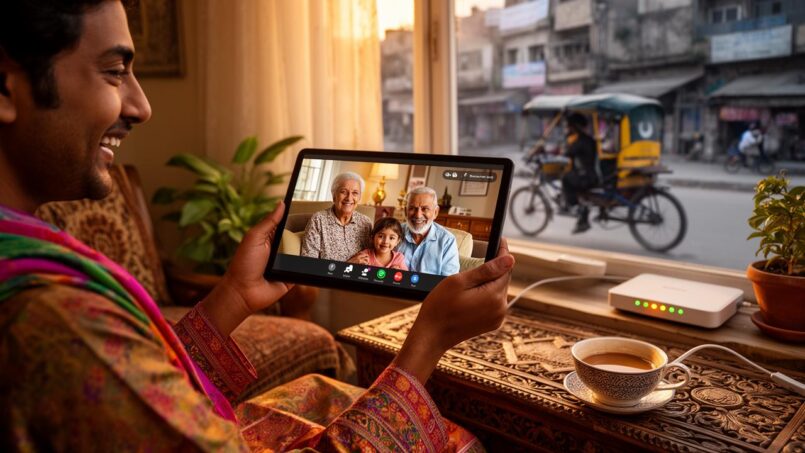
Video Calls: Bridging Generations
Video calls via WhatsApp, Zoom, Skype, Google Meet, FaceTime, or others have become essential to compensate for the impossibility of frequent visits. Literature on the elderly shows that:
Video calling can reduce isolation and strengthen feelings of presence and affection. However, it can present technical obstacles, such as connection issues, complex devices, or poorly adapted interfaces. Additionally, its use can increase the workload of family caregivers or nursing home staff.
Solutions dedicated to seniors exist, even if not specifically Pakistani, such as:
– CallGenie, ONSCREEN, JubileeTV: devices that turn a TV into a video calling screen, with auto-answer, subtitles, large buttons;
– GrandPad: simplified tablet for seniors, no passwords, streamlined interface;
– Heedy or JoyCalls: systems where the senior just looks at a tablet or picks up a simple phone, while relatives handle the tech.
In a Pakistani context where many elderly live with their children or grandchildren, these devices can be useful for families whose young people go abroad and want to maintain regular visual contact with grandparents.
For daily use, however, an entry-level Android smartphone with WhatsApp, good mobile data (or Wi-Fi), and a bit of guidance remains the most accessible solution.
Staying Connected Beyond the Screen: Packages, Gifts, and Thoughts
In Pakistani culture, the family bond is also nourished by very concrete gestures: sending a birthday cake, flowers for a wedding, a fruit basket during Ramadan. The rise of e-commerce platforms has made these attentions much easier to execute, even from abroad.
Online Gift Shops: An Emotional Bridge
Many websites now specialize in sending gifts to Pakistan: Express Gift Service, Gifterzz, PrimeGiftService, Pakistan Gift Online, Pakgiftshop, etc. They allow someone living in the UK, Canada, the Gulf, or Australia to have delivered in just a few clicks:
Discover our wide selection of items and services for all occasions, from celebrations to traditions.
Flower bouquets, cakes from major bakeries (Layers, Delizia), fruit baskets, chocolates, and mithai.
Popular combinations like cake + flowers or pizza + cake for a complete and practical gift.
Toys, clothing, perfumes, and small appliances to meet every wish.
On-site handling of religious sacrifices like sadqa and aqiqa.
Deliveries cover major cities (Lahore, Karachi, Islamabad, Rawalpindi, Faisalabad, Peshawar, Gujranwala…) and often some rural areas. Many platforms offer:
– same-day delivery in large metropolitan areas,
– scheduling for a specific date (birthday, Eid, wedding),
– order tracking, support via WhatsApp, phone, or chat,
– secure payment by card or PayPal.
For a parent living in, say, London or Houston, sending a homemade breakfast to their parents in Lahore or a birthday cake to a nephew in Karachi becomes a very concrete way to “compensate” for the distance and show they are thinking of them beyond video calls.
The Importance of Family Rituals
Research on Pakistani families shows just how much social structure is centered on the extended family, with a strong emphasis on elders, cousins, and collective events (weddings, Eid, births). When you live far away, the risk is feeling disconnected from these rituals, or no longer being perceived as a full member of the family community.
A few practices can help maintain this sense of belonging:
– contribute financially and symbolically to major events (gifts, contribution to a wedding meal, covering festive outfits for certain members),
– ask to attend key moments live via video call (nikkah, bridal entry, cake cutting, Eid prayers),
– send voice or video messages addressed to elders, to be played during a family gathering.
In a society where loyalty to family is highly valued, these gestures carry significant weight in how your commitment is perceived, even from a distance.
Bridging the Digital Divide: When Technology Excludes
Pakistan has a literacy rate of about 60%, with significant gender disparities (68% for men, 52% for women) and regional differences. About 40% of the population cannot read or write, and nearly half do not use the internet at all. The elderly, women, and low-income households are particularly affected by this digital divide.
Common Obstacles
Studies identify several barriers to digital adoption:
Several factors hinder digital adoption: lack of awareness of the internet’s usefulness, difficulty with basic phone functions, cost of devices and data, interfaces often in English while Urdu and regional languages dominate, shame related to digital illiteracy among adults and seniors, and cultural norms that sometimes restrict women’s access to technology and mobility.
Result: many parents or grandparents are entirely dependent on their children to use WhatsApp, answer video calls, or read messages. During the pandemic, this lack of autonomy was especially cruel, when physical visits became impossible.
Strategies to Include Seniors and the Less Connected
To stay connected with the whole family from within Pakistan, you often need to adapt your practices:
To help seniors use technology better and stay in touch, several concrete actions are recommended: prioritize voice notes over long texts for those uncomfortable with reading; simplify their phone’s home screen by making the WhatsApp icon very visible and creating shortcuts to their main contacts; organize small “family training sessions” during visits to teach them step by step how to make a video call, send a photo, or record a voice note; and involve grandchildren in this support, as it strengthens both their digital skills and the intergenerational bond.
At the national level, several experts recommend implementing digital literacy programs tailored to adults (e.g., an accelerated “digital baccalaureate”), but in the meantime, much happens at the family level.
Organizing Collective Moments: Virtual Family Reunions
When part of the family is in Pakistan and the other scattered across several countries, large gatherings become very rare. Hence the growing interest in “virtual family reunions,” which exploded during the pandemic but remain highly relevant afterward.
Choosing the Right Platform
For a large online family gathering, several options exist:
Comparison of the main solutions for organizing family video calls, with their advantages and limitations.
Very popular and easy to use. The free version limits meetings to 40 minutes. The paid account allows up to 100 participants with no time limit.
Free for up to 60 minutes for 100 participants with a Google account. Convenient for those already using Google services like Gmail.
Suitable for medium-sized groups. Allows group video calls with a fairly simple interface.
Ideal if the whole family uses Apple devices, allowing calls with up to 32 participants.
For a large Pakistani family split between Karachi, Doha, London, and Toronto, Zoom or Google Meet remains the most universal choice.
Making These Gatherings Meaningful
Feedback shows that virtual reunions work best when they have: a clear agenda, prepared participants, reliable technology, and an active moderator.
To organize an effective family reunion, it is essential to define a clear objective (birthday, religious holiday, engagement, etc.), plan a minimal structure with a speaking order and activities suitable for all ages, and include shared activities like a photo slideshow, a family quiz, stories from elders, or presenting a family tree.
Many guides suggest sending in advance:
– a detailed invitation with date, time in each time zone, connection link,
– a mini schedule (e.g., 15 min of casual catching up, 20 min of photo slideshow, 15 min of games, 10 min of blessings from elders),
– even a virtual “kit” (a family recipe for everyone to prepare on their own, a wallpaper template, a common dress code).
For families accustomed to large physical gatherings at weddings or religious festivals, these virtual gatherings — even just an hour or two — become a new ritual, helping maintain a sense of belonging despite the distance.
Preserving Balance: When Digital Weakens the Bond Instead of Strengthening It
Studies on Pakistani youth warn: while social media and messaging facilitate contact with the diaspora, their excessive use can paradoxically weaken relationships within the household itself.
Several findings stand out:
– a large proportion of young people spend over 6 hours per day on social networks,
– many admit they participate less in family activities (meals, visits, conversations with parents),
– a majority believe that social networks reduce face-to-face time and weaken emotional bonds.
In other words, it is possible to be reachable 24/7 on WhatsApp and still feel more alone and more distant from your own family.
To stay in touch with loved ones from within Pakistan in a healthy way, two questions should be asked regularly:
1. How much time do I spend talking to my family… face-to-face or via video, compared to time spent scrolling through videos? 2. Am I using digital tools to nurture existing relationships, or to escape from them?
The answer may differ whether you are the child who left to work in Dubai or the one who stayed behind, but in any case, technology is just a tool. The quality of the bond always depends on emotional effort, listening, respect for sensitivities (especially religious and political, which are very strong in Pakistan), and the place given to elders.
In Summary: Weaving a Strong Thread Between Pakistan and the Rest of the World
Staying in touch with your loved ones from Pakistan is not just about mastering a few apps, but combining several layers:
To maintain the connection with Pakistan from abroad, prioritize a reliable infrastructure (local carriers like Jazz or eSIM plans). Use smart calling solutions (international options or dedicated apps) for affordable communications. Everyday tools (WhatsApp, social media) and adapted family rituals (video conferences, sending gifts online) are essential. Pay special attention to vulnerable individuals (seniors, women, rural areas) by simplifying digital access.
On the scale of a country where family remains the heart of social identity, these technical, financial, and emotional efforts are not mere details: they determine how a new generation of Pakistanis — often spread across multiple continents — manages to remain a real family, despite the miles.
Disclaimer: The information provided on this website is for informational purposes only and does not constitute financial, legal, or professional advice. We encourage you to consult qualified experts before making any investment, real estate, or expatriation decisions. Although we strive to maintain up-to-date and accurate information, we do not guarantee the completeness, accuracy, or timeliness of the proposed content. As investment and expatriation involve risks, we disclaim any liability for potential losses or damages arising from the use of this site. Your use of this site confirms your acceptance of these terms and your understanding of the associated risks.

Cyril Jarnias is an independent expert in international wealth management with over 20 years of experience. As an expatriate himself, he is dedicated to helping individuals and business leaders build, protect, and pass on their wealth with complete peace of mind.
On his website, cyriljarnias.com, he shares his expertise on international real estate, offshore company formation, and expatriation.
Thanks to his expertise, he offers sound advice to optimize his clients' wealth management. Cyril Jarnias is also recognized for his appearances in many prestigious media outlets such as BFM Business, les Français de l’étranger, Le Figaro, Les Echos, and Mieux vivre votre argent, where he shares his knowledge and know-how in wealth management.





