
 Published on and written by Cyril Jarnias
Before becoming a modern state in 1947, the territory now called Pakistan saw the birth of some of the world’s oldest urban civilizations, was conquered by empires from Central Asia, crossed by the armies of Alexander, ruled by Persian, Greek, Buddhist, Muslim, and Mughal dynasties, and then by the British colonial power. To recount the history of Pakistan is to reach back far beyond the birth of the Islamic Republic of Pakistan, to the first stone tools of the Soan Valley and the planned cities of the Indus civilization.
From the First Hunters to Sedentary Agriculture
Long before the brick cities, human groups already occupied the plateaus of northern Pakistan. Archaeologists group a vast set of Paleolithic sites under the name Soanian culture, roughly dated between several hundred thousand years ago and the end of the last ice age. In the Soan Valley, near Rawalpindi, shaped pebbles and hand axes comparable to Acheulean tools have been found, testifying to a very ancient occupation of the Himalayan foothills.
The site of Sanghao, in Khyber Pakhtunkhwa, bears witness to a long prehistoric occupation. The archaeological sequence covers the Middle Paleolithic and Mesolithic, showing that inhabitants used chipped stone tools, hunted, and gathered, long before the development of agriculture.
Mehrgarh, Laboratory of the South Asian Neolithic
The shift to a producer economy is strikingly visible at Mehrgarh, in the Kachi Plain of Balochistan. This Neolithic site, occupied from about 7000 BCE, offers one of the most complete records in the world of the emergence of agriculture and herding in South Asia. Its inhabitants built mud-brick houses, cultivated wheat and barley, stored cereals, domesticated sheep, goats, and cattle, and already worked copper.
emphasized the local originality of the site of Mehrgarh, highlighting a unique trajectory, rooted in an indigenous substrate, despite parallels with the Neolithic of the Near East.
Archaeologist Jean‑François Jarrige
The Indus Civilization, Ancient Heart of Pakistani Territory
At the confluence of these Neolithic experiments developed, several millennia later, one of the three great urban civilizations of the ancient world, alongside Pharaonic Egypt and Mesopotamia: the Indus Valley Civilization, or Harappan civilization. It then covered a large part of what is now eastern Pakistan (Sindh, western Punjab, Balochistan), as well as northwestern India and a fringe of Afghanistan.
From Villages to Cities: The Early Phases
Between Mehrgarh and the great urban centers like Mohenjo‑daro or Harappa, several stages structure the rise of Indus societies. So-called “pre-Harappan” cultures developed in different regions: Pirak, Bolan, Kachi, Sheri Khan Tarakai, Lewan, or Amri-Nal show agricultural communities undergoing complexification, laying the foundations for future urbanization.
In the Ravi Valley, the “Early Harappan Ravi Phase”, around the 4th millennium BCE, saw farmers alternate between mountain habitats and alluvial valleys. It is linked to the Hakra phase on the now-dry Ghaggar-Hakra river system. Further south, the Kot Diji phase, named after a site in Sindh near Mohenjo‑daro, marks increasing centralization and already pronounced urban traits: fortifications, street plans, storage, and the birth of a political hierarchy. Sites like Rehman Dheri or Amri in Pakistan, and Kalibangan in India, illustrate this pivotal moment.
The Urban Apogee: Harappa, Mohenjo‑daro, and Others
Around the middle of the 3rd millennium BCE, these traditions converged into what archaeologists call the “Mature Harappan” phase. More than 1,000 cities and sites have been recorded, nearly half of which lie within the current borders of Pakistan. Despite this profusion, only five major urban centers dominate the landscape: Mohenjo‑daro, Harappa, Ganeriwala (Ganweriwala), Dholavira, and Rakhigarhi. Two of these major cities, Mohenjo‑daro and Harappa, are located in Sindh and Pakistani Punjab and form the political and economic cores of the civilization.
Pakistan is the only country that inherits all the known sites and inscriptions of the Indus civilization.
| Archaeological Data (Indus) | Pakistan | India | Afghanistan | Remarks |
|---|---|---|---|---|
| Recorded Mature Harappan sites (circa 2008) | 406 | 616 | A few sites | Mostly along the Indus and Ghaggar‑Hakra |
| Inscribed objects & seals (1977) | ~90% | ~10% | Marginal | Mostly at Harappa & Mohenjo‑daro |
| Major urban centers | Mohenjo‑daro, Harappa, Ganeriwala | Dholavira, Rakhigarhi | Shortugai (trading post) | Ganeriwala remains unexplored |
Excavations, begun systematically after the creation of the Archaeological Survey of India in 1861, led in the 1920s to major revelations at Harappa (by Daya Ram Sahni in 1921) and then Mohenjo‑daro (by R. D. Banerji in 1922). It was quickly understood that this was a civilization contemporary with Egypt and Mesopotamia, but with its own characteristics: grid-like urban planning, standardized bricks, a sophisticated sewage system, and above all, a still undeciphered script.
Mohenjo‑daro, Planned Metropolis of the Indus Valley
Located on the right bank of the Indus, in the province of Sindh, Mohenjo‑daro—literally the “mound of the dead”—is one of the largest urban complexes of the Indus. Built of fired brick, the city consists of a raised western citadel, flanked by ramparts, and a vast residential quarter to the east, crisscrossed by straight streets intersecting at right angles. Archaeologists have unearthed a large assembly hall, a complex often interpreted as a granary, and above all the famous “Great Bath,” a monumental watertight basin surrounded by galleries.
The site of Moenjodaro, a UNESCO World Heritage Site, illustrates an ancient rigorous urban planning. The absence of palaces or monumental temples suggests a society where authority rested on civic order and technical mastery, as evidenced by its advanced drainage systems, water distribution, and domestic toilets for comfort and sanitation.
Iconic discoveries are numerous: the bronze statuette of the “dancing girl,” the bearded figure known as the “priest-king,” terracotta toys, jewelry, woven cotton fabrics, and the famous steatite seals engraved with stylized animals (bulls, unicorns, zebus) accompanied by Indus signs. Over 90% of known inscribed seals come from Pakistani sites, mainly Harappa and Mohenjo‑daro, highlighting the central role of present-day Pakistani territory in the written culture of the Indus.
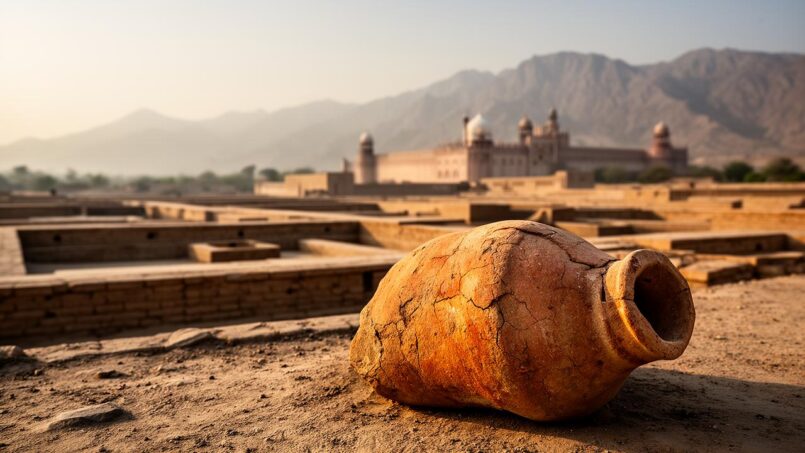
The life of the city did not end with the Bronze Age: a large Buddhist stupa was later built on the remains of the citadel, recalling the continuity of occupation of the site into late antiquity. Recent excavations have even uncovered, near this stupa, a terracotta jar containing hundreds of copper coins from the Kushan period, confirming the long-term importance of Mohenjo‑daro.
Harappa, Metropolis of the Ravi
Further north, in the Sahiwal district of Pakistani Punjab, the city of Harappa gives its name to the entire civilization. Built on the banks of a tributary of the Indus, the Ravi, it also presents a plan articulated between a fortified citadel, a residential quarter, and storage complexes. Excavations have revealed large buildings interpreted as granaries, a sewage system, standardized weights, and distinct cemeteries containing burials in coffins or sarcophagi.
The Harappan civilization displays internal diversity, illustrated by cities with distinct functions: Harappa, a major urban hub; Ganeriwala, located in the Cholistan Desert; Chanhudaro, specialized in crafts (beads, cosmetics) and lacking a citadel; Balakot, established on the ancient coastline of the Arabian Sea; and Kot Diji, which documents the transition to fully developed urbanism.
A Connected World: Ports, Colonies, and Trade
From Balochistan to the plains of Gujarat, Harappan sites dot the coastlines, river valleys, and even islands. Ports like Balakot or Lothal, a bit further east, opened the Indus civilization to the maritime routes of the Indian Ocean. To the west, Sutkagan Dor, in Pakistani Makran, marks the known western extremity of the network, near the Iranian border. To the north, Shortugai, on the Oxus (Amu Darya) in Afghanistan, served as a trading post, notably for the lapis lazuli trade extracted from the mountains of Badakhshan.
The table below illustrates some geographical extremes of the Harappan area and the place present-day Pakistan holds within it.
| Geographical Extremity | Main Site | Present Country | Type of Site | Importance |
|---|---|---|---|---|
| West | Sutkagan Dor | Pakistan | Fortified coastal post | Contact towards Gulf of Oman & Mesopotamia |
| North (commercial) | Shortugai | Afghanistan | Trading colony | Control of lapis lazuli & Oxus routes |
| North (historical area) | Manda | India (Jammu) | Riverine site | Known northern limit of expansion |
| East | Alamgirpur | India (UP) | Small settlement | Eastern fringe of material culture |
| South | Daimabad | India (Maharashtra) | Large village | Southern extremity of cultural area |
This dispersion shows how much the Indus civilization transcends modern borders, but also how the densely occupied core lies within the territory of Pakistan, along the Indus and its tributaries.
The End of an Urban World
The Harappan civilization experienced a gradual decline at the beginning of the 2nd millennium BCE. The causes remain debated: climate change, shifting river courses, soil exhaustion, reconfiguration of trade networks, or even migratory pressures. What is certain is that the great cities like Mohenjo‑daro or Harappa were depopulated, while smaller settlements persisted in some regions. In Balochistan, the Kulli culture prolonged certain Harappan traits. In the plains, so-called “Late Harappan” cultures evolved in dialogue with the Indo-Aryan waves that gradually settled in.
Crossroads of Empires: From the Iron Age to Islam
The disappearance of the great Harappan cities did not erase the strategic importance of the region. The Indus Valley remained a major corridor of movement between Central Asia, Iran, and the Indian subcontinent.
From the Vedic Period to the Mauryan Empire
Indo-Aryan traditions, carried by pastoral groups likely arriving through the passes of the Hindu Kush, settled in Punjab and the upper Indus Valley in the 2nd millennium BCE. This is the Vedic period, marked by tribal societies, the emergence of Sanskrit, and religious texts that would durably structure Hinduism.
From the 6th century BCE, the region of Gandhara—covering part of northwestern Pakistan and southeastern Afghanistan—was integrated into the Achaemenid Empire as a satrapy. Shortly after, Alexander the Great crossed the Indus and fought King Porus on the Jhelum. His conquest was brief, but it opened a period of intense Greco-Iranian contact.
After the withdrawal of the Macedonians, Chandragupta Maurya unified the Punjab region into his vast empire. Under the reign of his grandson Ashoka, Buddhism experienced significant growth. Its spread, particularly in the territories of present-day Pakistan, is attested by moral and religious edicts carved on rocks, still visible today at sites like Shahbazgarhi or Mansehra.
Taxila, Intellectual and Commercial Crossroads
In this context, the region of Taxila (Takshashila) played a pivotal role. Located at the crossroads of routes linking Central Asia, Gandhara, the Indus Valley, and the Gangetic plain, the city became a major center of exchange and learning. Ancient accounts describe it as a center of higher education, sometimes called the “first university” in history, though this image should be treated with caution. What is certain is that philosophers, scholars, Buddhist monks, and merchants converged there for centuries.
The archaeological layers of the site reveal the superposition of several cities, testifying to the evolution and richness of this cultural and commercial crossroads.
The oldest of the cities, where recent discoveries such as a terracotta figurine of a dancer and lapis lazuli beads imported from Badakhshan illustrate its material and symbolic wealth.
A city with a Hippodamian (grid) plan of Greek inspiration, marking a phase of structured urbanization and Hellenistic influences.
The last of the successive cities identified in the site’s stratigraphy, succeeding Sirkap.
Indo-Greek Kingdom, Kushans, and Buddhist Gandhara
Following the Mauryas, an Indo-Greek kingdom established itself in the 2nd century BCE, founded by Demetrius of Bactria. It controlled Gandhara and Punjab for a long time, fostering an art blending Greek, Persian, and Indian influences. After the Indo-Iranian Parthians, a new power dominated the region: the Kushan Empire, centered on the Indus Valley and the Kabul corridor.
The Kushans, and especially Kanishka, made Taxila and Peshawar political and religious capitals. Under their patronage, Buddhism spread to Central Asia and China, carried by monks, artists, and merchants who traveled the Silk Road. Gandharan art was born from this matrix: Buddha statues carved from local stone but inspired by the Greek canon, drapery in the manner of Apollo, motifs of centaurs, Hellenic deities, all in the service of Buddhist iconography.
The numerous monasteries, stupas, and rock-cut sites still visible in places like Takht-i-Bahi, Mora Moradu, or Chhatial tell of this era when northwestern Pakistan was a center of world Buddhism.
From the Islam of the Conquerors to the Indo-Muslim Sultanates
From the 8th century onward, another religious and political current would durably mark the history of the region: Islam. From the first Arab governor of Sind to the construction of a Turco-Mongol Mughal empire, the lands of Pakistan became a pivot of Muslim powers in South Asia.
Arab Conquest of Sind and Early Islamic Anchoring
In 711, the Umayyad army led by Muhammad ibn Qasim crossed the Indus, defeated the Hindu king of Sind, Dahir, and captured the city of Aror. Muslim administration then established its provincial capital at al-Mansura, while Multan, further north, also fell under control. Pakistan’s official historiographical tradition presents this conquest as the “starting point” of a specifically Pakistani history, seeing in ibn Qasim a sort of precursor to the modern Muslim state.
In the following centuries, the Islamization of the region progressed less through armed conquest than through the preaching of Sufis. These spiritual masters, affiliated with various brotherhoods, settled in towns and countryside, founded sanctuaries, preached in vernacular languages, and created forms of expression blending Persian, Turkish, and Indian cultures. The mausoleums of saints, such as that of Shah Rukn-i-Alam in Multan, became essential centers of popular piety.
From the Afghan highlands, the Ghaznavid dynasty, founded by Sebuktegin and expanded by his son Mahmud of Ghazni, launched multiple campaigns toward Punjab and beyond. Mahmud seized Peshawar, Multan, then large parts of Punjab and conducted numerous raids as far as the Gangetic plain, amassing loot and captives. His conquests durably entrenched Turco-Persian garrisons and Muslim elites in what is now northern Pakistan.
In the 12th century, the Ghurid dynasty, led by Muhammad of Ghor, conquered Punjab and ended the Ghaznavid empire. Their general Qutb-ud-Din Aibak then founded the Delhi Sultanate, which became the principal Muslim state in northern India. For several centuries, this sultanate controlled a large part of present-day Pakistan, while the west (Balochistan, Makran) was contested between Iranian and Turkish powers.
Toward the Indo-Islamic Synthesis
The Delhi Sultanate inaugurated a long period of cultural fusion: stone architecture combining Islamic arches and domes with Indian vegetal motifs, development of Persian and Indo-Aryan languages, birth of Sufi musical forms, and consolidation of administrative practices that would fully flourish under the Mughals. At the same time, the northwestern region remained a fluid frontier, exposed to Mongol incursions and revolts by mountain tribes.
The Mughals: Empire, Splendors, and Fractures in the Pakistani Region
In 1526, Babur, heir to a Timurid lineage from Central Asia, defeated the sultan of Delhi at Panipat and founded the Mughal dynasty. For the territory that would become Pakistan, this period is fundamental: it was then that Lahore became the imperial capital, major architectural works were built, and part of the administrative system that would mark British colonization took shape.
Babur, Humayun, and the Anchoring in the Indus Valley
Even before taking Delhi, Babur had already explored and attacked the northwestern regions. He passed through the Khyber Pass, captured the fort of Bajaur, obtained the allegiance of certain Gakkar tribes near Rawalpindi, and traced a strategic route linking Kabul to Agra via Lahore. While Multan remained for a time in the hands of local rulers of Arghun origin, Mughal authority was eventually recognized there, thus integrating the Indus Valley into the new empire.
After dethroning Humayun, the Afghan emperor Sher Shah Suri extended his authority from Bihar to Punjab. His reign left two major legacies: a defensive architectural work, with the construction of Rohtas Fort near Jhelum to contain the Gakkars and prevent Humayun’s return, and a lasting administrative reform, such as the reorganization of the imperial road, which Humayun would retain after his reconquest of Delhi.
Akbar and Imperial Consolidation
Under Akbar, the Mughal empire experienced a political and economic golden age. He centralized administration through the mansabdar system, great military and civil officers remunerated by temporary land grants (jagirs). He abolished or reorganized these endowments in key provinces like Lahore and Multan to better control taxation. He annexed lower Sindh, Balochistan, and the Makran coast, strengthening Mughal control over the Indus and maritime routes.
Akbar chose Lahore as his capital at certain times during his reign. He had the fort reinforced there, laid out gardens, and funded mosques. It was also under his authority that the central power made pacts with local chiefs in frontier regions, without ever truly stabilizing the Pashtun areas, often in revolt.
From Jahangir to Aurangzeb: Territorial Apogee and Tensions
Akbar’s successors consolidated and embellished the Mughal cities of present-day Pakistan. Jahangir and especially Shah Jahan transformed Lahore into an architectural showcase: expansion of the fort, Shalimar Gardens, richly decorated mosques. The mausoleums of Jahangir and Nur Jahan on the banks of the Ravi testify to the funerary splendor of the dynasty.
But under Aurangzeb, the empire reached its greatest territorial extent at the cost of incessant campaigns, notably in the Deccan. In the northwest, revolts of Pashtun tribes and the rise of Sikhism, born in the Punjab region, weakened Mughal dominance. Aurangzeb executed Guru Tegh Bahadur, then led a long siege against Anandpur, a Sikh stronghold, without managing to permanently break the movement.
By the end of his reign, religious tensions sharpened, while fiscal overburden and the militarization of power undermined imperial legitimacy. The 18th century saw the empire disintegrate: Persian incursions by Nader Shah, the rise of the Marathas, the assertion of local lordships.
Between Regional Empires and Great Britain: The 19th Century in Gestation
In the region corresponding to contemporary Pakistan, the Mughal ebb gave way to competing powers.
To the west, the empire of Ahmad Shah Durrani extended at one time to Punjab, before seeing the latter slip away under the pressure of a new force: the Sikh Empire. Ranjit Singh, founder of this state, united several Sikh confederations (misls), took Lahore in 1799, and extended his authority from the Khyber Pass to the Kashmir Valley.
Ranjit Singh, founder of the Sikh Empire
Meanwhile, the British East India Company advanced from Bengal and Bombay. After securing its hegemony over the Gangetic plain in the 18th century, it turned its attention to the northwest, both for commercial reasons and out of fear of Russia in the context of what would be called the “Great Game.”
British conquest was gradual: Sind was annexed in 1843 after the battles of Miani and Hyderabad. Punjab was conquered following the two Anglo-Sikh wars (1846 and 1849). Influence then extended to Balochistan through treaties (Kalat, Gandamak) and transit agreements, such as the lease of the Bolan Pass. Finally, the Durand Line, established in 1893, divided Pashtun territories between Afghanistan and British India.
By the end of the 19th century, all the territory that would later form Pakistan was integrated, under varying statuses, into the Indian Empire: directly administered provinces (Punjab, Sind attached to the Bombay Presidency), political agencies (Baluchistan Agency, Gilgit Agency), and vassal princely states.
British Colonization and the Reshaping of Society
The British Raj was not limited to military domination. It transformed infrastructure, the economy, administration, and social relations in the region.
Rails, Canals, and Colonial Cities
From the 1850s, colonial authorities built a dense railway network intended for moving troops and goods. The first line in present-day Pakistan linked Karachi to Kotri in the early 1860s, then tracks reached Lahore, Peshawar, and Quetta. In parallel, a vast canal irrigation system turned the Punjab plains into the “breadbasket of India,” thanks to “canal colonies” that attracted agricultural settlers.
In Lahore, Karachi, and other cities, the colonial era left neighborhoods with a hybrid architectural style, known as Indo-European. This style combines Victorian and Gothic elements with Indo-Islamic decorative motifs. Iconic buildings such as the Lahore Museum, railway stations, administrative buildings, and former commercial houses in Karachi are striking examples, still defining part of Pakistan’s current urban landscape.
Social and Political Restructuring
Colonization profoundly altered the social hierarchy. The Mughal mansabdar system gave way to a hereditary landed aristocracy, the zamindars, many of whom allied with British power. The colonial administration generalized the use of English to the detriment of scholarly languages like Persian or Urdu in certain domains, marginalizing Muslim elites who hesitated to adopt the new education.
From the late 19th century, legislative councils with local elites were created, but remained under colonial control. Reforms, such as the Minto-Morley Reforms in 1909, established separate electorates for Muslims, thereby contributing to distinguishing and dividing Hindu and Muslim political spaces.
In the northwest, British policy oscillated between repression and accommodation. The North-West Frontier Province (NWFP) was created in 1901 but remained under special administration, with indirect control over the Pashtun tribal areas through agreements with local chiefs—a practice that would weigh heavily on Pakistan’s security history.
Toward Pakistan: Nationalisms, Religion, and Partition
At the beginning of the 20th century, the rise of nationalist demands gradually transformed the political landscape of British India. The Indian National Congress, dominated by Hindu and secular leaders, demanded autonomy, then independence. On the Muslim side, the All-India Muslim League was founded in 1906 to specifically defend the interests of Muslims in the Indian Empire.
The Construction of a Muslim Political Identity
Several intellectual figures contributed to reformulating Muslim identity in political terms. Sir Syed Ahmed Khan, through the Aligarh movement, encouraged a modernist Muslim elite to adopt Western science and education while preserving an Islamic cultural framework. The poet and philosopher Muhammad Iqbal, originally from Sialkot, envisioned in the 1930s an autonomous political entity for Muslims in northwestern India, without yet specifying that it would be a separate state.
The idea of a distinct Muslim country, Pakistan, developed around the theory that Hindus and Muslims form two incompatible political nations. This vision was championed by Muhammad Ali Jinnah, a former Congress member who became the main leader of the Muslim League.
From Demand to Partition
World War II accelerated the timetable. British exhaustion paved the way for exit negotiations. Attempts at compromise for a unified federal state failed. In 1940, the Lahore Resolution clearly formulated the demand for independent “states” for Muslims in the northwest and northeast of the subcontinent. Seven years later, the partition plan was approved: British India would be divided into two dominions, one Hindu-majority and one Muslim-majority.
The number of people displaced during the partition of British India in 1947, leading to a major humanitarian crisis.
Kashmir, a Himalayan princely state with a Muslim majority but ruled by a Hindu maharaja, immediately became a major point of friction. The first Indo-Pakistani war, triggered in 1947, ended with a ceasefire and the division of the former princely state along a ceasefire line that would become the Line of Control.
Independent Pakistan: Continuities and Historical Ruptures
The birth of the Pakistani state did not wipe the slate clean. It is part of a long history in which the territory of Pakistan was successively a cradle of civilization (Indus), a march of empire (Achaemenids, Alexander, Mughals), a center of power (Mughals, Kushans), and then a colonial periphery.
The new republic had to contend with this multiple legacy: the heritage of the Indus civilization and great ancient urban traditions, the layering of Buddhist, Hindu, Sikh, and Muslim cultures, the weight of Sufis in popular piety, agrarian structures deriving from both the Mughals and the British, and borderlines drawn during the Great Game. The official historical narrative has often sought to trace the “genesis of Pakistan” back to the Arab conquest of Sind, or even the arrival of the first Muslims, integrating into a single continuum the ancient Indus, medieval Islam, and modern independence.
At the same time, archaeological and historical reality shows that Pakistani territory has always been a space of interweaving, circulation, and mixing. The bricks of Mohenjo‑daro, the stupas of Taxila, the Mughal mosques of Lahore, the forts of Rohtas or Ranikot, the necropolises of Makli or Chaukhandi, and the sites of Mehrgarh or the Soan Valley compose a landscape where each layer tells of an era, a religion, a power.
Heritage as a Mirror of This Long History
Today, Pakistani authorities and international institutions strive to preserve this exceptional heritage. Several sites in the country are inscribed on the UNESCO World Heritage List: the ruins of Mohenjo‑daro, the archaeological city of Taxila, the Fort of Lahore and the Shalimar Gardens, the Buddhist monastery of Takht‑i‑Bahi, the necropolis of Makli at Thatta, not to mention Rohtas Fort, commissioned by Sher Shah Suri on the margins of the Pothohar Plateau.
Total number of protected sites and monuments in Argentina at the end of the 1990s, divided between the federal state and the provinces.
Beyond legal protection, the history of Pakistan is also read in debates on national identity and the way school textbooks, museums, and media discuss sometimes forgotten or downplayed phases: the still partially mysterious Indus civilization, the Buddhist Gandhara era, the composite Mughal heritage, and the role of religious minorities in the past as well as the present.
Conclusion: A Territory as a Hinge in Asian History
From the first shaped tool of the Soan Valley to the orthogonal planning of Mohenjo‑daro, from the Buddhist edicts carved into the rock of Mansehra to the Mughal forts on the Ravi, from the caravan routes of Gandhara to the Durand Line, the territory of Pakistan has never ceased to be at the center of great historical movements. The modern state born in 1947 was built upon this long accumulation of civilizational layers, inscribing its own project: that of a country defined first by Islam and by a political memory reaching back to the conquest of Sind.
The territory of Pakistan tells a story that transcends national categories. It is the story of the world’s first cities, trans-Asian exchanges, religious and artistic hybridizations, and empires that used the Indus Valley as a logistical axis or power base. Understanding the history of Pakistan involves accepting this plurality and recognizing that sites like the Indus, Mehrgarh, Taxila, Lahore, and Mohenjo‑daro belong both to Pakistani memory and to the heritage of all humanity.
Disclaimer: The information provided on this website is for informational purposes only and does not constitute financial, legal, or professional advice. We encourage you to consult qualified experts before making any investment, real estate, or expatriation decisions. Although we strive to maintain up-to-date and accurate information, we do not guarantee the completeness, accuracy, or timeliness of the proposed content. As investment and expatriation involve risks, we disclaim any liability for potential losses or damages arising from the use of this site. Your use of this site confirms your acceptance of these terms and your understanding of the associated risks.

Cyril Jarnias is an independent expert in international wealth management with over 20 years of experience. As an expatriate himself, he is dedicated to helping individuals and business leaders build, protect, and pass on their wealth with complete peace of mind.
On his website, cyriljarnias.com, he shares his expertise on international real estate, offshore company formation, and expatriation.
Thanks to his expertise, he offers sound advice to optimize his clients' wealth management. Cyril Jarnias is also recognized for his appearances in many prestigious media outlets such as BFM Business, les Français de l’étranger, Le Figaro, Les Echos, and Mieux vivre votre argent, where he shares his knowledge and know-how in wealth management.





