
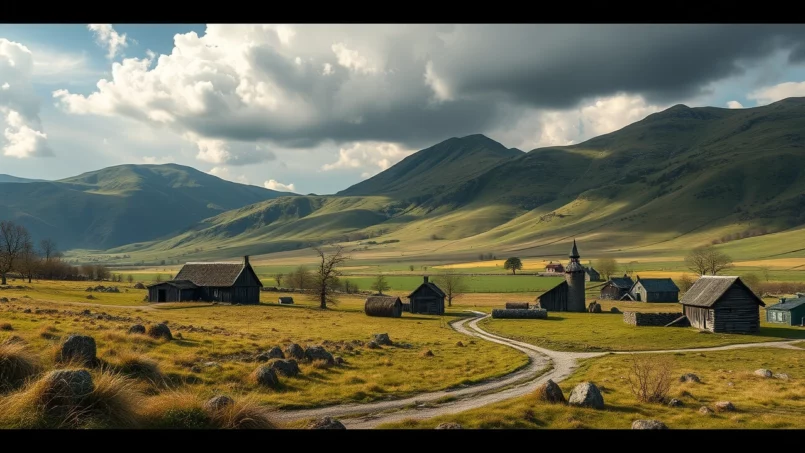
 Published on and written by Cyril Jarnias
The history of Greenland reads like a long polar saga, marked by a succession of forgotten cultures, Viking colonies, religious missions, world wars, political struggles, and demands for autonomy. This vast Arctic territory, now autonomous within the Kingdom of Denmark, has seen peoples from North America, Scandinavian sailors, Moravian missionaries, American soldiers, and United Nations jurists pass through. Tracing this history means following a thread that runs from the first skin tents pitched on the sea ice to contemporary debates over independence and the exploitation of mineral resources.
From the First Arctic Cultures to the Arrival of the Inuit
Well before the Vikings and the Danes, Greenland was the stage for a succession of cultures arriving in waves from North America. Archaeological and climatic data today allow us to reconstruct a much richer and more nuanced story than was imagined just a few decades ago.
Saqqaq, Independence, and Dorset: The Pioneers of the Cold
The earliest known human traces date back to around 2500 BCE, with the Saqqaq culture established across much of western Greenland. To the north, another population, called Independence I, occupied the Independence Fjord region from about 2400 BCE. Researchers agree that these two cultures came from distinct groups that migrated from North America via Arctic Canada.
Greenland’s first inhabitants experienced a highly variable climate, with an initial mild period followed by abrupt cooling and further fluctuations. Around 800 BCE, the Independence II culture replaced Independence I in the far north, while the Dorset culture, a Paleo-Eskimo tradition, established itself in western Greenland.
Archaeologists distinguish an early Dorset (circa 700 BCE – start of the Common Era) and then a late Dorset, present until the 13th century CE. Typical artifacts of this “Greenlandic” Dorset have been found far to the north, as far as Inglefield Land on the west coast and the Dove Bay region in the east. Yet, around the year 1 CE, traces of these populations disappear: Greenland then appears empty of inhabitants for several centuries.
Around 700 CE, a new Dorset wave settled, this time mainly in the northwest and the Nares Strait area. It lasted until around 1300, even as another culture from the west began to gain ground: the Thule culture, the direct ancestor of Greenland’s Inuit.
The Thule Revolution: Kayaks, Umiaks, and Dog Sleds
Around 1100–1200 CE, Thule groups left Alaska and Arctic Canada and spread rapidly eastward through the Canadian Arctic Archipelago and then the Nares Strait. They reached Greenland and eventually occupied all habitable coasts. Genetic studies indicate this colonization occurred in a single major movement, with no real mixing with the local Dorset populations, which ultimately disappeared.
The Thule developed a sophisticated technological toolkit for exploiting Arctic resources, including kayaks, umiaks (large skin boats), dog sleds, toggle harpoons, and floats for hunting. Their subsistence economy was based on hunting whales, narwhals, walruses, seals, caribou, seabirds, and fishing. Their dwellings varied by season, with semi-subterranean winter camps and summer skin tents. This adaptability to the marine environment and sea ice presented a major contrast with the Viking settlers established in southwestern Greenland during the same period.
From a chronological perspective, the sequence of early occupations can be summarized as follows:
| Approximate Period | Dominant Culture | Main Area |
|---|---|---|
| 2500–800 BCE | Saqqaq | West and southwest |
| 2400–1300 BCE | Independence I | North (Independence Fjord) |
| 800 BCE – 1st c. BCE | Independence II | North |
| 700 BCE – 1st c. CE | Early Dorset / “Greenlandic Dorset” | West and north |
| 700–1300 CE | Late Dorset | Northwest / Nares Strait |
| 1100–1300 CE | Thule arrival and expansion | Greenlandic coasts |
Thus, when the first Scandinavians sighted Greenland from their ships, the human landscape was already ancient, even if the areas they would occupy in the southwest seemed sparsely populated, or even temporarily empty.
The Viking Adventure: Five Centuries of Nordic Presence
The Viking episode in Greenland is undoubtedly the most well-known part of its early history, largely thanks to the Icelandic sagas. But modern research, by cross-referencing texts, radiocarbon dating, and excavations, has profoundly reassessed this narrative, revealing both the ingenuity and the fragility of this European colony at the edge of the world.
Erik the Red and the Founding of the Norse Settlements
At the end of the 9th century CE, a navigator named Gunnbjörn Ulfsson, blown off course between Norway and Iceland, sighted islands off a large unknown land in the distance: this was the first European mention of Greenland. However, it was not until the end of the 10th century that a real colonization project emerged.
Around 982, the Icelander Erik the Red, exiled for manslaughter, set sail westward. For three years, he explored the southwest coast, identified fjords suitable for grazing, and decided to settle there. Upon returning to Iceland, he campaigned to attract settlers, even naming the territory “Greenland” (Grœnland, “green land”) to tout its merits.
Number of people transported by the 14 ships that reached Greenland to found the first Viking colonies.
Excavations have identified approximately 620 Norse farms across these areas, including nearly 500 in the Eastern Settlement and 95 in the Western Settlement. The farm at Brattahlíð, Erik the Red’s residence in Eiríksfjörð (today Tunulliarfik), has yielded dates close to the year 1000. At their peak, these settlements probably numbered between 2,000 and 3,000 inhabitants, although some authors have previously suggested figures as high as 10,000.
A Frontier Economy: Livestock, Hunting, and Walrus Ivory
The Norse settlers brought with them a complete agricultural “package”: cattle, sheep, goats, pigs, horses, dogs, cats, and they even attempted growing barley and flax. Their hierarchical society was based on a network of farms centered around large estates dominated by chieftains and clergy.
In a climate that was certainly milder than today (a period often called the Medieval Warm Period), but still demanding, they combined grazing and hunting. Herds provided milk, butter, meat, and hides, while hunting supplemented this base: caribou, birds, eggs, and especially seals, whose share in the diet increased markedly over the centuries. Isotopic analysis shows that within a few generations, the proportion of marine protein in their diet rose from about 40% to nearly 80%.
The prosperity of the Norse settlements in Greenland relied on a niche economy focused on exporting Arctic products (walrus tusks, narwhal teeth, bear skins) from the northern hunting grounds (Norðrsetur), in exchange for essential goods and European luxuries. This viability depended on the medieval demand for ivory and the maintenance of sea links with Norway.
Christianization and Integration into the Crown of Norway
Religiously and politically, the colony followed the trend of the rest of the Scandinavian North Atlantic. Around the year 1000, Leif Erikson, son of Erik the Red, converted to Christianity in Norway and introduced it to Greenland. Stone churches were built on the main estates, and in 1126 the papacy established the episcopal seat of Garðar in the Eastern Settlement (today Igaliku). The diocese was attached to the Archdiocese of Nidaros (Trondheim).
Starting in 1261, the settlers formally recognized the authority of the King of Norway, integrating Greenland into the Norwegian monarchy system. By the end of the Middle Ages, dynastic games in Scandinavia and the union of different kingdoms under the Dano-Norwegian crown would eventually absorb this distant territory into a much larger political entity.
The Silent Decline of the Norse Colonies
From the 14th century onward, signs of weakening multiplied. The climate cooled significantly, ushering in what climatologists call the Little Ice Age: longer winters, shorter growing seasons, thicker sea ice, increased storms. Agriculture became more precarious. At the same time, the European economy gradually turned away from walrus ivory in favor of more accessible or cheaper African and Russian ivory.
The Black Death, which reached Norway around 1349, severely disrupted the trade networks essential to Greenland. Ship arrivals became rare and then almost completely ceased, isolating the Nordic colonies. This population found itself with a considerably reduced resource base, while being exposed to harsh winters and local droughts, evidence of which is preserved in lake sediments.
The hypotheses advanced to explain the progressive disappearance of these colonies thus combine climatic, economic, environmental (soil erosion, overgrazing), demographic (hunting accidents, high mortality), social (highly hierarchical society, limited flexibility), and cultural factors (incomplete adaptation to Inuit techniques, especially for open-water seal hunting and kayak use).
The sagas and chronicles gradually fall silent. The last certain written mention of the Norse presence is a wedding celebrated in 1408 at Hvalsey Church in the Eastern Settlement. The Western Settlement seems to have been abandoned already around 1350. By the mid-15th century, the farms were deserted. A European ship landing in the 1540s discovered the body of a Norse man, the final echo of a vanished community.
The Inuit, however, remained. Traces of contact — Norse objects found in Thule sites and vice versa — attest to a certain degree of interaction between the two populations before the Scandinavians left the Greenlandic stage for several centuries.
From Royal Claim to Danish Recolonization
After the disappearance of the Norse colonies, Greenland did not vanish from the European political imagination. The Kingdom of Denmark-Norway maintained a claim of sovereignty over this land, even if no effective control was exercised for a long time.
Royal Expeditions and Whaling
At the beginning of the 17th century, King Christian IV of Denmark-Norway financed several expeditions (1605–1607) to find the descendants of the settlers and reassert his rights. These attempts failed, partly due to ice and poorly understood geography. At the same time, Greenland’s seas became a hunting ground for Dutch, German, French, Basque, and Dano-Norwegian whalers, attracted by the great cetaceans of the Greenland Sea and the riches of Arctic waters.
A strong symbol of this claim, a polar bear was added to the coat of arms of the Dano-Norwegian monarchy in the 1660s, a way of displaying the royal pretension over these icy lands.
Hans Egede and the Founding of Godthåb
The founding act of modern colonization occurred in 1721. The Lutheran missionary Hans Egede obtained a charter from King Frederick IV to go to Greenland, officially to bring the “old Norwegians” back into the fold of the Church. In reality, he found only Inuit and the ruins of Viking settlements.
He established his first base, the “Colony of Hope,” in the Nuup Kangerlua fjord. His movement combined religious mission and trade. The Bergen Greenland Company obtained a trade monopoly but went bankrupt as early as 1727. The Danish crown then directly took over, via other companies and then a state agency.
Hans Egede, missionary and colonizer
In 1728, military officer Claus Paarss founded a new post on the site of a former Inuit village, Godthåb (“Good Hope”), which would become the colonial capital of western Greenland. The beginnings were difficult: undisciplined soldiers, convicted criminals sent forcibly, lack of food, scurvy. A terrible smallpox epidemic imported in 1733–1734 decimated a large part of the local Inuit population and also took Gertrud Egede, the missionary’s wife.
From 1733, the Moravian Brethren established a network of missions on the southwest coast of Greenland, exerting a lasting spiritual and educational influence until 1900.
In 1733, the Moravian Brethren obtained the right to establish their own missions and founded their first post, Neu-Herrnhut, near Godthåb (Nuuk).
After the initial settlement, the Moravians expanded their activities by establishing a network of mission stations along the southwest coast of Greenland.
Their spiritual and educational influence was profound and enduring. The Moravian missions persisted until their final departure in 1900.
The Trade Monopoly and Organized Isolation
From the second half of the 18th century, the Danish state tightened its control. In 1776, the Crown instituted an official closure of Greenland to all foreign trade: only the Royal Greenland Trade Department (Kongelige Grønlandske Handel, KGH), inherited from the General Trade Company, was authorized to supply the colonies and extract resources from them. A royal instruction of 1782 strictly regulated trade and aimed, through a form of “paternalistic protectionism,” to limit contact between the Inuit and other Europeans.
Western Greenland was divided into two large inspections (north and south), each headed by a Danish inspector. The system favored stability and moderate profitability of trade (mainly furs, seal oil, fish), rather than rapid development. Within this tightly controlled framework, the Greenlandic population became massively Christianized over the generations; by the early 20th century, it was almost entirely Lutheran.
From the Early 19th Century to World War II: Slow Modernization and Geopolitical Stakes
The 19th century opened a new phase: Greenland remained a colonial territory, but timid beginnings of local participation in management appeared, and the island began to attract explorers and scientists.
From the Treaty of Kiel to the First Newspapers in Greenlandic
The Napoleonic Wars and the British blockade weakened the Danish empire. In 1814, the Treaty of Kiel ended the union of Norway with Denmark: Norway passed into the Swedish orbit, while Greenland, Iceland, and the Faroe Islands remained under Danish sovereignty. The island continued to be administered directly from Copenhagen via the KGH.
Gradually, the administration introduced advisory structures. From the mid-19th century, elected local assemblies — the “forstanderskaber” — participated in the management of social affairs and public order. In 1911, two provincial councils (Landstings), one for the north and one for the south, were created. They could discuss common issues and submit proposals to the Danish authorities, although real power remained in Copenhagen.
Intellectual life also became more rooted locally. Inspector Hinrich Rink set up a printing press in Nuuk in 1857 and launched, in 1861, Atuagagdliutit, the first newspaper in the Greenlandic language. The written use of Greenlandic, developed in the 19th century by missionaries like Samuel Kleinschmidt, fostered the emergence of a local literary and political identity.
At the same time, the economy diversified slightly: exploitation of cryolite at Ivittuut (from 1854), coal in some regions, development of commercial fishing at the turn of the 20th century, introduction of sheep farming in the south in 1906.
Race for the Arctic and International Arbitration
Greenland also became a starting point or strategic object for major polar expeditions. In the 19th and early 20th centuries, British, Norwegian, German, Danish, and French explorers crisscrossed its coasts. Fridtjof Nansen completed, in 1888, the first ski crossing of the ice cap from east to west, from Umivik Bay to Ameralik Fjord, before wintering at Godthaab. Other expeditions mapped the fjords of the east coast, set up scientific stations, and identified Arctic fauna.
Year the Permanent Court of International Justice confirmed Denmark’s sovereignty over all of Greenland.
World War and Shift Toward the United States
World War II profoundly disrupted the political balance around Greenland. On April 9, 1940, Nazi Germany invaded Denmark. Greenland found itself in an unprecedented situation: a colony of an occupied state, left to its own devices in the North Atlantic. Senior Greenlandic officials, Eske Brun and Aksel Svane, then invoked an emergency clause of a 1925 law to declare that, in effect, the territory would administer itself and seek external protection.
With the support of the Danish ambassador in Washington, Henrik Kauffmann — who chose to act against instructions from the occupied government — Greenland turned to the United States. In April 1941, an agreement signed with U.S. Secretary of State Cordell Hull authorized the establishment of American military bases on the island. In practice, Greenland became a U.S. military protectorate, integrated into the Western “zone of neutrality” even before Washington’s official entry into the war.
During World War II, the Americans established a network of military bases in Greenland, such as Bluie West One (Narsarsuaq) and Bluie West Eight (Kangerlussuaq), including airfields, ports, and depots. At the same time, Germany attempted to set up clandestine weather stations there for its forecasts. To counter this threat, the Sirius Dog Sled Patrol, composed of Danes, Norwegians, and Inuit, conducted long raids along the east coast to track and destroy these enemy installations.
Economically, the Ivittuut cryolite mine took on major strategic importance. This mineral, essential for aluminum production, was crucial for the Allied aircraft industry. Exports to the United States financed Greenland’s supplies and permanently reshaped its trade flows.
At the end of the conflict, after Denmark was liberated, the Danish Parliament finally ratified the Kauffmann–Hull agreement, retroactively legitimizing what had been an act of diplomatic rebellion. The American bases remained in place under a new defense agreement signed in 1951, which would make Thule, in the northwest, a pivot of Cold War strategy.
From Colony to Danish County: Forced Integration and Brutal Modernization
The return to peace did not mean a simple return to the status quo ante. The war had reinforced the strategic and economic importance of Greenland, but also accelerated a growing awareness of identity among part of the population. The post-war decades were marked by rapid modernization, but also by deep social traumas.
The Formal End of Colonial Status
In the aftermath of the war, Denmark established a commission — often called the G‑50 commission — tasked with reflecting on Greenland’s future and development. The dominant idea in Copenhagen was to transform the territory into a modern “welfare state”, along the Danish model, by focusing on education, health, urbanization, and economic rationalization.
In 1953, a Danish constitutional reform transformed Greenland, a former colony, into a county (amt) integrated into the Kingdom, granting it two seats in the Danish Parliament. Although the UN removed the territory from its list of non-self-governing territories in 1954, the decision-making power of Greenlanders remained limited and the asymmetry with Copenhagen remained strong.
Danification and Imposed Experiments
Modernization proceeded through policies of cultural “assimilation”, which many historians and local actors would later describe as forced “Danification”. Danish became, de facto, the dominant language of administration and school. Large standardized apartment blocks, like the infamous Block P in Nuuk, were built to centralize populations dispersed in small villages, in the name of economic efficiency and access to services.
In 1951, 22 Greenlandic children were sent to Denmark to be “modernized” and form an elite. Sixteen returned in 1953 but were placed in an orphanage in Nuuk instead of being reunited with their families, suffering a profound cultural rupture. This experiment caused lasting psychological damage and led, decades later, to demands for official apologies and reparations.
In the 1960s and 1970s, a birth control campaign led to the mass insertion of intrauterine devices (IUDs) in thousands of Greenlandic girls and women, sometimes very young, often without informed consent. Again, later investigations would see this as a grave violation of human rights.
These policies were part of a broader context of unequal power relations, symbolized notably by a “birth criterion” which, according to testimonies, granted better salaries and conditions to native-born Danes than to Greenlanders in equivalent positions. This latent social apartheid fueled resentment and nourished the emergence of autonomist demands.
Military Bases and Conflicts of Interest
At the same time, Greenland remained a pawn in Cold War geopolitics. The 1951 defense agreement with the United States formalized the presence of bases, including Thule in the far northwest. To expand this strategic base, intended to host bombers and early warning radars (BMEWS), the Danish authorities forcibly relocated part of the local Inughuit population in 1953 to a new village, Qaanaaq, further north. This forced displacement, justified at the time by military considerations, would become one of the symbols of sacrifices imposed on Greenlanders in the name of external interests.
In the 1950s-1960s, American nuclear weapons were secretly present at Thule Air Base, contradicting signed agreements. Bombs were temporarily installed there in 1958. The 1968 crash of a B-52 carrying nuclear weapons near Thule revealed this reality, sparking debate in Denmark. An exchange of notes in May 1968 officially confirmed the absence of permanent nuclear storage in Greenland.
From Protest to Autonomy: Home Rule then Self-Government
The 1960s–1970s saw the rise of a new generation of Greenlanders, educated, often bilingual, increasingly critical of Danish paternalism. Two factors in particular served as catalysts: the de facto discriminatory policy in employment and the European question.
The Shock of the Common Market and the Rise of the Autonomist Movement
In 1972, Denmark held a referendum on joining the European Communities. Nationally, voters approved entry; in Greenland, nearly 70% of voters opposed it. Despite this massive rejection, the island was automatically integrated into the European Community in 1973 as part of Denmark.
The resentment was deep. For many, it illustrated the lack of real voice for Greenlanders on major decisions directly affecting their resources, especially fisheries. This was one of the driving forces behind the structuring of local political parties, such as Siumut (social democrat), Inuit Ataqatigiit (left-wing pro-independence), and Atassut (liberal unionist), and the strengthening of autonomy demands.
Percentage of votes in favor in the 1979 referendum on Greenland’s home rule.
Home Rule: A First Transfer of Powers
The implementation of Home Rule created a Greenlandic parliament, the Inatsisartut (then often called the Landsting), and a local government (Landsstyre, later Naalakkersuisut). The Danish governor was replaced by a High Commissioner (rigsombudsmand), who represented Copenhagen but lost direct management of internal affairs.
Over the years, Greenland took control of many areas: internal administration, taxation, education, culture, health, housing, fisheries and hunting, agriculture, environmental protection, social affairs, and the labor market. One of the first laws adopted by the new parliament concerned income tax, a sign of the desire to assert its own fiscal power.
Year of adoption of the distinctive Greenlandic flag, a major symbol of autonomy.
Leaving the European Community
Once Home Rule was in place, Greenland wished to reverse its participation in the European Community, which had become a highly sensitive issue, particularly due to fisheries policies and regulations on the trade of seal skins. A referendum was held in 1982: 52% of voters voted to leave, a modest but significant majority.
Negotiation with Brussels resulted in a specific treaty, which formalized Greenland’s withdrawal in 1985. The territory obtained the status of an Overseas Country and Territory (OCT) associated with the Community, providing a specific framework for cooperation and access to the European market, while regaining control of its fishing waters. Fisheries and partnership agreements have been regularly renegotiated, typically for six-year periods, with annual quota adjustments.
This episode reinforced the idea of a Greenlandic people capable of making distinct strategic choices from those of Denmark, and of having them respected on the European stage.
Toward Self-Government: Recognition of a People and the Right to Self-Determination
After two decades of Home Rule, most transferable powers had been taken over by local authorities. One question remained: how to redefine Greenland’s constitutional status within the Kingdom, while clearly opening a path toward possible future independence?
The Joint Commission and the 2008 Referendum
At the turn of the 1999–2000 period, the Greenlandic government established a Home Rule Commission tasked with assessing the political situation and proposing an evolution. Its report in 2003 suggested moving to a form of enhanced self-government. In 2004, a joint mandate was signed between the Danish Prime Minister and the Greenlandic Prime Minister to establish a Self-Government Commission, composed of representatives from both sides, co-chaired by figures such as Jonathan Motzfeldt.
This Commission submitted a report and a draft law on Greenland’s self-government in 2008, published as Danish White Paper No. 1497. A consultative referendum was held in Greenland in November 2008: turnout reached nearly 72%, and 75.54% of voters approved the proposal.
Year the Greenland Self-Government Act was adopted by the Danish Parliament, marking a decisive step in its autonomy.
Content and Scope of the Self-Government Act
The 2009 text marks a major turning point. Its preamble explicitly recognizes that the Greenlandic people constitute a people under international law, with the right to self-determination. The law formally repeals the 1978 Home Rule regime (which survives only through transitional provisions) and establishes a framework based on the division of powers between Copenhagen and Nuuk.
For areas already assumed by Greenland or that can be assumed, the model is one of clear separation of powers: legislative power rests with the Inatsisartut, executive power with Naalakkersuisut, and judicial power with the courts of Greenland (district courts, Greenlandic Court, Country Court). The Danish Supreme Court remains the ultimate court of appeal.
The transfer of powers from Denmark to Greenland operates via two lists. List I (e.g., workplace accidents, road traffic) can be taken over by Greenland at a date of its choosing. List II (e.g., police, judiciary, criminal law), concerning more sensitive areas, requires prior negotiation with the Danish government.
At the same time, the law designates Greenlandic (Kalaallisut) as the island’s official language. Danish remains widely used in administration and education but loses its official status. Since 2011, all Greenlandic legislation has been accessible online in Greenlandic and Danish.
Financing, Resources, and the Prospect of Independence
Financially, self-government rests on a compromise: Denmark guarantees Greenland a fixed annual block grant of DKK 3,439.6 million (2009 base amount, indexed to inflation). In return, revenue from mineral resources (hydrocarbons, minerals, rare earths, etc.) accrues to the Greenlandic side, but beyond a threshold of DKK 75 million per year, the Danish grant is reduced by half of that surplus. If the grant fell to zero, a new financial framework would need to be negotiated.
Areas of defense, foreign policy, security, and currency fall under Denmark’s jurisdiction. However, the Greenlandic government can enter into specific international agreements for the territory in its fields of competence. Greenlandic representatives can be part of Danish diplomatic missions. Denmark must inform and consult Greenland on negotiations for agreements that significantly impact it.
Finally, the 2009 law enshrines a key principle: any decision regarding possible Greenlandic independence belongs to the Greenlandic people. In the event of an independence proposal, a referendum must be held, and the final agreement must be approved by both the Inatsisartut and the Danish Folketing, in accordance with Article 19 of the Constitution on the modification of the Kingdom’s borders.
Contemporary Greenland: Between Autonomy, Economic Dependence, and Global Stakes
Today, the country operates with its own institutions — a 31-member Parliament, a local government, courts — while remaining integrated into the political and legal community of the Kingdom of Denmark, and, through it, NATO and the broader European system. Its recent trajectory has been marked by several tensions: desire for greater autonomy, dependence on the Danish block grant, openness to investments in resources, and the intersecting interests of major powers in the Arctic.
An Economy Still on Danish Life Support
Greenland’s economy relies primarily on fisheries (shrimp, halibut, cod), which account for the vast majority of exports, supplemented by public sector activities, a few mines (cryolite until 1987, recent zinc, iron, or rare earth projects), a growing tourism sector, and experiments in energy (notably hydropower). Despite a relatively high per capita income, the structure remains fragile: the Danish grant represents nearly half of public revenue.
The mechanism for sharing mining revenue provided for in the 2009 law fuels an ongoing debate: how to develop resources without compromising the environment, or creating dependence on new external actors (foreign companies, third powers) that would replace financial dependence on Copenhagen?
Indigenous Peoples’ Rights and International Recognition
In terms of international law, Greenland is at the heart of debates on indigenous peoples’ rights. Denmark ratified International Labour Organization Convention No. 169 on indigenous and tribal peoples in 1996. In the so-called Thule Air Base case, the Danish Supreme Court and the ILO supervisory body qualified Greenlanders as “one people” under international law, with collective rights to lands and resources. In 2007, the United Nations Declaration on the Rights of Indigenous Peoples reinforced this framework. The recognition of the right to self-determination in the preamble of the 2009 law clearly fits into this evolution.
Past policies toward indigenous populations, such as forced sterilizations and child placements, are the subject of investigations and demands for reparations. In 2023, women who were victims of an IUD insertion campaign in the 1960s-1970s demanded compensation from Denmark. Furthermore, in 2025, Copenhagen and Nuuk agreed to abandon a standardized psychological tool, deemed culturally biased, used to assess parenting skills.
The Arctic, a New Strategic Frontier
In the 21st century, the accelerated melting of the Arctic sea ice, the prospect of new maritime routes, and the appetite for mineral and energy resources make Greenland a highly coveted space. The United States, which maintains a military presence through Pituffik Space Base (formerly Thule Air Base), periodically expresses interest in controlling the island, even reviving the idea of purchasing it at the highest U.S. political level in 2019 — a proposal firmly rejected by Denmark and Greenland.
Initiatives by Denmark and Greenland to assert their presence and sovereignty in the face of regional geopolitical challenges.
Deployment of drones, reactivation of radars in the Faroe Islands, use of satellites, and coordination with NATO allies to monitor the Arctic.
Opening of representations in Copenhagen, Brussels, Washington, Reykjavik, and Beijing to advance Greenland’s voice on the international stage.
Proactive strategy by Greenland to increase its influence in world affairs and defend its own interests.
In this context, the relationship between Nuuk and Copenhagen oscillates between cooperation and tension. The joint Denmark–Faroe Islands–Greenland committee on foreign and security policy, created in 2021, illustrates the growing recognition of the role of autonomous territories in the Kingdom’s strategic choices. But debates remain lively over Greenland’s place in alliances, the sharing of defense information, and the balance between collective security and local sovereignty.
A Singular Trajectory at the Heart of the North Atlantic
The history of Greenland is neither linear nor uniform. It is composed of long periods of relative isolation, sudden irruptions from the outside — Norse colonization, Danish missions, American bases — silent traumas, and progressive assertions of the right to decide for oneself. It highlights the extraordinary adaptive capacities of populations living in one of the harshest environments on the planet, but also the vulnerability of societies situated on the margins of great economic and political systems.
From the Saqqaq to the Inuit of today, from the Viking farms of Brattahlíð to the modern buildings of Nuuk, from the first Lutheran missionaries to the jurists who drafted the 2009 law, the common thread remains a question: who decides the future of this immense white island? The answer, now enshrined in law, is clear: it is the Greenlandic people themselves, at the end of a long historical journey that, however, has not yet delivered its final chapter.
History and Sovereignty of Greenland
Disclaimer: The information provided on this website is for informational purposes only and does not constitute financial, legal, or professional advice. We encourage you to consult qualified experts before making any investment, real estate, or expatriation decisions. Although we strive to maintain up-to-date and accurate information, we do not guarantee the completeness, accuracy, or timeliness of the proposed content. As investment and expatriation involve risks, we disclaim any liability for potential losses or damages arising from the use of this site. Your use of this site confirms your acceptance of these terms and your understanding of the associated risks.

Cyril Jarnias is an independent expert in international wealth management with over 20 years of experience. As an expatriate himself, he is dedicated to helping individuals and business leaders build, protect, and pass on their wealth with complete peace of mind.
On his website, cyriljarnias.com, he shares his expertise on international real estate, offshore company formation, and expatriation.
Thanks to his expertise, he offers sound advice to optimize his clients' wealth management. Cyril Jarnias is also recognized for his appearances in many prestigious media outlets such as BFM Business, les Français de l’étranger, Le Figaro, Les Echos, and Mieux vivre votre argent, where he shares his knowledge and know-how in wealth management.





