
 Published on and written by Cyril Jarnias
Moving abroad often sparks the desire to buy your own home or tap into a still-underexploited market. Suriname is precisely one of those destinations that remain off the international radar, even as its real estate market is in a full development phase. For an expat ready to go off the beaten path, the country offers a rare combination: still-affordable prices, growth prospects tied to offshore oil, and sometimes spectacular rental yields—provided you know how to navigate a very specific legal and administrative environment.
A Small Country, a Real Estate Market Waking Up
Suriname is the smallest independent state in South America, nestled on the continent’s northeastern coast. Its population is around 611,000 inhabitants, with more than 95% living along the coastal strip and nearly two-thirds in urban areas, primarily in Paramaribo, the capital.
Inflation peaked at 17.8% in 2024 before dropping to a single digit the following year.
On the ground, the real estate market is experiencing a marked expansion. Prices remain significantly lower than in many Caribbean markets, while demand is rising due to ongoing urbanization, a growing local middle class, the arrival of multinationals, and an influx of expats linked mainly to the mining and oil sectors.
The equation for the investor rests on three pillars: still-low entry prices, potentially high rental income, and a capital appreciation outlook supported by the rise of offshore oil production, with revenues estimated at several billion dollars in the early years.
An Unusual Price and Yield Dynamic
Available data gives an idea of what an expat investor can expect, especially in Paramaribo, where the market is most structured and transparent.
Here is a summary of current order-of-magnitude figures for apartments in Paramaribo:
| Indicator | Paramaribo City Center | Paramaribo Suburbs |
|---|---|---|
| Average price per m² (apartment purchase) | $487.66 ($150–$1,012.99) | $416.81 ($100–$900.43) |
| Average 1-bedroom rent / month | $380.66 ($295–$1,000) | $217.08 ($118–$300) |
| Average 3-bedroom rent / month | $1,074.50 ($591–$2,500) | $501.62 ($400–$854) |
| Average gross rental yield | 21.39% | 12.81% |
| Price-to-rent ratio | 4.68 | 7.80 |
These figures show a market where some properties, especially in the city center, display very high theoretical gross yields compared to European standards. But these flattering percentages must be tempered by purchase costs, taxation, maintenance expenses, vacancy periods, property management and, above all, the risks inherent to an emerging country.
Where to Invest in Suriname as an Expat?
For a foreign buyer, not all properties are equal. Questions of resale liquidity, legal security of property titles, infrastructure, and rental demand are decisive. Several areas stand out as prime territories.
Paramaribo: Economic Heart and Real Estate Hub
Paramaribo concentrates economic and administrative activity, along with a large share of the middle class. It is the most structured market, with the best guarantees in terms of property titles and demand stability. For an expat, it also offers the best balance between liquidity, rental profitability, and capital appreciation potential.
Prices remain accessible by international standards. In central neighborhoods, a colonial building or mixed-use property (commercial + residential) frequently trades between $150,000 and $350,000 USD. An apartment in the more residential and sought-after northern neighborhoods typically ranges from $70,000 to $150,000, with construction or purchase costs around $500 to $800 per square meter depending on the level of finish.
Paramaribo breaks down into sub-markets with very different profiles:
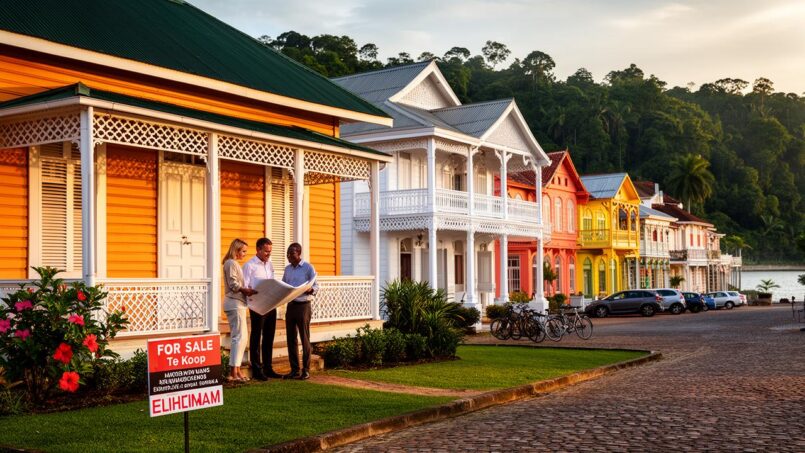
The real estate market of Suriname’s capital is structured around three distinct poles. The historic center, a UNESCO World Heritage site, is characterized by restored wooden colonial houses, whose value is preserved by strict regulations limiting demolition, although this imposes renovation constraints. To the north, residential neighborhoods like Geyersvlijt or Morgenstond are seeing development of modern homes and secure residential complexes, highly attractive to executives and expats. Finally, Paramaribo-South concentrates high-end offerings with villas, recent office buildings, and furnished residences designed for long-term stays by employees of large groups.
In these micro-markets, rental demand is driven by a solvent clientele, local or foreign (multinationals, NGOs, extractive sector companies), which limits vacancy risks for well-positioned properties.
Wanica: The Fast-Growing Residential Extension
West of Paramaribo, the district of Wanica serves as a booming suburb. Large residential projects, secure subdivisions, and still-affordable plots along roadways make it an attractive target for Surinamese families as well as expats seeking space.
The order-of-magnitude figures give a sense of the market.
| Property / Land Type | Indicative Price Range |
|---|---|
| Family home in Wanica | $80,000 – $180,000 |
| Buildable plot | $20 – $40 / m² |
| “Altona Vrolijk Thuis” project | €60 / m², plots 335 to 523 m² (≈ 174 lots) |
The “Altona Vrolijk Thuis” project in Houttuin (Wanica) illustrates the emergence of modern subdivisions: 174 ready-to-build plots with asphalt roads, sewer system, water and electricity connections, and the possibility of 100% financing. This type of program targets local families, first-time buyers, and investors looking for serviced land.
For an expat, Wanica represents a bet on suburban development: projections indicate annual price appreciation potential of 5% to 7% over five years in these expanding areas, higher than in central Paramaribo.
Commewijne, Nickerie, and Districts Focused on Agriculture and Ecotourism
East of Paramaribo, across the river, the district of Commewijne mixes old plantations, historic colonial houses, and riverfront land. Localities like Meerzorg or Mariënburg offer residential or mixed-use opportunities (tourism, leisure, small hotels) with still-modest prices—homes often falling between $70,000 and $150,000, with construction costs also ranging from $500 to $800 per square meter.
Further west, Nickerie, the country’s second city and center of rice farming, mainly attracts projects related to agribusiness (warehouses, silos, housing for agricultural workers). Family homes there remain very cheap, often between $60,000 and $120,000, with per-square-meter costs in the range of $400 to $700.
Saramacca, Brokopondo, or Para are more interesting for investors focused on agriculture or ecotourism. In Saramacca, large agricultural plots sometimes trade between $0.50 and $3 per square meter, while in lake or protected nature areas (Brokopondo, Para), lodges, waterfront plots, or vacation homes range from $50,000 to $250,000 depending on size and amenities.
These are more niche markets, often less liquid, but they can benefit in the medium term from the spillover effects of tourism and oil expansion.
Yields and Appreciation Prospects: What the Numbers Say
Available data provides an idea of gross yields as well as property appreciation prospects in the country’s different zones.
| Zone / Segment | Observed or Average Gross Yield | Projected Annual Price Increase (5 years) |
|---|---|---|
| Apartments in central Paramaribo | Up to ~21% (theoretical average) | 4–6% |
| Apartments in Paramaribo suburbs | Approx. 12–13% | 4–6% |
| Peri-urban areas like Wanica | Target yield ~10% (investment) | 5–7% |
| Coastal frontage | Variable | 6–8% |
| Most promising tourist zones | Variable | 7–10% |
These forecasts are based on GDP growth expectations, the ramp-up of offshore oil production, and continued urbanization. They remain obviously indicative: in an emerging country, variability is high, and the gap between the “central scenario” and extreme scenarios can be significant.
Understanding the Legal Framework: Who Can Buy What, and How?
For an expat, the first step must be to understand how property rights are structured. In Suriname, the logic is largely inspired by Dutch civil law, but with local specifics, particularly regarding land categories.
Types of Land and Foreigner Rights
We mainly distinguish:
– Private land: a foreigner can, in principle, become full owner, subject to authorizations;
– State land (government property): cannot be held in full ownership by non-Surinamese, but long-term usage rights (leases of 40 years or more, renewable) can be granted for an annual fee;
– Customary land rights, particularly in the interior and certain sensitive or border areas, where claims from local communities and the political dimension greatly complicate projects.
Overview of property types for investors, with a focus on recommended areas.
In areas like Paramaribo and the main coastal districts, the majority of properties fall under a classic private ownership regime, with relatively clear titles.
These clear-title sectors are recommended as a priority for foreign investors due to the legal security of their acquisitions.
In the interior, situations are more delicate. Authorities have sometimes granted concessions without customary rights being fully integrated into official records. For an expat, this makes direct acquisition risky: it is better there to turn to emphyteutic leases or partnerships with experienced local players.
Mandatory Ministerial Authorization for Non-Residents
Any real estate purchase by a non-resident must first obtain approval from the ministry in charge of land policy and forests. This is an unavoidable step and often the longest part of the process.
Announced processing times range from 6 to 12 months. For an expat, this means the timeline between accepting an offer and signing the deed of sale typically stretches to six to nine months. It is therefore impossible to envision a quick “hit-and-run” deal: the investment is immediately long-term.
Since 2023, companies holding real estate must also declare their ultimate beneficial owners to the Chamber of Commerce register. This obligation, aimed at increasing transparency, also concerns structures used by foreign investors.
The Central Role of the Notary and Land Registry
As in any civil law system, the notary is the legal architect of the transaction. In Suriname, their involvement is mandatory for:
– drafting the preliminary agreement and the deed of sale;
– verifying the chain of title, any mortgages, easements, ongoing disputes;
– ensuring property taxes and charges are up to date;
– registering the transfer with the MI-GLIS cadastre, which serves as the land registry.
This verification is crucial in a country where documents may be old, incomplete, or even contradictory. The notary acts as a filter, but it is common to also hire a real estate attorney for complex setups (companies, large-scale projects, sensitive areas).
How Does a Real Estate Purchase in Suriname Actually Unfold?
The general outline resembles that of other civil law countries, but with more red tape for foreigners and the mandatory step of ministerial authorization.
From Searching for a Property to Signing the Preliminary Agreement
In practice, the first step is to identify the property, most often through a local agency. In the market, players like Surgoed Makelaardij NV, Terzol Vastgoed, and other specialized brokers act as gateways and intermediaries.
Surgoed, presented as the country’s largest agency, has positioned itself as a true real estate hub: a broad portfolio of properties for sale or rent in Paramaribo and other districts, a dedicated mobile app for the Surinamese market, and complementary services through its Surgoed Construction & Infra division (construction, renovation, maintenance) and Surgoed Happy Home (property management, upkeep, 24/7 assistance).
Percentage of the selling price typically paid as a deposit by the buyer when signing the preliminary agreement in Belgium.
The preliminary agreement can and should include suspensive conditions, for example:
– obtaining financing (local or in the expat’s home country);
– issuance of the ministerial authorization for non-residents to acquire;
– satisfactory result of the title audit and technical due diligence.
The Crucial Due Diligence Step
In an emerging country, due diligence should not be a formality but a thorough audit. It notably includes:
Before any real estate purchase, it is crucial to carry out several checks: a land registry search to confirm the chain of ownership and the absence of disputes or mortgages; verification of tax and charge payments; zoning and urban planning compliance checks (permits, authorizations); and a technical inspection of the building by a professional to identify necessary work and hidden defects.
On some large-scale projects, an Environmental and Social Impact Assessment (ESIA) may be required by the authorities.
Ministerial Authorization and Signing of the Deed
Once the file is assembled, the notary submits the application for authorization to acquire to the competent ministry. This is the most time-consuming phase: depending on the case, the timeline can vary from six months to a year.
When the administrative green light is finally given, the deed of sale is signed, the balance of the price paid, and the transfer registered with MI-GLIS. A new title is then issued in the buyer’s name (or the company they control).
Ancillary costs (transfer duties, notary fees, registration taxes, stamps) are added to the price. Although lower than in some European countries like France or Belgium, they remain significant in Suriname and require thinking on a long horizon to amortize them.
How Much Does a Real Estate Investment in Suriname Really Cost?
Beyond the face value of the property, one must factor in acquisition taxes, taxation on rents, recurring charges, and, if applicable, financing costs.
Transfer Duties, Notary, and Registration
On a property purchase, the expat must pay several layers of fees:
– a property transfer duty, generally ranging between 4% and 6% of the purchase price, borne by the buyer;
– registration and stamp duties, modest in absolute value but adding to the notary’s fees;
– notary fees, varying according to the complexity of the file.
Even if no complete fee schedule is provided, it can be noted that these entry costs are high enough to justify a medium-to-long-term wealth strategy, rather than quick in-and-out moves.
Taxation of Rents and Ownership
Rental income is subject to income tax. For individuals, the scale is progressive, with a top marginal rate that can go up to 38%. For companies, the corporate income tax rate is 36%, in a territorial system where only Surinamese-source income is taxed for non-residents.
Wealth tax rate beyond exemption thresholds, i.e., 8 per thousand.
A typical case gives a measure of this effect:
– property value: $150,000;
– target gross yield: 7%, i.e., $10,500 in annual rents;
– property tax (0.4%): $600;
– insurance (0.7%): $1,050;
– management fee (10%): $1,050;
– maintenance reserve (3%): $4,500.
After deducting expenses, the property generates a net operating income of about $3,300, representing a net yield of 2.2%. Including an assumption of 5% annual appreciation, the total annualized performance reaches nearly 7.2%. This example illustrates that, in an emerging market, an investment’s value often comes from the combination of rental flows and potential capital gains, rather than immediate cash flow alone.
Capital Gains Tax and International Taxation
At this stage, there is no widespread specific taxation regime for individual capital gains on real estate. However, a resale gain may be reclassified as taxable income if the tax authorities consider it speculative or professional activity.
For an expat, the international dimension should not be neglected: the tax treaties of their home country, whether or not agreements exist with Suriname, and non-double taxation rules must be reviewed with a specialized tax advisor. In some cases, structuring through a local company or a foreign holding can optimize the overall burden, but adds complexity.
Financing in Suriname as an Expat: Possible, but Rarely Ideal
The Surinamese mortgage market is dominated by a few banks—De Surinaamsche Bank, Hakrinbank, Republic Bank—which offer mortgage loans, but under conditions quite different from what expats from Europe or North America are used to.
Typical requirements are as follows:
– significant down payment: between 30% and 50% of the purchase price;
– high annual interest rates: often between 10% and 15%; statistics show an average rate of about 16.25% for a fixed-rate mortgage over 20 years;
– relatively short loan terms: from 5 to 15 years in many cases.
In other words, the cost of local credit is such that for many investors, the logic remains “cash is king.” Expatriates investing in Suriname frequently favor this approach.
Expat investors in Suriname
– cash purchase, using savings denominated in a strong currency;
– financing arranged in their home country, using an already-owned property as collateral (unallocated mortgage, lombard loan backed by an investment portfolio, etc.);
– seller financing arrangements, where the seller agrees to spread payment over several years with contractual interest.
Furthermore, expensive and hard-to-access credit partly explains why a significant portion of the population still chooses to rent rather than become homeowners, fueling rental demand in well-positioned segments.
Managing Risks: Currency, Bureaucracy, Land Titles, Security
Promises of yield and capital appreciation should not obscure the very real risks of an emerging market like Suriname. A savvy expat devotes as much time to mapping these risks as to their profitability calculations.
Currency Volatility and Exchange Rate Risk
The Surinamese dollar has experienced several episodes of sharp depreciation. To mitigate the impact, a common practice is to denominated sale prices and rents in US dollars. This partially protects the property’s value and rental flows from the owner’s perspective.
But many recurring expenses (maintenance, salaries, taxes) remain in local currency. Exchange rate fluctuations can therefore impact the effective yield once income is converted into the expat’s currency. Depending on the investor’s profile, this risk may be accepted as currency diversification, or even sought after if one anticipates long-term appreciation of the local currency driven by oil revenues.
Administrative Delays and Regulatory Inconsistencies
Whether for acquisition authorizations for foreigners, building permits, or environmental certificates, procedures are often lengthy and still largely paper-based. Rules may be applied unevenly, depending on the interlocutor or the period.
Despite efforts to digitize and centralize administrative documents with international partners, processing times remain difficult to anticipate. For an expat, this requires planning with wide margins, especially when starting construction or delivering a program depends on an official document.
Land Titles, Customary Lands, and Potential Disputes
While titles are relatively clear in urban areas, the situation is more complex in the interior and some peripheral districts, where customary rights of local communities are not always properly recorded in the land registry. Concessions have sometimes been granted on land with sensitive social and political realities.
For an expat investing outside major centers, the combined support of an experienced notary, a specialized lawyer, and ideally a local partner familiar with the terrain is virtually indispensable to avoid unpleasant surprises.
Security and Remote Management
On the security front, Suriname is not a war-torn country, but violent crime exists, particularly armed robberies, burglaries, and carjackings, especially in Paramaribo. Certain urban areas, like Palmentuin park in the Dutch quarter, are known for illegal activity and limited police presence. Some roadways (the east-west Paramaribo–Albina route, the Afobakka highway, Brokopondo district) are also reported as sensitive.
For an expat property owner, these realities imply securing the property (fences, alarm systems, security guards) and relying on professional local management. Companies like Surgoed Happy Home, for example, offer a range of services from tenant selection to conflict mediation, including financial administration, garden and pool maintenance, and 24/7 emergency assistance.
What Investment Profile for an Expat in Suriname?
Based on these elements, investing in Suriname is neither an ultra-safe blue-chip investment nor a casino where you roll the dice with your stake. Rather, it is a medium-to-long-term diversification project in a country in transition, with an assumed risk premium in exchange for above-average yield and capital appreciation potential.
Example of a Strategy: A Residential Building in Paramaribo
A practical case illustrates how an expat can structure their approach. A French entrepreneur in his fifties was considering investing between $400,000 and $600,000 in residential real estate in Suriname, without using local credit, in order to increase his exposure to the Surinamese currency while seeking attractive rental returns.
The specifications adopted:
For a rental investment in Suriname, target a building or a large divisible house in a developing neighborhood of Paramaribo to diversify risk. Aim for a gross yield close to 10%, accepting higher risk than that of a premium property. Include all costs (acquisition, light renovations, management) for a total budget of around $500,000. Structure the acquisition through a local company or an ad hoc entity, weighing the tax implications with a specialized lawyer. Finally, build a reliable local network including a real estate agent, notary, lawyer, manager, and construction firm.
The expected performance was broken down into two streams: a moderate but steady net cash flow, after taxes and expenses, and a gradual capital appreciation linked to Paramaribo’s growth, the arrival of oil revenues, and the gradual rise in rents.
What Type of Expat Is This Market Suitable For?
Suriname is more suited to profiles:
This investment is primarily for people who already own their primary residence in another country, have significant savings allowing them to forgo local credit or afford more expensive external financing, are ready to accept macroeconomic and currency volatility higher than in mature markets, can invest time in building a solid local network (agents, notaries, lawyers, managers, tradespeople), and must consider their investment on a horizon of at least seven to ten years.
For a young expat early in their career, very mobile, or someone simply looking for a second home with no wealth-building objective, other more transparent or better-served countries may seem more suitable. But for the investor seeking geographic diversification, exposure to a commodity-driven economy, and a real estate market still little contested by international capital, Suriname clearly deserves a look.
Building Your Local Network: The Key to a Successful Investment
Beyond the numbers and the law, the success of a real estate project in Suriname largely depends on the quality of the professionals you surround yourself with.
To secure and optimize your real estate acquisition project in Suriname, it is essential to surround yourself with the right local experts. Here are the main players to consult.
The natural entry point. They know the neighborhoods, market prices, and tenant expectations. They often offer integrated services: management, valuation, construction monitoring, and liaison with notaries.
The legal pivot of the transaction and verification of property titles. It is crucial to choose a professional used to working with foreign clients and complex files.
Firms like Rootz Tax Lawyers or VANEPS secure the acquisition structure, optimize the tax burden, handle permit issues, and manage potential litigation.
They provide risk coverage (fire, flood, liability) and manage financial flows in local currency and foreign currencies.
The Investment and Development Corporation Suriname (IDCS), the Chamber of Commerce, and the Ministry of Land Policy play key roles for large-scale projects (assessments, authorizations, tax incentives).
For an expat, building this network doesn’t happen in a weekend. It requires on-site visits, meetings, sometimes the support of specialized services for accompanying foreign investors, and a good dose of patience and curiosity.
In Summary: A Niche Market, but a Promising One
Suriname is not the new Dubai or the next Lisbon. Nor is it a mere exotic curiosity. It is a small country undergoing profound change, driven by commodities—particularly offshore oil—and rapid urbanization, where the real estate sector is beginning to take shape.
For expats willing to accept above-average risk, real estate in Suriname presents opportunities: still relatively low entry prices, attractive rental yields in certain segments, and appreciation potential in key areas like Paramaribo. This approach requires investing time to understand the market and surrounding yourself with experienced professionals.
Investment there is anything but passive: it requires mastering a particular legal framework, anticipating administrative delays, dealing with currency volatility, and factoring in security and infrastructure issues. But for those who view their wealth as a global adventure, Suriname is increasingly shaping up as a destination to watch closely.
Disclaimer: The information provided on this website is for informational purposes only and does not constitute financial, legal, or professional advice. We encourage you to consult qualified experts before making any investment, real estate, or expatriation decisions. Although we strive to maintain up-to-date and accurate information, we do not guarantee the completeness, accuracy, or timeliness of the proposed content. As investment and expatriation involve risks, we disclaim any liability for potential losses or damages arising from the use of this site. Your use of this site confirms your acceptance of these terms and your understanding of the associated risks.

Cyril Jarnias is an independent expert in international wealth management with over 20 years of experience. As an expatriate himself, he is dedicated to helping individuals and business leaders build, protect, and pass on their wealth with complete peace of mind.
On his website, cyriljarnias.com, he shares his expertise on international real estate, offshore company formation, and expatriation.
Thanks to his expertise, he offers sound advice to optimize his clients' wealth management. Cyril Jarnias is also recognized for his appearances in many prestigious media outlets such as BFM Business, les Français de l’étranger, Le Figaro, Les Echos, and Mieux vivre votre argent, where he shares his knowledge and know-how in wealth management.





