
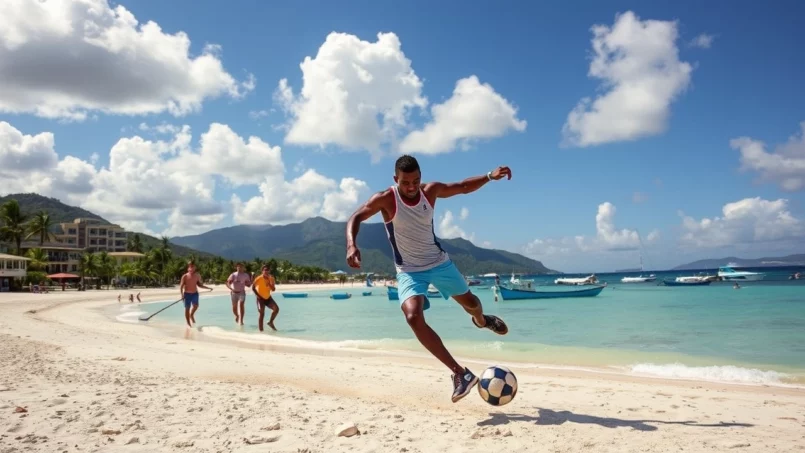
 Published on and written by Cyril Jarnias
With its 365 beaches, sun-drenched climate year-round, and steady trade winds, Antigua and Barbuda is a veritable open-air playground. Beyond the picture-perfect postcard image, the archipelago hides an extremely rich sporting culture, where the sea and cricket ball occupy a central place, but where football, sailing, hiking, sport fishing, golf, surfing, kitesurfing, and tennis have also found an ideal stage for expression.
Antigua and Barbuda is a renowned Caribbean destination for sporting activities, thanks to its adapted infrastructure, major events, and prized natural spots. This article details the most popular sports on these islands, offering a comprehensive overview for visitors looking to combine vacation and athletic pursuits.
Cricket, the Beating Heart of Sport in Antigua and Barbuda
Cricket is not just a sport on the archipelago: it is an element of the national identity. It is played everywhere, all the time, on official grounds as well as on makeshift patches of grass. The local season, which typically runs from January to July, sets the rhythm of sporting life, with matches on Thursdays, Saturdays, and Sundays, supplemented by regional and international games.
The passion is such that the country is sometimes referred to as the “cricket capital of the West Indies”. Despite its small population, Antigua and Barbuda has produced an impressive lineage of world-class players who have profoundly marked cricket history.
A Land of Legends
Among the great figures from the archipelago, some have become global icons. Sir Vivian Richards remains the absolute legend, considered one of the greatest batsmen of all time. His nickname “Master Blaster” sums up his playing style: explosive, dominant. His bat is now on display at the Museum of Antigua and Barbuda, a sign of his importance in the collective memory.
Number of wickets taken by Curtly Ambrose in Test matches during his 13-year international career.
Eldine Baptiste, Winston and Kenny Benjamin, Ridley Jacobs, and Sylvester Joseph are added to this impressive list. For a fan, visiting Antigua and Barbuda is therefore also about walking in the footsteps of these heroes, visiting their stadiums, and sometimes even encountering them on cricket-themed tours.
Mythical Stadiums and a Sports Village Project
Two venues dominate the cricket landscape in Antigua. The Antigua Recreation Ground (ARG), located right in the heart of St. John’s, is a place steeped in history. It hosted Test matches from 1981 to 2009, in an atmosphere renowned for its fervor and closeness between players and spectators. It was here that Brian Lara, in 1994, scored 375 runs, breaking the world record, before returning ten years later to raise it to 400 runs, still on that same ground. It was also at the ARG that the West Indies staged a historic comeback against Australia in 2003, chasing a total of 418 runs, a record at the time. The pitches, very favorable to batsmen, shaped a spectacular and offensive style of play.
The international cricket relay in Antigua is now handled by the Sir Vivian Richards Stadium, located at North Sound, 15–20 minutes from St. John’s and near the V.C. Bird International Airport. Built specifically for the 2007 World Cup with an investment of about 60 million US dollars, largely funded by China, the stadium has a standard capacity of 10,000 seats, expandable to 20,000 with temporary stands. It is structured around two main stands: a North Stand and a large five-story South Stand housing the pavilion, suites, and media. In 2015, the ends of the ground were renamed the “Andy Roberts End” and the “Curtly Ambrose End” in honor of these two local cricket idols.
The stadium hosts One Day Internationals and numerous International T20s. For example, it was one of the major venues for the 2024 T20 World Cup, where South Africa posted a total of 194/4 against the United States, one of the highest scores in the tournament on that ground. The only blemish: a 2009 Test match interrupted due to a sandy outfield deemed dangerous, an episode that ironically earned it the nickname “Beach 366“.
A former airport runway, renamed and renovated after years of abandonment, the Coolidge Cricket Ground is today an ICC-accredited international venue and serves as a high-performance center for West Indies cricket, having notably hosted legendary matches and feats like Kieron Pollard’s six sixes.
The momentum doesn’t stop there, as a large Antigua Barbuda Sports Village project is set to be developed around the Sir Vivian Richards Stadium, covering more than 300 acres, further strengthening the country’s international sporting vocation.
An Organized Structure and Competitions for All
The Antigua and Barbuda Cricket Association, affiliated with the Leeward Islands Cricket Association and the Cricket West Indies board, manages the national team, which has represented the archipelago since the late 19th century. The team, which participates in regional competitions under the Leeward Islands banner and internationally within the West Indies, played its first List A match during the 1998 Commonwealth Games in Kuala Lumpur and its first T20 match in 2006 as part of the Stanford 20/20. To date, it has over a dozen matches of each format to its name.
Beyond the elite, cricket permeates schools, neighborhood clubs, and local leagues. It is seen as a vector for cohesion, discipline, and national pride. A curious traveler can easily attend a championship match or even take part in training sessions at community clubs, as the welcome from the public is very warm.
Football: The Serious Challenger Behind Cricket
If cricket reigns supreme in hearts, football has established itself as the second most popular sport in Antigua and Barbuda. Here too, the structure is advanced. The Antigua and Barbuda Football Association (ABFA), founded in 1928 and affiliated with FIFA and CONCACAF since 1970, oversees the development of the sport.
An Active Federation and a Highly Competitive Championship
The ABFA has 50 members, including 49 clubs and the national referees’ association. It organizes men’s competitions (Premier Division, First Division, Second Division), women’s (Female Division), as well as the national cup (FA Cup), a League Cup, and youth championships (U-18, U-15, U-13). The season generally runs from September to February or March.
The football league system in Jamaica is organized into three tiers. At the top is the Premier Division (also called the Digicel/Red Stripe Premier Division), founded in 1968. It usually has ten clubs, but can vary (e.g., 15 teams in 2023-2024). The bottom two in this tier are relegated. The second tier is the First Division, which includes about twelve clubs and serves as an intermediate level. The third tier is the Second Division, split into two groups for a total of about 22 teams. Each season, between two and three clubs are promoted or relegated between these different levels.
To measure the density of the championship, a few figures from the 2025–2026 season give an idea: twelve teams competing, an average of 3.63 goals per match, about half of the matches won by the home team, 13% of away wins, and 38% draws. An open, attacking style of football that pleases the public.
Among the clubs in the recent elite are All Saints United, Aston Villa (St. John’s), Five Islands, Garden Stars, Green City FC, Grenades (Jennings), Hoppers (Greenbay), Liberta, Old Road, Ottos Rangers, Parham, Pigotts Bullets, SAP (Bolans), Swetes, and Willikies. Empire FC remains the most historically successful club, with 13 championship titles. Parham (6), Bassa (5), SAP (4), English Harbour (3) or Hoppers, Liberta, Lion Hill Spliff, Old Road, Supa Stars, and Villa Lions (2 each) complete this record. All Saints United, crowned champion in 2023–2024 and then in 2024–2025, symbolizes the rise of new forces.
Homegrown Scorers and an Ambitious National Team
The championship has built genuine local figures. Conrad Whyte, with 158 goals, holds the record for goals scored, ahead of Peter Byers (141 goals). Whyte notably scored 26 goals in the 2001–2002 season alone, the best individual performance in a single season. Stefan Smith, capable of scoring six goals in a single match, and Raheem Deterville each have three top scorer titles, while Byers holds the record for hat-tricks (six). The 2022–2023 season saw no fewer than 25 hat-tricks scored.
The national team, managed by the ABFA, regularly aims for the World Cup (12 attempts, most recently for 2026). It has a solid organization with a president, a management team, a technical director, coaches for the men’s and women’s teams, and an active referees department. Home matches are played at the Antigua Recreation Ground, approved for 2010 World Cup qualifiers. The Sir Vivian Richards Stadium did not have this accreditation during its bid due to ongoing works.
For a visitor, attending a Premier Division match or a national team game is a privileged way to feel the pulse of the country beyond the beaches.
Sailing and Regattas: Antigua, the Caribbean Sailing Capital
Antigua and Barbuda is widely recognized as the sailing capital of the Caribbean. Its position in the Lesser Antilles, bathed by steady trade winds, its protected bays, and its numerous anchorages explain the concentration of top-level nautical events.
English Harbour and Falmouth Harbour, on the south coast, constitute the nerve center of this activity, with Nelson’s Dockyard – a UNESCO World Heritage Site – as the historical backdrop.
Antigua Sailing Week, the Unmissable Event
Among the major events, Antigua Sailing Week holds a special place. This event, built since the late 1960s from informal regattas between classic yachts, is now described as one of the world’s premier offshore regattas and often presented as “the Caribbean’s hottest regatta week.” It attracts over 100 to 200 yachts annually, from 24 to over 100 feet, professional crews, passionate amateurs, and thousands of spectators.
The racing week, organized by the Caribbean Sailing Association (CSA) under the CSA rating rule, spans five days, from Sunday to Friday, with daily races of three to four hours. Starts are from English Harbour and Falmouth Harbour. The competition structure mixes offshore courses around buoys and an Olympic-type course off Dickenson Bay. The fleet is divided into two main divisions: Division A (Racing Fleet, sport boats, Racer/Cruiser with spinnaker) and Division B (Racer/Cruiser without spinnaker, cruising, charter boats). Precise rules govern the use of spinnakers, jibs, and poles according to categories, and bareboats must belong to real charter fleets, equipped only with a mainsail and jib.
The following table summarizes the fleet structure during the week:
| Division | Boat Types | Spinnaker Use |
|---|---|---|
| A | Racing Fleet, sport boats, Racer/Cruiser (with spi) | Spinnaker allowed |
| B | Racer/Cruiser (non-spi), cruising fleet, bareboats | Spinnaker generally not allowed |
Beyond the racing, the onshore atmosphere is equally renowned, with a busy social program: parties sponsored by major international brands, concerts, a lively lay day at the Antigua Yacht Club, prize-giving on Friday evening, festivities until the early hours. Operators like Sunsail, the official sponsor of bareboat charters for the event, or Ondeck, which offers participation on racing boats such as the Farr 65 Spirit of Juno, allow individual crew members, small groups, or companies to join the adventure, even without prior experience.
Classic Yacht and Superyacht Regattas
Another iconic event: the Antigua Classic Yacht Regatta, born in 1987 when captains of large classic yachts gathered aboard the schooner Aschanti of Saba to create an event dedicated to this floating heritage. Since then, between 50 and 60 classic yachts meet each year: traditional island sloops, ketches, schooners, yawls, Spirit of Tradition, J Class, Tall Ships.
The regatta alternates sea races and typical onshore entertainment: a concours d’élégance for the condition and authenticity of the boats, ‘Cream Tea & Gig Racing’ days blending English tea and rowing races, Open Mic music evenings, and yacht parades at Nelson’s Dockyard. The program also includes a single-handed race with classes based on length and the ‘Spirit of Tradition’ category, as well as happy hours for sailors and locals in the bars of English Harbour.
The Superyacht Challenge Antigua, held in late January or early February for yachts over 80 feet, complements this schedule. Conceived as a “friends” gathering without sponsors or heavy advertising exposure, it is coordinated by a committee led by Paul Deeth and Stan Pearson. The races, rated under the ORCsy rule with adapted sailing rules, cover 12 to 30 nautical miles, with starts and finishes off English Harbour.
Major Offshore Races and Related Events
The archipelago also hosts major offshore races, starting with the RORC Caribbean 600, described as the Caribbean’s great distance race. Imagined at the Antigua Yacht Club bar by club members and John Burnie of the Royal Ocean Racing Club (RORC), the course forms a 600-nautical-mile loop around 13 islands of the Lesser Antilles, with start and finish at Falmouth Harbour. Managed by RORC in partnership with the Antigua Yacht Club, the event benefits from the support of about 50 local volunteers.
The race is preceded by the Antigua 360, a counter-clockwise circumnavigation of the island reserved for boats qualified for the Caribbean 600, born after a yacht, *Phaedo*, completed this course during training in 2015.
Antigua 360
Other events round out this impressive calendar: the Valentine’s Regatta and the Around Redonda Race organized by the Jolly Harbour Yacht Club in February, the Superyacht Challenge, the Antigua Classic Yacht Regatta in April, or the anticipated return of the Antigua–Bermuda race, organized by the Royal Bermuda Yacht Club in conjunction with Antigua Sailing Week. In the offshore segment, Antigua also serves as the finish point for the RORC Transatlantic Race, which starts from Lanzarote, while events like the Worlds Toughest Row (rowing) or the Salty Dawgs Rally also have the island as a destination.
Nautical life also extends to training the youth. Antigua has twice hosted the North American Optimist Championships (OPTINAM), with a fleet of 144 young sailors from 20 countries racing off English Harbour in 2016. The Antigua and Barbuda Yachting and Marine Association (ABYMA), supported by the Ministry of Tourism, coordinates a wide calendar of events – including Discover Yachting & Marine, which introduces young Antiguans to career opportunities in the marine industry.
Water Sports: Diving, Snorkeling, Kitesurfing, Surfing, Sport Fishing
Beyond pure sailing, the sea offers an incredible palette of activities.
Snorkeling and Diving Around Reefs and Wrecks
Thanks to warm and clear waters year-round, snorkeling and scuba diving are must-dos. The archipelago lists at least 127 wrecks around its coasts, vestiges of an intense maritime past, which divers explore today.
On the west coast, more sheltered from the Atlantic, conditions are generally calmer and the water clearer, often with less sargassum than on the eastern side. Sites like Deep Bay, where the wreck of the three-masted barque Andes lies at about thirty feet deep, or Cades Reef, nearly two miles long in a protected marine area, offer encounters with turtles, moray eels, nurse sharks, barracudas, leopard rays, lobsters, and schools of tropical fish.
The table below presents some major snorkeling and diving spots:
| Site | Main Features |
|---|---|
| Deep Bay | Wreck of the Andes, near Fort Barrington, fish, turtles |
| Cades Reef | 2-mile reef, protected area, numerous species and 20 sites |
| Pillars of Hercules | Limestone rocks, coral nursery program, rays, turtles |
| Galleon Beach | Small wreck near the beach, frequent turtles and rays |
| Long Bay | Shallow reef, colorful fish, green turtles |
| Carlisle Bay | Deep bay with several wrecks, seahorses, octopus, rays |
| Dickenson Bay | Paradise Reef offshore, elkhorn coral, schooling fish |
Authorities have banned certain toxic sunscreens to protect the coral reefs. On site, operators emphasize a few basic rules: never dive alone, be mindful of currents and boat traffic, do not touch corals or wildlife, protect yourself from the sun, stay well hydrated.
Surf, Windsurf, and Kitesurf: Playing with the Trade Winds
While Antigua and Barbuda is not the number one surfing destination in the Caribbean due to a coastal shelf that dissipates some of the swell, the archipelago still has a handful of quality spots, especially in winter with north-northeast swells and in late summer during the passage of tropical storms and hurricanes.
The island of Antigua offers several notable spots. Fort Barrington, east of St. John’s, offers a long left-hander (up to ~300 m) on a mixed sand/reef bottom during aligned winter swells. Galley Bay is known for its fast, hollow lefts over brain coral, suitable for intermediate and advanced surfers. Turtle Bay, sometimes considered the country’s best wave, offers long rights on a very shallow reef during southeast swells. Finally, Half Moon Bay serves as a playground for summer wind swells.
Barbuda, more exposed to the Atlantic, is home to one of the region’s hidden gems: Palmetto Point, also informally called “Fuckallya”, a world-class left-hand barrel discovered in the early 2000s, which works particularly well with hurricane swells in late summer. The threat of some real estate projects around this headland has sparked debates and legal action, so precious is the spot in the eyes of surfers.
Antigua is a renowned destination for freeride windsurfing and kitesurfing, benefiting from reliable trade winds and ideal spots, especially on its north and northeast coasts.
The trade winds blow reliably from November to July, with peak intensity (12 to 18 knots) between December and July.
The heart of the community, this national park offers safe side-onshore winds, a sandy beach, and little shorebreak.
Centers like Windsurf Antigua or Kitesurf Antigua, some IKO-accredited, offer lessons and equipment rental there.
Other bays like Dutchmans Bay, Nonsuch Bay, Dickenson Bay, or Half Moon Bay complete the map, each with its own character – flat water protected by a reef, small waves for bump & jump, or more technical water. On these same coasts, wing foiling is also gaining ground, propelled by the same windy conditions and protected waters.
Sport Fishing: Between Deep Sea and Barbuda’s Flats
Sport fishing is another pillar of nautical activities, whether offshore trolling, bottom fishing, or flats fly fishing. The deep waters where the Atlantic and Caribbean Sea meet are home to large pelagics: wahoo, dolphinfish (mahi mahi), tuna (yellowfin and blackfin), blue and white marlin, sailfish, sharks. Near the bottom, anglers target snappers, groupers, jacks, amberjacks, and other predators. In the lagoons and shallow areas, especially around Barbuda and the Codrington Lagoon, the targets are bonefish, tarpon, snook, and permit, prime targets for fly-fishing enthusiasts.
Specialized companies like Obsession Charters, Overdraft Deep Sea Fishing Charters, or Hardcore Fishing operate from Falmouth Harbour, English Harbour, or Jolly Harbour. Their boats are well-equipped (fish finders, VHF, life rafts, life vests, shaded space, toilet) and local captains often have over twenty years of experience. Trips cater to both beginners (with introduction to techniques) and seasoned anglers seeking trophy catches like marlin or wahoo.
The following table illustrates some price ranges noted for private charters (indicative amounts in US dollars):
| Duration / Trip Type | Observed Price Range (USD) |
|---|---|
| 4 hrs offshore fishing | 550 to 650 |
| 6 hrs offshore fishing | 750 to 850 |
| 8 hrs offshore fishing | ~1000 |
| Full day marlin (6am–6pm, catch & release) | ~1200 |
| Full day marlin (8am–4pm, tag & release) | ~1100 |
Charters generally include gear (rods, reels, bait, lures), non-alcoholic drinks, sometimes beer and rum, and sometimes mask/snorkel if the trip combines snorkeling and fishing. The catch, in principle, belongs to the boat, but it’s not uncommon for clients to take home a portion of their fish.
Finally, the archipelago hosts a highly followed annual sport fishing tournament, marked by impressive catches and a spirit of camaraderie between local and international crews.
Golf: Tropical Fairways with Ocean Views
Amid this profusion of nautical activities, golf occupies a discreet but very real place. Antigua has two courses open to visitors, plus a private club and a project under development.
Cedar Valley Golf Course: The Historic Course
Three miles north of St. John’s lies the Cedar Valley Golf Course, the island’s only 18-hole championship course. Designed by Ralph Aldridge, first opened as a 9-hole layout in 1970, then completed to 18 holes in 1977, the course totals 6,157 yards for a par 70. The undulating fairways wind through mature tropical trees, with beautiful views of the hills and the Caribbean Sea.
The scorecard offers several tees, with moderate difficulty:
| Tees (Cedar Valley) | Par | Slope | Length (yards) |
|---|---|---|---|
| Blue (men) | 70 | 124 | 6157 |
| White (men) | 70 | 122 | 5884 |
| Red (men) | 70 | 120 | 5528 |
A 300-yard driving range, resident pros offering private lessons, and the possibility to organize group outings and tournaments complete the offering. The club welcomes players of all levels, with booking through the pro shop, proper attire required (golf attire, soft spikes only). Payments are by card (Visa, Mastercard, American Express), and rates are given “per person,” subject to change.
Jolly Harbour Golf Club: Fairways by the Marina
On the west coast, near the marina and residential complex of Jolly Harbour, another 18-hole championship course awaits golfers. Designed by Florida architect Karl Litton, this par-71 course stretches 5,587 yards through a lightly rolling tropical park, irrigated by seven lakes. The easterly trade winds add an extra challenge on some tee shots, while the wide fairways and well-kept greens make it an accessible yet technical course, considered one of the best courses in the Caribbean.
The daily rate for an 18-hole round at Jolly Harbour Golf is 100 USD.
Other Courses and Projects
A private club, the Mill Reef Club, has a 9-hole course on the east coast, with open views of the Atlantic. Another project, the Half Moon Bay Golf Club, is announced around the superb bay of the same name. Finally, Barbuda once had a 9-hole course now closed following damage from Hurricane Irma, with hope for eventual reconstruction.
Many of Antigua’s upscale hotels offer golf packages in partnership with local clubs. These offers can include the provision of brand-name club sets or the organization of dedicated transfers to the courses.
Hiking and Nature: From 365 Beaches to the Hills of Mount Obama
While Antigua is known as one of the driest islands in the Caribbean, its hills, cliffs, and secondary forests give rise to a more varied network of trails than one might imagine. Hiking has become a popular way to discover another facet of the archipelago, between colonial ruins, 360-degree viewpoints, and hidden coves.
A Structured Network Around National Parks
A collective of enthusiasts, including the Rohrman Sports Association, the Wadadli Trail Blazers, 268 Trails, the 5 AM Hikers, and the Jolly Roger Hikers, has created the “Hike 365” guide, a veritable atlas of the trails of Antigua and Barbuda. It lists routes by level (easy, intermediate, intermediate-advanced), specifies duration, elevation gain, average speed, and compiles hiker reviews.
Nelson’s Dockyard National Park, in the southwest, offers several interconnected hiking trails like the Middle Ground Trail, Carpenter’s Rock Trail, Jones Valley Trail, and Lookout Trail. The combination of Desmonds & Carpenters allows you to link Galleon Beach, the heights of Shirley Heights, cliffs, and abandoned forts. This network is complemented by other national parks such as Devil’s Bridge (Indian Town Point), Green Castle Hill, and Fort Barrington.
The “Green Corridor“, a wetter area in the southwest, is home to the forests and hills of Wallings Nature Reserve and Christian Valley, with trails leading to dams, waterfalls, viewpoints, and lush valleys (Button Pond, Wallings Dam–Signal Hill, Christian Valley Bird Trail, Body Pond Valley). An entry fee of about ten US dollars is required to access some of these protected areas.
Iconic Hikes
Several routes stand out as must-dos for those wanting to combine sport and discovery.
This 5.4-mile (loop) trail starts at Galleon Beach. It offers an intermediate to advanced-level hike of about 2 hours of walking (excluding breaks), combining cliffs, historical vestiges (18th-century ruins, gravesites), and access to coves for swimming and snorkeling at the foot of iconic limestone formations.
Mount Obama (formerly Boggy Peak) is the highest point of the archipelago, around 400 meters (1,300 feet) in elevation according to sources. The hike, just over 6.5 km (4 miles) round trip, traverses tropical vegetation, with steep and sometimes slippery sections. Allow two to three hours of sustained effort to reach the summit, topped by a communication tower surrounded by a fence. On a clear day, the view sweeps across all of Antigua, the Caribbean Sea, and, in the distance, the island of Montserrat.
Signal Hill, the second-highest point on Antigua, is accessible from Wallings and offers a circular panorama of the island and yachts offshore, for a walk of about two hours. Fort Barrington, in contrast, is a short climb (less than an hour) from Deep Bay beach to the ruins of an 18th-century fort, ideal for more moderate exertion.
On the island of Barbuda, hiking allows exploration of remarkable natural and historical sites. The walks lead notably to the Two Foot Bay Caves, Darby Cave (a massive sinkhole about 90 meters in diameter), and Dark Cave, where one can observe stalactites, bats, cavernicolous crustaceans, and ancient petroglyphs. Walks around the Frigate Bird Sanctuary complete this exploration experience.
Practical Tips for Hikers
Local organizers recommend sturdy shoes, sometimes water-appropriate sandals for coastal sections, a swimsuit, snorkeling gear to enjoy the coves, a waterproof camera, breathable long-sleeved clothing, a backpack, plenty of water, and good sun protection. Guides like AllTrails or komoot offer maps and routes, with the ability to download tracks offline.
Many hikers choose to be accompanied by a local guide, especially for Mount Obama (where summit access may require a key for the fence), for some Barbuda caves, or to combine walking, swimming, and history. Operators like Footsteps Rainforest Hiking Tours, Triflexcursion, or Adventurous Hikes (by Rodney Baltimore) organize custom outings, often combined with kayaking, biking, or snorkeling.
Tennis, Pickleball, and Racquet Sports: The Ideal Complement
The mild climate and hotel infrastructure have favored the development of racquet sports like tennis and, more recently, pickleball.
Several hotel complexes on the island offer quality facilities for tennis and other racquet sports, with equipment rental and professional coaching.
Has several tennis courts (up to nine), some of which are lit. Also offers two pickleball courts. Coaching is provided by professionals like Rennie George and Nigel Anthony.
Boasts four lit tennis courts and employs three professional coaches. The resort regularly hosts events like Antigua Tennis Week or themed camps.
St. James’s Club & Villas, Jumby Bay Island, Galley Bay Resort & Spa, Pineapple Beach Club, Hawksbill Resort, Sandals Grande Antigua, The Verandah Resort & Spa, and other all-inclusive hotels also offer tennis facilities and often pickleball courts, squash, mini-golf, croquet, or ping-pong tables. At Jolly Harbour, an outdoor complex groups four lit tennis courts and a glass-backed squash court, with a resident pro for lessons.
These sports constitute an easily accessible option for vacationers wanting to alternate between swimming, excursions, and more structured sessions, sometimes as part of clinics or amateur tournaments.
A 360° Sports Destination
Cricket and football for popular roots, sailing and regattas for the international showcase, diving, snorkeling, surfing, windsurfing, kitesurfing, and sport fishing to exploit the sea’s potential, golf and tennis to round out the offering, not forgetting hiking, biking, ziplining, horseback riding, or sea kayaking: Antigua and Barbuda combines all the ingredients of a complete sports destination.
Geographically, it offers over 100 miles of coastline, reefs, sheltered bays, reliable trade winds, and panoramic hills. Culturally, cricket is an art and a heritage, football a community binder, sailing a second nature, and the sea an economic, recreational, and identity resource.
Whether you come to sail in the fleet during Antigua Sailing Week, walk in the footsteps of Sir Vivian Richards in the stadiums of St. John’s, try kitesurfing at Jabberwock Beach, dive on the wreck of the Andes, challenge the wind on the fairways of Cedar Valley, or simply follow a local guide to the Pillars of Hercules before a snorkel, the archipelago offers a rare sports adventure playground, where adrenaline constantly blends with the beauty of the landscapes.
For those seeking a destination where sporting activities, heritage, and nature reinforce each other, Antigua and Barbuda clearly stands out as one of the jewels of the Caribbean region.
Disclaimer: The information provided on this website is for informational purposes only and does not constitute financial, legal, or professional advice. We encourage you to consult qualified experts before making any investment, real estate, or expatriation decisions. Although we strive to maintain up-to-date and accurate information, we do not guarantee the completeness, accuracy, or timeliness of the proposed content. As investment and expatriation involve risks, we disclaim any liability for potential losses or damages arising from the use of this site. Your use of this site confirms your acceptance of these terms and your understanding of the associated risks.

Cyril Jarnias is an independent expert in international wealth management with over 20 years of experience. As an expatriate himself, he is dedicated to helping individuals and business leaders build, protect, and pass on their wealth with complete peace of mind.
On his website, cyriljarnias.com, he shares his expertise on international real estate, offshore company formation, and expatriation.
Thanks to his expertise, he offers sound advice to optimize his clients' wealth management. Cyril Jarnias is also recognized for his appearances in many prestigious media outlets such as BFM Business, les Français de l’étranger, Le Figaro, Les Echos, and Mieux vivre votre argent, where he shares his knowledge and know-how in wealth management.





