
 Published on and written by Cyril Jarnias
Buying real estate in Monaco is no ordinary transaction. Prices are among the highest in the world, the rules are very specific, and every mistake comes at a high cost, both in time and money. However, if well prepared, an acquisition in the Principality can offer a rare trio: legal security, strong capital preservation, and exceptional tax advantages.
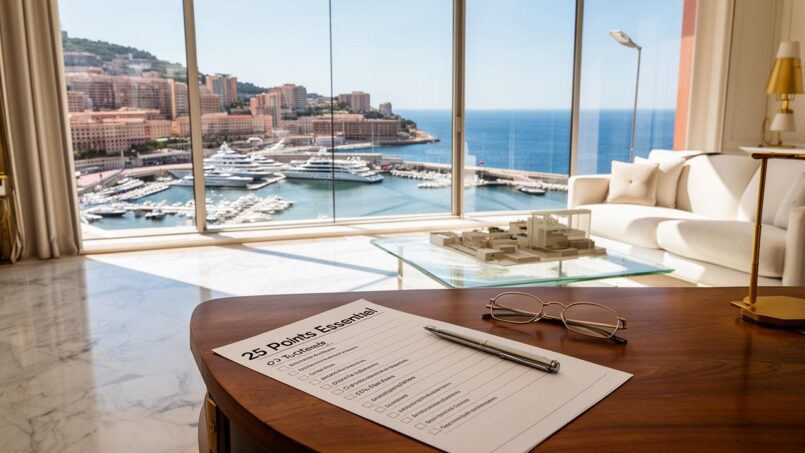
25 concrete points to review before buying in Monaco: market, taxation, purchase procedure, and residency issues.
Price analysis, market trends, and sought-after areas.
No income tax and reduced property tax.
Key steps: preliminary contract, notary, deposit.
Obtaining a residence permit through real estate purchase.
Notary fees, registration duties, and service charges.
Rates, bank loans, and required down payment.
1. Confirm That You Are Allowed to Buy
First and foremost, you need to check the conditions for accessing the market. On this point, Monaco stands out sharply from many other countries: there are no nationality restrictions for buying a property.
Foreigners, even non-residents and regardless of nationality, can freely buy, rent, and resell a property in Monaco without any prior residency requirement. The only exceptions: certain buildings near the Prince’s residence (subject to special authorizations) and part of the public domain reserved for Monegasques or subject to strict conditions, which almost never affects ordinary transactions.
In short, if you are a foreigner, you can buy without quotas or special passports, but you must remain attentive to the nature of the property (private, public, regulated sector) and its precise location.
2. Understand the Link Between Real Estate Purchase and Residency
Being a property owner does not automatically grant you residency, but it is a major asset. At the heart of the system is the Carte de Séjour, a residence card issued to foreigners who settle in the Principality for more than three months.
To obtain the Carte de Séjour in Monaco, it is mandatory to own or rent a habitable dwelling proportionate to the size of the household, demonstrating a stable base on the territory.
It is important to distinguish between:
– The right to buy: open to all, with no minimum property value requirement.
– The right to reside: subject to a set of criteria, including housing, financial resources, a clean criminal record, and, for non-Europeans, prior obtaining of a French long-stay visa.
Buying a property therefore often serves a dual purpose: asset investment and the foundation for a residency application. But residency remains a separate administrative process, with its own requirements and timelines.
3. Clarify Your Objectives: Residency, Investment, or Both
Before even starting visits, you need to clearly define why you are buying in Monaco. Buyers roughly fall into three profiles:
Three typical profiles are described: those seeking a primary residence and a tax base for their family; those adopting a long-term wealth strategy based on land scarcity and price stability; and those looking for a property that meets the Carte de Séjour criteria to secure their resident status.
These objectives will guide your specifications: number of rooms, neighborhood (Larvotto, Carré d’Or, Fontvieille, Monte-Carlo, etc.), sea view or not, amenities (concierge, pool, 24/7 security), rental potential.
In a market where the average price exceeds €50,000 per square meter, and climbs much higher in the most sought-after areas, it is crucial to know whether you prioritize liquidity, rental yield, quality of life, or optimizing your residency application.
4. Set a Realistic Budget Including All Costs
Monaco is an ultra-prime market: a 100 m² apartment easily runs around €6 million, even more in Larvotto or the Carré d’Or. But that’s only the beginning of the equation.
For a resale purchase (a “secondary” property already sold at least once, or more than five years old), an individual must factor in around 6.25% in acquisition costs (registration duties and notary fees). Add to that agency fees, typically 3% of the price excluding VAT, or 3.6% including VAT on the buyer’s side.
The table provides an order of magnitude for the main costs depending on the type of acquisition, without a specific numerical value provided.
| Type of Buyer / Property | Registration Duties | Notary Fees | Total Cost (excl. agency) |
|---|---|---|---|
| Individual, resale (“secondary”) | ≈ 4.75% | ≈ 1.5% | ≈ 6.25% |
| Individual, new / VEFA | ≈ 1% | ≈ 1.5% | ≈ 2.5% |
| Foreign transparent company | ≈ 7.5% | ≈ 1.5% | ≈ 9% |
| Foreign opaque / offshore company | ≈ 10% | ≈ 1.5% | ≈ 11.5% |
On top of that, add:
– Agency fees (3% + VAT for the buyer).
– Possible independent legal advisory fees.
– Bank processing fees and mortgage registration fees if you take out a loan.
Local banks, very accustomed to an international clientele, finance non-residents, but often require a substantial down payment, on the order of 30 to 50% of the price. Note that they finance the value of the property, but not the notary and agency fees, which must be paid from your own funds.
5. Take Advantage of Tax Benefits… But Know Exactly Which Ones
Monegasque taxation is a large part of the appeal of the Principality, but you need to understand it.
For individuals:
– No income tax.
– No wealth tax on real estate or any “IFI”-type tax.
– No capital gains tax on private sales, even on resale with strong appreciation.
– No annual local tax on residential properties: no property tax, no occupancy tax, or equivalent.
Once the purchase is completed, the only recurring costs will be condominium fees, insurance, and possibly loan interest. Rental income received by an individual is not taxed in Monaco.
One point not to overlook: inheritance tax. It is zero in the direct line (spouse, children), but progressive for other beneficiaries, up to 16% for a legatee with no family relationship. And crucially, you must consider your home country tax situation (especially if you are a French national, subject to a specific regime under agreements with France).
6. Build Your Financing Plan and Open a Local Bank Account
Before making an offer, it is strongly recommended to:
– Obtain a pre-approval from your bank (in the Principality or abroad) or have proof of sufficient funds.
– Open an account with a Monegasque bank, which will facilitate deposit payments, management of any mortgage, and later, the required deposit for a residency application (often €500,000 or more).
Local banks require complete documentation on the source of funds (bank statements, balance sheets, tax returns, proof of inheritance or asset sales). These requirements are reinforced by a very strict anti-money laundering framework, aligned with FATF standards, with real penalties for intermediaries who fail to comply with due diligence procedures.
Once your financial capacity is clearly established, your negotiating position is considerably strengthened.
7. Choose a Local Agency and Accept the “Off-Market” Logic
The Monegasque market is very particular: public listings reflect only a part of the actual supply. Many properties, especially in the ultra-prime segment, are negotiated “off-market,” through a network of licensed agencies.
Relying on a reputable agency, licensed in the Principality, is therefore almost indispensable, even if not legally required. The agency:
This service filters properties based on your profile and objectives, gives you access to discreet opportunities, prepares and submits the Purchase Offer, and coordinates exchanges with the notary and, if applicable, your lawyer.
Agency fees on the buyer’s side are regulated by the Monaco Real Estate Chamber: 3% of the price, plus 20% VAT. However, this cost is justified by the scarcity of properties, the technical nature of the market, and individualized support.
8. Arrange Physical Visits and, if Needed, a Technical Inspection
In a Principality of 2.08 km², the concept of location remains decisive: orientation, view, noise level, building quality, nearby amenities, accessibility, etc. Nothing replaces on-site visits to assess:
Several key factors influence a property’s value: the actual standard of common areas, exposure (sunlight, overlooking, sea or city view), quality of finishes and equipment, and the neighborhood atmosphere both day and night.
It is possible to commission an expertise or “building survey” by a specialist to identify any structural, dampness, insulation, or electrical compliance issues. These technical reports, which add to the mandatory diagnostics (energy performance, asbestos, lead, depending on the building’s age), also serve as a basis for potential price renegotiation.
9. Understand the Building Structure and Condominium Rules
In Monaco, most apartments are part of condominiums. Before buying, it is essential to request:
– The condominium bylaws and their amendments.
– The minutes of general meetings for the past three to five years.
– Details of the reserve fund (sinking fund) and planned works.
– The amount of regular fees and any outstanding arrears.
These documents allow you to check:
Before buying, verify the building’s purpose (strictly residential or mixed), rental restrictions (especially short-term), condominium rules on renovations, noise, and exterior modifications, as well as the overall condition of the building and major works planned (facades, roofs, communal networks).
An insufficient reserve fund or unfunded major works are signals to factor into your budget and, sometimes, into your negotiation strategy.
10. Check Renovation Possibilities: Permits and Constraints
Even in a tiny country, urban planning and construction rules are particularly strict. In Monaco, no work – whether demolition, structural modification, or even certain interior alterations – can begin without prior government authorization, via the Directorate of Planning, Urbanism and Mobility (DPUM).
Works are broadly classified into two categories:
Works requiring a building permit or formal authorization include opening up bays, modifying load-bearing walls or full-height partitions, changing the use (e.g., apartment to office), and interventions on common areas. Conversely, light or aesthetic works (changing floor coverings, renovating a kitchen or bathroom without structural modification) may require a simple declaration or no administrative formalities, subject to condominium rules.
A Monegasque architect must sign permit applications for major projects, and an approved inspection office intervenes to verify structural, electrical, fire, acoustic, accessibility, etc., compliance.
If you plan to transform the space (merging apartments, reconfiguring rooms, changing use), you must check:
– Condominium rules: general meeting approval is often required for work on load-bearing walls or common elements.
– Compliance obligations (accessibility, ventilation, fire safety).
– Processing times for files by the DPUM (about 45 days in the simplest cases).
Ignoring these constraints can lead to orders to restore the property at your expense.
11. Assess the Property’s Compliance with Habitability Standards
Monegasque regulations set precise standards for housing: minimum room volume, ceiling height, natural lighting, sanitary facilities, ventilation. For example:
A main room must have at least 25 m³ of volume, 9 m² of floor area, and 2.70 m of height. For dwellings with two or more rooms, a separate WC and washbasin are mandatory, unless exempted. Living rooms require natural light from windows opening onto a street, courtyard, or open space.
These rules impact the valuation of the property, especially in older buildings or former hotels converted into residences. Your notary and, if applicable, your architect, will verify the dwelling’s compliance with these criteria, particularly if you intend to rent it out or present it as a primary residence in a Carte de Séjour application.
12. Make a Purchase Offer with Full Knowledge
Once the property is chosen, the next step is drafting a Purchase Offer (or Letter of Intent). In Monaco, this written offer is usually prepared with the agency’s help and includes:
– Description of the property.
– Proposed price.
– Validity period of the offer.
– Full contact details of the buyer.
– Agency fees attributable to the buyer.
– Any conditions (obtaining financing, specific technical checks, etc.).
Once accepted by the seller, this offer may have legally binding value, limiting subsequent wiggle room. Hence the importance of having already properly prepared the required elements before acceptance.
– Clarified your financing.
– Reviewed the main condominium documents.
– Anticipated the scope of work and possible permits.
Price negotiation remains possible, especially for so-called “secondary” properties (less sought-after, without a view, needing work, or in lower-standard buildings), but the structural scarcity of the market reduces the margins.
13. Choose and Mandate a Notary from the Start
Every real estate transaction in Monaco must go through a Monegasque notary. There are only three firms, all appointed by sovereign ordinance. The notary:
The notary drafts or supervises the Preliminary Contract/Promise of Sale, verifies the chain of title at the land registry, ensures the absence of undisclosed encumbrances, checks compliance with Principality rules and anti-money laundering regulations, deposits the down payment in a sequestered account, then collects and remits registration duties to the State.
The notary acts on behalf of the State and guarantees the legal security of the transaction for both parties. He is personally responsible for the content and date of the deed.
It is entirely possible, in addition, to hire a private lawyer to exclusively defend your interests, especially if you are buying through a corporate structure or in a complex context (family, inheritance, structured financing).
14. Sign a Preliminary Sales Contract Without Rushing
After the offer is accepted, the next step is signing the preliminary sales contract (or promise of sale). This document details:
– The price and payment terms.
– The legal description of the property.
– Condominium charges and regimes.
– The target date for signing the final deed.
– Any potential conditions precedent (rarely related to financing in Monaco, more common for well-defined administrative or technical aspects).
Unlike some countries where a withdrawal period applies, in Monaco, once the preliminary contract is signed, the transaction is in principle definitive, and the deposit paid is committed. So it is before signing that you must have all necessary guarantees.
– Reviewed all legal documents.
– Clarified the financing conditions.
– Obtained, if necessary, additional technical opinions.
The notary will assist you in including appropriate clauses, but the general logic remains: due diligence upfront, firm commitment afterwards.
15. Pay a Secured Deposit, Often 10% of the Price
At the time of the preliminary contract, you pay a deposit, typically around 10% of the purchase price. This deposit:
– Is placed in the notary’s sequestered account.
– Serves as a guarantee of your seriousness.
– Is credited toward the final price at the signing of the authentic deed.
It is not an additional cost, but an advance. In case of default by either party, the preliminary contract and Monegasque law determine the fate of this sum (retention, restitution, indemnity, etc.).
16. Allow the Notary Time to Complete Their Checks
Between the signing of the preliminary contract and the final deed, the notary conducts all the checks:
The transaction requires compliance with the land registry, absence of unsettled privileges or mortgages, adherence to urban and condominium regulations, validity of technical diagnostics, and verification of the buyer’s source of funds via bank statements, employment contracts, tax returns, or inheritance deeds.
This thorough work generally takes several weeks. In the Monegasque context, marked by heightened vigilance in the fight against money laundering, both notaries and real estate agencies are required to refuse or report any suspicious flow. You must therefore anticipate this process and have a perfectly documented financial file.
17. Finalize the Transaction at the Notary’s Office
The conclusion of the sale, via the authentic deed (deed of sale), takes place at the notary’s office, in the presence of both parties or their authorized representatives. On that day:
– You pay the balance of the price.
– You pay the registration duties and the notary’s fees.
– You pay, if applicable, your agency fees.
– The notary immediately proceeds with the formalities of land publicity.
As soon as the deed is signed and the funds are collected, ownership is officially transferred to you. The notary then handles the registration of the transaction with the competent authorities, and you receive a certificate of sale proving your status as owner, followed by the final title.
18. Plan for Ancillary Costs: Agency, Notary, Financing
To avoid nasty surprises, it is useful to summarize the main costs, excluding the price itself:
| Cost Item | Order of Magnitude (resale, individual) |
|---|---|
| Registration duties | ≈ 4.75% of price |
| Notary fees (emoluments) | ≈ 1.5% of price |
| Agency fees (buyer’s side) | 3% + 20% VAT = 3.6% of price |
| Total “acquisition costs” excl. financing | ≈ 9.5% – 11% of price |
| Mortgage registration fees (if loan) | ≈ 0.92% of loan amount |
| Lawyer fees (optional) | A few thousand to > €10,000 |
For new homes or sold off-plan (VEFA), this total is significantly reduced because VAT (20%) is included in the price, and registration duties drop to about 1%, bringing notarial costs to around 2.5%.
19. Know the Specifics of the Monegasque Market
The Monaco real estate market is one of the most exclusive and most expensive in the world, and it operates on its own logic:
– Structurally scarce supply, on a territory of 2.08 km².
– Sustained international demand, driven by high-net-worth individuals and families.
– Relatively low transaction volume, but unit values are often very high.
– Dominance of “cash” purchases, even though credit remains possible.
The average price per square meter is €57,000, with variations by sector and moderate annual increases.
In this context, buyer tolerance for “compromised” properties – poorly exposed, dated, poorly maintained – decreases: the hierarchy of values strengthens around truly “best-in-class” properties.
20. Decide Whether to Buy in Your Own Name or Through a Structure
The question of the acquisition structure is central. Three main options exist:
Choosing the appropriate legal structure for your real estate acquisition in the Principality of Monaco influences registration duties and asset management.
The simplest and most tax-efficient solution, ideal for most cases, with total duties of about 6.25% on resale.
Registration duty treatment similar to that of an individual, but allows optimization of family ownership and inheritance.
More costly structure with duties up to 10%, as the legislator discourages opaque and complex arrangements.
In some specific cases (e.g., property trading activity), a reduced regime may apply, but it requires resale within a limited period under penalty of significant fines. Any structuring must be studied with a tax advisor and a notary, taking into account your country of tax residence, your inheritance goals, and the level of transparency accepted.
21. Anticipate a Possible Residency Application
If your purchase is part of a residency project, you need to prepare the Carte de Séjour application in parallel. The main points:
The minimum bank deposit required to prove financial independence when applying for residency in Monaco.
Obtaining the Carte de Séjour follows a progression: temporary card (1 year, renewable), then ordinary card (3 years), then 10-year card for long-term residents meeting the presence requirements. The purchase of real estate, in itself, is not sufficient to obtain Monegasque nationality, which remains subject to naturalization conditions (notably 12 years of permanent residence and renunciation of original nationality).
22. Meticulously Check Anti-Money Laundering Compliance
Monaco applies strict rules regarding the fight against money laundering and terrorist financing. Notaries, banks, and real estate agencies must:
– Precisely identify clients and beneficial owners.
– Understand the ownership structure (especially if companies are involved).
– Verify the lawful origin of funds (salaries, professional activities, asset sales, inheritances, etc.).
– Report any suspicion of money laundering or illicit activity to the authorities.
Even small agencies can be penalized for lack of procedures, insufficient training, or incomplete files. For the buyer, it is essential to anticipate these risks.
– Providing bank statements going back several months.
– Presenting tax returns, employment contracts, balance sheets, or inheritance certifications.
– Accepting additional delays if the ownership structure is complex or involves high-risk jurisdictions.
A clear and perfectly documented file significantly speeds up the transaction.
23. Prepare for Condominium Living and Daily Rules
Buying in Monaco also means joining a condominium, often highly structured, with:
– Strict work hours (noise, deliveries, technical interventions).
– Traffic rules in common areas.
– Delicate prescriptions on balcony decoration, sun protection, etc.
Before committing, it is wise to:
To choose your future home wisely, talk to the building manager or concierge to understand the quality of management, especially staff stability and responsiveness. If you plan renovations, inquire about usual procedures regarding access for tradespeople, elevator use, and necessary protections.
For significant work, it is recommended to have a condition report of neighboring apartments conducted by a bailiff to prevent potential disputes over alleged damage.
24. Review Your Long-Term Wealth Strategy
A purchase in Monaco is never a “small gesture.” Given the price levels, it necessarily fits into a structured wealth strategy. Before signing, it is useful to ask several questions:
Your holding horizon (long-term or medium-term), the use of the property (primary residence, pied-à-terre, rental, or evolving mix), inheritance with favorable succession tax in the direct line, and portfolio diversification (risk, currencies, liquidity, yield) are the four determining factors to evaluate.
The near-absence of taxation on ownership and resale favors long-term holding, with a view to preserving and gradually growing capital.
25. Surround Yourself with the Right Professionals and Accept the Monegasque Tempo
Finally, the last point on this checklist, but not the least: choosing your interlocutors. In Monaco, the key players are:
– The notary, at the center of the legal and tax system.
– The real estate agency, for access to properties and negotiation.
– The lawyer (optional but valuable for complex or very large files).
– The bank, which plays a dual role as financier and guarantor of your financial solidity, especially in the context of a Carte de Séjour application.
– Possibly, an architect and an inspection office if you plan works.
The entire process, from scouting to key handover, generally spans several months. It is advisable to respect this pace, as the rigor of legal, technical, and financial checks is essential to the security offered by the Monegasque market.
—
By methodically reviewing these 25 points – purchase rights, taxation, financing, notarial procedures, condominium, work constraints, residency requirements, and anti-money laundering compliance – you transform a potentially daunting decision into a controlled project. In an environment as competitive and selective as Monaco, this preparation is the best guarantee that your acquisition will meet your expectations, today and in ten or twenty years.
Have a wealth project or a question? Contact us now to speak with a wealth management expert.
Disclaimer: The information provided on this website is for informational purposes only and does not constitute financial, legal, or professional advice. We encourage you to consult qualified experts before making any investment, real estate, or expatriation decisions. Although we strive to maintain up-to-date and accurate information, we do not guarantee the completeness, accuracy, or timeliness of the proposed content. As investment and expatriation involve risks, we disclaim any liability for potential losses or damages arising from the use of this site. Your use of this site confirms your acceptance of these terms and your understanding of the associated risks.

Cyril Jarnias is an independent expert in international wealth management with over 20 years of experience. As an expatriate himself, he is dedicated to helping individuals and business leaders build, protect, and pass on their wealth with complete peace of mind.
On his website, cyriljarnias.com, he shares his expertise on international real estate, offshore company formation, and expatriation.
Thanks to his expertise, he offers sound advice to optimize his clients' wealth management. Cyril Jarnias is also recognized for his appearances in many prestigious media outlets such as BFM Business, les Français de l’étranger, Le Figaro, Les Echos, and Mieux vivre votre argent, where he shares his knowledge and know-how in wealth management.





