
 Published on and written by Cyril Jarnias
Buying in Bulgaria can be a powerful wealth accelerator… or a trap that locks up your capital for years. Behind the attractive prices and the prospect of high yields lies an opaque market riddled with legal quirks, pitfalls for foreigners, and often underestimated costs. For a wealth investor, the challenge is not just to “get a good deal,” but above all to avoid the toxic asset that undermines the entire structure.
The enthusiasm surrounding the EU, rising real estate prices, and eurozone entry can lead to costly mistakes. These often stem from a lack of understanding of local law, insufficient due diligence, and chasing “good deals” at 15,000 euros that turn out to be misleading.
Understanding the Bulgarian market before talking about wealth
Entering Bulgaria without understanding its structure means accepting to gamble your wealth strategy at the roulette table. The market appears stable, governed by European law and buoyed by rapid price increases in recent years. But behind this reassuring façade lie very real fragilities for a long-term investor.
Major cities and established resorts follow classic European market dynamics, while overbuilt seaside complexes, aging properties, and rural areas combine illiquidity, demographic decline, and legal issues.
Two factors shape the wealth risk: on one hand, macroeconomic dynamics (interest rates, possible overheating, localized oversupply), and on the other, the concrete functioning of the land and registry system. Bulgaria is one of the least transparent markets in the European Union, with incomplete public registries, partial digitalization, and very uneven intermediation practices. This opacity is precisely what turns a poorly prepared purchase into a time bomb for your wealth.
The fake “good deals” at 15,000 euros: the enemy of your strategy
One of the clearest messages emerging from field analyses is the existence of a true “red zone” of prices around 15,000 euros. Listings at this level attract buyers looking for a “vacation investment” or low-ticket diversification, but this threshold very often corresponds to structurally flawed assets.
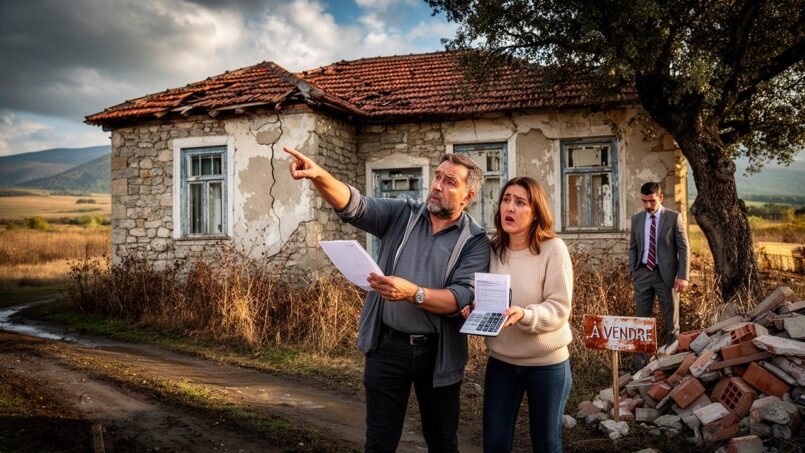
In 2026, properties around 15,000 euros are often problem products: ground floors or basements classified as warehouses or garages with no sunlight, humidity and mold, or those with legal defects such as mortgages, seizures, unresolved inheritance, or lack of permits.
Another typical profile involves vacation constructions that have remained for years without Act 16 (use permit), connected to water and electricity at industrial rates 3 to 5 times higher than residential tariffs, with homeowners’ association fees that can reach 25 to 30 euros per square meter per year. Owners are often trying to get rid of a burden.
At the portfolio level, “cheap” assets are often the worst: illiquid, hard to rent, expensive to maintain, and nearly unsellable in a downturn. They lock up capital and degrade the overall portfolio profile.
For truly liquid vacation properties, the real entry points are much higher: studios in Sunny Beach start at around 35,000 to 40,000 euros (furnished resales with Act 16 and reasonable fees), and two-bedroom apartments around 50,000 to 55,000 euros depending on distance to the beach and the condition of the complex. In cities like Nessebar or Pomorie, the possibility of year-round occupancy adds another 20 to 30 % to prices.
The structural mistake: buying a property incompatible with your non-resident status
The most underestimated risk for non-European investors lies in the very structure of Bulgarian law. Unlike many Western markets, Bulgaria makes a very strict distinction between ownership of the building and ownership of the land.
A key principle must be engraved in any wealth strategy: a non-European national cannot directly own land in Bulgaria. This includes not only bare plots and agricultural land, but also the garden attached to a detached house. They can, however, buy an apartment or a building, but the land under a house requires the use of a Bulgarian legal entity (usually an OOD).
Ignoring legal constraints exposes you to invalid contracts; a non-European signing a preliminary contract for a house with land in their personal name may be blocked at the final sale and lose their deposit without a contingency clause, leading to loss of liquidity and costly litigation.
The alternative, setting up a Bulgarian company, has an entry cost and recurring fees (setup around 500 to 1,500 euros, plus 300 to 800 euros for accounting and annual filings). Integrating this vehicle into a wealth strategy means factoring in these operating costs, the tax impact, and the complexity of management (dealing with the local tax authority, maintaining accounts, etc.).
Direct purchase of apartments, houses, and urban land is possible for an EU investor, but acquiring agricultural or forest land requires five years of residency. Bypassing these rules with creative structures risks contract nullity and loss of the investment.
When the market itself threatens your wealth
Even an investor who chooses legally clean properties can weaken their wealth if they ignore the dynamics of the Bulgarian market. The country has seen significant annual price increases for several years, around 9 to 16 % in some segments, with peaks above 15 % in major cities. Moreover, entry into the eurozone has fueled renewed demand, reducing currency risk for eurozone buyers and sending a stability signal.
In some peripheral neighborhoods of Sofia, prices are overvalued by 10 to 15 % relative to fundamentals. The Bulgarian National Bank and European authorities are warning about the rise in real estate credit, the disconnect between prices and wages, and the lack of strict measures on household debt, creating systemic vulnerability.
Reasonable correction scenarios suggest declines of 10 to 20 % in the most fragile segments – overbuilt seaside complexes, new standardized blocks on the outskirts – and 5 to 10 % in prime areas of Sofia in case of a downturn. For a long-term wealth investor, this is not necessarily disastrous… provided you have bought solid assets and are not forced to sell during a trough.
Concentrating capital in oversupplied segments (new builds or saturated resorts) or technically poor products exposes you to price instability and low resale liquidity. Outside the central neighborhoods of Sofia and a few destination markets, selling can take months or even years, complicating any rapid portfolio reallocation.
Hidden costs that kill returns… and cash flow
The other classic way to weaken your wealth strategy in Bulgaria is to drastically underestimate the total cost of acquisition and ownership. The comparison with Western Europe, where transaction fees often run around 3 to 5 %, is misleading: in Bulgaria, the accumulation of taxes, fees, registration costs, translations, commissions, and additional work very frequently falls between 8 and 10 % of the price, or more.
Ancillary costs for a 200,000 euro apartment in Sofia can reach 25,000 to 40,000 euros.
Here is a synthetic example of typical acquisition cost breakdown, to illustrate the gap with the listed selling price.
Example of cost structure for an apartment purchase
| Cost item | Typical range | Wealth commentary |
|---|---|---|
| Municipal acquisition tax | 0.1 % – 3 % of price | 3 % in Sofia and Burgas, borne by the buyer |
| Registration fees with the registry | ~0.1 % of price | Land publicity costs |
| Notary fees | 0.1 % – 1.5 % of price | Degressive scale, capped around 3,000 € |
| Agency commission | 2.5 % – 6 % of price | 3 % most common, sometimes entirely buyer-side |
| Attorney fees | 0.5 % – 2 % of price | Not something to “save” on |
| Translations, apostilles, certificates | 500 € – 2,000 € | Depending on number of documents and language |
| Work / renovation | 8 % – 15 % of price | Highly variable, often underestimated |
| Furniture and equipment | 5,000 € – 10,000 € (standard apartment) | Immediate impact on rental capacity |
| Miscellaneous (appraisals, interpreter, etc.) | 1,000 € – 3,000 € | Mandatory for non-Bulgarian speakers |
On a budget of 200,000 euros, it is not uncommon for the “all-in” total to reach 230,000 to 240,000 euros, not counting a safety reserve. For a buyer using bank financing, you must add loan processing fees (0.5 to 1 % of the loan), appraisal (a few hundred euros), mortgage registration costs, and mandatory insurance (multi-risk and often life insurance that conditions the interest rate).
A gross yield of 6 % can drop to 2-3 % net real after factoring in costs and vacancy. During inflation, this can erode the real value of capital, unless prices rise sustainably.
Vacation property: pleasure asset or costly liability?
Bulgarian vacation homes, especially along the Black Sea coast or in certain mountain resorts, are tempting with their listed price and the promise of seasonal income. Yet this segment concentrates several dangerous characteristics for a sound wealth strategy.
The first is extreme seasonality. Many seaside complexes operate two to four months a year, and the rest of the time the infrastructure “dies”: shops closed, services reduced, access more difficult. Actual rental returns are often far removed from commercial projections that assume near-continuous occupancy or unrealistic guaranteed rental contracts.
Annual maintenance fees for a 35 m² studio reach between 800 and 1,000 euros, reducing net portfolio performance.
The third is legal risks. Some projects remain stuck for years without Act 16, preventing the opening of residential-rate utility meters, complicating insurance and resale, and making any subsequent bank financing impossible. Others were built on former agricultural land or in environmental protection zones without a full regularization procedure, exposing owners to litigation or usage restrictions.
Developers sometimes offer ‘concrete’ rental guarantees through shell companies with no assets or history. These vehicles can be easily liquidated, leaving the investor with an overvalued property that is hard to rent and has no real guarantee.
From a wealth strategy perspective, a vacation property should only enter the portfolio if you can demonstrate, with concrete figures, that even in a conservative scenario (low season, lower occupancy rate, high costs), the property does not become a structural cost center. It must also remain marginal in relative weight compared to more stable and liquid assets.
Due diligence: the ultimate safeguard for your wealth
The common thread in most wealth disasters in Bulgaria is not bad luck, but the absence of systematic checks. The Bulgarian system relies on several registries that are neither perfectly synchronized nor fully digitized. The notary, contrary to what many foreigners believe, does not conduct an exhaustive investigation on behalf of the buyer: he authenticates the deed and verifies identity, but does not guarantee the absence of mortgages, the legality of construction, or the economic balance of the contract.
For a wealth investor, the only rational approach is to arrange an independent due diligence, conducted by a lawyer specialized in Bulgarian real estate law, a member of the local bar, ideally bilingual. This work, which should cover at least the last ten years and often more, follows a precise framework.
Verification of the ownership chain and encumbrances
The first axis is the examination of the chain of title. The central document is the notarial deed (notarialen akt), which must be traced from owner to owner, contract after contract, judgment after judgment, sometimes back to post-communist restitution procedures. The lawyer reconstructs this chain by consulting the Property Register, municipal archives, the cadastral agency, and, if necessary, the land restitution services.
Obtain an official certificate from the Registry Agency covering the entire period since the seller’s acquisition. It should list mortgages, seizures, easements, rights of use, registered leases, and litigation. Cross-check this information with cadastral data, the title deed, and the actual site conditions.
A serious mistake, sometimes called “encumbrance oversight,” is to only superficially check for tax debts, mortgages, or seizures. In Bulgaria, certain claims can “follow” the property: the buyer then becomes the owner of a burdened asset, which may be subject to seizures or freezes, ruining its resale potential and potentially absorbing part of their overall borrowing capacity.
Cadastre, urban planning, and construction legality
The second component is cadastral and urban planning verification. Each property should have a unique cadastral identifier, consultable in the system of the Agency of Geodesy, Cartography, and Cadastre. This number must exactly match the property description in the notarial deed (area, boundaries, purpose), and the physical reality on the ground.
Beyond the plan, check urban plans, construction legality (valid permit, work follow-up for recent buildings, occupancy certificate/Act 16). For older constructions, be wary of a simple ‘tolerance certificate’ from the municipal architect: it attests existence but not regularity, complicating insurance, financing, and resale.
This urban planning check must also identify any unresolved restitution procedures (especially for former agricultural or forest land that has been urbanized), or infrastructure projects that could affect the property (road widening, new infrastructure, etc.). Otherwise, you could end up owning a house on land that is still claimed, or an apartment whose living environment suddenly deteriorates due to a change in the local plan.
One of the most common fraud schemes in Bulgaria relies on the fraudulent use of powers of attorney. Individuals present themselves as representatives of the owner, display documents that seem authentic, and push for a quick signing of a preliminary contract and payment of a deposit. The power of attorney later turns out to be forged or revoked.
To protect your wealth, any power of attorney should be considered high-risk. Every power must be verified directly with the notary who issued it through the registers of the Chamber of Notaries. Signatures, dates, numbers, and stamps must be consistent with the file. Any pressure to avoid a notary chosen by the buyer is a red flag.
Corollary: never pay a significant deposit based solely on an unverified power of attorney, nor sign a preliminary contract before ownership and encumbrance certificates have been obtained and analyzed. Many foreign investors’ regrets stem precisely from this point: having paid a non-refundable deposit on a burdened or disputed property.
Act 16, tolerated buildings, and illegal construction: the major legal risk
A building without Act 16, a “tolerated” but unlicensed building, or construction on agricultural land that has not been regularized are legal time bombs at the heart of your wealth. You can de facto live there, sometimes even rent it, but legally the property is shaky: inability to obtain certain insurance policies, blocked from a mortgage loan, risk of refusal of utility connections, or impossibility to regularize work.
In a wealth portfolio, holding an asset with uncertain liquidity exposes you to regulatory risk that is difficult to model. A municipal crackdown on unregularized constructions can turn a dormant asset into a source of litigation and additional costs.
The rule of thumb is simple: without Act 16, there should be no purchase for family wealth, nor any leveraged investment. The rare exceptions are only justified for professionals fully versed in regularization procedures, with significant financial and legal leeway.
Don’t confuse notary and advisor: a decisive reflex
In many countries, the presence of a notary is seen as sufficient legal security. In Bulgaria, this belief directly exposes your wealth to surprises. The notary’s role is to authenticate the deed and verify the identity of the parties, but he is not responsible for protecting the buyer economically or conducting a full investigation into the property’s situation.
The notary does not systematically verify the absence of mortgages or seizures beyond the documents presented, does not check the history of ownership rights beyond the last deed provided, and does not examine urban compliance nor review contract clauses solely in the buyer’s interest.
This is precisely why practitioners insist: trying to “save” on independent attorney fees is one of the worst possible savings. At the scale of a wealth strategy, a few hundred or thousand euros in fees represent a negligible insurance premium compared to the tens of thousands of euros that a property dispute, transaction invalidation, or the discovery of an unidentified mortgage can cost.
Red flags never to ignore
Certain situations should immediately trigger a cautionary reflex in any investor mindful of their wealth. Among the most dangerous signals, the same patterns of behaviors and configurations emerge systematically.
These include, for example, sellers or agencies that refuse to provide a copy of the notarial deed and encumbrance certificates before a deposit is paid; listings with a price far below the local market with no credible explanation; persistent pressure to sign a preliminary contract or pay a 10 % deposit “to reserve” before any lawyer has been engaged.
Paying part of the price in cash not declared in the notarial deed exposes the buyer to serious risks: in the event of a dispute, they can only prove the declared amount, which facilitates blackmail and complicates relations with banks and anti-money laundering authorities.
More broadly, any scheme where financial flows pass through intermediaries’ personal accounts, or where you are offered to “save time” by skipping verification steps, should be rejected. The basic rule, at the portfolio level, is that no good deal depends on a decision made in 24 hours under pressure.
Integrating Bulgaria into a coherent wealth strategy
Buying a property in Bulgaria is neither an isolated act nor a simple “bet” on an emerging market. It is a decision that changes the structure of your wealth: geographic allocation, exposure to a specific legal framework, evolution of income profile, and liquidity constraints.
To ensure this decision does not weaken the whole, several structuring principles can serve as a guiding thread.
The first is to never concentrate a disproportionate share of your wealth on high-risk segments: saturated seaside real estate, aging complexes with high fees, properties without Act 16, disputed land. If these assets are present, they must remain marginal and be offset by positions in liquid urban areas, well-documented buildings, and clean legal structures.
A safety margin of 15 to 25 % should be added to the purchase price to cover fees, work, cash reserves, and contingencies in Bulgarian real estate return simulations.
The third is to build a network of trusted professionals – specialized lawyer, experienced international market agent, sworn translator, technical expert – who support the investor over the long term. In a country where registries are public but sometimes hard for a foreigner to access, and where the rules on land ownership vary depending on the buyer’s status, this relational capital is an integral part of the “intangible capital” of wealth.
Conclusion: secure first, optimize later
Bulgaria offers real opportunities: prices still attractive compared to Western European capitals, moderate taxation, European integration, appreciation potential in certain cities and well-chosen segments. But it is also a market where legal errors, yield illusions, and “good deals” too good to be true can jeopardize a patiently built wealth strategy.
To avoid a risky purchase, follow these rules: refuse abnormal prices, never buy without Act 16, invest in a comprehensive due diligence, be wary of pressure and procedural shortcuts, and remember that capital protection takes precedence over growth.
In Bulgaria more than elsewhere, the best wealth performance begins with the ability to say no to bad deals.
A wealth project or a question? Contact us now to speak with a wealth management expert.
Disclaimer: The information provided on this website is for informational purposes only and does not constitute financial, legal, or professional advice. We encourage you to consult qualified experts before making any investment, real estate, or expatriation decisions. Although we strive to maintain up-to-date and accurate information, we do not guarantee the completeness, accuracy, or timeliness of the proposed content. As investment and expatriation involve risks, we disclaim any liability for potential losses or damages arising from the use of this site. Your use of this site confirms your acceptance of these terms and your understanding of the associated risks.

Cyril Jarnias is an independent expert in international wealth management with over 20 years of experience. As an expatriate himself, he is dedicated to helping individuals and business leaders build, protect, and pass on their wealth with complete peace of mind.
On his website, cyriljarnias.com, he shares his expertise on international real estate, offshore company formation, and expatriation.
Thanks to his expertise, he offers sound advice to optimize his clients' wealth management. Cyril Jarnias is also recognized for his appearances in many prestigious media outlets such as BFM Business, les Français de l’étranger, Le Figaro, Les Echos, and Mieux vivre votre argent, where he shares his knowledge and know-how in wealth management.





