
 Published on and written by Cyril Jarnias
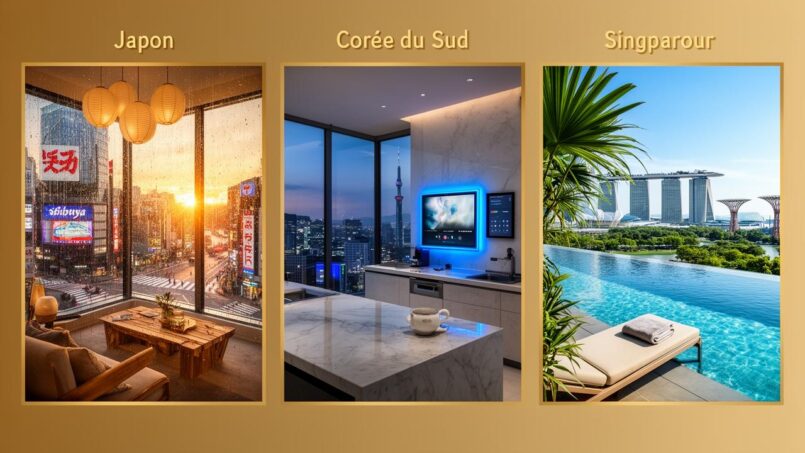
As the Asia-Pacific region concentrates a growing share of global capital flows, one question keeps coming up among investors: between Japan, South Korea, and Singapore, where should you put your money in 2026 to optimize the return / safety trade-off?
Japan benefits from Tokyo, the top regional hub, and a weak yen. South Korea focuses on Seoul with a regulated market for foreigners, but supported by strong local demand. Singapore is an ultra-prime, highly liquid, and expensive market for non-residents, where taxes change the game.
Three Markets, Three Investment Logics
Before diving into each country in detail, it’s important to understand the general logic behind Asia-Pacific flows in 2026. Institutional investors and high-net-worth individuals are now seeking less the “magic” of bond yield compression than the solidity of rental income and predictable net operating income growth.
Tokyo, Singapore, and Seoul dominate regional rankings thanks to their membership in liquid developed markets, strong governance, and stable regulatory frameworks.
An ULI–PwC report ranks the top five Asia-Pacific cities for real estate investment and development in 2026: Tokyo, Singapore, Sydney, Osaka, and Seoul. On this expanded podium, two Japanese cities, one Singaporean, and one Korean appear side by side, summarizing the stakes for an investor torn between Japan vs. South Korea vs. Singapore in 2026.
Japan: Tokyo Leads, Entire Country Priced at a Discount for Strong Currencies
If only one fact should be remembered, it’s this one: Tokyo is ranked number one for real estate investment in Asia-Pacific for 2026, for the third consecutive year. Japan’s capital dominates not only in investment prospects, but also in development and office rent growth.
The same report designates it as the top market for office rent growth, with very low vacancy rates and sustained demand for Grade A buildings. At the same time, Tokyo remains, for the seventh consecutive year, the world’s most sought-after city for cross-border investment, ahead of New York or London.
An Atypical but Supportive Macro and Monetary Environment
Japan has entered a “reflation” phase rare in its recent history. The Bank of Japan has ended negative interest rates and gradually raised its policy rate to 0.75%, a level not seen since the 1990s. Markets anticipate one or two more modest hikes, but the cost of money remains very low compared to the rest of the world.
Mortgage rates thus generally range between 0.3% and 1.4% for eligible borrowers, with long-term fixed rates still around 2%–2.5%. For a fundable foreign investor, leverage therefore remains attractive.
A Tokyo apartment was worth the equivalent of 800,000 Singapore dollars in 2020, but now trades between 550,000 and 600,000 S$ due to the yen’s decline.
Tokyo: Liquidity, Legal Security, and Rent Growth
Tokyo checks several boxes that major investors consistently tick: market depth, data transparency, legal and financial stability. Japan’s Ministry of Infrastructure publishes actual transaction prices, improving visibility on asset values.
Grade A offices are in a full rental upswing, with vacancy around 3% market-wide. Scarcity of land in the city center, combined with increased competition with office developers for sites, limits new residential supply. This combination of solid demand and constrained supply results in:
| Key Indicator (Tokyo) | 2026 Data (or Latest Available) |
|---|---|
| Asia-Pacific Rank – Investment | #1 |
| Asia-Pacific Rank – Development | #1 |
| Asia-Pacific Rank – Office Rent Growth | #1 |
| Grade A Office Vacancy Rate (Tokyo/Osaka) | ~3% |
| Projected Prime Residential Value Increase 2026 | +4% to +5.9% (after ~30% in 2025) |
| Gross Residential Yield City Center | 3% to 5% |
For an investor, this means a very readable “core” profile: exit liquidity, growing rental income, and a city regarded as a safe haven in case of geopolitical turbulence elsewhere in Asia.
Taxation and Access for Foreigners: A Radical Contrast with Singapore
One of Japan’s major advantages in 2026 is its fiscal neutrality towards foreigners. A non-resident pays not a yen more than a Japanese resident in acquisition taxes. The state applies no additional stamp duty specific to foreigners, unlike Singapore.
Concretely, for a condo worth ¥60 million in central Tokyo:
| Cost Item – Tokyo Condo (¥60M) | Approximate Amount |
|---|---|
| Acquisition Price | ¥60,000,000 (~$400,000) |
| Purchase Taxes and Fees (acquisition + registration, etc.) | +3% to 4% (≈ ¥1.8M to 2.4M) |
| Foreign Surcharge | ¥0 |
| Total Entry Cost | ≈ ¥64,000,000 (~$427,000) |
| Annual Property Tax (1.4% of assessed value) | ≈ ¥300,000 estimated |
| Estimated Gross Rental Yield | ≈ 4% (~¥2.4M / year) |
For a foreign investor, this cost structure means that most of the capital actually works within the asset, instead of being locked up in a punitive stamp duty. Conversely, in Singapore, a foreigner buying a condo for S$2M pays S$1.2M in ABSD, i.e., 60% of the price, before even considering the question of yield.
Returns and Rental Dynamics: A Net Differential with Singapore
Consolidated yield figures show that Japan, and notably Tokyo, outperforms Singapore when reasoning in net yield on capital employed.
Available data indicates:
| Yield & Cost Comparison – Japan / Singapore (Central) | Japan (Tokyo 23 Wards) | Singapore (CCR) |
|---|---|---|
| Median Condo Price Central | ¥50–80M ($330–530k) | S$2–3M ($1.5–2.2M) |
| Gross Yield | 3–5% | 2–3% |
| Indicative Mortgage Rate | 0.3–1.4% | 1.3–1.8% (fixed rates 2026) |
| Property Tax | 1.4% of assessed value | Up to 20% of annual rental value (non-occupant) |
| Total Acquisition Tax | ≈ 3–4% (no foreign surcharge) | BSD 1–6% + ABSD 60% for foreigners |
| Specific Foreign Surcharge | 0% | 60% |
At comparable price and rent, Tokyo’s gross yield is 1 to 2 percentage points higher, and the net yield on actual capital invested can exceed that of Singapore by 100 to 200 basis points, once transaction costs are taken into account.
Beyond Tokyo: Osaka and Regional Hubs
If Tokyo monopolizes attention, Osaka is not far behind. Ranked in the regional top 5 for investment and development, the Kansai metropolis shows a more industrial and logistics-oriented profile, but with a dynamic residential supply.
The investment rank has advanced six places, signaling renewed institutional interest. Supply of new office space will slow, leading to Grade A rent increases. Opportunities in urban logistics, rental housing, and mid-market retail attract investors looking for yields higher than those in central Tokyo.
Finally, other cities like Fukuoka or Sapporo offer higher gross yields (up to 6–8% in some residential cases), at the cost of lower liquidity and greater exposure to demographic risk.
Japan Assessment: Ideal for Risk-Adjusted Returns and Entry Ticket
For a foreign investor, Japan ticks many boxes:
– Unrestricted access to property, including land, for all nationalities.
– No foreign surcharge, moderate acquisition taxes.
– Gross yields generally higher than Singapore on residential assets.
– Weak currency, offering an entry discount for dollar or S$ capital.
– Top-tier markets (Tokyo, Osaka) leading Asia-Pacific rankings and driven by genuine rental momentum (offices and prime residential).
On the downside, the country faces accelerated aging and a declining population, requiring very selective choices on location and asset quality. The polarization between dynamic centers and declining peripheries is a key theme to keep in mind.
South Korea: Seoul, a Promising but Locked Market for Foreign Rental Investment
South Korea presents a much more contrasting profile. On paper, Seoul ranks among the Asia-Pacific top 5 for both investment and development, just behind Tokyo, Singapore, Sydney, and Osaka. International capital sees the capital as a “safe harbor” in North Asia, with transaction activity clearly up in recent years.
But the regulatory framework changed profoundly in 2025, to the point of radically altering the situation for a foreign investor looking to buy and rent.
An Economy in Slow Recovery, but a Capital Under Pressure
On the macroeconomic front, South Korea enters 2026 in a phase of gradual recovery. After sluggish growth of around 1% in 2025, GDP is expected to pick up to 1.8–2.1% in 2026 according to estimates. Inflation is converging toward the 2% target, and the Bank of Korea maintains its policy rate around 2.5%, with a bias toward gradual easing.
This macro context remains marked by high credit costs compared to the previous decade, and by an explicit political will to curb speculative excesses in real estate, especially in Seoul and the capital region.
Seoul: High Prices, Compressed Yields, but Expected Growth on Premium
Price data confirm strong tension in the metropolis. The average price of apartments in Seoul reaches nearly 13.8 million won per square meter, more than 2.3 times the national average. Official price indices still show increases, but at a slower pace after a previous surge.
For 2026, projections indicate a 4 to 7.9% increase for high-end apartments in Seoul, after a 14.3% jump in 2025. Land scarcity, long development timelines, and concentrated demand in central districts maintain upward pressure, despite a more subdued overall market.
In contrast, rental yields are compressed. Indicators such as “price-to-income” and “price-to-rent” ratios show tight levels, with yields significantly lower than in Japan or some emerging markets. In the most sought-after districts, gross residential yields are below 3%.
A Rental Market Under Strain: Jeonse Shortage and Shift Toward Monthly Rent
The Korean specificity also lies in its jeonse deposit system, which for a long time structured the rental market. This mechanism, based on a large deposit rather than monthly rent, is now in crisis: falling supply, regulatory restrictions, and landlord concerns have led to a shortage of jeonse contracts in Seoul.
Agencies note a sharp drop in listings of this type and a surge in monthly rents in the capital, which hit records in late 2025. For tenants, the situation is becoming significantly harder; for a local landlord, rising monthly rents theoretically support income, but credit regulation and higher rates erode net profitability and curb investment purchases.
The 2025 Turning Point: Mandatory Permit for Foreigners in Seoul
The most decisive change for a foreign investor is regulatory. Since August 2025, a land transaction permit system for non-residents applies to all of Seoul, most of Gyeonggi Province, and parts of Incheon.
To buy a residential property in these areas as a foreigner, you must follow the specific applicable rules.
– You must obtain a permit from the authorities before signing the final deed.
– After purchase, the buyer is required to move into the property within four months.
– They must then reside there for at least two years as a principal residence.
– Purely rental acquisitions, without intent to occupy, are effectively excluded.
This essentially bans almost all foreign rental investment in the Seoul metropolitan area for 2026, except for very specific cases of expatriates moving in to live there themselves.
Outside these zones (Busan, Daegu, Jeju Island, rural areas), the regime is more flexible: a simple declaration obligation within 60 days of the transaction, with no residence requirement. These markets thus become the main potential playgrounds for foreigners looking to generate rental income in South Korea.
Price and Cost of Living Indicators: A Metropolis Already Very Expensive
Price indices confirm that Seoul sits at the high end of the regional range in terms of residential cost. On a national level, South Korea shows:
| South Korea National Indicator | Indicative Value |
|---|---|
| Property Price Index | 24.1 |
| Rent Index | 1.1 |
| Price-to-Income Index | 176.9 |
| Local Purchasing Power Index | 93.4 |
Seoul itself stands out with a price-to-income index above 190, reflecting a market already very stretched relative to household incomes.
South Korea Assessment: Sophisticated Market but Hardly Accessible for the Typical Foreign Investor
On fundamentals, South Korea offers many attractions: advanced economy, strong demand in major cities, dynamic office and logistics market, and Seoul ranked in the top 5 regional real estate investment destinations. The rise of data centers, “living” assets, and tech hubs further reinforces this appeal.
For non-residents looking to invest in residential rental property in 2026, the context is very restrictive and requires careful attention to regulations and market conditions.
– Permit and personal residence requirement throughout the Seoul metropolitan area.
– De facto ban on foreign “buy-to-let” investment at the heart of the country’s most dynamic market.
– Low gross yields in premium districts, with already very stretched prices.
– High regulatory risk, as the state clearly displays its intention to discourage real estate speculation and redirect capital toward the stock market or other productive sectors.
The most sophisticated foreign investors will likely continue to operate in prime office, logistics, or data centers via professional vehicles. For an individual comparing Japan vs. South Korea vs. Singapore, South Korea in 2026 appears as a market best reserved for institutional strategies or owner-occupier purchases, rather than a classic rental portfolio strategy.
Singapore: The Stronghold That Protects Value… by Punishing Foreign Entry
Singapore holds a paradoxical place in this comparison. On all criteria of seriousness – political stability, governance, legal framework, market transparency – the city-state remains one of the very best choices globally. The ULI–PwC report ranks it number two in Asia-Pacific for investment and development, just behind Tokyo, and number three for office rent growth.
Institutional investors cite it as an essential “safe haven”, and its role as a regional financial and logistics hub makes it a pivot for office real estate, logistics, and digital assets (data centers).
But for a private foreigner, the core issue boils down to three letters: ABSD.
A Solid but Quieter Residential Market
From a fundamentals standpoint, Singapore’s residential real estate heads into 2026 in a robust but more measured state. Private price indices rose by 3.4% in 2025, their smallest gain since 2020, after +3.9% in 2024 and +6.8% in 2023.
Prices are still climbing, however: +0.9% in Q1 2026, the sixth consecutive quarter of growth. Analysts expect moderate growth for the full year 2026, between 2% and 5%.
Only 8,100 new non-landed apartments will be launched in 2026, 30% fewer than in 2025.
ABSD at 60%: A Hammer Blow for Foreign Residential Purchases
Since April 2023, foreigners buying a residential property in Singapore face an Additional Buyer’s Stamp Duty of 60%. This surcharge applies to the first property, on top of the basic stamp duties (1–6% depending on price).
The structure is as follows:
| Buyer Profile in Singapore (Residential) | ABSD 1st Property | 2nd Property | 3rd and Subsequent |
|---|---|---|---|
| Singapore Citizen | 0% | 20% | 30% |
| Permanent Resident | 5% | 30% | 35% |
| Foreigner (except a few FTA nationalities) | 60% | 60% | 60% |
| Company / Trust | 65% | 65% | 65% |
A few nationalities covered by free trade agreements (USA, Switzerland, Iceland, Norway, Liechtenstein) receive the same treatment as citizens for their first purchase. For all others, the calculation is simple: 60% of the price, payable in cash within 14 days of exercising the option to purchase.
To illustrate the impact, let’s take a central city condo (CCR) worth S$2M for a typical foreign citizen:
| Cost Item – CCR Condo S$2M (Foreigner) | Estimated Amount |
|---|---|
| Acquisition Price | S$2,000,000 |
| Buyer’s Stamp Duty (BSD, progressive scale) | ≈ S$80,000 (order of magnitude) |
| ABSD 60% | S$1,200,000 |
| Miscellaneous Fees (legal, etc.) | S$10,000–20,000 |
| Total Entry Cost | ≈ S$3.29M |
In other words, on this typical case, the additional stamp duty exceeds the property value itself by 50%. The investor must therefore hope for a price increase well above 60% over the holding period just to break even, which severely limits the appeal of a purely financial purchase.
Returns and Recurring Taxation: Security Comes at a Price
Gross yields on condos in Singapore’s city core (CCR) generally sit around 2–3%, a level comparable to global prime markets. But once you factor in:
Property tax can reach 20% of the annual rental value, to which are added condo management fees, maintenance costs, and the colossal ABSD locked in at entry.
… the net yield on invested capital becomes modest, especially compared to an equivalent investment in Tokyo.
The good news – for those who accept this level of taxation – is that Singapore applies no true capital gains tax on exit (except for a degressive Seller’s Stamp Duty on quick resales). For a very long horizon, the combination of political stability / land scarcity / economic attractiveness makes it an excellent wealth preservation tool.
Singapore Still a Regional Top 3 for Institutional Investors
Despite this entry cost for foreigners, the city-state remains ranked number two in Asia-Pacific for investment and development, just behind Tokyo and ahead of Sydney, Osaka, and Seoul. The reasons lie in the macro profile and hub role:
The Singapore market stands out for its political stability and predictable regulation, attracting strong multinational demand for prime offices with low vacancy. Assets aligned with ESG criteria meet the expectations of major investment funds. As a regional pivot, Singapore supports logistics and digital infrastructure, although land and energy constraints push some growth toward Malaysia or Indonesia.
Political stability and predictable regulatory framework, favoring investment.
Sustained demand from multinationals, with low vacancy in the high-end segment.
Alignment with environmental, social, and governance criteria, meeting the requirements of major funds.
Key position for regional logistics and data centers, despite land and energy constraints.
For a fund, acquisitions of prime offices, high-end retail, or logistics platforms remain strategic, even with compressed yields, because liquidity and market depth justify the “core” positioning.
Singapore Assessment: A Market for Preservation, Not Yield, for the Typical Foreigner
Coming back to the Japan vs. South Korea vs. Singapore dilemma, the Singaporean hub in 2026 plays a very specific role:
– For a private foreigner, residential real estate is more akin to an ultra-secure safe box than a source of attractive cash flow. The 60% ABSD, gross yields of 2–3%, and high cost of living turn the purchase into a long-term bet on the city-state’s resilience.
– For an institution or family office, prime offices, retail, and certain digital assets remain fully relevant in a global portfolio logic, but at the price of an accepted moderate yield.
From a strictly financial perspective, with equal capital, the analysis of 2026 figures shows that Japan offers a better return-to-entry cost ratio than Singapore for a standard foreign investor.
Comparing Japan vs. South Korea vs. Singapore in 2026: A Framework for Investors
To summarize, we can position the three markets along a few key axes: accessibility for foreigners, entry taxation, rental yield, appreciation potential, and regulatory risk.
| Criteria / Market | Japan | South Korea | Singapore |
|---|---|---|---|
| APAC Investment Rank (Flagship City) | Tokyo #1 | Seoul in top 5 | Singapore #2 |
| Foreign Residential Access | Free, no restrictions | Heavily regulated in Seoul, freer in provinces | Free in condos, punitive ABSD |
| Specific Foreign Surcharge | 0% | None on purchase, but usage constraints | ABSD 60% on all residential acquisitions |
| Gross Residential Yield Center | 3–5% (Tokyo) | <3% in Seoul premium districts | 2–3% (CCR) |
| Prime Upside Potential 2026 (High-End) | +4–5.9% (Tokyo) | +6–7.9% (Seoul high-end) | ≈ +2.9% (projected luxury rebound) |
| Regulatory Risk for Foreigners | Moderate (ongoing debate on land, but no concrete punitive project) | High (permit, residence requirement, possible fiscal tightening) | High on entry duties, structure stable but expensive |
| Market Dominant Profile | Reflation, weak yen, solid rental demand | Polarization Seoul / regions, strong regulation | Mature market, expensive, heavily regulated |
Which Investor Profile Suits Each Market?
Without stepping outside the factual framework, we can identify three typical positions in 2026.
In Japan, a foreign investor seeking:
– A more affordable entry ticket than Singapore.
– Full ownership, including land, with no segment reserved for nationals.
– A net yield 100–200 basis points higher than what they would get in Singapore on capital actually invested.
– A currency exposure to a historically weak yen.
… finds a particularly interesting playing field, especially in major cities well positioned on demographic and economic flows (Tokyo, Osaka, Fukuoka).
In South Korea, an institutional or highly sophisticated investor can still target:
Three key sectors driven by local demand and structural trends in the Korean market.
Dynamic market with low vacancy and high transaction volumes, offering quality assets.
Supported by e-commerce growth and digital policies, these segments meet rising tech demand.
Co-living and student housing driven by an influx of young professionals and international students.
But for the private foreigner who simply wants to buy an apartment to rent in Seoul, the 2026 framework, with a mandatory permit and personal residence requirement, makes the endeavor unrealistic.
In Singapore, finally, the foreign investor faces a clear trade-off:
– Accept paying very high entry costs to place part of their wealth in an ultra-secure, stable, and highly liquid market.
– Or consider that, with equal capital, the same sum would generate more income and potential capital gains in a market like Japan.
Conclusion: 2026, the Year When the Question Is No Longer “Where Is Safest,” but “Where Does Capital Work Best”
All three markets share political stability, solid governance, and top-tier economic infrastructure. But a foreign investor’s perspective in 2026 can no longer be limited to simply seeking a safe haven.
Market data and regional rankings converge:
Comparative analysis of the Tokyo, Seoul, and Singapore markets for foreign investors.
Dominates the region in real estate investment, development, and office rent growth. Neutral tax environment and weakened currency facilitate access.
Market with strong appreciation potential in the premium segment, but heavily regulated for foreigners. Modest rental yield and high regulatory risk.
Asset of choice for large capital seeking stability, transparency, and market depth. The 60% ABSD makes investment very costly for foreigners.
In this comparison of Japan vs. South Korea vs. Singapore, the year 2026 clearly crowns Japan, and especially Tokyo, as the most consistent terrain for a foreign investor seeking a robust compromise between rental performance, revaluation potential, and reasonable entry taxation.
This takes nothing away from the strategic interest of Singapore for wealth preservation or Seoul for institutional players, but for those seeking to make their capital work best, Japanese real estate emerges as the big winner in this three-way match in Northeast Asia.
A wealth project or a question? Contact us now to speak with a wealth management expert.
Disclaimer: The information provided on this website is for informational purposes only and does not constitute financial, legal, or professional advice. We encourage you to consult qualified experts before making any investment, real estate, or expatriation decisions. Although we strive to maintain up-to-date and accurate information, we do not guarantee the completeness, accuracy, or timeliness of the proposed content. As investment and expatriation involve risks, we disclaim any liability for potential losses or damages arising from the use of this site. Your use of this site confirms your acceptance of these terms and your understanding of the associated risks.

Cyril Jarnias is an independent expert in international wealth management with over 20 years of experience. As an expatriate himself, he is dedicated to helping individuals and business leaders build, protect, and pass on their wealth with complete peace of mind.
On his website, cyriljarnias.com, he shares his expertise on international real estate, offshore company formation, and expatriation.
Thanks to his expertise, he offers sound advice to optimize his clients' wealth management. Cyril Jarnias is also recognized for his appearances in many prestigious media outlets such as BFM Business, les Français de l’étranger, Le Figaro, Les Echos, and Mieux vivre votre argent, where he shares his knowledge and know-how in wealth management.





