
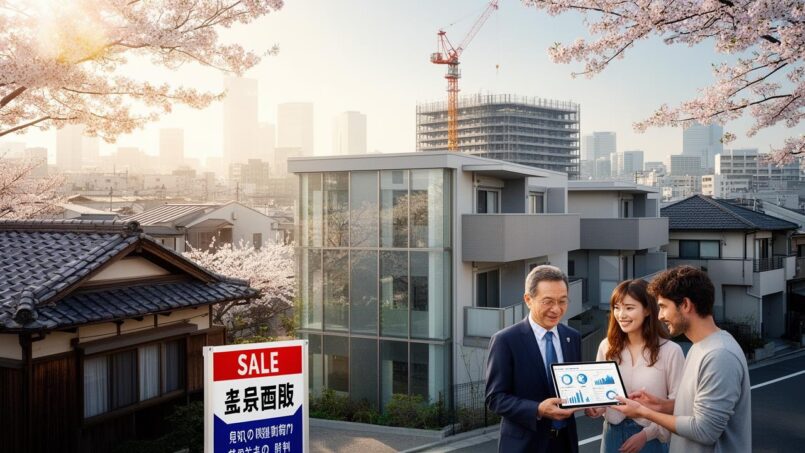
 Published on and written by Cyril Jarnias
In recent years, two trends have been intersecting in Japan: a red-hot real estate market in major metropolitan areas, and a historically weak yen that acts like a giant “sale” sign for foreign capital. In the middle, a key question for anyone looking at the country: what concrete difference does residence in Japan – or the lack thereof – make for investing in property, accessing credit, optimizing taxes, and managing assets on a daily basis?
Contrary to popular belief, purchasing real estate does not grant any right to stay in Japan. However, having resident status offers significant advantages for accessing the real estate market, financing, renting, and managing regulatory constraints.
This article provides a comprehensive overview, with supporting data, of the concrete impacts of residence status in Japan on real estate and on investor strategies, whether they are based in Tokyo or at the other end of the world.
Buying in Japan Without Residing There: Total Freedom… in Theory
The starting point is simple and often misunderstood: Japan does not restrict foreign real estate ownership. The Constitution and Civil Code make no distinction between Japanese and non-Japanese regarding land ownership.
In practice, this means:
A foreigner can freely purchase any type of property (apartment, house, land, building) in full ownership, without a visa, residence permit, government approval, quota, or specific “foreign buyer” tax, whether they reside in the country or not.
The same framework applies to permanent residents, holders of work visas, non-residents, and even someone in Japan on a simple tourist visa. The purchase can be carried out remotely via power of attorney, with a shihō shoshi (司法書士, judicial scrivener specializing in real estate registration) acting as agent.
Purchase ≠ Right of Residence
The major nuance, crucial for investors dreaming of a long-term foothold: owning a property grants no right of residence. The government states it in black and white: buying a house does not allow you to settle year-round, nor to bypass the limitations of short-stay visas.
A foreign property owner must always comply with legal obligations.
– Obtain an appropriate visa (work, spouse, business, etc.) to live in Japan,
– Respect the authorized periods of stay,
– And, if necessary, renew their status.
This strict separation between ownership and residence explains part of Tokyo’s current strategy: opening the real estate market broadly to foreign capital, while keeping tight control over long-term residency.
A 2026 Market Under High Tension: Record Prices, Weak Yen, Contrasting Yields
To understand why the question of residence has become so central, we need to take a snapshot of the market at the end of 2025 – early 2026.
Official data indicate: current market trends and growth forecasts.
– The national residential price index rose by 3.74% year-on-year (May 2025).
– The average land price increased by 2.8%, the fifth consecutive annual rise and the strongest since 1992.
– Commercial land surged by +4.3%, residential land by +2.1%.
– In Tokyo, average prices for new apartments jumped about 30% in 2025, and Savills forecasts another +4 to +5.9% in 2026 for prime sectors.
For investors, this environment boils down to a formula: moderate but solid growth, with strong geographical polarization. Major metropolises and a few attractive regional cities are soaring, while large parts of the country stagnate or decline.
Investor analysis
Highly Variable Yields by City
The figures show considerable gaps in gross yield:
| Market / Segment | Average gross yield (range) |
|---|---|
| Tokyo 23 wards (central) | 3.4 – 4.4% |
| Central Tokyo ultra-prime (Yamanote) | ~3 – 4% |
| Osaka (central districts) | 4.5 – 6.5% |
| Osaka (student areas, studios) | Up to 7% |
| Kyoto (long-term rental) | 2 – 3% |
| Kyoto (legal tourist rental) | 6 – 8% |
| Fukuoka (residential rental) | 6 – 8%, sometimes 7 – 10% |
| Dynamic regional cities (Sapporo, etc.) | >5% |
| Hokkaido ski (Niseko, etc.) | 4 – 7% (managed lodges) |
Nationally, studies (Global Property Guide) put residential gross yields around 4.5%, with an average of 4.47% in August 2025. But these are gross figures: net yields, after management, maintenance, taxes, and fees, typically come in 30 to 45% lower.
Combining Yield and Capital Gains: What Property Profiles?
Projections for 2026 by asset type give an idea of the trade-offs:
| Segment | Estimated annual ROI | Estimated annual appreciation | Risk level |
|---|---|---|---|
| Residential Tokyo | 4 – 6% | 2 – 3% | Low |
| Commercial Osaka | 6 – 8% | 3 – 5% | Medium |
| Resort properties | 8 – 12% | 5 – 8% | High |
| Regional apartments | 5 – 7% | 1 – 2% | Medium to high |
The message is clear: Japan is not a speculative boom market, but a platform for reasonable yield and steady appreciation – provided you choose the right locations and master financing and management constraints.
“Weak Yen” Effect: A Discounted Market (in Foreign Currency) for Non-Residents
The other major force attracting foreign investors is monetary. Since 2021, the yen has literally collapsed:
– Depreciation of 30 to 35% against the US dollar.
– Similar movement against the euro and British pound.
– A property worth the equivalent of $100,000 in 2021 trades around $70,000 today, all else equal.
The orders of magnitude are striking:
| Price in yen | Approximate USD equivalent (2026) |
|---|---|
| ¥1,000,000 | ≈ $6,600 |
| ¥5,000,000 | ≈ $33,000 |
| ¥10,000,000 | ≈ $66,000 |
| ¥85–130 M (70 m² Tokyo prime) | ≈ $586,000–$897,000 |
| ¥137.84 M (avg new condo 23 wards) | ≈ ~$900,000+ depending on rate |
For an investor converting dollars, pounds, or euros, Japan has become materially cheaper in four years. This is especially visible in the segment of vacant houses (akiya):
– Over 28,800 listings under ¥1 million (≈ $6,600).
– Over 58,000 listings under ¥5 million (≈ $33,000).
– Over 87,600 listings under ¥10 million (≈ $66,000).
Two key points change the game for non-residents: the ability to finance and managing currency risk.
Residence and Access to Credit: Two Parallel Worlds
This is probably the most concrete impact of resident status on investment: access to local borrowing.
While Japanese rates remain among the world’s lowest, the vast majority of this advantage is only available to people who stably reside in Japan.
For Permanent Residents: The “Holy Grail” of Financing
Permanent residents and Japanese nationals play in the same league:
– Access to virtually all major banks (MUFG, SMBC, Mizuho, regional banks, online banks).
– Very competitive floating rates around 0.7–1.2%.
– Fixed 35-year rates like Flat 35 around 1.9–2.4%.
– Common loan-to-value (LTV) ratios of 80–90%, up to 100% for certain profiles.
– Typical down payment often 20%.
– Terms from 1 to 35 years, with repayment required by age 75–80.
In short, a permanent resident can finance a real estate purchase under conditions nearly unheard of in Europe or North America. This completely changes the yield equation and allows using leverage aggressively but at controlled cost.
Non-Permanent Residents: Doors Ajar, but Pricier
Holders of long-term work visas, but without permanent residence, have access to a more limited pool of lenders, often dubbed “foreigner-friendly”: SMBC Trust Bank (Prestia), Shinsei, Tokyo Star, Suruga, SBI Shinsei, some online banks, or specialized players like Yen Loans K.K.
Typical conditions of an example include standard characteristics or usual circumstances that define the reference framework for understanding the mentioned example.
– Stable residence requirement (often 2 to 3 years of continuous employment).
– Minimum annual income around ¥4–6 million.
– Down payment of 20–30%, or even 30–50% without PR.
– LTV capped at 70–80%.
– Rates 0.5–1.5 points higher than for permanent residents.
– Often a Japanese language requirement (N2) and enrollment in group life insurance (dan-shin).
For a foreigner settled in Japan who plans to stay at least 7 to 10 years, obtaining permanent residence becomes a major financial lever: it opens the door to the best market rates, highest LTVs, and full eligibility for the Flat 35 program.
Non-Residents: Almost Cash Only
For investors living abroad with no registered address in Japan, the picture is radically different:
Non-residents face an almost systematic refusal from Japanese retail banks. Local credit is virtually unavailable, regardless of income or wealth. Here are the rare possible alternatives.
Some international banks offer specific programs for non-residents, but conditions are restrictive.
Possibility to mobilize assets held in the home country: mortgage on primary residence, credit line, etc.
Entities like Yen Loans K.K. offer loans with limited LTV (often 50 to 70%) and higher-than-average rates.
The simplest and most common solution to bypass the lack of local financing for a non-resident.
In practice, most acquisitions by non-residents, especially in central Tokyo, are all cash. This naturally filters demand: only investors with substantial liquidity can really position themselves.
Concrete Impact on Investment Strategies
This financing/residence divide has direct consequences:
– A resident (especially permanent) can multiply acquisitions with cheap leverage, and target more expensive properties (Tokyo prime, central Osaka) betting on appreciation.
– A non-resident must select more carefully and accept high cash entry tickets, or fall back on cheaper segments (regions, akiya), but often with more operational risks.
– The trade-off between cash flow (yield) and capital gains is managed differently: a resident can accept a 3–4% gross yield in Tokyo if their financing cost is near 1%; a non-resident cash buyer will be more attracted by Fukuoka at 7–10% gross yield, even if appreciation is less dynamic.
Taxation: When Residence Dictates the Overall Bill
On the tax front, Japan operates on a simple logic: it’s the location of the property that determines taxation, not nationality. But resident status profoundly alters:
– the type of taxes due,
– cash flow (via withholding taxes),
– optimization possibilities.
Property and Local Taxes: Same Rules for Everyone
Every property owner in Japan, resident or not, must pay: property taxes and possibly management and maintenance fees.
– Property tax (about 1.4% of the assessed value),
– City planning tax (about 0.3% in applicable areas).
Residing outside Japan does not exempt one from these taxes: the municipality taxes the property, not the person.
Rental Income: The Wide Gap Between Resident and Non-Resident
On rents, the difference becomes major.
– Japanese tax resident: their rental income is integrated into their global income, taxed at progressive rates up to 55% (national tax + local tax).
– Non-resident: taxed at a flat rate of 20.42% on gross rents, withheld at source by the tenant or management company.
For a non-resident foreign investor, this means: the need to understand the tax and regulatory implications of investing in the host country.
– a cash flow mechanically reduced by a 20.42% withholding,
– less flexibility to optimize through deductions, depreciation, or rental deficits,
– the need to appoint a tax representative (nōzei kanrinin) to handle formalities.
On capital gains, the gap persists:
– Non-resident: 30.63% on short-term gains (holding ≤ 5 years), 15.315% beyond.
– Resident: a combination of national and local tax, with slightly higher rates, but the possibility to offset other income, deductions, etc.
Residence and Structuring: Buying in Personal Name or Through a Company?
For major investors, Japan also offers sophisticated structures: GK, KK, GK-TK, TMK, with distinct tax treatments. Here again, being a resident or not influences:
A non-resident individual faces high withholding and little flexibility. A Japanese company (GK/KK) is taxed at 30–34% on profits, then 20.42% withholding on dividends paid, subject to tax treaties. The GK–TK structure (limited partnership) reduces double taxation and suits intermediate portfolios. TMK structures are reserved for institutional investments over ¥2 billion.
A permanent resident who plans to stay may prefer personal ownership for a single rental property. A non-resident with multiple assets will be more tempted by an optimized corporate structure, especially since some banks are more inclined to lend to a Japanese company than to an individual based abroad.
New 2026 Rules: Increased Transparency, Same Freedom to Buy
From April 2026, several reforms have fueled the idea – often exaggerated – that Japan is closing itself to foreigners. In reality, it’s more about transparency and administrative control, not restrictions on eligibility.
Two changes directly affect foreign investors:
Since the removal of the exemption for personal residential use, any non-resident acquiring property in Japan, even for occasional use, must file the post-acquisition FEFTA report (Form 22) with the Ministry of Finance via the Bank of Japan within 20 days. This is a reporting obligation, not an authorization request, aimed at informing the state of capital flows.
– 2. Mandatory declaration of nationality upon registration
– Since April 2026, every buyer, Japanese or foreign, must provide proof of nationality (passport or residence card) when registering the property transfer with the Legal Affairs Bureau.
– This data feeds a national basic registry shared among ministries, but is not public.
– The rules also apply to foreign companies, which must specify the nationality of their directors and majority shareholders.
For a non-resident investor, the practical consequence is twofold:
– An additional administrative delay must be factored in for registration and filing Form 22.
– It becomes harder to remain completely “anonymous” within the Japanese system, especially if acquisitions multiply.
But the red line has not been crossed: no morality check, no residence condition, no purchase cap has been introduced. The market remains one of the most open in Asia.
Residing in Japan: A Growing Competitive Advantage in a Polarized Market
If we put together the previous elements – ultra-cheap financing for residents, more flexible taxation, lighter reporting obligations – one conclusion emerges: being a resident in Japan becomes a strategic advantage for investing in local real estate.
Residents, Natural Winners of the 2026 Cycle
Several market trends particularly favor those already living in Japan or planning to settle permanently:
Tokyo condo rents hit a record of ¥4,803 per square meter in mid-2025.
The recommendations circulating in Japan point in this direction: precautionary measures should be strengthened to ensure the safety and health of the population.
– Rent if you plan to stay less than 5 years or don’t have permanent residence.
– Buy if you have a spouse visa or PR, a residence plan beyond 7 years, and an income above about ¥6 million/year.
In other words, the longer and more stable your presence in Japan, the more rational – and profitable – buying property becomes.
Non-Residents: A Central but More Regulated Role
This does not mean non-residents are marginalized. On the contrary, the figures show:
Record foreign investment with ¥6.5 trillion in commercial real estate in 2025 (+31% year-on-year), 20% above the previous record in 2007. Tokyo ranked first global city for direct investment, ahead of New York and London.
Share of foreign investors can reach 27% of transactions nationally, and up to 40% of new apartment sales in central Tokyo according to some studies.
Explosion in foreign searches: +62% Canadian users, +57% British, +38% American year-on-year.
But within this “great return” of foreign capital, residence draws a line:
– Non-residents concentrate on urban prime segments (Tokyo, Osaka, Fukuoka, Hokkaido ski resorts) or institutional portfolios.
– They accept the constraints of cash-only, withholding tax, and new reporting obligations in exchange for exposure to a market deemed safe, transparent, and diversifying.
– Residents, on the other hand, can navigate more freely in intermediate or regional markets, explore akiya, take advantage of local subsidies, and smooth their investments over time.
Vacant Houses (Akiya) and Residents: A Laboratory of Cohabitation
The case of vacant houses perfectly illustrates how residence changes the very nature of a real estate project.
With an estimated 9 to 10 million akiya nationwide, up to 18% of the housing stock in some areas with declining populations, Japan faces a silent crisis. The government and local authorities see it as both:
– a problem (abandoned homes, safety risks, blighted image),
– and an opportunity (repopulating the countryside, attracting families, capturing international teleworkers).
Attractive Prices… But Hidden Costs
Databases like Akiya Japan reveal the scale of the phenomenon:
| Akiya price range (yen) | Approximate number of listings | Approximate USD equivalent |
|---|---|---|
| < ¥1,000,000 | > 28,800 | ≈ $6,600 |
| < ¥5,000,000 | > 58,000 | ≈ $33,000 |
| < ¥10,000,000 | > 87,600 | ≈ $66,000 |
But authorities warn: a ¥1 million house may require ¥5 to 10 million in renovations to be habitable. Termites, roofing, plumbing, insulation, seismic issues… surprises are frequent, especially when buying remotely via virtual tours.
For a non-resident, an akiya is therefore mainly a project:
– for occasional secondary residence,
– or a very long-term investment, with a strong “life project” component rather than purely financial,
– requiring reliable local contacts (contractors, managers, accountant, tax representative).
For a resident – especially one considering permanent settlement in a rural area – an akiya can become:
– a primary residence at very low acquisition cost,
– an entrepreneurial project (guesthouse, café, workshop),
– a vehicle for substantial subsidies: relocation assistance (¥1–3 M), renovation grants (10–50% of work costs, sometimes 30–50% for energy efficiency improvements).
Municipalities explicitly target these neo-rural profiles, often young families or teleworkers, Japanese or foreign, capable of integrating locally. Here again, residence – or at least a plan to reside on site – becomes a strong argument for obtaining aid and support.
2026 Market Outlook: Cautiously Optimistic for Well-Prepared Investors
Beyond the numbers and reforms, what does the horizon look like for those considering a real estate project in Japan today?
Institutes converge:
– Fitch anticipates a national price increase of around 3–4% in 2026.
– Savills sees Tokyo prime rising by 4–5.9% after the 2025 surge (+30%).
– CBRE expects 2026 investment volumes close to the 2025 record (¥6.5 trillion).
– Bank of Japan rates, raised to 0.75% in December 2025 (a high since 1995), should rise slightly further but remain low by Western standards.
The consensus describes a market that is:
Solid, supported by rising rents and scarcity of new supply due to a 29.3% drop in housing starts; polarized, with clear winners like Tokyo, Osaka, Fukuoka, Sapporo, and major ski resorts, and losers in prefectures with severe demographic decline; and more demanding, where “the era of blind investment is over” and each asset is judged case by case.
Japanese real estate market analysis
For foreign investors, the window remains open, but narrower:
– The weak yen still offers a structural discount – a property bought for $70,000 today would have cost $100,000 in 2021 with a strong yen.
– But a future strengthening of the yen would reduce this advantage upon resale and could compress returns in the home currency.
– The new transparency rules impose more administrative rigor, especially on non-residents.
How Residence Becomes a Central Decision Parameter?
In summary, residence in Japan currently impacts four main levers:
– 1. Financing
– Resident (especially permanent): ultra-low rates, high LTVs, powerful leverage.
– Non-resident: almost cash only, recourse to international structures, higher cost of capital.
Withholding tax rate applied to rents received by non-resident investors
– 3. Access to public programs and subsidies
– Resident: eligible for tax credits on mortgages, akiya renovation subsidies, relocation assistance.
– Non-resident: more limited access or conditional on non-speculative use, sometimes nonexistent depending on the municipality.
– 4. Operational management and risks
– Resident: ability to self-manage, monitor work, engage in homeowners’ associations, anticipate local developments.
– Non-resident: dependence on external managers, increased vacancy risks, management errors, cultural gaps.
In other words, residence in Japan does not grant a right to buy, but a true ‘comparative advantage’ for buying well, financing well, and managing well.
Conclusion: Residence, Non-Residence… and Strategic Coherence
Residence in Japan: what concrete impact on real estate and investors? The facts show that the answer is neither fantasy (“I buy, so I get a visa”) nor catastrophism (“Japan is closing to foreigners”), but a much more nuanced logic.
The Japanese real estate market is open to any foreigner, resident or not, without special tax, quota, or visa. The weak yen offers a historic sale effect for investors in strong currencies. However, only residence allows full access to the system’s advantages: cheap credit, tax optimizations, subsidies, and on-the-ground management.
For a foreign investor, the question is therefore not only “where to buy?” (Tokyo, Osaka, Fukuoka, akiya…) but also “what will my position be relative to Japan in 5 to 10 years?“.
For a foothold or a financial investment without relocating, adopt a non-resident strategy: high down payment, liquid markets, professional management, and currency vigilance. If you wish to settle, work, or start a family, obtaining a solid residence status (long-term visa, then PR) is a key investment that opens wider access to real estate opportunities.
In a 2026 Japan described as “cautiously optimistic” by analysts, the true pivot is no longer just between Tokyo and the provinces, nor between office and housing, but between distant capital and capital embedded in the local fabric. Residence, in this sense, is not a mere administrative formality: it is the link between the investor and the market, between financial logic and on-the-ground reality.
Have a wealth project or a question? Contact us now to speak with a wealth management expert.
Disclaimer: The information provided on this website is for informational purposes only and does not constitute financial, legal, or professional advice. We encourage you to consult qualified experts before making any investment, real estate, or expatriation decisions. Although we strive to maintain up-to-date and accurate information, we do not guarantee the completeness, accuracy, or timeliness of the proposed content. As investment and expatriation involve risks, we disclaim any liability for potential losses or damages arising from the use of this site. Your use of this site confirms your acceptance of these terms and your understanding of the associated risks.

Cyril Jarnias is an independent expert in international wealth management with over 20 years of experience. As an expatriate himself, he is dedicated to helping individuals and business leaders build, protect, and pass on their wealth with complete peace of mind.
On his website, cyriljarnias.com, he shares his expertise on international real estate, offshore company formation, and expatriation.
Thanks to his expertise, he offers sound advice to optimize his clients' wealth management. Cyril Jarnias is also recognized for his appearances in many prestigious media outlets such as BFM Business, les Français de l’étranger, Le Figaro, Les Echos, and Mieux vivre votre argent, where he shares his knowledge and know-how in wealth management.





