
 Published on and written by Cyril Jarnias
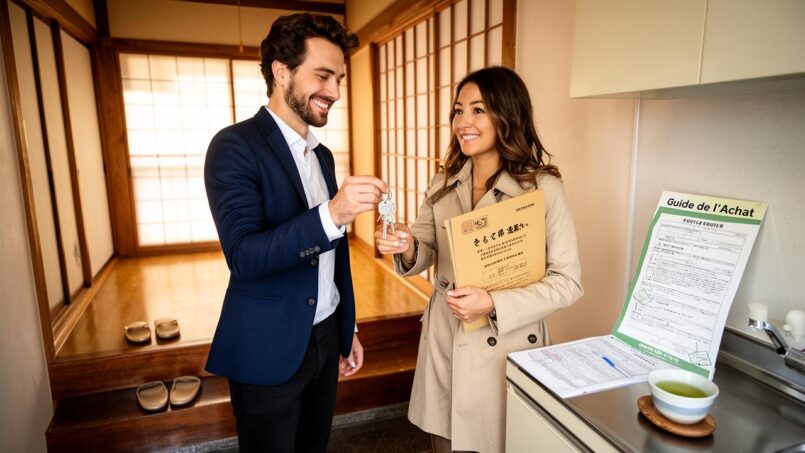
Buying an apartment in Japan is increasingly fascinating French people. From trendy Tokyo neighborhoods, views of Yokohama Bay, or quiet small condominiums in Kyoto, the Japanese real estate market seems very accessible… and it is, provided you clearly understand the local rules. Unlike many Asian countries, Japan imposes no quotas, visas, or nationality requirements to become a property owner. In 2026, a French person can buy an apartment in Japan with the same rights as a Japanese person.
Buying real estate in Japan is free for foreigners, but this seemingly simple process hides a very codified system, entirely in Japanese, with high ancillary costs and, since 2026, new administrative obligations for non-resident buyers.
Understanding the legal framework for a French buyer
First, it’s essential to distinguish three things that, in Japan, do not overlap: property rights, residency rights, and access to credit. You can perfectly well own an apartment in Tokyo without having a Japanese visa, but you cannot live permanently in that apartment without a residency permit. And obtaining a mortgage depends mainly on your resident status and local income, not your passport.
What Japanese law allows (and does not allow)
A French person can buy:
– a condominium apartment
– a single-family house
– a residential building
– land and building, in freehold ownership
without any nationality restrictions. The buyer’s name is recorded in the land registry (Legal Affairs Bureau) with exactly the same legal value as that of a Japanese citizen. Rights are not limited in time, the property can be freely resold or inherited, and there is no foreigner quota in buildings.
However, certain categories of land are regulated
– agricultural or forest land: purchase subject to specific authorization
– land near military bases or sensitive sites: subject to monitoring, or even prior declaration
In these specific cases, it is not about prohibiting purchases by foreigners, but about controlling the subsequent use of the land. For a standard apartment in a city (Tokyo, Osaka, Fukuoka, etc.), these limitations almost never apply.
No visa required… but no automatic residency rights
Buying an apartment in Japan in 2026 grants:
– neither a visa
– nor resident status
– nor a shortcut to permanent residency
Immigration and property ownership are managed by two different administrations that hardly “talk” to each other. You can:
– own an apartment in Japan while staying in France all year round
– come occasionally as a tourist to stay for a few weeks
– but not live there year-round without a long-term visa (work, Japanese spouse, student, etc.)
This reality is often misunderstood by foreign buyers. It is therefore important to see the purchase for what it really is: an investment, a pied-à-terre, or a future residence if you obtain a visa through other means, but never a “residency ticket” in itself.
New 2026 rules: what changes for foreigners
Political discussions about land have fueled many rumors. In 2026, Japan has not closed its real estate market to foreigners. The changes concern transparency, not access. Concretely, for a French person buying an apartment:
– they must declare their nationality at the time of property registration (with passport)
– if they are a non-resident (living outside Japan), they must file a real estate acquisition report via the Bank of Japan within 20 days of purchase
– enhanced anti-money laundering checks apply to all transactions, regardless of nationality
These steps are declaration obligations, not requests for authorization. The administration does not rule on “accepting or rejecting” the transaction; it simply records the information.
A foreign resident in Japan (work visa, student, spouse, permanent resident) can obtain a Japanese mortgage based on their status and income. A French person with a stable job, local payslip, and tax history has reasonable chances of getting a loan, even without permanent residency, at banks like SMBC Trust Bank PRESTIA, Suruga, or SBI Shinsei, but under stricter conditions than for a Japanese person.
– Non-resident living in France In practice, Japanese banks almost never lend. So you must buy with cash or arrange financing in France (mortgage on a French property, personal loan, etc.). Some Asian banks offer yen-denominated loans for buying in Japan, but that’s a niche market reserved for large investors.
This distinction conditions everything else: project size, timeline, choice of property type (a small apartment with cash or a more ambitious purchase with a local loan).
Prioritize a bilingual or foreigner-specialized agency offering services in English or French. Ensure the fudōsan-ya has a valid license and is registered. Check their experience with non-residents: handling power of attorney, apostille, and Bank of Japan declarations.
The agent can legally represent both buyer and seller (a practice called ryō-te). However, many foreigners prefer an agent clearly positioned as a “buyer’s agent” defending their interests, especially for negotiating sensitive clauses.
The Japanese scrivener verifies the title deed, mortgages, and easements, prepares and files property transfer applications with the Legal Affairs Bureau, registers the mortgage if applicable, and often handles aspects of the Foreign Exchange and Foreign Trade Act (FEFTA) for non-residents.
For a French person buying remotely, the shihō shoshi is often the key representative, the one given power of attorney to sign and finalize the transfer.
For a real estate investment in Japan, favor buildings constructed after 1981 (Shin-Taishin standards) and even better after 2000, to ensure seismic safety and facilitate insurance. Always check natural hazard maps (flooding, landslides, tsunamis) provided by agents. Also verify the condominium’s health: reserve fund status and existence of a long-term repair plan (Chōki Shūzen Keikaku).
During the visit, test floor flatness with a marble, observe ceilings and corners for water stains, mold, or cracks, check the condition of window frames and the operation of sliding doors and windows, note sound insulation, and ask about the date and nature of the last major repairs (roof, facade, elevators).
It is also advisable to:
– check cell reception and fiber optic availability
– test water pressure in the bathroom and kitchen
– assess actual sunlight, especially in the afternoon
For a remote project, insist on detailed video tours, asking the local representative to film the “unflattering” areas: under sinks, ceiling, stairwell, roof from outside, garbage room, etc.
On a well-priced property, negotiation is often marginal. An overly aggressive price can cause you to lose priority to another buyer, especially in Tokyo and Osaka.
For each apartment, it is useful to set in advance: the investment objective, the budget to respect, the location criteria, and the sought-after features.
– a “ceiling” price all costs included
– a target price taking into account the condition of the property and necessary work
– an offer strategy (slightly below, at price, or above in case of high competition)
The agent reads the document aloud in Japanese during a formal session. The buyer must sign to attest having received and understood the explanation. The agent is not required to provide a translated version, so it is prudent for a French person to take extra precautions.
– be accompanied by a professional interpreter
– and/or hire a bilingual advisor for a full review before signing
Contractual conditions (final price, timeline, treatment of defects, cancellation clauses) must be perfectly clear. The contract is drafted in Japanese; an unofficial translation may be attached, but only the Japanese text is legally binding.
At the time of signing, the buyer pays a much larger deposit (still called 手付金, tetsukekin):
– in practice, 5 to 10% of the property price in many cases
– some customs even mention 10 to 20% depending on the market and banking relationship
This deposit is paid directly to the seller (or held by a third party depending on the arrangement). The contract’s cancellation clauses define what happens if you withdraw: in Japanese practice, withdrawing without legitimate reason after signing can result in losing all or part of this deposit.
Standard residential loans are almost inaccessible. Only a few investment lenders finance a rental project, but with higher rates, limited loan-to-value (50 to 70% of the maximum price), and high requirements in terms of assets and international income.
In practice, the vast majority of French non-residents buy their apartment in Japan with cash or via financing backed by their assets in France (mortgage, Lombard loan, etc.).
Financing follows two key steps: first a pre-screening (Jizen Shinsa) before the preliminary agreement, based on income and property description. Then, after acceptance of the agreement, a complete application (Hon Shinsa) is submitted with employment certificates, income statements, tax notices, bank statements, and documents on the property and price. Finally, the loan contract is formally signed at the bank, over several hours.
Banks generally calculate:
– a maximum loan amount (often up to 7–8 times annual income for the best profiles)
– a maximum monthly payment (25 to 35% of gross monthly income, including debts)
Non-residents or non-PR may be required to make a down payment of 30 to 50% of the price, especially for rental investments.
For a power of attorney in Japan, provide: copy of passport (identity, nationality, date of birth), proof of address in France (utility bill or bank statement), an affidavit or sworn declaration of identity certified by a notary in France or by the embassy/consulate in Japan, a certified signature (notarization) to replace the Japanese seal, and a Power of Attorney letter in Japanese authorizing a local representative (agent, shihō shoshi) to sign.
In addition, the law requires non-residents to:
– file an acquisition report (Form 22) with the Bank of Japan within 20 days of purchase
– and, if necessary, designate a tax representative in Japan to receive and pay local taxes
Summary of operations closing the sale: identity verification, fund transfer, fee payment, key handover, and registration.
Checking IDs and originals (certificates, powers of attorney, etc.).
Loan disbursement by the bank and/or transfer of the remaining purchase price from buyer to seller.
Payment of agency commission, shihō shoshi fees, registration duties, insurance, and prorated charges.
Keys are officially handed over to the buyer.
Submitting registration applications by the shihō shoshi to the Legal Affairs Bureau, usually the same day.
Ownership is legally transferred only after this registration, even though, in practice, the buyer receives the keys at settlement.
After purchase, the shihō shoshi finalizes the land registration including nationality. You must file the acquisition report with the Bank of Japan within 20 days (possible via your bank). Declare the property to the municipality for fixed asset and city planning taxes. If needed, appoint a local tax agent to receive tax notices.
It is only at this point that the purchase can be considered fully complete.
Withholding tax rate applied to rents paid to a non-resident, creditable against the final tax on rental income
In case of resale with a capital gain, taxation depends on the holding period:
– less than 5 years: high combined rate, around 30% on the gain
– 5 years or more: reduced rate (about 15%)
All this must be coordinated with French taxation via the double tax treaty, which requires planning with a tax specialist familiar with both systems.
To simplify property management, entrust rental and management to a property management company. They typically charge 5 to 8% of gross rent to handle finding tenants, collecting rent, and managing common issues like breakdowns or minor repairs. Alternatively, a simpler option is to leave the apartment empty between stays and only pay the charges.
In any case, even an unoccupied apartment generates a non-negotiable monthly cost (management fees, provisional taxes, insurance) that can reach ¥30,000 to ¥50,000 for a standard condominium.
This model is also becoming common among Europeans, but requires a high level of trust and rigorous selection of partners.
Maximum time in months between offer and key handover, not including file preparation
For foreigners, real estate acquisition in Japan faces three main barriers.
Everything is in Japanese and professionals are not required to provide translations.
Credit is almost exclusively for residents with local income, forcing many French buyers to pay cash.
The total cost exceeds the listed price by 6 to 10% once taxes and fees are included.
In return, Japan offers a solid legal framework, often very low interest rates for those who can access them, and the possibility of owning an apartment in freehold in one of the world’s most stable major metropolises.
By carefully preparing your project, surrounding yourself with an experienced agent, a competent judicial scrivener, and ideally a bilingual advisor, a French person can transform what initially looks like an administrative labyrinth into a controlled operation, from the first click on a listing to the first night spent in their own apartment in Japan.
A wealth project or a question? Contact us now to speak with a wealth management expert.
Disclaimer: The information provided on this website is for informational purposes only and does not constitute financial, legal, or professional advice. We encourage you to consult qualified experts before making any investment, real estate, or expatriation decisions. Although we strive to maintain up-to-date and accurate information, we do not guarantee the completeness, accuracy, or timeliness of the proposed content. As investment and expatriation involve risks, we disclaim any liability for potential losses or damages arising from the use of this site. Your use of this site confirms your acceptance of these terms and your understanding of the associated risks.

Cyril Jarnias is an independent expert in international wealth management with over 20 years of experience. As an expatriate himself, he is dedicated to helping individuals and business leaders build, protect, and pass on their wealth with complete peace of mind.
On his website, cyriljarnias.com, he shares his expertise on international real estate, offshore company formation, and expatriation.
Thanks to his expertise, he offers sound advice to optimize his clients' wealth management. Cyril Jarnias is also recognized for his appearances in many prestigious media outlets such as BFM Business, les Français de l’étranger, Le Figaro, Les Echos, and Mieux vivre votre argent, where he shares his knowledge and know-how in wealth management.





