
 Published on and written by Cyril Jarnias
Buying an apartment in Tokyo, a traditional house in the countryside, or a “discounted akiya” fascinates more and more foreigners. The environment is safe, property rights are solid, and there are virtually no nationality restrictions. But behind this apparent simplicity lies one of the most treacherous markets for an unprepared investor.
Japanese real estate law strongly protects tenants, involves complex taxation and specific construction standards. Starting in 2026, additional formalities apply to non-residents. Language and cultural difficulties in transactions also come into play.
The goal here is not to discourage investment, but to review, concretely, the main pitfalls and mistakes to avoid before investing in Japanese real estate, whether for personal use or to build a rental portfolio.
Believing that buying property grants a visa or resident status
The first illusion to dispel is simple: owning property in Japan gives no right to stay. There is no real estate-linked “golden visa.” The right to remain in the country depends exclusively on the type of visa (work, spouse, student, investor/business manager, etc.), not on property ownership.
A tourist can buy an apartment in Tokyo without a long-term visa, even remotely, with the same rights as a Japanese owner. However, this purchase does not change immigration status in any way and cannot be used to obtain a residence permit.
Another dangerous belief: thinking that “passport + cash” is all you need. To open a bank account, obtain a loan, pay taxes, interact with local authorities, you often need an address in Japan, local income proof, and sometimes a Japanese tax number. Buying is easy; living in Japan stably is much less so.
Underestimating the actual cost of an acquisition
Focusing only on the list price of the property is one of the most common mistakes. In Japan, the sale price is only the tip of the iceberg. Between agency fees, acquisition taxes, registration fees, judicial scrivener fees, translations, and international transfers, the bill adds up fast.
Figures from reforms and practices show that a reasonable buyer should plan for at least 7 to 10% additional acquisition costs. For a foreign non-resident, the total bill—including bank fees, currency conversions, and translation services—can rise to 12–18% of the property price.
Simplified overview of the main cost items at purchase
Main cost corresponding to the price negotiated with the seller.
Costs related to transporting goods to the delivery location.
Taxes and duties collected when goods cross borders.
Costs incurred by storing products before use.
Insurance premium covering risks related to transport or storage.
Costs related to managing orders, invoices, and customs documents.
Main costs associated with acquiring a property
| Cost item | Basis of calculation | Typical order of magnitude |
|---|---|---|
| Real estate agency commission | 3% of price + ¥60,000 + 10% consumption tax | ≈ 3.3% of price |
| Registration and license tax | Taxable value of land/building | 0.4% to 2% depending on type and regime |
| Real estate acquisition tax | Taxable value (often < market price) | 3–4% (3% for primary residence) |
| Stamp duty | Contract amount | ¥10,000 to ¥60,000, more for luxury |
| Judicial scrivener fees | Per transaction | ≈ ¥100,000 to ¥200,000 |
| Fire/earthquake insurance (year 1) | Annual premium paid at signing | ¥20,000 to ¥80,000 and up |
| Bank/loan processing fees | Loan amount | 1–2% of borrowed capital |
| Translation/interpretation | Volume of documents | Variable, often several hundred € |
| International transfers and currency exchange | Amount transferred | 2–4% spread + fixed fees |
On a 50 million yen apartment (about €300,000 depending on the exchange rate), agency fees alone amount to around ¥1.7 million. Adding acquisition taxes, registration, stamp duty, and insurance, you easily reach ¥3.5 to 5 million in closing costs. For a non-resident, currency losses and bank fees can add several thousand euros more.
Not factoring these amounts into the business plan, or worse, underestimating taxes payable several months after purchase (like the acquisition tax), leads to cash flow shortfalls and returns far from initial projections.
Forgetting annual charges and local taxation
Even once you have the keys, the meter is running. One classic pitfall is not budgeting for local taxes and recurring charges, which typically run around 1–2% of the property’s value per year.
The main annual taxes are the fixed asset tax at 1.4% of the taxable value, and the city planning tax which can reach 0.3%. Added to that are condominium fees, long-term repair reserve fund contributions, and insurance.
Example annual budget for a ¥50 million condo
| Annual item | Assumption | Estimated amount |
|---|---|---|
| Fixed asset tax (1.4%) | Assumed taxable value ≈ 70% of price | ≈ ¥490,000 |
| City planning tax (0.3%) | Same basis | ≈ ¥105,000 |
| Condominium fees | ¥15,000 / month | ¥180,000 |
| Repair reserve fund | ¥10,000 / month | ¥120,000 |
| Building / PNO insurance | Annual flat rate | ¥30,000–¥50,000 |
| Property management (if rented) | 5–8% of annual rents | Variable, several tens of thousands ¥ |
For a ¥50 million property, you quickly arrive at between ¥750,000 and ¥1.25 million in annual costs, excluding any one-off repairs. For a foreign investor, add the cost of a tax representative, possibly a property administrator, and international transfer fees. All of this must be integrated from the initial yield modeling.
Ignoring the hidden costs of a Japanese property is a frequent mistake that significantly reduces the actual profitability of the investment, often well below initial expectations.
Choosing the wrong ownership structure and tax strategy
Japanese tax law strongly distinguishes between ownership in one’s own name, through a standard Japanese company (KK, GK), or through more sophisticated structures like the GK–TK scheme. Choosing the wrong wrapper is a trap that can hamper cash flow and inflate the effective tax rate.
The top marginal global tax rate for residents can reach 55%, including progressive brackets, surcharges, and local tax.
On the corporate side, standard forms (KK or GK) suffer from double taxation: first corporate income tax on profit (around 30–34%), then withholding tax of about 20.42% when dividends are distributed to a foreign shareholder, unless reduced by tax treaty. For a simple rental holding vehicle, this treatment is often penalizing.
For many medium-sized investments, practitioners favor structures like GK-TK (Godo Kaisha + Tokumei Kumiai). These structures allow treatment closer to “pass-through,” thus limiting double taxation.
On the larger fund side, 2026 tax reforms have eased the permanent establishment (PE) risk for foreign limited partners investing in Japan via partnerships, but these changes remain highly technical. Key takeaway: even when PE exemption applies, certain Japanese-source income—dividends, interest, real estate gains, and stock capital gains beyond the 25%/5% threshold—remains taxable in Japan.
In other words, Japanese taxation cannot be circumvented by a simple structural trick. Preparing with a cross-border tax specialist before buying, rather than after, is a vital reflex.
Misunderstanding capital gains taxation and timing
Another classic pitfall: neglecting the tax on resale. In Japan, the treatment of real estate capital gains for individuals depends essentially on the holding period, calculated not from the exact date of sale, but from January 1 of the year of sale.
If the property has been held for 5 years or less as of January 1 of the sale year, the gain is classified as short-term and taxed at approximately 39.63%. Beyond 5 years, the tax rate drops to about 20.315% for residents and 20% for non-residents.
This difference is not a technical detail, but a public policy choice: to discourage short-term speculation and favor patient capital. For an expatriate on a 3- or 4-year contract who sells their home upon leaving, the tax bill can be almost twice as high than if they waited one more year.
Many hurried or poorly informed sellers thus deprive themselves of millions of yen in savings by selling a few months too early. Simply adjusting the timing, considering this January 1 rule, is one of the basic optimizations.
Being unfamiliar with inheritance taxation and valuation reforms
For a long time, some investors—Japanese and foreign—rushed into “tower mansions” (high-rise luxury condos) to exploit a blind spot in inheritance tax. The taxable value was often far below market value, thanks to methods based on administrative indicators (rosenka, road valuations) that ignored rents, building quality, and actual demand.
Reforms launched in 2024 and expanded in plans for 2026 explicitly aim to close this loophole. The direction is clear: bring taxable value closer to real value, relying more on the historical purchase price adjusted for market changes, then discounted by about 20% to account for selling costs or minor discrepancies.
The new calculation method can significantly increase the inheritance tax base for many properties, especially those held for a long time. With a top inheritance tax rate potentially reaching 55%, the financial impact is considerable for heirs, whether they reside in Japan or abroad.
Another nuance often overlooked: a foreigner who owns a condo in Tokyo and dies abroad can create a Japanese tax liability for their heirs, even if those heirs have no tax nexus with Japan. The reforms under preparation do not change this territoriality principle, but they strengthen valuation accuracy. Betting on Japan solely as an “inheritance tax haven” is now a very risky strategy.
Underestimating market opacity and the complexity of valuations
The Japanese real estate market suffers from a paradox: while legally highly regulated, it remains in practice “notoriously opaque” for a foreigner. Official values (rosenka, prices published by the Ministry of Land – MLIT) are often far from actual transaction prices. Surveys have shown that administrative valuations can be barely half the market value in some central Tokyo neighborhoods, and conversely exaggerated in rural areas with no demand.
For inheritance and some taxes, official indicators are used, but professionals (agents, investors, appraisers) think in terms of real price per square meter and compare it with local transactions. Common mistakes by foreigners include: looking at the total price instead of price per m², confusing book value and market value, or overestimating building depreciation without considering the land potential.
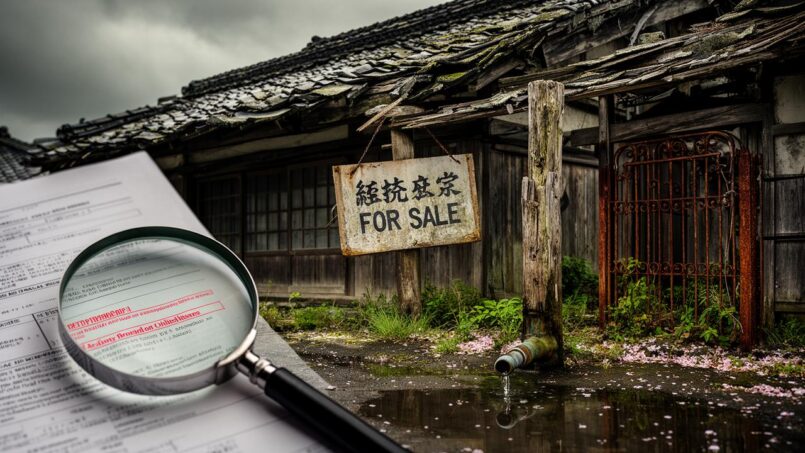
This is even truer for “akiya”, those abandoned houses often publicized at ¥1 or a few thousand euros. Official statistics indicate that about 8 million homes are vacant, but only a small minority (around 15%) are in truly attractive areas, near transportation and in decent condition. The rest suffer from dilapidation, isolation, and structural risks.
A very low price often hides ¥10 to 20 million in renovations. Demolishing and rebuilding can cost less than bringing it up to seismic and insulation standards. Without a professional inspection, you risk buying a liability.
Confusing tax depreciation and real devaluation
A recurring misunderstanding among foreign investors is the famous phrase: “In Japan, houses are worth zero after 20–30 years.” It actually mixes two distinct things: on one hand, the tax depreciation of the building (for amortization and certain taxes), on the other, the evolution of the market price.
From a tax perspective, buildings (houses, apartment blocks) are depreciated over a statutory useful life—for example, 22 years for most wooden houses, 47 years for many reinforced concrete buildings. At the end of the depreciation period, the book value of the building tends toward zero. But this does not mean the property becomes unsalable or uninhabitable.
The Japanese real estate market places more value on land, which does not depreciate and can appreciate (especially in urban centers), while the functional quality of the building (condition, seismic compliance, rental appeal) remains a key factor. In some Tokyo neighborhoods, land value is overwhelmingly dominant. A tax-depreciated building can still be rented, resold, or demolished to rebuild larger depending on BCR/FAR coefficients.
Basing a decision solely on the depreciation period to declare a building “finished” is a mistake. Conversely, ignoring the age of the building, especially the key 1981 threshold for seismic standards (Kyū-taishin vs. Shin-taishin), is equally dangerous: buildings from before June 1981, subject to more lenient standards, are more difficult to finance and insure, and may require major reinforcement work.
Ignoring seismic standards, structural condition, and environmental risks
Japan is a country of earthquakes, typhoons, landslides, and floods. Simply succumbing to the charm of a traditional house or the low price of a building is not enough; you need to look closely at the “hardware”: structure, soil, environment.
Several traps lie here.
A first one is neglecting the year of construction and the applicable seismic standard. The cutoff of June 1, 1981, is fundamental: buildings before that date (Kyū-taishin) may be considered riskier in a major quake. Banks and insurers often require specific inspections or structural reinforcements for these buildings. Conversely, favoring post-1981 buildings (Shin-taishin) makes financing, resale, and renting easier.
A second trap concerns soil pollution and environmental risks, particularly for former industrial sites, gas stations, or land with heavy prior use. The Contaminated Soil Law provides that the owner—even if the pollution predates their purchase—can be held responsible for remediation measures if the contamination is deemed hazardous to health. This can go as far as requiring the removal of large volumes of polluted soil, at enormous cost.
Finally, in historic cities, the potential presence of archaeological remains can block a project. If buried cultural properties are discovered, work can be suspended or even prevented, directly impacting the profitability of a development operation.
All this argues for thorough due diligence: engineering reports, consultation of hazard maps (flood, landslide, tsunami), verification of historical land use, and, if in doubt, environmental analyses.
Neglecting title verification and easements
Assuming the seller is the legitimate owner of record is a dangerous gamble. In Japan, ownership is defined by the land registry (Toukibo). Verifying that the seller is the rightful owner and that the chain of title is clear is the indispensable starting point.
Typical problems include unresolved inheritances, poorly recorded corporate reorganizations, or residual real rights, exposing the buyer to lengthy and costly litigation, or even the inability to resell.
For land and individual houses, another source of trouble lies in cadastral boundaries. In Japan, the fence or wall does not always coincide with the legal boundary. A few centimeters of dispute can be enough to freeze a sale in case of conflict with a neighbor. The existence and quality of an official boundary survey (boundary confirmation) must therefore be checked.
Again, resorting to an experienced judicial scrivener, working in concert with a lawyer if necessary, is not an optional extra but an indispensable safeguard.
Neglecting contract language and document complexity
Virtually all real estate contracts, condominium rules, meeting minutes, and tax documents are in Japanese. Many foreign buyers make the mistake of signing based on an oral summary or partial translation, relying entirely on an intermediary who, moreover, can legally represent both the seller and the buyer.
The explanation of important points (Jyu-setsu) details rights, construction restrictions, risks, easements, height limitations, and reconstruction prohibitions; a misunderstanding about a road setback or a prohibition can jeopardize any renovation or elevation project.
Not engaging a bilingual adviser—lawyer, scrivener, or experienced agent with an obligation of transparency—is one of the greatest risks for a non-Japanese speaker. Conversely, relying on an agent whose primary priority is to close the sale quickly, and who downplays unfavorable aspects, exposes you to very costly surprises.
Misjudging rental risks: tenant rights, “sticky” rents, and eviction
Japanese residential lease law is openly asymmetrical: the legislator considers housing security as a primary social good. Concretely, a standard lease is designed to renew automatically, and evicting a tenant against their will is highly regulated.
In a standard lease, the mention “2-year term” is misleading: unless the landlord gives notice between 6 months and 1 year before the expiry, with “just and reasonable grounds,” the lease is tacitly renewed. Case law is strict: wanting to sell vacant to make a capital gain is rarely considered sufficient grounds. The tenant’s need (stability of life, schooling, etc.) is often deemed more important than the landlord’s economic interest.
Case law and lease law
When an amicable eviction is the only realistic path, resort is often made to “tachinoki-ryō”, a moving-out compensation covering moving expenses, agency fees for the new property, any rent difference if the new home is more expensive, and a component of moral compensation. In practice, this compensation can amount to 6 to 12 months’ rent, sometimes more.
During inflationary periods, a landlord cannot unilaterally increase the rent. If the tenant refuses, they can deposit the old rent with the Legal Affairs Bureau (kyōtaku), remain protected from eviction, and wait for the dispute to be resolved. This creates ‘sticky’ rents both downward and upward, while costs (taxes, repairs, fees) increase.
Finally, according to the so-called “Tokyo Rules,” most wear and tear over time—wall discoloration, normal floor wear, replacement of aging fixtures—is borne by the owner, not the tenant. The security deposit (shikikin), often one to two months’ rent, is not always sufficient to cover restoration costs between occupants.
Ignoring these realities leads many investors to overestimate their net cash flow and the flexibility of managing their rental portfolio.
Underestimating management costs and condominium risks
Buying an apartment in a condominium (“manshon”) in Japan does not just mean owning a concrete volume; it means becoming a member of a management association, with its rules, finances, and tensions. Many problems arise when a majority of absentee investors lose interest in the building’s life.
To preserve your property’s value and avoid costly problems, pay your fees regularly, attend meetings even by proxy, keep your contact address updated, and monitor warnings about insufficient repair reserve funds. Neglecting these points leads to underfunded renovations, deterioration, conflicts, and resale depreciation.
Legal reforms in effect since 2026 further strengthen discipline. Associations must now file annual financial reports with local authorities, make public their long-term repair plan and the level of their reserves relative to recommended standards. Buildings below these standards are required to mention this to potential buyers—becoming a stigma on the market.
Owners deemed unreachable after unsuccessful contact attempts over one year can have their voting rights suspended or neutralized. The meeting can then proceed without them for certain decisions, including reconstruction or sale projects. A foreign investor neglecting their mail or without a local representative risks losing their voice in decisions affecting their property’s value.
Being blinded by the myth of “akiya” and ¥1 houses
Viral videos showing expats buying Japanese houses for ¥1 or €10,000 have circulated widely. The reality described by experts is far less glamorous.
On one hand, it is true that millions of homes are vacant, and some sell for a handful of yen. On the other hand, official data indicates that 85% of these empty houses are in underserved areas, in demographic decline, even in natural hazard zones, and/or in such condition that the renovations needed to make them safe and comfortable far exceed the purchase price.
The costs to consider are not limited to the roof and paint. A serious upgrade of an old house often involves:
– Structural reinforcement to meet current seismic standards;
– Complete roof replacement (heavy tiles, a danger source in earthquakes);
– Treatment of termite damage and wood rot;
– Complete overhaul of plumbing and electrical systems;
– Virtually nonexistent thermal insulation in many pre-1980s houses.
The amount, sometimes over 30 million yen, needed to transform a traditional house into high-end accommodation in Japan.
Not to mention legal pitfalls: title scattered among a dozen hard-to-locate heirs, adjacent agricultural land making acquisition impossible without authorization, undisclosed easements, or landscape restrictions severely limiting possible alterations.
For a few profiles—retirees wanting to settle in the countryside, extreme DIYers willing to devote years, heritage enthusiasts—this can be a viable life project. For most investors seeking a return or a hassle-free pied-à-terre, it is a trap.
Neglecting new reporting and transparency obligations for foreigners
Since 2026, the Japanese framework for foreign buyers has evolved, not to restrict property rights, but to increase transparency and control.
Two major developments directly concern non-residents:
Since new rules came into effect, owners must declare their nationality in the land registry (via passport). Furthermore, any non-resident acquiring property, even for personal use, must file a Form 22 with the Bank of Japan within 20 days of the transaction.
Failure to comply with these obligations exposes you to risks ranging from administrative fines to, in extreme cases, invalidation of the transaction. Added to this is the increasing prominence of anti-money laundering checks on all transactions.
These measures are part of a broader context of tightening control over foreign investment in sensitive sectors via the Foreign Exchange and Foreign Trade Act (FEFTA), although most standard residential acquisitions do not trigger in-depth scrutiny.
For an investor, this simply means that the “no questions asked” era is over. You must accept that the administration knows who you are, where the money comes from, and for what purpose you are buying.
Confusing an open market with a simple market
It would be wrong to say Japan is closed to foreigners: legally, it ranks among the most liberal countries concerning property rights. No nationality is prohibited from buying, there are no ownership quotas, and a foreigner can hold property in full ownership without a local co-owner.
But an open market is not necessarily an easy market. The combination of the following factors creates an environment particularly treacherous for the unprepared investor:
Information opacity (public databases understating prices, unreliable private aggregators, truncated or paywalled English listings), the language barrier (contracts and correspondence only in Japanese), conservative banking practices (loans nearly impossible for non-residents, tougher conditions for foreign residents), a dense and changing tax framework (reforms on depreciation, inheritance, consumption tax), and a tenant-protective lease law complicate investment.
In this context, the main mistake is to mechanically project onto Japan the reflexes from other markets (USA, Europe, Southeast Asia). A very cheap old house does not necessarily hide a “value play” à la New York, but often serves as a warning signal about future costs, resale liquidity, or structural risks. A condominium with low fees is not necessarily a good deal, but may betray a critically underfunded repair reserve.
Settling for superficial due diligence
Finally, the cardinal sin, which conditions all others, is not doing real due diligence. Many foreign investors visit a few properties, vaguely compare expected rents with loan payments, take a quick look at the neighborhood, and then sign. Yet in Japan more than in many other countries, value and risk lie in what is not immediately visible: the land registry, zoning rules, the condominium’s financial health, the nature of the lease, natural hazards.
A solid process should at a minimum include: planning, execution, monitoring, and evaluation stages.
Before buying real estate in Japan, carry out a screening phase (address, hazard zone, zoning, construction coefficients, and price per m²), followed by a confirmation phase (review of Toukibo, easements, leases, condominium rules, repair plan and financial statements). A physical inspection by a professional (kensa-sha) is recommended, especially for individual houses and older buildings, costing ¥50,000 to ¥150,000. Finally, a legal and tax review by a lawyer, scrivener, or tax advisor is essential to anticipate the consequences of a quick resale, inheritance, or non-resident tax status.
The difference between the investor who comes out ahead in Japanese real estate and the one who ends up trapped lies not in nationality, but in the degree of preparation. In Japan, more than anywhere else, the actual profitability of a property is not read solely from its price and advertised gross yield, but from the precise mapping of hidden risks that you have taken the time to uncover before signing.
A wealth project or a question? Contact us now to speak with a wealth management expert.
Disclaimer: The information provided on this website is for informational purposes only and does not constitute financial, legal, or professional advice. We encourage you to consult qualified experts before making any investment, real estate, or expatriation decisions. Although we strive to maintain up-to-date and accurate information, we do not guarantee the completeness, accuracy, or timeliness of the proposed content. As investment and expatriation involve risks, we disclaim any liability for potential losses or damages arising from the use of this site. Your use of this site confirms your acceptance of these terms and your understanding of the associated risks.

Cyril Jarnias is an independent expert in international wealth management with over 20 years of experience. As an expatriate himself, he is dedicated to helping individuals and business leaders build, protect, and pass on their wealth with complete peace of mind.
On his website, cyriljarnias.com, he shares his expertise on international real estate, offshore company formation, and expatriation.
Thanks to his expertise, he offers sound advice to optimize his clients' wealth management. Cyril Jarnias is also recognized for his appearances in many prestigious media outlets such as BFM Business, les Français de l’étranger, Le Figaro, Les Echos, and Mieux vivre votre argent, where he shares his knowledge and know-how in wealth management.





