
 Published on and written by Cyril Jarnias
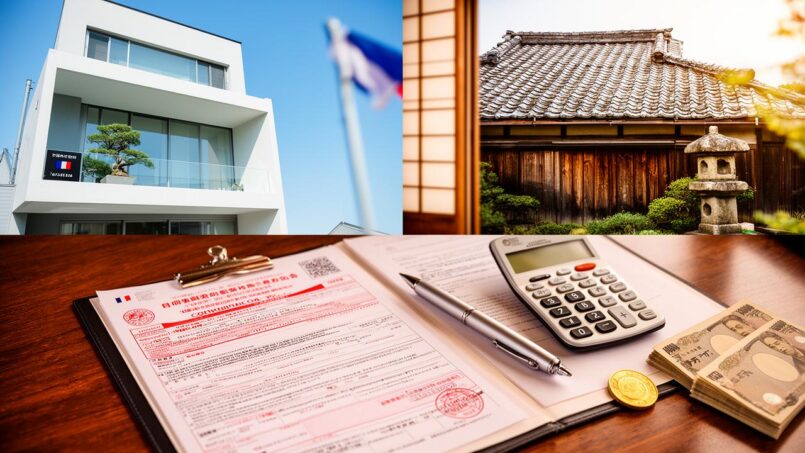
Owning or considering buying real estate in Japan as a French resident immediately raises three questions: what local taxes will you pay on-site, how are capital gains taxed upon resale, and how can you avoid being taxed twice thanks to the Franco-Japanese tax treaty?
Taxation for French owners involves distinguishing between Japanese rules, French rules, and the treaty between the two countries. This article offers a structured, plain-language overview of this dense but workable legal framework.
Local taxes in Japan: what every owner pays, French or not
In Japan, local taxes apply to property ownership regardless of the owner’s nationality or tax residency. A French owner is treated exactly the same as a Japanese owner: no more, no less tax.
General logic: no “wealth tax,” but targeted taxes
Japan has neither a global real estate wealth tax nor a British-style council tax equivalent. Instead, the system relies on a few clearly identified taxes:
– an annual property tax, the Fixed Asset Tax (固定資産税);
– a potential surtax in urban areas, the City Planning Tax (都市計画税);
– acquisition and registration taxes paid once at purchase;
– stamp duties on contracts.
Amounts are calculated not on the purchase price or market value, but on a value assessed by the municipality, generally between 50% and 70% of actual value. This value is revised every three years.
Fixed Asset Tax: the “core” of local taxation
The Fixed Asset Tax is the mandatory annual tax for any owner of land or buildings in Japan, whether it is a primary residence, a rental investment, or a vacant pied-à-terre.
This is the standard property tax rate in Japan, applied to the assessed value as of January 1 of the year.
The law provides significant deductions for residential land, which in practice greatly reduce the tax for smaller properties:
| Type of residential land | Area concerned | Taxable base for Fixed Asset Tax |
|---|---|---|
| “Small lot” land | Up to 200 m² | 1/6 of assessed value |
| Land over 200 m² | Portion > 200 m² | 1/3 of assessed value |
Two important consequences for a French person buying an apartment in Tokyo or Kyoto: first, the land portion attached to the unit often benefits from the 1/6 reduction; second, the annual tax burden is usually much less than 1.4% of market value. For a prime apartment valued at 500 million yen, the annual bill typically falls between 1.5 and 3 million yen, or about 0.3% to 0.6% of the market price.
The buildings themselves do not benefit from this land reduction, but there is another favorable mechanism for new constructions.
Reductions for new buildings
For newly built residential buildings that meet certain conditions, the tax on the building is halved for the first few years:
– –50% Fixed Asset Tax on the building for 3 years for a “standard” new home;
– extended to 5 years for fire-resistant constructions (reinforced concrete, reinforced structure, etc.).
These reductions target the building, not the land, and are subject to size thresholds (typically between 50 m² and 240 m² for a dwelling) and residential use. They do not apply to a building considered strictly as a rental investment without direct residential use by the owner.
City Planning Tax: urban surtax in urbanization zones
The City Planning Tax is added to the Fixed Asset Tax for properties located in urbanization promotion areas (市街化区域). Many urban or suburban properties are subject to it; conversely, many country houses or “akiya” (vacant houses) in rural areas are exempt.
The maximum legal rate is 0.3% of the assessed value. Some municipalities, such as Tokyo’s 23 wards, apply this full rate, while others adopt a lower rate or no levy at all.
Here again, residential land benefits from tax base reductions:
| Type of residential land | Area concerned | Taxable base for City Planning Tax |
|---|---|---|
| Up to 200 m² | 0–200 m² | 1/3 of assessed value |
| Over 200 m² | Portion > 200 m² | 2/3 of assessed value |
In total, for a property in an urban area, the Fixed Asset Tax + City Planning Tax combined is around 1.7% of the assessed value, which is well below market value in most cases.
Tax bills typically combine both taxes and can be paid in a single payment or in four installments throughout the year.
Real Estate Acquisition Tax: the purchase tax, paid once
At purchase, the buyer must pay a real estate acquisition tax at the prefectural level, the Real Estate Acquisition Tax (不動産取得税). It is levied only once, several months after the property is registered, based on the assessed value and not the price paid.
The system distinguishes between residential and non-residential properties:
| Type of property | Standard rate | Usual reduced rate for housing |
|---|---|---|
| Residential land and house | 4% | 3% of assessed value |
| Non-residential building | 4% | No general reduction |
For residential land, the taxable base can be reduced to half of the assessed value, proportionally lowering the amount. Additional provisions exist for new or specially qualified homes, subject to size and use criteria.
Registration and License Tax: tax on land registry registration
Any acquisition, new construction, or change of title in the land registry requires payment of a Registration and License Tax (登録免許税) to the state. Again, it is due once, when the transaction is formalized at the Legal Affairs Bureau.
Overview of the main rates in effect
Rate set by the central bank, influencing the cost of credit and inflation.
Compensation received on a loan or investment, expressed as a percentage.
Value of one currency relative to another, key for international trade.
| Transaction | Basis | Standard rate | Reduced rate (subject to conditions) |
|---|---|---|---|
| Property transfer – land | Assessed value | 2.0% | 1.5% until a certain legal deadline |
| Property transfer – existing building | Assessed value | 2.0% | 0.3% for certain homes used as residence |
| Registration of new construction | Assessed value | 0.4% | 0.15% for certain new homes |
| Mortgage registration | Loan amount | 0.4% | 0.1% in certain home loan cases |
Here too, reductions primarily target owner-occupied homes, not purely rental properties.
Stamp Duty: the stamp affixed to the sales contract
The sales contract signed between buyer and seller is subject to stamp duty, the Stamp Duty (印紙税). It takes a very concrete form: a tax stamp affixed to each paper copy of the contract. The scale depends on the price:
| Price stated in the contract | Stamp amount |
|---|---|
| 1 to 5 million JPY | 2,000 JPY |
| 5 to 10 million JPY | 10,000 JPY |
| 10 to 50 million JPY | 20,000 JPY |
| 50 to 100 million JPY | 60,000 JPY |
| 100 to 500 million JPY | 100,000 JPY |
| > 5 billion JPY | 480,000 JPY |
Reduced rates are available until a certain legal deadline, but as an order of magnitude, this cost remains marginal relative to the property price.
Practical obligations for a French non-resident
One point often underestimated by French people buying in Japan: municipalities send tax notices only to an address in Japan. A non-resident owner must therefore appoint a tax representative (納税管理人 / nouzei kanrinin) residing in Japan.
This representative receives the notices, handles payments, and, if necessary, the filing procedures. Without one, the risk is accumulating unpaid taxes simply due to not receiving the mail, along with penalties.
Capital gains tax on real estate in Japan: rules, rates, and specifics for non-residents
Beyond local taxes, the tax that really weighs on investment profitability is capital gains upon resale. This is also where the link with French taxation becomes critical.
How is taxable capital gain calculated in Japan?
Japanese capital gains tax is never calculated on the total sale price, but on the net profit:
> Taxable gain = Selling price – (Acquisition cost + selling expenses)
The acquisition cost includes the purchase price, certain taxes and fees (registration fees, agent fees at purchase up to regulatory limits, etc.), and, if applicable, the cost of capitalizable improvements. Selling expenses include mainly:
– the real estate agent’s commission on resale (usually 3% of the price + 60,000 yen + consumption tax);
– legal advertising and registration fees;
– certain advisory fees.
This capital gain is treated as a separate income category, distinct from business income and other income, with its own rates.
If the calculation results in a capital loss, no tax is due. If a withholding tax was applied (in case of a non-resident seller, see below), the owner can file a return to reclaim the excess withheld.
Short term, long term: the five-year criterion
The Japanese system distinguishes two main categories of gains:
– short-term capital gain: when the property is held 5 years or less;
– long-term capital gain: when the property is held more than 5 years.
A property purchased in November 2020 and sold in February 2026 will be considered held for more than 5 years, because as of January 1, 2026, more than five calendar years have passed. The period is calculated from January 1 of the year of sale.
The tax rates vary significantly depending on this holding period.
Rates applicable for a Japanese resident
For an owner considered a Japanese tax resident, the combined rates (national tax + reconstruction surcharge + local tax) are as follows:
| Type of gain | Holding period | National rate (incl. surcharge) | Local rate | Combined rate |
|---|---|---|---|---|
| Short term | ≤ 5 years | 30.63% | 9% | 39.63% |
| Long term | > 5 years | 15.315% | 5% | 20.315% |
These rates are heavy, especially for a quick resale. For a resident, selling after three years a property bought for speculative purposes therefore exposes to a taxation of almost 40% of the gain.
Rates applicable for a non-resident (typical case of a French person living in France)
A French person who lives in France and is not a Japanese tax resident is, from a Japanese perspective, a non-resident. Japan then taxes them only on their Japanese-source income, which includes the capital gain on a property located in Japan.
For non-residents, the national rates remain the same, but the local inhabitant tax (10%) is generally not due. Result:
| Type of gain | Holding period | Combined rate for non-resident |
|---|---|---|
| Short term | ≤ 5 years | 30.63% |
| Long term | > 5 years | 15.315% |
Furthermore, the local inhabitant tax on the gain does not apply in principle if the seller is not registered as a resident on January 1 of the year following the sale and no longer holds any real estate used as an office, establishment, or residence in Japan on that date.
Withholding tax of 10.21% on the sale price
A very important particularity for a French person selling their property as a non-resident: in Japan, there is no notary in the French sense, and it is the buyer who becomes the tax collector for the Japanese tax authorities.
When the seller is non-resident:
– the buyer must withhold 10.21% of the gross sale price;
– and remit this amount to the Japanese tax authorities by the 10th day of the month following the transaction.
This 10.21% levy is a mandatory deposit calculated on the total price, not on the gain. The final tax is then determined using the net gain formula, with rates of 30.63% or 15.315% depending on the holding period.
The non-resident seller must then:
– file a Japanese annual tax return (確定申告 / kakutei shinkoku) between February 16 and March 15 of the year following the sale;
– calculate their net gain in that return, deduct the 10.21% already withheld;
– obtain, if necessary, a refund if the deposit exceeded the tax due.
In many cases (low or even no gain), this mechanism results in a refund of a significant portion of the 10.21%.
The residence exception: no withholding if the buyer is an individual occupant
The law provides for an exemption from this 10.21% withholding. The buyer does not need to withhold if two conditions are met:
– they buy as an individual;
– the property is intended to serve as a primary residence for themselves or their relatives;
– and the price does not exceed 100 million yen.
This exception is strictly interpreted: the mere fact that the buyer is an individual or that the property is an apartment is not enough. The tax authorities look at the actual occupancy of the property.
Specific benefits for primary residence in Japan
Even a French non-resident may be concerned if, for example, they lived in Japan and sold their main home before returning to France. Japanese tax law provides several favorable provisions for primary residence:
You can benefit from an exemption of 30 million yen on the gain, regardless of how long you have held the property. This exemption is limited to once every three years and requires that the property was your actual primary residence, not a rental investment.
In practice, if the gross gain on the primary residence does not exceed 30 million yen, no Japanese tax is due on that sale.
For primary residences held for more than 10 years, even more favorable rates exist after applying, if applicable, the 30 million yen exemption:
– for the portion of taxable gain up to 60 million yen: 14.21% (10.21% national tax + 4% local tax);
– above 60 million yen: 20.315%.
These “long-term” rates reinforce the advantage of holding a main home for the long term before selling it.
Filing obligations for non-residents: tax representative and deadlines
A non-resident who must file a capital gains return in Japan must absolutely appoint a tax representative (納税管理人) on the ground. This representative:
– receives correspondence from the tax authorities;
– responds to requests for supporting documents;
– facilitates, if necessary, additional payment or refund.
The return must be filed no later than March 15 of the year following the sale. For foreign corporations, a separate deadline applies: within two months following the close of the fiscal year.
In the event of a loss (negative gain), filing a return is not required. However, if a 10.21% deposit was withheld, it is in the seller’s interest to file in order to obtain a refund.
Rental income: Japanese taxation and specifics for non-residents
Even if your priority is capital gains, rental flows are often the core of the project for a French investor in Japan. They raise several types of taxation.
Rental income: always taxable in Japan
Rents received from a property located in Japan are classified as Japanese-source income. They are always taxable in Japan, whether the owner is resident or non-resident, Japanese or French.
For a Japanese resident, rents are included in total income and taxed at progressive rates (up to 45% at the national level, plus surcharge and local tax, for a marginal rate that can exceed 55%).
The withholding tax rate applied to gross rents of non-residents combines 20% national tax and 0.42% reconstruction surcharge.
– the tenant, when it is a company or entity required to withhold;
– or the property manager, who remits the amounts to the Japanese tax authorities before the 10th day of the following month.
Individual tenants who rent for their own residential use are not required to perform withholding. In practice, most non-residents renting through an agency will have 20.42% applied to their gross rents.
Annual return and possible recoveries
This 20.42% withholding on the gross amount is not the final tax. The non-resident can (and should):
– file an annual income tax return in Japan;
– claim all deductible expenses (management fees, loan interest, repairs, insurance, building depreciation, local taxes, etc.);
– obtain a refund of the excess withholding if the income tax actually due on the net amount is lower.
Without filing, the owner bears 20.42% on gross income indefinitely, without taking any expenses into account. In a rental context, the difference between gross and net can be very significant.
Here again, the non-resident must appoint a tax representative on the ground and respect the filing window between February 16 and March 15.
France–Japan tax treaty: how to avoid double taxation on capital gains
A French resident in France who owns property in Japan potentially faces a second tax upon resale, this time in France. This is where the tax treaty between the two countries comes in.
Principle: Japan has priority to tax the capital gain on real estate
Article 13(1) of the Franco-Japanese double taxation treaty provides that gains derived by a resident of one state from the alienation of real property situated in the other state are taxable in that other state.
Concretely, a capital gain realized by a French resident on an apartment in Tokyo falls primarily under Japanese taxation. This is what was described above: 15.315% or 30.63% for a non-resident, after calculating the net gain.
But this does not mean that France gives up all taxation.
France taxes its residents on their worldwide income
French domestic law (CGI) provides that French tax residents are taxable in France on all their income, wherever it is located. The fact that the property is in Japan, that the sale proceeds remain in a Japanese account, or that tax has already been paid in Japan does not exempt them from reporting in France.
For a seller who is a French tax resident, the capital gain realized in Japan must be declared in France under the capital gains tax regime for real estate. First verify French tax residency (Article 4 B of the CGI).
The mechanics of French real estate capital gains tax
In France, real estate capital gains for an individual are, under the common law regime:
– taxed at 19% for income tax;
– plus 17.2% in social security contributions (CSG-CRDS, etc.);
– i.e., 36.2% in total, before applying allowances for holding period.
For large gains, an additional surtax of 2% to 6% is added beyond 50,000 € of taxable gain, calculated using Form 2048-IMM. Holding period allowances progressively reduce the taxable base for income tax and social contributions starting from 5 years of ownership, up to full exemption in the long term, but these rules are beyond the scope of this article.
To determine the “theoretical” French tax amount on the Japanese capital gain, the administration applies its own internal rules, without initially considering what was paid in Japan.
Article 23 of the treaty: the choice of method for eliminating double taxation
The France–Japan treaty provides, in Article 23, the methods for eliminating double taxation. For France, two methods are possible:
Two methods are used in France to avoid double taxation of foreign income: exemption with progressivity, which neutralizes tax on certain foreign income but includes it in calculating the average rate on other income, and the tax credit, which reduces French tax up to the amount of foreign tax already paid.
For real estate capital gains covered by Article 13(1), the treaty expressly classifies these gains in the second category: France must apply the tax credit method equal to the Japanese tax paid, capped at the corresponding French tax.
In practice:
– 1. France calculates the taxable gain under its domestic law, in euros, and determines the total French tax (income tax, social contributions, applicable surtax). 2. This amount is compared with the Japanese tax actually paid on the same gain. 3. France grants a tax credit equal to the Japanese tax, but limited to the amount of the calculated French tax. 4. Two scenarios arise:
– if the theoretical French tax is higher than the Japanese tax, a balance remains payable in France;
– if the Japanese tax is equal to or higher than the French tax, the credit is capped at the French amount and there is no refund of the “excess” Japanese tax.
In other words, the treaty guarantees that you will never pay more than the higher of the two taxes, but it does not protect you from an additional amount in France if French taxation proves heavier than Japanese taxation.
Simplified numerical illustration
Imagine a French person selling an apartment in Osaka with a net capital gain of €200,000.
That is approximately 30,630 euros of tax for a non-resident owner in Japan for more than 5 years, taxed at 15.315%.
In France, the gain is calculated according to French rules. Suppose that after holding period allowances (if applicable) and currency conversions, the total tax (income tax + social contributions + possible surtax) is €50,000.
France will grant a tax credit of €30,630, corresponding to the Japanese tax actually paid. The remaining amount to pay in France is €19,370.
If, on the other hand, the French calculation resulted in €25,000, the credit would be capped at that amount and nothing would be payable in France, but the €5,630 of “excess” Japanese tax would not be refunded.
Practical points of attention for French owners
To properly manage this interplay:
– you must keep all proof of Japanese taxation (notices, proof of 10.21% withholding, gain calculation, payment receipt);
– the gain and tax paid must be converted into euros at the applicable rate, then reported on the French tax return;
– the French return must use the standard forms for real estate capital gains, with the treaty coming into play at the tax credit stage.
It is also important to distinguish this double taxation elimination issue from any matter related to IFI (French Real Estate Wealth Tax). IFI is a French wealth tax that may apply to a French resident on their worldwide real estate, including a Japanese apartment, but has no impact on Japanese taxation and does not enter into the treaty’s tax credit mechanism.
Summary: what a French person must absolutely keep in mind
A French resident investing in real estate in Japan sits at the crossroads of three layers of taxation.
At the local Japanese level, they bear:
– each year, the Fixed Asset Tax at 1.4% of the assessed value and, if applicable, the City Planning Tax up to 0.3%, with significant reductions for residential land;
– once at purchase, the Real Estate Acquisition Tax (3–4% of assessed value), the Registration and License Tax (0.1–2% depending on the transaction), and the Stamp Duty.
At the flow level, they incur:
The withholding on gross rents for a non-resident owner is 20.42%, largely recoverable through filing a return.
At the international level, as a French resident, they must:
– declare in France their Japanese real estate capital gain, calculated under French domestic law;
– benefit, under Article 23 of the treaty, from a tax credit equal to the Japanese tax paid on that gain, limited to the corresponding French tax.
In practice, this mechanism makes Japan the priority country for taxing gains related to properties located on its territory, with France playing a “catch-up” role when its own real estate taxation exceeds that of Japan.
Franco-Japanese tax mechanism
For a French person, properly preparing their real estate investment in Japan therefore means:
– anticipating the burden of local taxes, generally moderate relative to market value;
– weighing the holding period considering the rate jump after five years for capital gains;
– organizing their filings and proof of payment to fully benefit from the tax credit provided by the Franco-Japanese tax treaty.
This overall view makes it possible to place taxation within the overall holding strategy: it is neither a detail nor a fatality, but a parameter to optimize from day one of the real estate project.
Have a wealth planning project or a question? Contact us now to speak with a wealth management expert.
Disclaimer: The information provided on this website is for informational purposes only and does not constitute financial, legal, or professional advice. We encourage you to consult qualified experts before making any investment, real estate, or expatriation decisions. Although we strive to maintain up-to-date and accurate information, we do not guarantee the completeness, accuracy, or timeliness of the proposed content. As investment and expatriation involve risks, we disclaim any liability for potential losses or damages arising from the use of this site. Your use of this site confirms your acceptance of these terms and your understanding of the associated risks.

Cyril Jarnias is an independent expert in international wealth management with over 20 years of experience. As an expatriate himself, he is dedicated to helping individuals and business leaders build, protect, and pass on their wealth with complete peace of mind.
On his website, cyriljarnias.com, he shares his expertise on international real estate, offshore company formation, and expatriation.
Thanks to his expertise, he offers sound advice to optimize his clients' wealth management. Cyril Jarnias is also recognized for his appearances in many prestigious media outlets such as BFM Business, les Français de l’étranger, Le Figaro, Les Echos, and Mieux vivre votre argent, where he shares his knowledge and know-how in wealth management.





