
 Published on and written by Cyril Jarnias
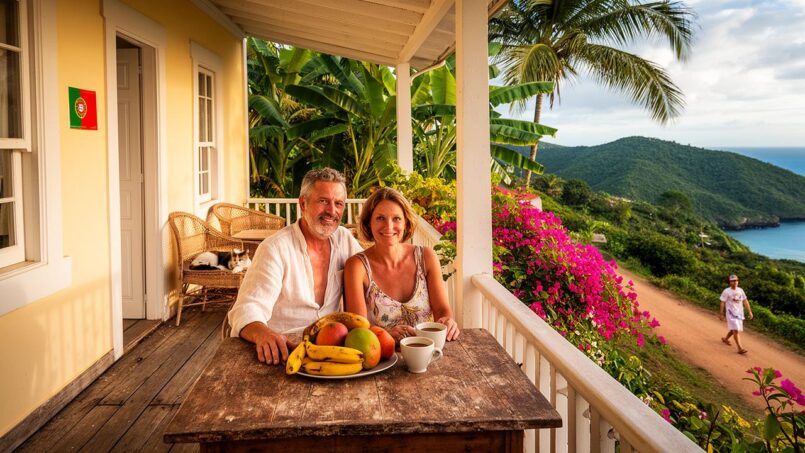
Moving to São Tomé and Príncipe means choosing a tiny island nation off the coast of Gabon, lost in the Gulf of Guinea, but with a personality all its own. Two main islands, just over 200,000 inhabitants, exceptional biodiversity, and a super laid-back lifestyle that locals sum up with a now-famous expression: “leve‑leve” – taking life as it comes.
Quality of life, safety, and the cost of daily living are mixed. Career prospects and the status of French nationals offer opportunities for a specific profile. The French community is tiny, with about thirty people registered with the consulate. Pascal settled here 25 years ago after a one-year contract.
A living environment between tropical paradise and structural fragility
Living in São Tomé and Príncipe means first accepting a dual reality. On one hand, a movie set: deserted beaches, equatorial forest covering about 40% of the territory, including vast protected areas, 700 recorded plant species (nearly a hundred endemic), sixteen bird species found nowhere else on Earth, and the island of Príncipe classified as a UNESCO Biosphere Reserve. On the other hand, a small, highly vulnerable island state, economically fragile, with virtually no social safety net and widespread poverty.
This country faces all the challenges of small island developing states: a small domestic market, dependence on a few sectors (cocoa, agriculture, tourism), isolation, high import costs, and exposure to climate change, with direct impacts on agriculture and fishing.
Social indicators reflect this fragility: a large share of the population lives below the national poverty line; about one quarter of inhabitants live on less than $1.90 a day, more than half below the national poverty line, and around 15% below the lowest international poverty line. The country ranks among the least developed in the world, although in recent years progress has been noted in basic infrastructure and public services. The Social Progress Index, which aggregates health, education, and rights indicators, rose from just over 58 to over 61 in five years. A real improvement, but still far from international standards.
Only about 21% of Santomean adults hold a job, illustrating massive unemployment.
This contrast between the sweetness of life and structural fragility is something every French expatriate quickly notices. Many sum it up this way: day to day, life can be incredibly peaceful… until a serious problem arises (health, transportation, supply crisis), suddenly revealing the limits of the system.
Cost of living: Financial paradise or illusion for families?
One of the major objective advantages of São Tomé and Príncipe for an expatriate remains its cost of living, well below that of France, Portugal, or the United Kingdom, especially for a simple, local lifestyle. Available comparisons show that the general price level is far below major Western cities, and even about 7 to 18% lower than the global median depending on household type.
Housing, in particular, is dramatically affordable if you are content with local standards. In the capital, a one-bedroom apartment in the city center rents on average around 200 to 250 euros per month, sometimes less depending on the source and condition of the property. On the outskirts, this type of housing often goes for around 170 euros. For a three-bedroom in the city center, the typical range is 400 to 600 euros, with an average close to 500 euros; outside the center, rents regularly drop to 300 to 400 euros. Some surveys even show lower amounts, around $200 for a one-bedroom and $590 for a three-bedroom.
To visualize these orders of magnitude, we can summarize as follows:
| Type of housing | Location | Average monthly rent (approx.) | Common range |
|---|---|---|---|
| 1 bedroom | São Tomé center | 200–250 € | 160–300 € |
| 1 bedroom | Outside center | 170–180 € | 120–200 € |
| 3 bedrooms | São Tomé center | 500–575 € | 370–750 € |
| 3 bedrooms | Outside center | 395–450 € | 285–600 € |
Compared to Europe, rents are 75 to 85% lower than those in Portugal, the United Kingdom, or the United States for comparable properties on paper. On a continental African scale, rents are estimated to be about 37% lower than the average. Land is generally cheap, although the best coastal locations, especially on the main island, have been largely snapped up by Portuguese and European investors over the past two decades.
The bill goes up as soon as international standards are demanded: modern housing, private generator, water reserve, reliable air conditioning, stable internet connection, even security service. In that case, rents can match or equal those of mid-range European cities. Families must also factor in extra costs for schooling, international health insurance, and a vehicle.
Estimates of overall budgets provide useful benchmarks. For a single person with a moderate lifestyle – simple housing, consumption focused on local markets, moto‑taxi travel, limited leisure – a budget of around $700 to $900 per month is often deemed sufficient, excluding international health insurance. Including a minimum of insurance, some calculations put it at $1,000–$1,100 per month. Calculations in euros converge around 550 to 700 euros for a very local lifestyle and 750 to 950 euros for a higher comfort level, including a decent one-bedroom in the city center, some restaurants, decent internet access, and health coverage.
The estimated minimum monthly budget for a family of three to four people living at an average expat standard in Cotonou.
A summary table helps you get your bearings.
| Expat profile | Typical monthly budget (excluding airfare) | Main comments |
|---|---|---|
| Frugal single | 550–700 € | Simple local housing, local food, few leisure activities |
| Comfortable single | 750–950 € | Decent 1-bedroom in town, mix of local/imported food, internet |
| Couple (average level) | 1,400–1,800 € | Decent comfort, moderate leisure budget |
| Family of 3–4 “average” | $2,500–$3,500 | Decent housing, some imported items, possibly a car |
| Family “high standard” | $4,500–$6,000 or more | Expat housing, imports, private schooling, car |
The gap with local income levels is striking. The average net salary is around 380 to 390 euros per month, roughly 84% less than the French average. The minimum wage in the public sector is around $60. In other words, the country is very cheap for anyone arriving with income from abroad, but the margin is much smaller for an expatriate intending to live solely on a local salary.
Working locally: A narrow market, niches for targeted profiles
On the professional front, São Tomé and Príncipe is not an employment El Dorado, including for foreigners. The economy remains very undiversified and still relies largely on plantation agriculture (cocoa, coffee, palm oil), services, a fledgling but growing tourism sector, and a few energy projects, including offshore oil where the country is more a potential producer than a full-fledged oil state.
The employment rate is low, barely one-fifth of adults have a job, urbanization has brought a sharp rise in youth unemployment in cities, and the state, the main employer, has limited capacity. The formal private sector remains narrow, weighed down by a still-fragile business climate, expensive and unreliable electricity, slow logistics, high debt, and high import costs.
Nevertheless, some niches exist for skilled expatriates, often provided they have external income or foreign-funded missions. The sought-after profiles are concentrated in:
Several sectors offer professional opportunities for foreigners: tourism and hospitality (ecotourism and small high-end structures before potential mass tourism), import‑export (networks and business skills are valued), technical construction trades (engineers, site managers, landscape architects), health (medical specialties in high demand despite infrastructure limits), education (needs for teachers in math, economics, physics, computer science, or languages), and management of development projects with international organizations like the World Bank, IFAD, UN agencies, or the French Development Agency (AFD).
As in many Portuguese-speaking African countries, a large number of expatriates in São Tomé and Príncipe are sent by foreign employers (Portuguese companies, donors, NGOs, cooperation agencies), paid according to scales outside the local market. Many others maintain their income remotely: telecommuting for a European company, consulting, pensions, investments, or even short-term assignments with back-and-forth travel.
For a French person settling on their own initiative, the most realistic option is to have income independent of the local economy, such as remote work, an online business, retirement, rental income, or capital gains. Most expatriates living comfortably on the islands fit this profile.
On the administrative side, the country is not particularly flexible. Citizens of dozens of countries can enter for tourist stays without a visa or with a visa on arrival, and French nationals are exempt from visa requirements for tourist stays of less than 15 days. To work, however, a permit issued by the authorities is required, usually based on a prior job offer. The local employer must demonstrate that no national candidate can fill the position, then sponsors the application, which can take one to three months to process in a sometimes slow administrative context. There is no dedicated “digital nomad visa” as of yet.
Anecdotal reports describe a formal job market where ads are rare, and recruitment largely happens through networks and word of mouth. Some major job sites literally show zero listings for the archipelago, which speaks volumes about the size of the market. Again, living in São Tomé and Príncipe often means creating your own opportunity or arriving with a project and funding already in place.
Taxation and investment: A surprisingly attractive framework
On the tax side, São Tomé and Príncipe holds a few surprises. The income tax system is progressive, with rates ranging from 0 to 25%. Tax residents are taxed on their worldwide income, while non‑residents are taxed only on their Santomean‑source income.
The country does not impose a wealth tax or inheritance tax (aside from administrative fees). There is no tax on foreign capital gains, and no property capital gains tax for non-citizens reselling a property. Property taxes are low, attracting foreign investors such as the Portuguese to coastal land.
São Tomé and Príncipe has even launched a citizenship‑by‑investment program, with a relatively fast procedure and, notably, no permanent residency requirement. To be eligible, the investment must present a real benefit to the country and its people. This scheme attracts a handful of wealthy profiles seeking geopolitical diversification, as the archipelago is seen as slightly outside major global tensions and far from conflict zones.
The local real estate market is very illiquid. Foreigners can buy without major restrictions, but a quick resale is not guaranteed. For a French expatriate, it’s therefore a secondary base or long‑term residence option, not a short‑term speculative investment.
Health: An Achilles’ heel that expats cannot ignore
If there is one point on which all observers and expatriates agree, it is the weakness of the healthcare system. This is probably the most deterrent factor for a long‑term move, especially for families or those with pre‑existing medical conditions.
Health infrastructure is still very rudimentary. The archipelago has two main public hospitals and about thirty health units spread across the islands. Around 70% of the population lives within an hour’s walk of a health center, which is significant for basic medicine, but the offering quickly runs out beyond simple ailments.
Dr. Ayres de Menezes Hospital offers general medicine, surgery, pediatrics, maternity, imaging, and lab services, but it lacks doctors, equipment, and basic medications; shortages affect more than half of households, and care is billed to foreigners.
Private clinics, of which there are about fifteen, are mostly concentrated in the capital. They offer consultations, a few simple procedures, sometimes a slightly more comfortable environment, and staff who sometimes speak English or French. But they are not full‑fledged hospitals: no major surgery, no intensive care, no proper medical technology. A private clinic consultation can cost around ten euros, paid in cash—a very low price for a Westerner, but high for the local average.
On the island of Príncipe, the situation is even more limited. The local hospital only provides basic care. For any specialist consultation or advanced test, you have to fly to São Tomé, when the flights—about six per week, vulnerable to weather—are not canceled. In a serious emergency, this time factor becomes critical.
The recommended coverage ceiling for medical expenses when moving to São Tomé and Príncipe is at least $500,000.
Cases of tropical diseases are not uncommon. Malaria remains present, described by some residents as a “major drawback,” even though authorities and international organizations have significantly stepped up the fight over the past fifteen years. One expatriate who spent twelve years on the islands mentioned three or four episodes of malaria during that period: nothing exceptional in a West African context, but a real risk requiring prevention and vigilance.
In short, for a French person accustomed to France’s healthcare system, living in São Tomé and Príncipe means completely revising reflexes: no longer relying on hyper‑equipped emergency rooms, not treating a serious condition locally, accepting that you may need to leave the country urgently, and factoring all of that into life decisions.
Infrastructure, electricity, internet: Life at the pace of outages
Beyond healthcare, infrastructure is another major friction point for expatriates. After independence, the economy slowed sharply, investments dropped, and a good part of the networks (roads, energy, water) aged faster than they were maintained. In recent years, some projects have emerged, but the catch‑up is far from complete.
Electricity is notoriously unstable: blackouts are frequent, sometimes daily, and can last from a few minutes to several hours. Recurrent protests in the city, sometimes gathering hundreds of people, show how socially explosive the issue is. To cope, many expatriates invest in generators or solar solutions, which significantly increases the housing budget.
Running water is not always guaranteed, and cuts, especially in outlying areas or during the dry season, are not uncommon. It is often necessary to store water in tanks. The internet remains one of the weak links for anyone dependent on constant high speed. Overall, the network is sufficient for simple browsing, emails, and sometimes video conferencing, provided you are patient and located in the best neighborhoods. But for professionals who need a fast, stable, low‑latency connection (developers, traders, gamers, videographers), the archipelago is hard to reconcile with intensive activity.
The archipelago is heavily dependent on imports (except fish, tropical fruits, water). A health crisis, a conflict in the Gulf of Guinea, or a surge in energy prices can cause supply disruptions or sharp price hikes. Covid‑19 illustrated the vulnerability to border closures and the collapse of tourism.
Domestically, logistics are slow: port procedures, administrative formalities, and internal transportation are limited. International flights are few. This contributes to the “timeless” charm that some seek, but can become a real problem for those who, for example, need to travel frequently or receive equipment regularly.
Safety: One of Africa’s calmest countries, with a few nuances
In terms of safety, São Tomé and Príncipe enjoys an enviable reputation on an African scale. Traveler and expatriate reports converge: the general feeling is of a quiet country, where you can relax more than in many other tropical destinations. Several foreigners report feeling able to “let their guard down,” not constantly being solicited or harassed, and not feeling that they are being “taxed” at every interaction. Street vendors are few, rarely pushy, and locals are described as generally welcoming.
About 88% of residents say they never fear crime in their homes, and over 80% feel safe walking home. The country has one of the lowest rates of violence on the continent, peaceful elections, and is far from terrorist hotspots, making it a discreet refuge in times of regional tensions.
But this very reassuring picture should not lead to complete naivety. French authorities, like other embassies, place the archipelago under enhanced vigilance, certainly without direct terrorist threats, but with a recommendation to be cautious. Minor and moderate crime does exist: pickpocketing, bag snatching, burglaries, sometimes armed attacks, especially in areas frequented by tourists (markets, beaches, near hotels) or at night. More serious violence is reported sporadically, particularly during burglaries or home invasions.
Some indicators suggest a possible deterioration in the security climate, marked by social tensions linked to poverty and growing inequality, daily micro‑violence during muggings or clashes with law enforcement, as well as acts of protest against the authorities, creating an impression of a “crack” in a traditionally peaceful society.
Finally, at sea, the waters of the Gulf of Guinea remain one of the world’s riskiest areas for piracy. Even though attacks are concentrated mainly off the coast of Nigeria, the entire region is discouraged for recreational boating. Recommendations are clear: avoid pleasure sailing in the area, especially far from the coast, both day and night.
For a French expatriate choosing the archipelago, in practice this translates into the now standard precautions: not openly displaying valuables, avoiding carrying large amounts of cash, using known taxis, not walking at night on deserted beaches or poorly lit areas, and always locking doors and windows. Vigilance remains in order, even if the overall climate is incomparably more relaxed than in so many other African capitals.
Education, families, and the question of Francophonie
One of the major weak points of São Tomé and Príncipe for a family move is the educational offering. The local school system, run by the Ministry of Education and Higher Education, has achieved interesting results in terms of enrollment and completion rates: according to the most recent international data, enrollment and completion rates are relatively high for the region. The country even has a national learning assessment program at the end of primary cycle (grades 2, 4, and 6), indicating attention to quality.
No recognized international schools, with limited alternatives to local Portuguese‑language institutions, a few English or French classes, and no French high school or AEFE network on site.
There is virtually no recognized international school for expatriates; options are limited to local public or private schools.
Available schools teach primarily in Portuguese, sometimes with a bit of English or French, but with no official French network.
The nearest French‑accredited schools are in Gabon, making access difficult for expatriates on site.
For a French family, this means children will either have to integrate into the local Portuguese system, with the linguistic and curricular challenges that entails, or take distance education (e.g., CNED), at the cost of heavy parental involvement and a certain social isolation for the child. Some families opt for boarding school abroad, which involves costs and separation.
In this context, the Alliance Française of São Tomé and Príncipe plays a central role. Present for several decades and recognized as a public utility by the Santomean state, it is the main vector of Francophonie in the country. It is also the only center authorized to issue DELF and DALF diplomas, allowing Francophone Santomeans to officially certify their level and, sometimes, obtain a scholarship to study in France or Morocco.
Number of teachers who obtained an official diploma thanks to a training program supported by the French Ministry of Foreign Affairs between 2020 and 2021.
For the small French community – about thirty people registered according to consular data – the Alliance Française serves as a cultural rallying point. It is complemented by the presence of an honorary French consulate in São Tomé and the French Embassy in Libreville (Gabon), responsible for the archipelago. In practice, this means that full consular services often require a trip or at least remote communication with Libreville.
For a childless couple or retirees, the absence of a French school on site is not an issue. For a family with young children, however, it is a major sticking point. Many analyses converge: São Tomé and Príncipe is poorly suited for families seeking a continuous international school curriculum.
Profile of the French who settle in São Tomé and Príncipe
In this landscape, who are the French who try the Santomean adventure? The official figures speak for themselves: about thirty registered with the consulate, which suggests a few additional unregistered people, but we are still talking about a small handful. Reports mention expatriates who are mostly Portuguese, a few Italians “found in every corner of Africa,” and rare French speakers, often very established.
Among them, you will find:
Among the French community are pioneers like Pascal, a man from Bordeaux who arrived 25 years ago with his wife for a one-year contract that was renewed; entrepreneurs like this food‑industry agent and trained chef; tourism players (guesthouses, restaurants, ecotourism); consultants and cooperation experts; and new citizens like this real estate agent who acquired nationality through investment, describing expatriation as “very cool.”
In the accounts, one word comes up repeatedly: “laid‑back,” “really relaxed.” The French met on site describe a warm human climate, very low social pressure, few aggressive solicitations, and the possibility of living simply, far from the noise and frenzy of big cities.
This typical expatriate profile aligns with the categories for which the archipelago is often deemed most suitable:
– retirees with a sufficient European pension;
– remote workers with stable income from abroad, ready to accept a less‑than‑perfect connection and power outages;
– childless couples who travel slowly, seeking a cheap tropical base for a few years;
– wealthy investors using São Tomé and Príncipe as an “occasional base” or second passport without necessarily living there full‑time.
The archipelago is, on the other hand, considered much less practical for families with school‑age children, expatriates with a high need for advanced medical infrastructure, or those who want to build a classic career with upward mobility in a large company. For these profiles, the narrow job market, healthcare system limits, lack of international schools, and transportation constraints weigh too heavily.
Conclusion: A niche destination, demanding but unique
Living in São Tomé and Príncipe is nothing like settling in Lisbon or Dakar, nor like moving to a major African metropolis. It is a niche, almost radical choice: that of an island with paradisiacal looks, but embedded in one of the poorest and most vulnerable countries on the continent. A country where crime remains low, where you can leave your belongings in a guesthouse without worry, where locals greet you on the street; but also a country where a fracture, a heart attack, or an obstetrical complication can turn into a race against time for an air ambulance.
For a French person considering this gamble, you need external income (retirement, remote job, investments) to live well, take out solid international insurance with a medical evacuation plan, accept the educational challenges (Portuguese system or distance schooling), the failing infrastructure (outages, slowness), and adapt to a culture marked by poverty, social tensions, and persistent discrimination against sexual minorities.
In return, the archipelago offers something rare: a simple life on an island still largely untouched by mass tourism, with derisory rents for anyone coming from Europe, a slowed‑down relationship with time, a generally kind population, and for many expatriates, the feeling of getting back to basics. It is not a choice for everyone. But for a few dozen French people, it has already become obvious: their “leve‑leve” now plays out in São Tomé and Príncipe.
An estate planning project or a question? Contact us now to speak with a wealth management expert.
Disclaimer: The information provided on this website is for informational purposes only and does not constitute financial, legal, or professional advice. We encourage you to consult qualified experts before making any investment, real estate, or expatriation decisions. Although we strive to maintain up-to-date and accurate information, we do not guarantee the completeness, accuracy, or timeliness of the proposed content. As investment and expatriation involve risks, we disclaim any liability for potential losses or damages arising from the use of this site. Your use of this site confirms your acceptance of these terms and your understanding of the associated risks.

Cyril Jarnias is an independent expert in international wealth management with over 20 years of experience. As an expatriate himself, he is dedicated to helping individuals and business leaders build, protect, and pass on their wealth with complete peace of mind.
On his website, cyriljarnias.com, he shares his expertise on international real estate, offshore company formation, and expatriation.
Thanks to his expertise, he offers sound advice to optimize his clients' wealth management. Cyril Jarnias is also recognized for his appearances in many prestigious media outlets such as BFM Business, les Français de l’étranger, Le Figaro, Les Echos, and Mieux vivre votre argent, where he shares his knowledge and know-how in wealth management.





