
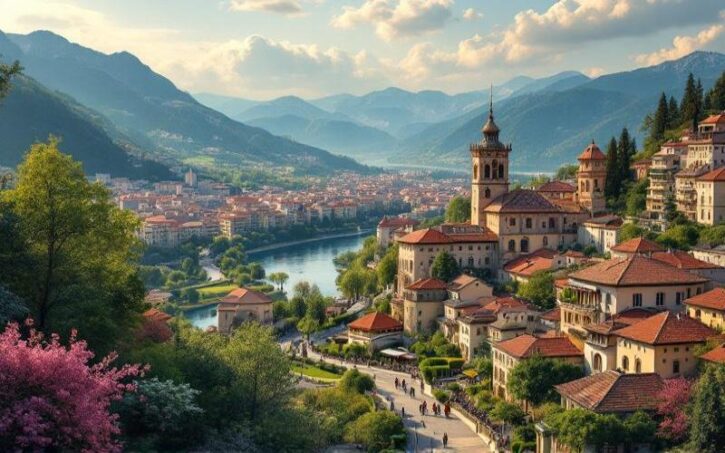
 Published on and written by Cyril Jarnias
Dara’s victory with “Bangaranga” at Eurovision has thrust Bulgaria into the spotlight like never before. For the first time, the country won the contest, with an impressive score of 516 points and a jury‑public double win. Beyond the musical euphoria, this event is changing the way millions of Europeans perceive this Balkan nation… at the very moment its real estate market is entering a new era.
Good to Know:
The intersection of Bulgaria’s cultural soft power, its entry into the eurozone, and the transformation of the real estate sector creates a window of opportunity rarely so clear for investors. This is an alignment of structural factors that makes Bulgarian real estate more visible, more transparent, and still surprisingly affordable—far from an easy ‘jackpot’ narrative.
From the Eurovision Stage to the Investors’ Mental Map
The Bulgarian victory goes beyond a trophy. Eurovision is one of the most-watched television events in the world, with a unique ability to reshape the image of participating countries. Studies on host cities show the scale of this impact. In Vienna, hosting the 70th edition of the contest, the ECO Austria institute estimates economic spin-offs at €57 million, for a cost of €36 million, 88,000 additional visitors, 550 full-time equivalent jobs, and €22 million in tax revenue generated.
€22.8 million
Direct benefits in euros generated by the Italian edition of Eurovision in Turin, 2.4 times the city’s initial investment.
For Bulgaria, which already has a significant tourism market (the sector accounts for 10 to 12% of GDP and the country expects around 14 million visitors for the year), this gain in visibility comes at a time when other, much deeper drivers are already in motion: eurozone entry, urban modernization, transparency reforms, and… an announced rise in real estate prices.
The Perfect Conjunction: Euro, Growth, Eurovision
The adoption of the euro on January 1, 2026 marks a major turning point. The lev was already pegged to the euro for a long time, but officially becoming the 21st member of the eurozone radically changes the perception of risk for foreign investors. Bulgaria enters the same monetary club as Germany, France, or Italy, with a fixed exchange rate of 1 EUR = 1.95583 BGN.
Example:
The European Commission forecasts real GDP growth for Bulgaria of 3% in 2025 and 2.7% in 2026, with very low unemployment around 3.7%. The IMF anticipates growth above the eurozone average, and the Vienna Institute for International Economic Studies estimates GDP growth of 2% to 2.4% between 2026 and 2028, illustrating moderate but robust growth framed by European discipline.
This dynamic is also reflected in foreign direct investment. In recent years, the country has attracted an average of nearly €188 million in FDI flows per month, with peaks exceeding €1.3 billion in the best years. Admittedly, 2024 marked a decline from 2023, but figures from early 2026 show a rebound, with €259.8 million in FDI in January alone, an increase of nearly 5% year-over-year.
Attention:
The Eurovision victory amplifies an existing trend by making visible the interest in Bulgaria, which ticks the criteria that reassure real estate investors: strong currency, growth above the eurozone average, low taxation, affordable market, and developing infrastructure.
Macroeconomic Overview in a Few Figures
The table below summarizes several forecasts for Bulgaria around 2026.
| Indicator | 2025 (approx.) | 2026 (approx.) | 2027 (approx.) | Primary Source |
|---|---|---|---|---|
| Real GDP Growth (EC) | 3.0% | 2.7% | 2.1% | European Commission |
| Real GDP Growth (IMF) | 3.1% | 2.8% | 2.5% | IMF – World Economic Outlook |
| Inflation (EC) | 3.5% | 2.9% | 3.7% | European Commission |
| Inflation (wiiw) | – | 4.5% | 3.7% | Vienna Institute (wiiw) |
| Unemployment | 3.5% | 3.7% | 3.8% | European Commission |
| Tourism Share of GDP | 10–12% | 10–12% | 10–12% | National sector analyses |
| Eurozone Entry | – | Yes | Yes | European Commission, BNB |
So this is far from an unstable or speculative country. What Eurovision brings is visibility that grafts onto an already solid economic base.
A Real Estate Market Leaving the ‘Overheating’ Phase and Entering Maturity
Bulgarian real estate has already gone through its catch-up cycle. Between 2024 and 2025, home prices rose at a double-digit pace, exceeding 15% per year according to Eurostat and the National Statistical Institute. Sofia, Varna, Burgas, and Plovdiv drove the national index upward, to the point that Bulgaria ranked among EU countries with the highest price increases.
But unlike the bubble of the 2000s, the current situation is not one of irrational exuberance. Bulgarian banks apply strict lending rules: minimum down payment of 15%, debt-to-income ratio limited to 50% of net income, maximum loan term of 30 years. Interest rates on mortgage loans—now denominated in euros—remain historically low, around 2.1% on variable rates in spring 2026, with a growing supply of fixed-rate or hybrid loans.
Monetary authorities ensure that credit growth remains relatively high while gradually slowing down. The result: the 2025 price increase is driven by real demand from Bulgarian households—an expanding middle class and urban residents seeking comfort—not by runaway debt.
Monetary authorities including the Bulgarian National Bank
In 2026, analysts widely describe a year of stabilization. The market is changing pace: moving from a buying ‘frenzy’ fueled by anticipation of the euro, to a more rational growth cycle supported by fundamentals.
Toward a More Moderate… Yet Still Solid Increase
Forecasts converge: the national progression of residential prices should settle, in a steady state, between 5% and 10% in 2026, with a central scenario around +8%. Sofia, the most dynamic segment, could see an increase of 8% to 12% over the year, and up to 15% in its most sought-after neighborhoods.
Tip:
On the Black Sea coast (Varna, Burgas), projections indicate increases of 10% to 12%, supported by tourism and the influx of new European investors thanks to the euro and the end of exchange fees. Seaside resorts like Sunny Beach and ski resorts like Bansko are expected to see even stronger revaluation, with a potential 25% to 30% rise for vacation residences in the coming years.
The following table illustrates some price ranges and growth estimates.
| City / Region | Avg. Price 2025 (€/m²) | Avg. Price 2026 est. (€/m²) | Forecast Increase 2024–2025 (HPI) | Forecast Increase 2026 (approx.) |
|---|---|---|---|---|
| Sofia (new, 2026) | ~2,080 (Q1 2025) | 2,487 (April 2026) | +17.5% (HPI 2024–2025) | +5 to +10% for remainder of 2026 |
| Varna | ~1,600 – 2,000 | 1,400 – 2,600 (coast) | +14.7% (HPI 2024–2025) | +10 to +12% |
| Burgas | ~1,340 – 1,750 | 1,400 – 2,600 (coast) | +12.5% (HPI 2024–2025) | +10 to +12% |
| Plovdiv | ~1,300 – 1,600 | – | +13.6% (HPI 2024–2025) | +5 to +8% |
| National Average | ~1,381 – 1,400 | Slight increase in 2026 | ~+15%/yr (2024–2025) | +5 to +10% |
Even after these increases, Bulgaria remains one of the cheapest markets in the EU: in the capital, new construction around €2,400 to €2,500 per m² is still far below the levels of many Western European capitals, even as wages rise and the country gradually converges with the European average.
Why Eurovision and the Euro Really Change the Game for Foreign Investors
For a French, German, or Spanish investor, Bulgaria suddenly shifts from an ‘exotic’ country to a familiar destination. On one hand, the Eurovision win offers a contemporary, young, creative face. On the other, the eurozone and Schengen simplify daily life: no more exchange fees, no devaluation risk, increased price transparency, and immediate currency recognition.
Concretely, this means a German tourist can now effortlessly compare the cost of a stay at Sunny Beach with a trip to Malaga or Crete, using the same units of measurement. Similarly, a French investor can evaluate an apartment in Sofia, Varna, or Bansko in euros, without worrying about exchange rate risk.
Tourism: Essential Fuel for Rental Yields
Since tourism is a major pillar of the Bulgarian economy (10–12% of GDP, over 10 million tourists in 2024, around 14 million expected in 2026), the impact of Eurovision will be felt primarily on short-term rental demand. Examples from Malmö, Liverpool, or Turin show that cities and countries linked to the contest see increased visitation, sometimes lasting.
Advantages of the Euro for Tourism
The adoption of the euro boosts destination attractiveness by simplifying transactions and price comparisons.
Eliminates exchange fees for German, Greek, French, Italian, or Spanish tourists.
Removes commissions on cash withdrawals at hotels, restaurants, and shops.
Prices are displayed in euros at hotels, restaurants, ski lifts, and apartments.
Bansko, Sofia, or Sunny Beach become more easily comparable to Spain, Greece, or Portugal.
The effect on investment is twofold:
– for large groups, the elimination of exchange rate risk makes projecting cash flows over 10 or 20 years simpler, which should encourage hotel chains and tour operators to establish themselves;
– for small investors, rental profitability can be better anticipated, especially on booking platforms where prices are in euros and users quickly compare several countries.
Airbnb Regulation, Transparency, and Upscaling
The European Union has adopted a specific regulation (2024/1028) on short-term rentals, with a key deadline in May 2026. From that date, major platforms like Airbnb and Booking.com must be directly connected to national systems (in Bulgaria, the unified tourism information system ESTI), and unregistered properties will no longer be allowed online.
The Bulgarian seasonal rental market is directly affected, as a significant portion of listings have so far operated in the ‘gray zone‘. It is estimated that about half of the properties currently rented on these platforms will disappear from listings if their owners do not comply. In the short term, this implies:
– a decrease in official supply on Airbnb and Booking;
– an expected increase in nightly rates, if only to incorporate taxes (a surcharge of at least 15% is mentioned for Sofia);
– increased professionalization of the sector, with more standards and less fraud.
For an investor who plays by the rules, the result can be very favorable: less competition, higher nightly rents, and authorities now better equipped to monitor and secure the market. Eurovision then acts as a showcase for this ‘new’ Bulgarian tourism ecosystem, more transparent and more profitable.
Sofia: Market Engine and Barometer of Upscaling
If one had to summarize the Bulgarian market in a single place, it would be Sofia. The capital concentrates most of the growth, high wages, corporate headquarters, and rental demand. It is also where the transition to a mature market is most clearly visible.
In ten years, the average price per square meter for new apartments has more than tripled, from around €700/m² in 2015 to nearly €2,400–2,500/m² (€4,000–5,000/m² in the hyper-center) in early 2026. Since 2020, prices have practically doubled. Over the past twelve months alone, the increase has been on the order of €500/m². Central and prestigious neighborhoods like Doktorski Pametnik exceed €5,000/m², while the wider center hovers around €3,300/m².
Good to Know:
Buyers no longer base their decisions solely on price per m². They now evaluate a set of criteria such as energy class, facade quality, building management, proximity to a metro station, green spaces, schools, and services.
Low-quality or poorly located properties are struggling, while new eco-efficient projects continue to sell very quickly, often with a 15% to 20% premium over existing stock.
Yields and Liquidity: A Still Very ‘Fluid’ Market
Even at these price levels, Sofia offers competitive gross rental yields for the EU. Market studies indicate:
– average gross yields of 4.3% to 4.6% nationally in 2025;
– yields of 5.5% to 6% in major cities like Sofia and Plovdiv for studios and small apartments;
– yields of 3% to 4.5% for large family apartments.
60
The maximum selling time for liquid properties such as well-located two- or three-bedroom apartments is 60 days, with a negotiation margin of 3%.
The tax framework reinforces the appeal:
– moderate property tax (0.1% to 0.45% of the cadastral value, often much lower than market value), with a 50% reduction for primary residences in Sofia;
– flat tax of 10% on rental income, with a standard deduction of 10% on the gross amount, bringing the effective tax rate to around 7–9%;
– capital gains tax of 10%, but many exemptions (primary residence held for more than 3 years; up to two properties held for more than 5 years; inherited properties).
In other words, the net yield / taxation combination remains very competitive, especially compared to other Southern European countries.
Black Sea and Mountains: The Last ‘Cheap’ Vacation Zones in the EU
One of the paradoxes of the Bulgarian market is that its resort segments remain among the cheapest in the Union, even as tourist demand explodes. On the Black Sea coast, in cities like Varna or Burgas, apartments generally trade between €1,400 and €2,600 per m², depending on proximity to the sea, project quality, and available services.
The contrast is even more striking in major tourist resorts:
– at Sunny Beach, current prices range between €1,500 and €2,000 per m²;
– at Sozopol or Saint Vlas, higher ranges go up to €1,700–€2,000 per m²;
– at Bansko, the iconic ski resort, a mountain apartment can still be found between €1,500 and €1,800 per m².
Good to Know:
Bulgaria offers low prices, growing tourist demand, and strong revaluation potential, similar to Spain or Croatia 15 years ago, with expected increases in local incomes and convergence toward European standards.
Projections from vacation real estate specialists are clear: a 25% to 30% increase in vacation home prices is considered likely in the medium term, especially in areas combining good accessibility, attractive landscapes, and leisure infrastructure.
Seasonal Yields: When Airbnb Can Exceed 10% Gross
In these tourist markets, short-term rentals act as a real lever. Studies on yields show that:
30-40
Short-term rentals are 30% to 40% more profitable than traditional leases, provided good management.
With the regulatory tightening planned for 2026 (mandatory registration, ESTI control, platform integration with tax systems), the market share of professional players should increase, while less structured owners will drop out. For an investor who anticipates this change and positions themselves in well-located properties, this shift can translate into high occupancy rates and rising nightly rates.
Eurovision helps fuel curiosity about these destinations, especially among audiences who had never considered Bulgaria as a vacation spot.
A Banking, Tax, and Regulatory Framework Now Readable
For a foreign investor, the question is not just ‘how much does it pay?‘, but also ‘is the system reliable, predictable, fair?‘. In this regard, recent developments clearly work in Bulgaria’s favor.
16
The entry into the eurozone freed up about 16 billion leva in bank liquidity.
On the tax side, the country maintains a corporate income tax and a personal income tax at a flat rate of 10%, one of the lowest in Europe. There is no special surtax targeting foreign buyers. Transfer duties (0.5% to 3% depending on the municipality), notary fees, and land registry registration typically amount to 5% to 10% of the purchase price, which is in line with the European average.
Attention:
Protection of foreign investments is now governed by a law establishing an FDI screening mechanism in critical sectors (essential infrastructure, energy, cybersecurity). This system requires notification for non-European equity stakes exceeding 10% of capital or €2 million, targeting strategic acquisitions, while real estate or portfolio investments remain unrestricted and treated the same as those by nationals.
For non-European non-residents (e.g., British), access to land ownership is regulated, as everywhere in the region, but solutions exist: structuring through a Bulgarian company (OOD/EOOD type), or using residence-by-investment programs starting at €300,000. In any case, guidance from an independent local lawyer remains essential, but the legal framework and property rights are now significantly clearer than ten or fifteen years ago.
Urban Real Estate Supported by Renovation, Transport, and Europe
Another piece of the puzzle, often underestimated, concerns public investments. Bulgaria is engaged in a vast urban modernization program, co-financed by the European recovery plan and national funds.
2.2 billion
More than 2.2 billion leva are mobilized between 2024 and 2026 for urban renovation, including parks, bike paths, roads, and public spaces in 24 regional centers.
A national energy efficiency program is also injecting an additional 200 million leva for the thermal renovation of thousands of residential buildings (facades, insulation, energy-saving installations). The goal, as part of the resilience plan, is to renovate 3.6 million m² of housing and 1.4 million m² of public buildings, which pulls up the entire housing stock, especially highly efficient new constructions.
Good to Know:
The extension of Sofia metro line 3 with 10 new stations by 2028, the completion of the Hemus (Sofia-Varna) and Struma highways, as well as the Bucharest-Sofia-Athens high-speed rail project, are improving the country’s connection to the rest of the European Union.
For real estate, these projects are far from trivial: proximity to a new metro station typically generates a 5% to 10% revaluation as soon as the project is announced, and an additional 10% to 15% upon commissioning. Properties located within 500 meters of a station often see a 10% to 20% premium compared to the rest of the market.
Why ‘Now’ and Not in Five Years?
Faced with a market already rising for several years, one might legitimately wonder if the train has already left. Five- to ten-year projection studies provide an answer: the main adjustment movement is ongoing, not complete.
The scenarios developed by specialized analysts estimate:
– a median cumulative increase of about 45% in residential prices between 2026 and 2031, in a controlled growth scenario;
– more expansive scenarios, in case of strong convergence toward Central European levels (Poland, Croatia, etc.), ranging from +70% to +150% over ten years in the most pressured areas (Sofia, Varna, Burgas);
– for mid-range new apartments in major cities, a total return over 5 years (appreciation + rents) on the order of 65% to 75%.
112,000
The average price of a standard 80 m² apartment nationwide is approximately €112,000.
In other words, the Eurovision victory acts as a starting signal for thousands of individuals discovering Bulgaria, while the best-informed investors are already on board. The window of entry at ‘historically low prices‘ is closing, but there are still several years of reasonable catch-up left, especially as long as interest rates remain contained and local wages continue to rise.
Conclusion: A Country Moving from Shadow to Light… and a Market Changing League
Bulgaria is no longer just that ‘cheap’ EU country viewed from afar. In the space of a few years, it has:
– consolidated economic growth above the European average;
– adopted the euro, with strengthened financial integration;
– implemented a vast urban and energy investment program;
– modernized its banking, tax, and regulatory framework;
– and now, achieved a major symbolic victory on the European cultural stage.
Good to Know:
For the real estate investor, assets include: affordable prices on a continental scale, attractive rental yields, moderate taxation, strong demand from tourism, remote work, and urbanization, and the prospect of economic convergence over ten years.
The Eurovision victory does not create this opportunity from scratch; it makes it visible to a much wider audience, precisely as Bulgaria moves from a phase of speculative overheating into a more mature growth phase, based on fundamentals. In this context, ‘now’ mostly means ‘before the market is fully revalued to the level of its Central European neighbors’.
As always, prudent investment relies on choosing good locations, quality projects, and serious legal support. But for those looking to position themselves in a transitioning European market with high catch-up potential, Bulgarian real estate now deserves a prime spot… and not just because one spring evening, Dara made the whole continent dance.
Have a wealth project or a question? Contact us now to discuss with a wealth management expert.
Disclaimer: The information provided on this website is for informational purposes only and does not constitute financial, legal, or professional advice. We encourage you to consult qualified experts before making any investment, real estate, or expatriation decisions. Although we strive to maintain up-to-date and accurate information, we do not guarantee the completeness, accuracy, or timeliness of the proposed content. As investment and expatriation involve risks, we disclaim any liability for potential losses or damages arising from the use of this site. Your use of this site confirms your acceptance of these terms and your understanding of the associated risks.

Cyril Jarnias is an independent expert in international wealth management with over 20 years of experience. As an expatriate himself, he is dedicated to helping individuals and business leaders build, protect, and pass on their wealth with complete peace of mind.
On his website, cyriljarnias.com, he shares his expertise on international real estate, offshore company formation, and expatriation.
Thanks to his expertise, he offers sound advice to optimize his clients' wealth management. Cyril Jarnias is also recognized for his appearances in many prestigious media outlets such as BFM Business, les Français de l’étranger, Le Figaro, Les Echos, and Mieux vivre votre argent, where he shares his knowledge and know-how in wealth management.





