
 Published on and written by Cyril Jarnias
Moving to Bangladesh for work, business, or international cooperation means stepping into one of the world’s most promising emerging markets. But in this country where personal relationships are at the heart of economic life, career success doesn’t depend solely on skills or a residence permit: it also hinges on the quality of one’s network.
To succeed as an expatriate, it is crucial to build a strong network by understanding local cultural codes, leveraging digital platforms, actively participating in existing clubs and events, and mastering the legal framework for visas and work.
Understanding the Context: A Country of Networks, Not Just Resumes
Bangladesh is a decidedly collectivist society, where extended family, professional clans, and university graduating classes often matter more than a perfectly formatted CV. In practice, many opportunities are passed through personal connections rather than public advertisements.
Local studies reveal that young graduates often find their first job through personal contacts, alumni groups, or recommendations, rather than through classic job portals. For an expatriate, it is essential to recognize the scale of this ‘hidden market’ and actively work to access it by building a network of trust.
Companies, especially family-owned ones, place major importance on loyalty, seniority, and honor. A partner is expected to be in it for the long term, to respect hierarchies, and to know how to preserve everyone’s ‘face.’ In this context, applying pressure, insisting on negotiating everything from the first meeting, or disrupting established codes often means cutting oneself off from a nascent network.
Cultural Foundations: Relationships, Hierarchy, and Indirect Communication
For a network to function in Bangladesh, one must first understand the ground on which it is built. Social norms heavily influence how professional ties are created and maintained.
The country operates on a very hierarchical structure where the most senior figure, often male, holds symbolic and practical authority, whether in the family, business, or administration. In meetings, it is this person who makes the final decisions, even after extensive discussion. For an expatriate, it is fundamental to greet and deal carefully with this central figure, as it is often they who open or close the doors to the local network.
Communication is largely implicit: lengthy contextualized sentences and subtle hints are preferred over direct statements. A ‘yes’ may simply mean ‘I heard you’ and not ‘I agree’. Unspoken words, silences, and body language are essential for decoding the reality of an exchange. Building a network therefore requires asking important questions several times, from different angles, and observing reactions with nuance.
‘Face’, which encompasses honor, dignity, and reputation, is a central concept. It is crucial to avoid criticizing, abruptly contradicting, or embarrassing someone in public, at the risk of severely damaging the relationship and being excluded from their social circle. Disagreements and critical feedback should always be expressed in private, tactfully, and using softened language.
At the same time, hospitality is strong and sincere. Bangladeshis are happy to welcome foreigners, especially those who make the effort to understand their codes, pronounce a few words of Bangla, or respect major holidays. It is on this ground of mutual respect that a strong network is built.
Legally Framing Your Activity: Visas, Permits, Clubs, and Status
Even before thinking about networking, an expatriate must be clear on their legal status, as many professional structures or clubs only accept members with regular status.
Work Visas and Permits: A Mandatory Step to Master
To carry out professional activity in Bangladesh, two main categories of visas exist: the ‘E’ visa for general employment and the ‘E‑1’ visa for technical expert assignments. It’s important to understand that these visas are not sufficient on their own: they are accompanied by a work permit, issued by the competent authorities (mainly the Bangladesh Investment Development Authority – BIDA – or the Bangladesh Export Processing Zones Authority – BEPZA, depending on the sector).
This is the ratio of local workers required for one foreign worker under the strict quotas for obtaining a work visa in Bangladesh.
Once in Bangladesh, registration with the police or immigration within seven days is mandatory. This administrative step may seem purely formal, but it sometimes conditions access to membership cards, subscriptions, or certain services.
Clubs, Associations, and Membership Types for Expatriates
Several international clubs or associations established in Bangladesh restrict membership to foreigners with valid work visas and permits. For example, different types of memberships can be found there: permanent (for long-term resident expatriates and their families), temporary (a few months), corporate (in the name of a company with several beneficiaries), or annual passes for short-term contracts.
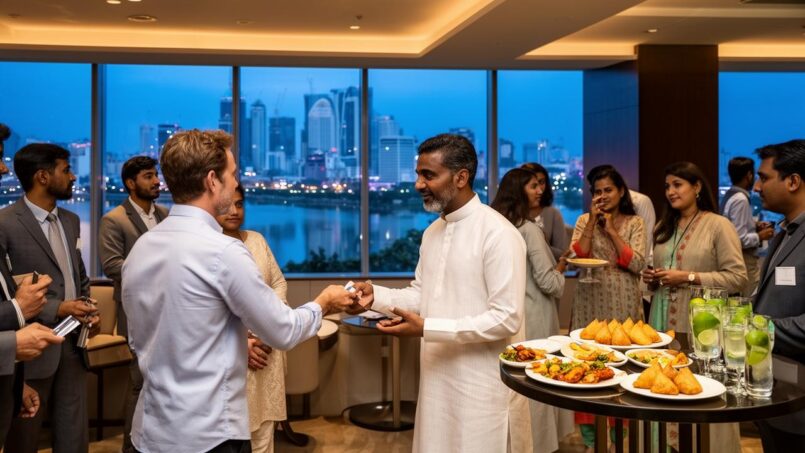
Professional and diplomatic events in Bangladesh are prime meeting points for expatriate managers, entrepreneurs, diplomats, and senior officials. To optimize networking, it is advisable to attend with regular administrative status, professional business cards, and a clear ‘storytelling’ explaining one’s goals and presence in the country. This approach allows for multiplying quality connections in a short time.
An important point: family visas (like the ‘FE’ visas linked to an E visa holder) do not authorize the spouse or children to work, even as volunteers for NGOs. If you are accompanying an expatriate spouse, you can network, but you will need to clarify the legal constraints on paid activity to avoid misunderstandings.
Decoding the Codes of Professional Meetings
In Bangladesh, networks are largely built through meetings, business meals, courtesy visits, and events. Presenting oneself correctly there becomes a genuine strategic tool.
Appointments should be scheduled in advance, avoiding the slot around midday prayer (around 1 PM) when many are absent, especially on Fridays. With the weekend falling on Friday-Saturday, it is more realistic to seek slots from Sunday to Thursday.
Although punctuality is expected from expatriates, it is common for their local counterparts to arrive late and accept interruptions during meetings (calls, signatures, visitors). These interruptions should not be interpreted as a lack of respect, as they are an integral part of local professional practices.
The beginning of meetings is often dedicated to lengthy small talk: health, family, children, origin, impressions of the country. This is where the personal connection is created. Appearing rushed, cutting these exchanges short, or immediately switching to numbers gives a cold image, not conducive to trust.
Business cards are given with the right hand, carefully. It is essential to read it attentively before putting it away in a case, as this gesture is a highly observed mark of respect in the professional sphere. Including your degrees or academic titles is appreciated, provided you remain humble in your speech.
Attire remains conservative: sober suit, closed shoes, clothing that is not flashy or tight-fitting. For women, sleeves at least to the elbow and skirts below the knee are appropriate in most contexts. Adapting one’s look to the hot climate without becoming too casual is often a balancing act.
Building Your Network Through Major Expatriate Communities
One of the simplest ways to start building a network in Bangladesh is to leverage the already structured expatriate communities. They play a role as a cultural airlock, a source of information, and a gateway to Bangladeshi circles.
The InterNations platform has an active community in Bangladesh, centered in Dhaka. It brings together more than ten thousand members, with regular meetups – about three events per month – and several thematic groups (gastronomy, culture, etc.). Its Dhaka group has over fourteen thousand people from more than 150 nationalities, an impressive pool for anyone wanting to meet professionals from all backgrounds.
Monthly meetups for expatriate professionals in Dhaka, allowing for exchanges on daily life and professional topics.
Practical exchanges on housing, schools, health, and settling in.
Advice on finding reliable lawyers, approaching chambers of commerce, and identifying key contacts by sector.
Meet professionals from NGOs, multinationals, embassies, education, tech, and industry.
For a newly arrived expatriate, attending allows them to: integrate into the local community, discover the culture, establish professional contacts, and share experiences with other expatriates.
– Understand ground realities beyond clichés.
– Quickly identify local ‘guides’, sometimes fellow countrymen already settled in.
– Obtain introductions to Bangladeshi decision-makers (via colleagues, spouses, suppliers).
– Test your professional pitch in a supportive environment.
Beyond InterNations, specialized networks exist, such as EO (Entrepreneurs’ Organization) for business leaders, or communities by profession (developers, agile practitioners, GitHub users, etc.). These more targeted circles are valuable for entering a specific sector.
Harnessing the Power of LinkedIn in the Bangladeshi Context
While face-to-face relationships remain privileged, Bangladesh is already well connected to global professional platforms. LinkedIn is gradually establishing itself as the digital extension of the physical network.
Millions of Bangladeshis are active there, including many local recruiters, managers, and entrepreneurs. This is particularly true in services, tech, consulting, and large export companies (textiles, IT, energy, etc.). Studies indicate that a very significant share of global B2B leads comes from LinkedIn, and the country is no exception.
To increase visibility among employers or partners in Bangladesh, it is essential to refine your profile by including a professional photo, a clear summary, and a list of skills adapted to the local market. Regularly publishing relevant content and leveraging multiple channels complements this strategy.
– Joining LinkedIn groups focused on Bangladesh (freelancers, start-ups, tech enthusiasts, marketing, etc.).
– Connecting with targeted professionals: HR heads of large groups, start-up founders, NGO managers, public institution executives.
– Personalizing each connection request by mentioning a common point or specific information about the country or sector.
– Commenting, sharing, and liking the content of local thought leaders to become visible without being intrusive.
For expatriate entrepreneurs or consultants, LinkedIn is an effective tool for identifying Bangladeshi investors, clients, or partners. Using premium tools like Sales Navigator, widely used in other contexts, can prove relevant for precisely targeting decision-makers by industry, company size, or function.
In the Bangladeshi context, where education is highly valued, highlighting degrees, certifications, and online training (for example via LinkedIn Learning) remains very effective, provided it is discussed with modesty.
Alumni, Diasporas, and Sectoral Networks: An Underutilized Resource
Bangladesh is experiencing an explosion in the number of graduates, but alumni networks are still unevenly structured. In the capital, some university departments or grandes écoles have active alumni associations, while many provincial institutions have no central structure.
For an expatriate, the network landscape in Bangladesh presents two main opportunities. First, there are international alumni networks (like those of Sweden, Australia, or the UK) that include Bangladeshis and can serve as a natural entry point. Second, the current lack of large-scale structuring of these networks leaves space for those who wish to catalyze or professionalize them.
Several associations are particularly dynamic:
Key networks that bring together graduates who have studied or worked abroad, fostering exchange and professional development.
Brings together former students, researchers, and professionals with experience in Sweden. Organizes thematic events related to sustainable development, innovation, and networking.
Federates recipients of Australian scholarships and serves as a bridge between alumni, Australian institutions, and Bangladeshi stakeholders. Hosts discussions on key themes like migration, climate, or social protection.
Groups targeting alumni of prestigious schools or specific departments, such as the Economics Department of the University of Dhaka.
For an expatriate, joining these networks – when an academic link exists – opens access to:
– Bangladeshi decision-makers trained abroad, more comfortable with international codes.
– Research, consulting, or project development collaborations.
– Positions or assignments circulated internally as a priority, before any public announcement.
Even without a direct academic link, participating as a speaker (conference, workshop, mentoring) at alumni events allows one to become visible and legitimate.
Mapping Tables: Key Communities and Organizations
To better understand the diversity of actors mentioned, here is a first table of some major communities useful for an expatriate in Bangladesh.
Main Expatriate Communities and Global Networks Present in Bangladesh
| Organization / platform | Type of network | Presence in Bangladesh / key data | Interest for the expatriate |
|---|---|---|---|
| InterNations (Dhaka community) | Global expatriate network | >10,000 members in Bangladesh; >14,000 members in the Dhaka group; 3 monthly events | First social and professional entry point, practical advice, meetups |
| EO – Entrepreneurs’ Organization | Global leaders network | Chapter in Dhaka | C‑level connections, start‑ups, investors |
| Connect Bangladesh | Global Bangladeshi diaspora network | Aims to mobilize expatriate expertise for the country’s development | Gateway to economic and intellectual elites |
| ExpatBD.org | Diaspora platform | Launched by Bangladeshi professionals on 4 continents | Structured link with the diaspora, information and connections |
| Bangladeshi Expat Network | Diaspora network | Community of Bangladeshi expatriates | Good relay for understanding local network logics |
Examples of Alumni Networks and Academic Associations
| Network / association | Primary target | Role in networking |
|---|---|---|
| Sweden Alumni Network Bangladesh | Alumni with an academic link to Sweden | Events, thematic projects, visibility with international actors |
| Australia Alumni Association Bangladesh | Alumni trained in Australia (scholarships, etc.) | Meetings, institutional links, bridges with ministries and agencies |
| Alumni networks (LUBS, ANU, etc.) | Graduates of foreign schools present in Dhaka | Dinners, seminars, ambassador groups, research and policy projects |
| Gradnet, Vaave (management platforms) | Local and global alumni associations | Digitization of address books, mentoring, targeted job offers |
Connecting with Bangladeshi Professional Networks
To get out of the expatriate bubble and build a network truly anchored in the country, it is essential to also frequent local professional structures: chambers of commerce, sectoral federations, IT clusters, etc.
Several actors structure economic life:
Main institutions that structure and energize the Bangladeshi digital ecosystem through events, training, and networking.
The Bangladesh Association of Software and Information Services federates IT companies and organizes major events like SoftExpo, outsourcing summits, and national ICT awards.
Organization that trains, raises awareness, and networks professionals in areas like software development, cybersecurity, data science, or AI.
Chambers (Dhaka, Chittagong, etc.) organize forums, fairs, trade missions, and workshops for the sector.
Participating in these gatherings offers massive exposure to sector actors, but also concrete opportunities to exchange with recruiters, service providers, regulators, and peers.
Major Trade Shows and Fairs: Large-Scale Networking
The Bangladeshi calendar is particularly rich in sectoral trade shows: textiles, energy, agri-food, health, construction, automotive, etc. For an expatriate, these are ideal places to establish dozens of contacts in a few days. Each major sector has its flagship event in Dhaka, attended by hundreds to thousands of visitors.
Some typical examples:
– Textile and machinery shows (DTG, DITATEX, etc.).
– Energy and equipment fairs (POWER Bangladesh, E‑POWER, BPLX…).
– Agri-food exhibitions, health, pharmaceutical, or medical tourism.
– Construction shows, wood, real estate, infrastructure.
Synthetic Examples of Major Trade Shows Useful for Networking
| Domain | Name of representative events | Networking interest for the expatriate |
|---|---|---|
| Textile & apparel | DTG, DITATEX, Bangladesh Denim Expo, BISMA | Supply chains, buyers, suppliers |
| Energy & infrastructure | POWER Bangladesh, E‑POWER, BPLX, BUILDEX, WATEREX | Public decision-makers, EPC contractors, equipment suppliers, investors |
| Agri & health | FOOD Bangladesh, AGRO Bangladesh, MEDITEX, Pharma Bangladesh, Health Tourism Expo | Hospitals, clinics, importers, distribution chains |
| Automotive & transport | Dhaka Motor Show, Dhaka Bike Show, Dhaka Auto Parts Show | Distributors, garages, logistics providers |
During these events, it is wise to:
– Prepare a clear objective (meet X types of actors, explore Y sectors).
– Identify priority exhibitors in advance.
– Set up on-site appointments via LinkedIn or email.
– Present oneself with an elevator pitch adapted to the sector.
Integrating into the Tech and Startup Ecosystem
For expatriates in tech, digital, or innovation, Bangladesh offers a booming environment, with its own hubs, communities, and programs.
Groups like Google Developer Group Dhaka, Women in Digital Bangladesh, or Startup Dhaka bring together thousands of developers, designers, marketers, entrepreneurs, and investors. They organize workshops, hackathons, conferences, pitch days, sectoral seminars.
Participation in these events allows for:
Key actions for identifying opportunities and maintaining an active presence in the local ecosystem.
Identifying and meeting local profiles (developers, UX, data) for future recruitment or collaboration.
Spotting start‑ups seeking mentors, capital, or strategic partners.
Maintaining a high level of monitoring on technologies and emerging models suited to the local context.
Organizations like CodersTrust train Bangladeshi freelancers for international platforms (Fiverr, Upwork, etc.), again fertile ground for spotting talent or building hybrid teams (expat + locals).
For female expatriates, networks led by Women in Digital Bangladesh, very active in training and promoting women, represent a valuable resource for overcoming some gender biases still present in the professional sphere.
Overcoming Language Barriers Without Losing Credibility
Even though a majority of urban professionals speak English, the official language is Bangla. Showing interest in it is a powerful signal of respect and a considerable relational asset. A few simple greetings (“As‑salamou aleikoum”, “Namaste” for some Hindus, “Dhonnobad” to thank) often make a difference in the welcome you receive.
As the education system has long favored grammar and translation, many professionals understand English but hesitate to speak it for fear of making mistakes. In meetings, it is advisable to use simple English, avoid complex jargon, rephrase, and regularly check for understanding. This approach avoids misunderstandings and demonstrates good will.
For the non-native English speaking expatriate, the same obstacles exist, multiplied. The key is to:
– Use visual aids (diagrams, slides, mockups).
– Identify people who can serve as a ‘linguistic bridge’ in the organization (bilingual assistants, young executives comfortable in English).
– Avoid correcting your counterparts’ language too directly, so as not to make them uncomfortable.
In some contexts, using an interpreter during complex workshops or negotiations is a good practice, even if English is used. This allows everyone to express themselves more nuancedly on legal, financial, or technical issues.
Concrete Strategies for Building a Strong Network
Once the framework is understood, how to move to action, in a structured way, when arriving in Bangladesh?
The first step is to map your targets: with whom do you really want to build a lasting relationship? One can distinguish, for example, five priority categories:
– Peers (expatriates in the same sector, local managers, entrepreneurs).
– Decision-makers (top management, regulators, senior officials).
– Connectors (well-connected individuals, community organizers, association presidents).
– Talent (promising young graduates, freelancers, technical experts).
– Facilitators (lawyers, consultants, placement agencies, reference employers).
From this map, you can build a simple but regular action plan, articulated around three axes: physical presence, digital presence, relational presence (follow-up).
Physical Presence: Being Where It Happens
Participating in sectoral events, joining a chamber of commerce, attending meet‑ups, accepting invitations for lunch or dinner are the basic building blocks. The goal is not to hand out cards en masse, but to collect a few qualified contacts each time and follow up with them in the following days.
Local culture favors in‑person meetings. Sharing a coffee, even without a specific purpose, is considered a long-term investment in the relationship. Being available, while knowing how to set boundaries, positions you as an accessible and appreciated person.
Digital Presence: Extending the Connection
Every meeting deserves to be followed by a personalized LinkedIn connection, recalling the context of the exchange. Regularly publishing content – experience feedback, reflections on your sector in relation to Bangladesh, highlighting successful collaborations with local partners – nourishes this network and gradually establishes you as a reliable reference.
Joining online groups (expatriates, tech, marketing, alumni) allows you to ask specific questions, share opportunities, and quickly identify influential people in a business sector.
Relational Presence: Maintaining and Giving
A network is built as much by what you give as by what you receive. Recommending a service provider, sharing a useful report, introducing two people who might work well together on a project, agreeing to participate in a panel or mentor a young graduate: all these actions create a reputation as a ‘resource’ in the ecosystem.
In Bangladesh, this reputation will circulate quickly, through the multiple micro-networks of family, academia, and profession. It is one of the best long-term investments for an expatriate who wants to go beyond a simple contract of a few years and leave a lasting mark.
Mentoring: A Discreet Network Accelerator
Global analyses on professional mentoring show that mentored individuals are far more likely to be promoted, feel satisfied with their work, and navigate complex environments successfully. In a country where access to information often flows through informal channels, having a local mentor is a major asset.
To find a Bangladeshi mentor in fields like IT, entrepreneurship, management, or marketing, you can turn to international mentoring platforms (MentorCruise, MicroMentor) or local/regional initiatives. Furthermore, some Bangladeshi structures, like incubators and accelerator programs, have their own mentor networks to support start‑ups.
For an expatriate, two avenues are particularly effective:
– Finding an experienced Bangladeshi mentor in your sector, who will help understand invisible lines of power, tacit codes, and pitfalls to avoid.
– Becoming a mentor yourself for young Bangladeshi professionals, which creates very strong bonds with the new generation of talent and, by ricochet, with their networks.
Much evidence shows that well‑designed mentoring increases confidence, clarifies professional expectations, and facilitates integration. In an environment where cultural misunderstandings can be frequent, this guidance is invaluable.
Synthesis: Transforming Complexity into Opportunity
Developing a professional network in Bangladesh, as an expatriate, is neither spontaneous nor immediate. The country combines a very relational culture, marked hierarchies, a constraining legal environment for foreigners, and a mosaic of communities, online and offline.
But the same characteristics that make this task demanding also make it a formidable career lever for those who engage seriously:
Loyalty and honor are paramount: a relationship of established trust is very strong. To develop your network, it is useful to use professional platforms (like LinkedIn) and expatriate communities. Alumni associations, chambers of commerce, trade shows, and tech communities also offer many opportunities for targeted meetings.
By combining a strong legal position (regular visa and permit), a nuanced understanding of cultural codes, smart use of digital tools, and regular presence in places where decision-makers meet, an expatriate can, within a few years, build a network in Bangladesh that is as dense as it is valuable.
This network doesn’t just serve to get one more job or contract: it becomes a capital of trust, mutual understanding, and cooperation, useful well beyond the duration of the expatriation. In a country in rapid transition, where the workforce, technology, and diaspora are driving forces, knowing how to insert oneself intelligently is undoubtedly one of the best international career investments.
Disclaimer: The information provided on this website is for informational purposes only and does not constitute financial, legal, or professional advice. We encourage you to consult qualified experts before making any investment, real estate, or expatriation decisions. Although we strive to maintain up-to-date and accurate information, we do not guarantee the completeness, accuracy, or timeliness of the proposed content. As investment and expatriation involve risks, we disclaim any liability for potential losses or damages arising from the use of this site. Your use of this site confirms your acceptance of these terms and your understanding of the associated risks.

Cyril Jarnias is an independent expert in international wealth management with over 20 years of experience. As an expatriate himself, he is dedicated to helping individuals and business leaders build, protect, and pass on their wealth with complete peace of mind.
On his website, cyriljarnias.com, he shares his expertise on international real estate, offshore company formation, and expatriation.
Thanks to his expertise, he offers sound advice to optimize his clients' wealth management. Cyril Jarnias is also recognized for his appearances in many prestigious media outlets such as BFM Business, les Français de l’étranger, Le Figaro, Les Echos, and Mieux vivre votre argent, where he shares his knowledge and know-how in wealth management.





