
 Published on and written by Cyril Jarnias
Moving to Bangladesh with your dog or cat is not just about booking an extra plane ticket. Between health requirements, administrative procedures, the reality of the tropical climate, and local social constraints, an expatriation project with a pet requires careful preparation well in advance, and in the right order.
This article provides a practical and detailed guide for organizing your pet’s arrival in Bangladesh, managing daily life there, and anticipating a potential return or move to another country.
Understanding the Legal and Health Framework
Expatriating a pet to Bangladesh involves complying with two distinct but complementary sets of rules: animal quarantine and import/export regulations, and the standard health requirements for any international travel for dogs and cats.
The country notably relies on the Bangladesh Animal and Animal Product Quarantine Act of 2005, which defines what constitutes an “animal” (all mammals except humans, birds, reptiles, certain aquatic animals, etc.), regulates quarantine, and specifies the powers of quarantine officers. Additionally, a more recent Animal Welfare Act aims to combat cruelty, although its enforcement remains fragile.
For an expatriate owner, it is impossible to import an animal without an import permit (NOC) and proper health documents. Authorities have extensive powers if the animal is deemed sick, contagious, or not meeting entry conditions.
Authorized Species and Specific Restrictions
Detailed rules primarily concern dogs and cats, including assistance or service dogs. Wolf hybrids, Savannahs, and Bengals are only accepted from the 5th generation removed from the wild ancestor, which must be provable through pedigree papers. For other animals (birds, rabbits, rodents, reptiles, amphibians, tropical fish), specific rules apply, sometimes requiring additional authorizations from the Forest Department or the Ministry of Environment, especially if the species is protected under CITES.
Bangladesh does not have an official list of banned dog breeds. However, owners are fully responsible for their pet’s behavior, including consequences in case of bites or any other safety-related issues.
The “Pet Passport” Principle for Bangladesh
When people talk about a “pet passport” for Bangladesh, it doesn’t refer to the official European passport, but rather a complete dossier of documents:
– International health certificate or export certificate issued by an approved veterinarian and then validated by the veterinary authority of the country of origin,
– Proof of vaccination, particularly against rabies,
– Proof of microchip identification,
– Import permit, called a No Objection Certificate (NOC), issued by the Department of Livestock Services (DLS),
– Possibly rabies titer test results, antiparasitic treatments, and other documents depending on the situation (high rabies risk country, avian influenza, CITES birds, etc.).
Everything must be ready before departure. Failure to comply with any step may result in quarantine, return of the animal to the country of origin, or, in extreme cases, euthanasia at the owner’s expense.
Before Departure: Preparing the Pet’s Health Dossier
The first recommended step is to start the process at least two months before the planned travel date. This allows time for vaccinations, obtaining certificates, sending documents to Bangladesh for the NOC application, and adjusting for any unforeseen issues (delays, errors, flight changes).
Microchip: A Non-Negotiable Requirement
Bangladesh requires dogs and cats to be identified by microchip. No other means of identification (tattoo, tag, paper record) is recognized.
The microchip must:
– Be 15 digits long,
– Comply with ISO standards 11784 or 11785 (Annex A),
– Be implanted before the rabies vaccination.
It is advisable to check with your veterinarian that the microchip is readable and compatible with standard ISO scanners. All official documents (health certificate, vaccination records, import permit) must clearly state the microchip number.
Rabies Vaccination and Other Essential Vaccines
Dogs and cats over three months old must be vaccinated against rabies to enter Bangladesh. The key points are strict:
The rabies vaccination for entry into the country must be administered no later than 12 months before arrival.
In practice, to avoid being in a gray area, many specialists recommend giving a “clean” annual booster within the correct timeframe, even if the animal is already covered by a multi-year vaccine.
Other vaccines are not legally required but are highly recommended, especially given the local health context:
– For dogs: distemper, hepatitis, leptospirosis, parvovirus,
– For cats: feline viral rhinotracheitis, panleukopenia, feline leukemia.
Ideally, these injections should be given at least two weeks before departure to allow time for the immune system to strengthen and for you to monitor any side effects before the trip.
Rabies Titer Test: Not Required, But Recommended
Bangladesh does not require a rabies titer test (blood test measuring rabies antibody levels) for import. However, it is advisable when the animal comes from a country classified as high-risk for rabies, or when you anticipate a future move to a country requiring this test.
The protocol recommends a blood draw more than 30 days after vaccination. Although not required for entry into Bangladesh, a positive result offers greater flexibility for a possible trip to another country from this territory classified as high-risk for rabies.
Antiparasitic Treatments
Bangladesh’s climatic conditions (heat, humidity, monsoon) create an ideal environment for parasites: fleas, ticks, intestinal worms, and sometimes heartworm depending on the area. It is therefore strongly recommended to administer before travel:
– An external treatment for fleas and ticks,
– An internal treatment for worms.
Before exporting an animal to Dhaka, antiparasitic treatments must be carried out with products approved in the country of origin, strictly following the dosage prescribed by the veterinarian. Information such as administration dates, types of products used, and the veterinarian’s signatures should be recorded, either on the official health certificate or on an annex sheet. A preliminary examination by the veterinarian to check for the absence of ticks or significant infestations is crucial to avoid complications or rejection during health inspection at the destination airport.
International Health Certificate
The health certificate is one of the pillars of the dossier. It must:
– Be completed by an approved veterinarian in the country of origin,
– Be issued shortly before departure (in international practice, often within 10 days before the flight),
– Include two original copies, which must then be officially endorsed (stamped, signed) by the competent veterinary authority (USDA in the United States, DDPP in France, etc.).
The document must detail: the objectives, the methods, the expected results, and the conclusion.
– The owner’s contact information,
– The country of departure and Bangladesh as the destination,
– The animal’s identity: species, breed, sex, age, color, microchip number,
– The vaccination history, especially rabies, and antiparasitic treatments,
– A statement that the animal shows no signs of contagious disease, does not come from a region under specific health restrictions, and is deemed fit for air transport.
For origins affected by avian influenza, an additional mention may be required, confirming that the animal (especially birds) was kept in home quarantine for 21 days before departure, without contact with infected animals.
Obtaining the Bangladeshi NOC: The Key to Entering the Country
Without a No Objection Certificate (NOC) issued by the Department of Livestock Services (DLS), no dog or cat can legally enter the territory. This is a temporary import permit that must be obtained in Bangladesh before the animal departs.
Where and How to Apply for the NOC
NOC applications are now made via the DLS web portal, accessible at www.dls.gov.bd. In practice, it is very difficult for an individual living abroad to obtain this document alone. Most often, a local agent, a relative on the ground, or a relocation company handles the application in Bangladesh.
The standard dossier includes:
To legally import your pet into France, you must submit a complete dossier including the following documents:
A formal letter addressed to the DLS (Department of Livestock Services) explaining the import request.
A copy of the official veterinary certificate, already endorsed and validated by the veterinary authorities of the animal’s country of origin.
Original documents or certified copies attesting to all up-to-date vaccinations for the animal.
A detailed description of the animal including its name, breed, color, sex, and age.
A recent, clear photo of the animal for identification purposes.
A copy of the valid passport of the animal’s owner.
The processing time is generally 5 to 6 working days for the DLS NOC. For animals imported as accompanied baggage, this NOC will suffice upon arrival. However, if the animal travels as unaccompanied cargo, an additional prior authorization from Bangladesh Customs is required, which takes an additional 4 to 5 working days.
The table below summarizes the main administrative deadlines related to the NOC and import/export authorizations:
| Procedure | Authority Concerned | Estimated Time |
|---|---|---|
| Import NOC (dogs/cats) | Department of Livestock Services (DLS) | 5 to 6 working days |
| Prior authorization for animals imported as cargo | Bangladesh Customs | 4 to 5 working days |
| Export NOC (taking an animal out of Bangladesh) | DLS | 5 to 6 working days |
| Additional NOC for diplomats (export) | Ministry of Foreign Affairs | 7 to 10 working days |
| Authorization from Office of the Chief Controller of Imports and Exports | Chief Controller of Imports and Exports | 3 to 4 working days |
Home Quarantine: An Obligation to Factor into Your Project
Even with a perfectly compliant dossier, authorities may impose a home quarantine upon arrival, lasting up to 21 days. In practice, for dogs and cats imported as pets, this isolation period takes place at the owner’s home, in the form of “in-house quarantine.”
The local agent submitting the NOC application must specify that the animal will be kept in quarantine at the owner’s home for at least 21 days after arrival. During this period, it is imperative to avoid contact with other animals, limit outings, and monitor for any abnormal clinical signs (fever, cough, neurological disorders, etc.).
If an abnormality is detected upon arrival at the airport, the Quarantine Officer may decide to order additional veterinary tests at the importer’s expense, or, if regulatory violations are serious, order quarantine in a public facility, return of the animal, or euthanasia.
Organizing the Trip: Choosing the Transport Option and Airline Constraints
The actual journey will depend on several parameters: chosen airline, animal size and weight, transport policy (cabin, hold, cargo), and most importantly, mandatory entry point.
All pets must enter or leave the country via Hazrat Shahjalal International Airport (HSIA) in Dhaka. No other airport, port, or land border is authorized for dogs and cats.
Accompanied Baggage vs. Cargo: Two Very Different Scenarios
An animal can travel:
– As accompanied baggage (checked baggage), on the same flight as its owner,
– As cargo, i.e., a separate shipment, sometimes via a specialized freight forwarder.
When the animal arrives as accompanied baggage, formalities in Dhaka are simpler: the owner presents the DLS NOC, the health certificate, the vaccination records, and handles the customs clearance with mandatory physical presence.
For animals shipped as unaccompanied cargo:
It is essential to notify a customs agent at least 30 working days before the scheduled arrival in Dhaka. The dossier must include the DLS NOC, the Bangladesh Customs authorization, and the Air Waybill. A copy of the latter must be sent to the agent at least 5 working days before landing.
Traveling with your pet on the same flight, as excess baggage, is generally the smoothest solution, when possible. But everything depends on the airlines serving your route and their pet policies.
Common Airline Rules and Requirements for the Travel Crate
Whether for baggage or cargo, most airlines apply IATA standards for transporting live animals. The crate (or kennel) must be:
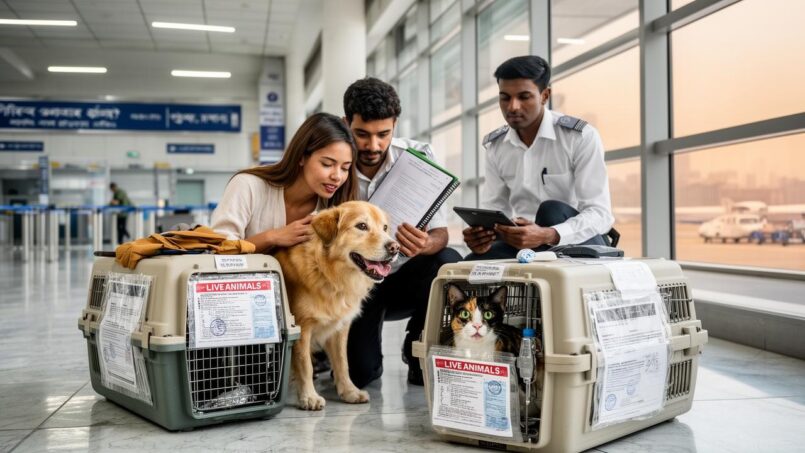
To be suitable for transporting an animal, a crate must be large enough for the animal to stand, turn around, and lie down comfortably. It must be sturdy, lockable, and well-ventilated. Inside, water bowls and possibly food bowls must be attached, but able to be filled from the outside. Finally, it must be labeled with the owner’s name and contact information, the animal’s name, and bear the words ‘LIVE ANIMAL’.
On many routes, the sum of dimensions (length + width + height) is capped at around 300 cm for the hold. However, each airline applies its own limits and may refuse a crate deemed too small or non-compliant.
Adding a familiar blanket or mat can help reassure the animal. It is advisable to stop feeding about 5 hours before departure, while maintaining access to water until check-in. The animal should be accustomed to its crate beforehand to reduce stress during a potentially long and hot flight.
Examples of Specific Airline Policies
Without being able to cover all airlines flying to Bangladesh, a few examples illustrate the differences in rules:
Qatar Airways accepts dogs and cats in the hold or as cargo (rates based on weight, 48-hour notice required), with service animals allowed in the cabin free of charge. Biman Bangladesh Airlines only accepts dogs and cats in the hold (flat fee USD 100, one animal per flight). American Airlines, used for transatlantic connections, imposes strict restrictions for the hold (reserved for military personnel, mandatory health certificates) and a temperature limit of 29.4°C for the entire itinerary, a crucial criterion for travel to Bangladesh.
Brachycephalic breeds (dogs and cats with flat faces) are also subject to restrictions on many airlines, due to the increased risk of heatstroke and respiratory distress in the cargo hold. Before booking your ticket, it is essential to check the current policies of each airline, reserve the “pet” spot well in advance (quotas per flight are often very limited), and reconfirm 2 or 3 days before departure.
Arrival in Dhaka: Checks, Quarantine, and First Steps
Upon arrival at Hazrat Shahjalal International Airport, all animals go through the animal quarantine service check. A dedicated station, the Livestock Quarantine Station, is operational on-site and coordinates inspections and formalities.
The owner must present themselves with:
– The original DLS NOC,
– The original health certificate and vaccination certificates,
– Any additional documents required depending on the situation (isolation certificate in case of avian influenza in the country of origin, customs authorization, etc.).
The animal is briefly examined to check for signs of diseases transmissible to humans. If there is serious doubt about its health status, additional tests may be ordered at the importer’s expense. Once formalities are completed, the animal is returned to its owner, with a possible mention of a 21-day home quarantine.
Living with a Pet in Bangladesh: Cultural Realities and Daily Constraints
Getting entry authorization is only the first step. Settling in Bangladesh with a dog or cat involves dealing with a demanding climatic environment, an unevenly distributed veterinary system, and sometimes hostile social attitudes, especially towards dogs.
Tropical Climate, Heatwaves, and Risks to Animal Health
The country experiences often extreme heat, with temperatures sometimes exceeding 40 °C, very high humidity, monsoon episodes, and cyclones. For animals, the main risks are:
– Dehydration,
– Heatstroke,
– Proliferation of parasites (ticks, fleas),
– Infectious diseases (rabies, parvovirus, distemper, feline panleukopenia).
To adapt your companion to this climate:
– It must have constant access to fresh, clean water; terracotta bowls, which stay cooler, are often recommended,
– Walks during the hottest hours should be avoided; it’s better to prioritize early morning and late evening,
– The interior of the home must be adequately ventilated; sensible use of air conditioning, combined with blackout curtains and good air circulation, will help maintain a tolerable temperature without thermal shock,
– Outdoor surfaces (asphalt, concrete) can burn paw pads: a hand test on the ground for a few seconds provides a good indication.
Heat and humidity promote skin conditions: hot spots, fungal infections, allergic dermatitis, massive flea or tick infestations. Regular grooming (brushing, cleaning fur and bedding) and year-round antiparasitics are a top priority defense.
Access to Veterinary Care: Strong Disparity Between Dhaka and Other Regions
The Bangladeshi veterinary landscape is marked by a sharp contrast between major cities, especially Dhaka, and rural or peri-urban areas.
In Dhaka, you can find:
Different types of facilities and services for animal health, ranging from public clinics to emergency and teleconsultation services.
Such as the Central Veterinary Hospital (with several branches in the city), generally offering more affordable rates.
Often more modern and better equipped for diagnostics, surgery, and imaging.
Emergency services and platforms like SUSTHOTAA TeleVet, accessible 24/7 for advice and prescriptions, with a network of partner clinics.
Outside the capital, several centers exist in major cities (Chattogram, Sylhet, Khulna, Rajshahi, Barishal, etc.), but access becomes more difficult the further one gets from major urban centers. According to a study, 68% of respondents cited lack of transportation as a major barrier to accessing care, and 56% considered local veterinary infrastructure insufficient. This perception worsens significantly in rural areas, where 75% of respondents described clinics as poorly equipped, compared to only 40% in urban areas.
For an expatriate with a pet, settling in Dhaka or a large metropolitan area greatly facilitates access to care. The following table summarizes some figures from this study on logistical and financial barriers:
| Type of Barrier | Percentage of Respondents Affected | Comment |
|---|---|---|
| Lack of transportation | 68% | 80% in rural/suburban areas |
| Difficulty catching animals (strays, etc.) | 47% | Mainly impacts stray dogs |
| Veterinary infrastructure deemed insufficient | 56% | 75% rural vs 40% urban |
| High cost of veterinary services | 45% | Significant financial barrier |
| Lack of public subsidies | 38% | Reinforces access inequalities |
Even though these figures largely concern stray animals, they reflect the overall reality of the system, upon which pets also depend.
Choosing a Veterinarian in Dhaka
In the capital, several dozen clinics have specialized in dogs, cats, and exotic pets. Some, like Gulshan Pet Animal Clinic, Dr. Sagir’s Pet Clinic & Research Center, or Veterinary Specialized Hospital & Diagnostic Center, are renowned for their modern equipment and ability to handle complex surgeries or emergencies. Other public facilities like the Central Veterinary Hospital offer basic procedures (vaccinations, routine care) at lower rates.
Common advice given to owners for choosing a veterinarian in Dhaka is pragmatic:
To select the right veterinary clinic, first clarify your main needs (preventive care, surgery, 24/7 emergencies, etc.). Then check the opening hours and availability of an emergency or on-call service. Inquire about available equipment (X-ray, ultrasound, laboratory), which is essential in case of serious illness. Also compare costs based on your expatriate budget. Finally, read reviews and talk to other pet owners, especially through the many Facebook and WhatsApp groups for ‘animal lovers’.
For situations where traveling to a clinic is difficult (heavy traffic, lack of vehicle, highly stressed animal), services like SUSTHOTAA TeleVet allow for an initial remote assessment, 24/7, for a moderate flat fee, and can guide you to a hospital or even arrange an animal ambulance in an emergency.
Local Culture and Perception of Pets
The social environment is an often underestimated aspect for expatriates with pets, especially if they come from countries where dogs are widely accepted in public spaces. In Bangladesh, dogs in particular remain surrounded by a strong stigma, for at least two reasons:
– A traditionally utilitarian view of animals, long focused on livestock and working animals rather than life companions,
– A religious dimension: certain interpretations of Islam consider the dog impure (haram or najis), especially indoors.
Concretely, this means:
– It is very difficult to find rental housing that accepts dogs, especially in apartment buildings in Dhaka, where condominium regulations often prohibit keeping them in apartments,
– That parks and green spaces where dogs are tolerated are extremely rare; Zinda Park, in the Narayanganj district, is cited as one of the very few sites accepting dogs,
– That fear of zoonoses (rabies, parasites) is very present, and dog owners may be perceived as “dirty” by some neighbors.
Cats benefit from greater social tolerance, partly because they can live indoors without direct contact with neighbors and public spaces. Consequently, they are generally more popular as pets than dogs.
In affluent neighborhoods of major cities like Dhaka (Gulshan, Banani, etc.), a ‘pet friendly’ culture is rapidly developing, marked by the opening of modern veterinary clinics, pet accessory stores, and specialized services. This evolution, influenced by Western models and social media, is accompanied by the emergence of online owner communities. These groups organize events and actively advocate for animal welfare, notably by opposing stray dog culling campaigns.
Housing: Between Rental Constraints and “Pet-Friendly” Options
Expatriates often face a paradox: Dhaka’s urban lifestyle, with its modern and secure buildings, suits an indoor cat well, but building regulations are frequently hostile to animals, especially dogs. The search for a “pet-friendly” apartment must therefore be integrated very early into the project.
Platforms like Airbnb or Tripadvisor list hundreds of tourist rentals in Dhaka that accept animals. For example, approximately 510 “pet-friendly” accommodations are listed for Dhaka, a large majority with WiFi, some with a pool, dedicated workspaces, etc. In the Mirpur area, about forty properties advertise accepting animals, all with internet access, which directly interests remote workers or families in housing transition.
Even though these accommodations are designed for temporary stays, they often offer an intermediate solution upon arrival, while finding a long-term lease with a landlord willing to accept your companion. Using local real estate agents and clearly stating the presence of an animal, along with a willingness to follow strict hygiene rules, remains essential to minimize unpleasant surprises.
For periods of absence (business travel, return home, regional trips), boarding facilities like Furryghor Foster Home, with branches in Mirpur and Gulshan, provide 24/7 care and supervision. The organization there is quite strict (no mixing animals from different households, limit of three cats per cabin, food provided by the owner, etc.), which helps reduce health and behavioral risks.
Feeding Your Pet: Availability of Food and Local Supply Chain
The question of diet is crucial in a context where many Bangladeshi families still feed their animals, especially dogs, table scraps (rice, curry, milk), an inappropriate diet that exposes them to deficiencies, digestive problems, and metabolic diseases.
For expatriates, the good news is that the pet food market has exploded in recent years. Several importers and distributors have established themselves:
Companies like 3S Impex BD or Birds Palace import and distribute dozens of international brands (Royal Canin, SmartHeart, Purina, Reflex, etc.) to over 500 points of sale across the country. Meanwhile, many online stores (PriyoPets, Amarpet, Pet Zone BD, PraniZone, Poshaprani, etc.) deliver kibble, wet food, litter, and supplements, often within 24 to 48 hours in major cities.
Thus, it is possible to maintain a high-quality diet, similar to what the animal ate in its country of origin, provided you anticipate stock levels to avoid shortages during the monsoon or periods of high demand.
The table below illustrates the type of products and services an owner can find locally:
| Type of Service / Product | Concrete Examples in Bangladesh | Relevance for the Expatriate |
|---|---|---|
| Pet food importers | Birds Palace (70% of imports), 3S Impex BD | Wide choice of international brands |
| Online stores | PriyoPets, Amarpet, Pet Zone BD, PraniZone, Poshaprani | Home delivery in 24–48 h (Dhaka…) |
| Product range | Kibble, wet food, litter, supplements, treats, accessories | Allows maintaining a stable diet |
| Regional delivery | Service announced to Dhaka, Chattogram, Sylhet, Rajshahi, etc. | Supply possible outside the capital |
Beyond availability, the key is to choose appropriate food (age, size, possible conditions) and avoid the pitfall of human food scraps, which are too fatty, salty, or spicy for dogs and cats, especially in a climate that already stresses their bodies.
Anticipating Emergencies and Major Health Risks
Bangladesh remains a country with a very high rabies endemic, with several thousand estimated human deaths each year, the vast majority linked to dog bites. Similarly, risks of natural disasters (floods, cyclones) are high. An emergency plan for your pet is therefore essential.
This plan should include:
To ensure your pet’s safety in a crisis situation, prepare a specific kit. This should include: a leash, harness, and travel crate; several days’ supply of food and water; its usual medications and a copy of its veterinary documents. Also ensure its essential vaccinations (rabies, parvovirus, distemper, panleukopenia, etc.) are up to date and that it is clearly identified (microchip, collar with tag and local contact info). Finally, establish a list of potential accommodation facilities in case of evacuation: pet-friendly hotels, friends, veterinary clinics with kennels or boarding facilities.
Local animal welfare organizations (PAW Foundation, Obhoyaronno, Care for Paws, etc.) play an important role in caring for stray animals and in some disaster relief efforts. For an expatriate, learning about these structures in advance and possibly building relationships with them can provide an additional safety net.
Planning for the Future: Leaving Bangladesh with Your Pet
Many expatriates will only spend a few years in Bangladesh. Paradoxically, exporting a pet from the country can be even more complex than bringing it in.
The exit process requires:
– An export NOC from the Department of Livestock Services (5 to 6 working days processing time),
– For employees of foreign embassies, an additional NOC from the Ministry of Foreign Affairs (7 to 10 days),
– An authorization from the Office of the Chief Controller of Imports and Exports (3 to 4 days),
– Customs formalities (1 to 2 days),
– An up-to-date health certificate and vaccinations, tailored to the destination country’s requirements.
Only a few airlines accept animals as cargo from Bangladesh. Organizing the transport generally requires using a specialized freight forwarder or relocation company (such as Homebound, Pet Service BD, or IPATA member providers).
– Booking the appropriate flight,
– Ensuring the travel crate is compliant,
– Collecting the animal from the home,
– Preparing and submitting a complete dossier to all relevant administrations.
Planning should ideally begin several months before the planned departure date, especially if the final destination applies stricter rules (European Union, United Kingdom, Australia, New Zealand, etc.) sometimes involving mandatory rabies titer testing, quarantine stays, or breed restrictions.
In Summary: Successfully Expatriating with a Pet to Bangladesh
Expatriating a dog or cat to Bangladesh is entirely possible, provided you:
For a successful move with your pet to Bangladesh, strictly follow the administrative sequence: microchip identification, rabies vaccination within the required timeframe, veterinary health certificate, then official endorsement of documents, application for an NOC (No Objection Certificate) from the Bangladeshi authorities, and, if necessary, obtaining a customs authorization for cargo. Anticipate non-negotiable administrative delays: allow 5 to 6 working days for the NOC and 4 to 5 days for cargo authorizations. Carefully choose the airline and mode of transport (accompanied baggage or cargo), taking into account the climate, possible breed restrictions, and cabin or hold temperatures. Physically prepare the animal for travel: get it used to its travel crate, administer required antiparasitic treatments, and do a complete veterinary check-up before departure. Integrate social and housing constraints from the start: very few rentals accept dogs, “dog friendly” parks are rare, and part of the population may be wary. Take advantage of the assets of major cities like Dhaka, where the network of veterinary clinics is growing, tele-consultation is available, and food/accessories are increasingly accessible through specialized platforms. Finally, plan for a future departure: as Bangladesh is classified as a high-risk country for rabies, exporting to some countries may require prior serological titer testing (blood test) several months in advance.
Methodical preparation, supported if necessary by pet transport professionals and local resources (veterinarians, associations, owner networks), can transform an initially daunting operation into a manageable project. In a demanding climatic and social context, your vigilance and ability to anticipate will remain the best guarantees to provide your companion with a comfortable and safe life in Bangladesh.
Disclaimer: The information provided on this website is for informational purposes only and does not constitute financial, legal, or professional advice. We encourage you to consult qualified experts before making any investment, real estate, or expatriation decisions. Although we strive to maintain up-to-date and accurate information, we do not guarantee the completeness, accuracy, or timeliness of the proposed content. As investment and expatriation involve risks, we disclaim any liability for potential losses or damages arising from the use of this site. Your use of this site confirms your acceptance of these terms and your understanding of the associated risks.

Cyril Jarnias is an independent expert in international wealth management with over 20 years of experience. As an expatriate himself, he is dedicated to helping individuals and business leaders build, protect, and pass on their wealth with complete peace of mind.
On his website, cyriljarnias.com, he shares his expertise on international real estate, offshore company formation, and expatriation.
Thanks to his expertise, he offers sound advice to optimize his clients' wealth management. Cyril Jarnias is also recognized for his appearances in many prestigious media outlets such as BFM Business, les Français de l’étranger, Le Figaro, Les Echos, and Mieux vivre votre argent, where he shares his knowledge and know-how in wealth management.





