
 Published on and written by Cyril Jarnias
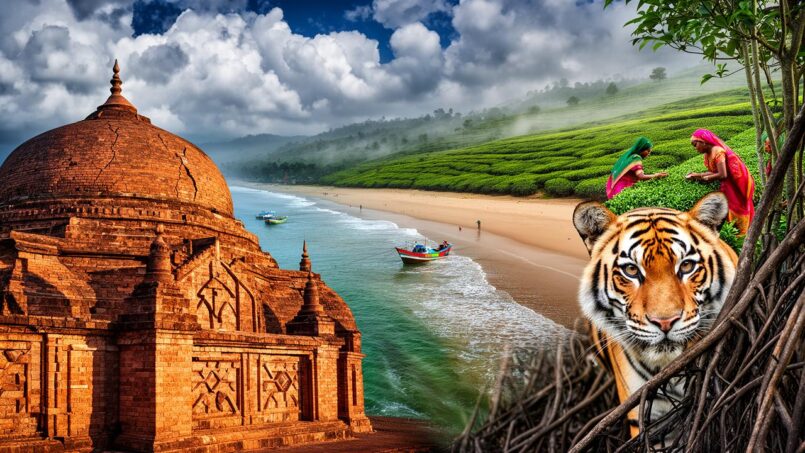
Long relegated to the sidelines of major Asian circuits, Bangladesh nonetheless boasts an exceptional density of natural, historical, and cultural sites. Between the world’s largest delta, a unique mangrove ecosystem, endless beaches, medieval cities swallowed by the jungle, and an extraordinarily rich Islamic, Hindu, and Buddhist heritage, the country offers a concentrated dose of South Asia without the crowds of its neighboring destinations.
This guide selects the main tourist sites of Bangladesh based on solid criteria: archaeological research, UNESCO classification, and historical significance. It aims to explain the meaning of these places, what they reveal about the country’s history, and provides practical tips for visiting them under the best conditions.
Understanding the Framework: Climate, Seasons and Type of Travel
Before diving into the details of the sites, it’s essential to grasp two structuring parameters: the climate and the still relatively unmassified nature of tourism.
Bangladesh experiences three distinct climatic periods. From March to May, temperatures can exceed 40 °C (104 °F), making daytime visits to urban or archaeological sites very tiring. From June to September, the monsoon brings heavy rainfall, sometimes floods, and can make some sites difficult to access, despite the beauty of the lush green countryside. The ideal period extends from October to February, with pleasant temperatures (15 to 25 °C / 59 to 77 °F), sunny days, and cool nights, offering the best conditions to explore the entire country, from the ruins of Paharpur to the beaches of Cox’s Bazar and the forests of the Sundarbans.
To get a more precise idea, just look at Dhaka, which gives a general trend for central Bangladesh:
| Month | Min. Temp. (°C) | Max. Temp. (°C) | Avg. Rainfall (mm) |
|---|---|---|---|
| January | 13 | 25 | 7 |
| February | 16 | 28 | 25 |
| March | 20 | 32 | 65 |
| April | 24 | 34 | 155 |
| May | 25 | 33 | 340 |
| June | 26 | 32 | 335 |
| July | 26 | 31 | 375 |
| August | 26 | 32 | 315 |
| September | 26 | 32 | 315 |
| October | 24 | 32 | 175 |
| November | 19 | 30 | 35 |
| December | 14 | 26 | 15 |
Tourism is still at a relatively early stage: infrastructure is improving, but the influx of international visitors remains limited. This means two things for the traveler: on the one hand, the possibility of discovering major sites almost alone; on the other, the need to accept an element of unpredictability, especially on the roads or river routes.
The Three UNESCO Highlights: Paharpur, Bagerhat, and the Sundarbans
Bangladesh has three sites inscribed on the UNESCO World Heritage List: two cultural, one natural. They are essential landmarks for grasping the historical and ecological depth of the country.
The Ruins of the Buddhist Monastery at Paharpur
In the northwest, in the Naogaon district, the village of Paharpur houses one of the most impressive vestiges of Buddhist Asia: the Somapura Mahavihara. Identified thanks to clay seals bearing its name, this vast monastery was erected under the reign of the Pala ruler Dharmapala, between the late 8th and early 9th century. It is often compared to Nalanda in India, with which it shares its scale and intellectual influence.
The complex appears as a vast quadrangle over 900 feet per side, about 27 acres, encircled by massive brick walls about five meters thick and twelve feet high. Along the edge of this large courtyard, 177 monastic cells are aligned on four sides, with a very regular distribution: forty-five on the north, forty-four on each of the other three sides. At the center, a cruciform, pyramidal, and soaring temple dominates the whole, surrounded by a constellation of small votive stupas and chapels.
Excavations, begun in the 19th century by Alexander Cunningham and systematized from 1923, have uncovered a multitude of objects that flesh out monastic life: terracotta plaques, decorated bricks, pottery, coins, inscriptions, bronze figures of Hindu and Jain deities, architectural fragments. More than 2,000 terracotta plaques adorned the temple walls, of which about 800 are now cataloged. The site museum, opened in the 1950s, and the Varendra Research Museum in Rajshahi preserve part of this corpus, allowing an understanding of how the Buddhist art of Somapura influenced religious architecture as far away as Burma and Java.
The year the Paharpur site was inscribed on the UNESCO World Heritage list, recognized as the largest Buddhist vihara south of the Himalayas.
For a traveler, the visit is as much about archaeological exploration as it is about wandering through a landscape. The cruciform structure of the central temple, the corridors of patinaed brick cells, the terracotta bas-reliefs depicting mythological scenes and daily life compose an experience very different from the great reconstructed temples elsewhere in Asia: here, it is the ruin that speaks.
The Historic Mosque City of Bagerhat
At the other end of the country, near the Sundarbans mangrove, stands another UNESCO-listed gem: the historic city of Bagerhat, founded in the 15th century by a Turkish military commander and mystic, Ulugh Khan Jahan, locally known as Khan Jahan Ali. At the confluence of branches of the Ganges and Brahmaputra, this city, then called Khalifatabad, was planned as a model Islamic city, entirely built of fired brick.
More than 300 religious and civil structures are recorded here: mosques, bridges, water reservoirs, mausoleums, public buildings. The most famous, the Shat Gombuj Masjid, literally “Sixty Dome Mosque,” actually has sixty pillars supporting seventy-seven domes. This vast volume, punctuated by rows of columns and subtle openings in the thick walls, perfectly illustrates how Islamic architecture adapted to the climate here, combining natural ventilation, diffused light, and robustness against cyclones.
Another important building is the tomb of Khan Jahan himself, located on the edge of a large body of water. After the death of its founder, the city was gradually swallowed by the jungle before being rediscovered and cleared. Recent restoration work, combined with nighttime lighting, now makes it possible to understand its original urban layout: a series of religious and civic hubs connected by embankments and basins.
To gauge the significance of Bagerhat in regional Islamic heritage, one need only compare it to other mosque-palace complexes of South Asia. Where Delhi or Lahore are now sprawling metropolises, Bagerhat offers the rarer image of a frozen medieval city, almost entirely dedicated to religious architecture, set in a green and watery setting.
The Sundarbans, the Largest Mangrove Forest in the World
Between Bagerhat and the Bay of Bengal, the Sundarbans unfold its 10,000 km² of amphibious forests, of which about 6,000 km² are on the Bangladeshi side. It is both the largest mangrove massif on the planet, a Ramsar wetland of international importance, and a UNESCO natural site. Its geography is unique: a labyrinth of tidal channels, mudflats, forested islands, subject to the mixed flows of the fresh waters of the Ganges, the Brahmaputra, and the Meghna, and the salt waters of the Bay of Bengal.
Its name comes from the dominant tree, the sundari (Heritiera fomes), but the flora includes more than 300 plant species, including various mangroves, Nipa Palm, Baen (Avicennia marina), native hibiscus, and fruit-bearing mangroves like Keora. This vegetation plays a major protective role against erosion, cyclones, and tsunamis, while storing significant amounts of carbon.
The region is home to the only mangrove habitat in the world for the Bengal tiger (over a hundred in the Bangladeshi part), as well as a great diversity of fauna including deer, saltwater crocodiles, Irrawaddy and Ganges river dolphins, and more than 260 bird species.
Access to this amphibious world is primarily through the cities of Khulna and Mongla. From Dhaka, you first reach Khulna or Jessore by bus, train, or plane, then travel to Mongla in two to three hours by road. From there, only authorized boats, chartered through agencies or ecotourism operators, can enter the forest, with permits issued by the Forest Department. Independent travel without an accredited guide is prohibited, both for safety and preservation reasons.
Classic tours lead to well-identified areas: Kotka, known for its beach and as a prime tiger area; Kochikhali and Harbaria, offering mangrove walks and good chances to observe deer and monkeys; Dobanki, where an elevated walkway allows walking above the canopy; Hiron Point, popular with birdwatchers; or the Karamjal center, where a deer breeding farm and crocodile pool also serve as an interpretation space for visitors.
A large part of the journey takes place on small boats or multi-day river cruise boats, which serve as both means of transport and accommodation. It is also an opportunity to approach the culture of forest communities, such as honey collectors (Mawali), whose stories are heavily marked by the figure of the forest goddess, Bonbibi.
The Sundarbans well illustrates the link between tourism and conservation. Classified as an ecologically critical area by the government, it is the subject of anti-poaching programs and ecotourism projects led by NGOs, which seek to convert exploitation pressure into a source of sustainable income for local populations. For the traveler, the challenge is simple: choose operators that employ local guides, minimize waste, avoid plastic, and strictly respect distance from wildlife.
Cox’s Bazar and the Shores of the Bay of Bengal
If the Sundarbans is the realm of mangroves, Cox’s Bazar is the realm of beaches. This southern city, nestled against the Chittagong hills and facing the Bay of Bengal, boasts what many present as the longest natural uninterrupted beach in the world: about 120 km (75 miles) of golden sand facing the ocean.
A Mosaic of Beaches and Viewpoints
Far from being a uniform strip, the coastline of Cox’s Bazar is divided into distinct sections, each with its own atmosphere.
Around the city, Laboni Point and Kolatoli Point concentrate most of the activity: here you’ll find modern hotels, seafood restaurants, snack stalls, horse rentals, beach scooter rentals, jet ski and parasailing operators. Laboni is a good spot to observe the local crowd, with thousands of Bangladeshis coming with their families to enjoy the sunset, while keeping in mind the conservative dress culture: one-piece swimsuits and cover-ups are the norm.
A coastal route south of Cox’s Bazar, offering spectacular views of the sea and wooded hills, and serving several beaches and points of interest.
A very popular beach, easily accessible from the scenic road.
A site where hills meet the sea, known for paragliding.
A long beach lined with hotels and famous for its black and green corals, particularly visible during the wet season.
Beyond, toward Teknaf, the coast becomes wilder. The beach at Teknaf itself is fringed with mangroves, and several coves like Shamlapur, Shilakhali, or Hajampara offer almost deserted landscapes, where only a few fishing boats break the horizon line.
For orientation, here is a schematic overview of the main sections of the Cox’s Bazar coastline:
| Sector | Main Characteristics |
|---|---|
| Laboni Point | Central, lively beach, water sports, market |
| Kolatoli Point | Major hotel area, departure point for many excursions |
| Sugondha Beach | Very crowded beach, Burmese market, souvenir shops |
| Himchari | National park, seasonal waterfall, coastal viewpoint |
| Darianagar | Hills and beach, paragliding site |
| Inani Beach | Longer, quieter beach, visible corals, hotels set back |
| Teknaf and surroundings | Mangrove-fringed beaches, wilder atmosphere |
Activities Between Sea, Hills, and Markets
Cox’s Bazar is one of the few sites in the country offering such a broad range of beach activities: horseback riding, cycling on the hard-packed sand, surfing (with lessons available), two-person jet skis, kayaking, swimming, walking along the cliffs. Paragliding over Darianagar or Himchari offers a stunning view of the coastline, with flights of about ten minutes that capture the dizzying length of the beach.
Inland, Himchari National Park provides a good introduction to the subtropical biodiversity of the Chittagong Hill Tracts: forest trails, seasonal waterfall, viewpoints over the bay. Other curiosities dot the road, such as the large golden reclining Buddha at Vimukti Bibeshan Bhabna Kendra or the Radiant Fish World aquarium, designed as both a fun and educational space on marine life.
Himchari National Park and roadside curiosities
On the cultural and shopping side, the Burmese Market at Sugondha and the bazaars of Cox’s Bazar allow you to discover handicrafts, textiles, costume jewelry, spices, and seaside products. Haggling is part of the game.
The best time to enjoy Cox’s Bazar without suffering the torrential rains remains the dry season, from November to March, which also coincides with the high season for other sites in the country.
Dhaka, Capital of Contrasts and Showcase of Built Heritage
To engage with Bangladesh without passing through Dhaka would be to deprive yourself of an essential key to reading the country. Located on the banks of the Buriganga, this megacity of over twenty million inhabitants concentrates some of the densest historical ensembles in the region, spanning nearly five centuries, from the Bengal Sultanate to modernist architecture.
Fortresses and Palaces from the Mughal and Colonial Eras
In the heart of the old city, Lalbagh Fort best embodies the imperial Mughal ambition in Bengal. Begun in 1678 by Prince Muhammad Azam Shah, son of Emperor Aurangzeb, the fort was never completed, partly due to the death of Pari Bibi, daughter of Governor Shaista Khan, whose white marble tomb is today one of the most remarkable elements of the site. The complex also includes a mosque, a hammam-audience hall (Diwan-i-Aam), and a network of geometric gardens punctuated by pools and channels.
Further north, on the same riverbank, Ahsan Manzil, nicknamed the Pink Palace, tells another era: that of the nawabs of Dhaka and the British Raj. Built in the 19th century in an Indo-Saracenic style, with its symmetrical pink facade topped by a dome, it was the residence of the city’s Muslim elite before becoming, after independence, a national museum. Inside, about twenty rooms reconstruct the material and political world of this aristocracy: furniture, photographs, weapons, everyday objects.
The ancient urban fabric is also marked by a series of remarkable Mughal mosques, often built by governors or dignitaries: Sat Gambuj in Mohammadpur, literally “seven domes,” still dominating a landscape of ponds and gardens; Khan Mohammad Mridha Masjid in Lalbagh, set on a raised platform; Kartalab Khan Mosque, with its rare stepwell (baoli), unique in Bengal; or the very old Binat Bibi Mosque in Narinda, whose foundation dates back to the 15th century.
The Bangladeshi capital houses several historic places of worship illustrating its religious diversity, including the Dhakeshwari Hindu temple (considered the national temple), the Rajarbagh Kali Temple (dating from the 18th century), the Armenian Church of Armanitola (erected in 1781), and the Nanak Shahi Gurdwara, associated with the first Sikh missions in the region.
National Memory and Architectural Modernity
Dhaka is not limited, however, to its precolonial layers. The city also bears the strong mark of the language struggle and independence. The Shaheed Minar, a monument dedicated to the martyrs of the 1952 Language Movement, and the Liberation War Museum, which documents the 1971 war, offer a poignant dual narrative, one symbolic, the other museographic, of the birth of Bangladesh.
The Jatiya Sangsad Bhaban, designed by American architect Louis Kahn, is a major monument of modern architecture. This building of raw concrete and marble is distinguished by its perforated geometric volumes and interior plays of light. The parliamentary complex, which also includes housing for MPs, a hospital, and other public buildings by the same architect, forms a rare example of coherent and monumental urban planning on the outskirts.
In another register, the works of Bangladeshi architect Muzharul Islam, such as the Institute of Fine Arts at Dhaka University or the central library, are now recognized by UNESCO on the Tentative List as a representative ensemble of modernism adapted to the tropics, playing with shadows, natural ventilation, and interior courtyards.
For a visitor, Dhaka is an intense immersion, sometimes exhausting, but extraordinarily rich. The trick is to combine deep dives into the chaos of Sadarghat or Chowk Bazar with stops in parks (Ramna Park, National Botanical Garden) or museums (National Museum, Varendra Research Museum in Rajshahi during a visit to the west).
The Great Archaeological Plains: Mahasthangarh, Mainamati, and Wari-Bateshwar
Beyond Paharpur, the subsoil of Bangladesh holds countless traces of ancient cities, many still partially excavated. Several sites nevertheless stand out for their scientific significance and interest for the curious visitor.
Mahasthangarh, the Oldest Known City in the Country
North of Bogra, on the western bank of the Karatoa, Mahasthangarh dominates the rice paddies with its earthen ramparts. This vast oblong enclosure about 1.5 km north-south by 1 km east-west, perched fifteen meters above the fields, corresponds to the ancient Pundranagara, capital of the Pundra kingdom. Research has revealed continuous occupation from the 4th century BCE to the Middle Ages.
A limestone plaque bearing an inscription in Prakrit, written in Brahmi script and dated to the 3rd century BCE, records a land grant, probably under a Mauryan king, possibly Ashoka. This discovery anchored the site in the political fabric of ancient India: Pundranagara served as a provincial capital for several major dynasties, including the Mauryas, Guptas, and later Palas and Senas.
Around the Mahasthangarh citadel, within a radius of five miles, are numerous mounds with evocative names like Govinda Bhita, Bairagir Bhita, Mankalir Dhap, Parasuramer Basgriha, Skandher Dhap, and Gokul Medh. Targeted excavations at these sites have revealed Hindu temples, Buddhist monasteries, and palatial structures. These discoveries testify to a cultural sequence covering seven major historical periods, from the pre-Mauryan era to the Muslim period.
The collections of the Mahasthangarh museum include Buddhist stone and bronze sculptures, coins (from punch-marked coins of the 4th century BCE to issues of 14th-century sultans and the East India Company), decorated bricks, and later Arabic and Persian inscriptions. The chronological depth of the site is measurable: archaeological layers have been identified up to 17 meters deep, testifying to successive occupations over nearly two millennia.
Mahasthangarh remains a place of great sanctity for Hindus, who perform ritual baths in the Karatoa every year in April and more broadly every twelve years, perpetuating an immemorial link between fortified city, river, and religion.
Mainamati-Lalmai, A Constellation of Buddhist Monasteries
Further southeast, in the Comilla district, a chain of low hills called Lalmai-Mainamati harbors one of the densest groupings of Buddhist sites in the country. Over 50 sites have been recorded there, primarily vihara (monasteries) and temples, mostly dated between the 8th and 12th centuries.
The Salban Vihara monastery consists of 115 cells arranged around a central courtyard.
Researchers believe this group of monuments may have played a significant role in the spread of Buddhism to Southeast Asia, given its geographical position and stylistic similarities with sites in Burma or Cambodia. It is on the UNESCO Tentative List as a potential candidate for future recognition.
Wari-Bateshwar, Proto-City and Crossroads of Ancient Routes
In the Narsingdi district, about sixty kilometers northeast of Dhaka, the site of Wari-Bateshwar has upset the accepted chronology of urbanization in Bangladesh. Identified as early as the 1930s, but only systematically excavated since the late 20th century, it has revealed the remains of a fortified city dated to around 450 BCE, nearly 2,500 years old.
Excavations have revealed sections of brick-and-lime paved roads, five to six meters wide with perpendicular alleys, indicating advanced urban planning. Additionally, the presence of pit-dwellings, a phenomenon known in Chalcolithic cultures of India and Pakistan, has been identified for the first time in Bangladesh.
The artifacts discovered — engraved beads, glass objects, stone tools, measuring weights, abundant iron materials (spearheads, knives, axes) — link Wari-Bateshwar to ancient port sites mentioned by Greek authors. Many specialists identify it with the emporion “Sounagora” cited by Ptolemy in his Geography, which would place this Bengali site on the map of Indian Ocean maritime trade alongside Arikamedu in India, Mantai in Sri Lanka, or Kion Thom in Thailand.
For the visitor, Wari-Bateshwar does not yet offer the visual spectacle of Paharpur or Mahasthangarh. But it constitutes an exciting stop for those interested in the birth of cities and ancient trade networks, especially as long-term research by Bangladeshi universities continues to refine its chronology.
Hills, Lakes, and Forests: Bangladesh’s Natural Side
The image of a uniformly flat Bangladesh is misleading. A significant portion of the territory, especially in the east, consists of hills, lakes, tropical forests, and wetlands. These areas are now at the heart of a network of fifty-three protected areas, including national parks, wildlife sanctuaries, eco-parks, and marine zones.
Sylhet and Sreemangal, Realm of Tea and Forests
In the northeast, the region of Sylhet is characterized by gentle hills covered with tea plantations. Introduced in the 19th century during the British period, tea cultivation made this region the “tea capital” of Bangladesh. The first garden, Malnicherra, founded in 1854, is considered the oldest tea estate in the entire Indian subcontinent, and the region now has over 150 plantations.
Around Sreemangal, many estates offer guided tours to discover the tea manufacturing process, from picking to drying. This region is also the birthplace of the famous “seven-layer tea,” a drink where distinct colored and flavored strata are layered in a single glass.
Natural diversity doesn’t stop at tea bushes. Nearby, Lawachara National Park, a protected evergreen forest, harbors rich fauna, including endangered hoolock gibbons, deer, and a variety of birdlife. A suspended walkway has been installed to allow visitors to observe the canopy without disturbing the wildlife. Further north, Ratargul Swamp Forest, the country’s only freshwater swamp forest, offers boat excursions among partially submerged trees.
The large wetlands like Hakaluki Haor or Baikka Beel are prime refuges for migratory birds, especially in winter, when thousands of waterfowl, herons, and waders gather.
Bandarban and Rangamati, Mountains, Lakes, and Tribal Cultures
Further south, in the Chittagong Hill Tracts, the districts of Bandarban and Rangamati make up the country’s mountainous facet. Bandarban offers peaks like Keokradong or Tajindong, reachable by treks that pass through villages of ethnic minorities — in total, about a dozen tribal groups, each with its language and customs. Boga Lake, a high-altitude lake, and the panoramas of the Nilgiri Hills have become symbols of this region.
In Rangamati, the landscape is structured around the artificial Kaptai Lake, with its arms stretching between the hills. The tourist offer includes boat cruises (some solar-powered) to visit floating villages, perched Buddhist monasteries, and waterfalls like Shuvolong. The Hanging Bridge is an iconic landmark, and a cultural museum preserves the traditions of local communities.
All these areas are increasingly integrated into ecotourism circuits, with stays in homestays, guided treks, and awareness-raising activities. The challenge, again, is to reconcile openness to tourism with respect for ecosystems and cultures.
An Expanding Network of Protected Areas
Beyond these iconic destinations, Bangladesh has gradually built a network of protected areas that cover parks as varied as Nijhum Dwip, an island off Noakhali, Himchari National Park south of Cox’s Bazar, or Kuakata National Park near the famous “Daughter of the Sea,” where one can see the sun rise and set over the Bay of Bengal.
The total area, in hectares, of the 53 protected areas in Bangladesh, including national parks, sanctuaries, and marine reserves.
For the traveler, this translates into a palette of sites where observing biodiversity — birds, dolphins, flying foxes, deer — can be combined with encounters with local communities already engaged in responsible tourism initiatives.
Rivers, Cruises, and Deltas: Exploring the Country by Water
With over 700 rivers and nearly 8,000 km of waterways, Bangladesh is literally a land of rivers. The combined delta of the Ganges, Brahmaputra, and Meghna is the largest on the planet, and its network of branches, canals, and backwaters has shaped the culture, economy, and imagination of the country.
Boarding a river cruise, whether an old paddle steamer, a modern boat, or a traditional houseboat, offers privileged access to local life: fishing villages, floating markets, shipyards, and ghats used for bathing or prayer.
Some routes have become almost classic, like the overnight Dhaka–Barisal run on old steamers nicknamed “Rocket,” which drop passengers at dawn in the heart of the “Venices of the South,” with its countless khals (canals) and guava floating markets during the monsoon season. Others combine river and heritage, like excursions to Sonargaon, the ancient capital of Bengal, where Sultanate mosques, the mausoleum of Ghiyasuddin Azam Shah, and Panam Nagar, an abandoned merchant city with neoclassical facades, coexist.
Major itineraries, like the Ganga Vilas cruise, highlight the historical connectivity between the Ganges and Brahmaputra basins via Bangladesh. This route uses modern infrastructure such as dams, locks, and bridges like the Jamuna Bridge and the Padma Bridge.
Costs remain highly variable, ranging from a day trip on the Shitalakshya or Meghna from Dhaka, to multi-week cruises combining India and Bangladesh. But, within the scope of a trip to Bangladesh, spending a few days on the water allows you to coherently link several of the sites mentioned above, while adopting the rhythm of the inhabitants.
Between Temples, Mosques, and Brick Villages: Other Gems
Alongside the “major” sites recognized by UNESCO or widely documented, Bangladesh is dotted with architectural ensembles less famous internationally but equally remarkable for those willing to venture off the beaten path.
Among them, the Puthia complex, near Rajshahi, groups the highest concentration of Hindu temples in the country, built between the 16th and 19th centuries by local zamindars. The great Shiva temple, about 18 meters high, and the Govinda Mandir, covered with terracotta panels illustrating episodes from the Ramayana and scenes of daily life, testify to the vitality of Bengali Brahmanical art in the precolonial era.
Estimated number of finely sculpted terracotta plaques covering the Kantajew temple, depicting mythological scenes, processions, and decorative motifs.
In the Comilla plain, finally, the ruins of Shalban Vihara and other monasteries of Mainamati, mentioned above, connect to a set of later Islamic architecture, such as the mausoleum of Sultan Ghiasuddin or the Goaldi Mosque near Sonargaon, forming an interesting transition between the Buddhist and Muslim phases of the region.
Choosing Your Priorities: Some Circuit Combinations
Faced with such a vast offering, structuring an itinerary can seem daunting. The climate provides a first grid, with a high season from November to February, a hot intermediate season from March to June, and a low monsoon season from July to October.
In practice, several combinations naturally emerge:
Three thematic itineraries to discover the diversity of Bangladesh, from its natural landscapes to its historical and cultural heritage.
Explore the capital, the world’s longest beaches, and the mysterious mangrove forest. Itinerary: Dhaka (2 days), Cox’s Bazar (2-3 days), Sundarbans (3-day cruise).
Journey through major archaeological sites and Mughal heritage. Circuit: Dhaka, Bogra (Paharpur, Mahasthangarh), Rajshahi (Varendra Museum, Puthia), Bagerhat (mosque city).
Discover tea plantations, lake landscapes, and hill cultures. Focus on Sylhet–Sreemangal and the Chittagong Hill Tracts (Bandarban, Rangamati) with ecotourism.
In all cases, a few principles are essential to respect the places and their inhabitants: travel light, avoid plastic, choose guides and agencies that involve local communities, embrace slow transport (boat, train) rather than multiplying domestic flights, adapt clothing to social codes, and take the time to listen as much as to photograph.
This is the price for the must-see tourist sites in Bangladesh to retain what makes their strength today: an authenticity still largely preserved, serving a journey that is less about consuming monuments than immersion in a human and natural geography in full rediscovery.
Disclaimer: The information provided on this website is for informational purposes only and does not constitute financial, legal, or professional advice. We encourage you to consult qualified experts before making any investment, real estate, or expatriation decisions. Although we strive to maintain up-to-date and accurate information, we do not guarantee the completeness, accuracy, or timeliness of the proposed content. As investment and expatriation involve risks, we disclaim any liability for potential losses or damages arising from the use of this site. Your use of this site confirms your acceptance of these terms and your understanding of the associated risks.

Cyril Jarnias is an independent expert in international wealth management with over 20 years of experience. As an expatriate himself, he is dedicated to helping individuals and business leaders build, protect, and pass on their wealth with complete peace of mind.
On his website, cyriljarnias.com, he shares his expertise on international real estate, offshore company formation, and expatriation.
Thanks to his expertise, he offers sound advice to optimize his clients' wealth management. Cyril Jarnias is also recognized for his appearances in many prestigious media outlets such as BFM Business, les Français de l’étranger, Le Figaro, Les Echos, and Mieux vivre votre argent, where he shares his knowledge and know-how in wealth management.





