
 Published on and written by Cyril Jarnias
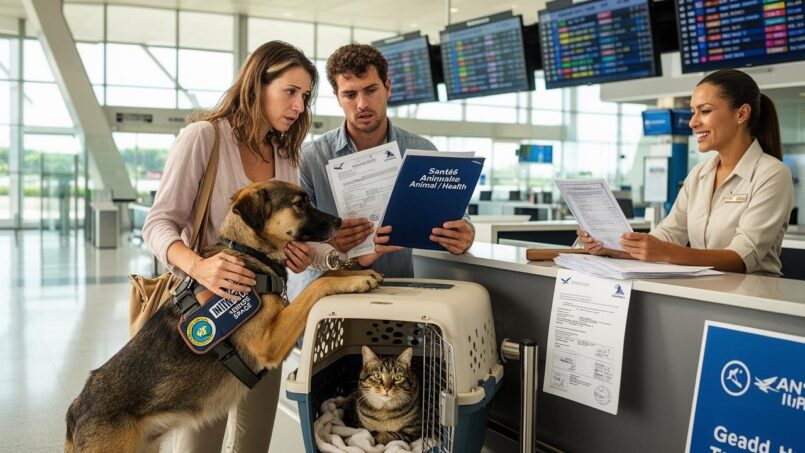
Moving abroad is already a logistical headache. Adding a dog or cat to the equation quickly turns the project into a real obstacle course. However, several recent travelers describe a “clear and well-documented” procedure for Saint Vincent and the Grenadines, provided you plan ahead, meet every health requirement, and choose your itinerary carefully.
This article details the official rules to be aware of, common pitfalls to avoid, and the practical reality on the ground for people wishing to settle in the country with their pet.
Understanding the Saint Vincent and the Grenadines Version of the “Pet Passport”
First and foremost, it’s important to clearly distinguish between two often-confused concepts. The “pet passport” in the sense used by Saint Vincent and the Grenadines is not the authentic European Pet Passport. It refers to a complete file containing all the documentation required for entry for dogs and cats.
This file must contain all required elements without exception.
| Required Document | Main Purpose | Key Notes |
|---|---|---|
| Import Permit | Official authorization for the animal’s entry | Must be obtained before travel, fee applies |
| Proof of Microchip | Unique identification of the animal | ISO 15-digit chip, number on all documents |
| Rabies Titer Test Result (FAVN) | Verifies rabies antibody level | Test at a UK or US-approved lab, > 0.5 IU/ml |
| Rabies Vaccination Certificate | Proves vaccination within the correct timeframe | Vaccine between 30 days and 12 months before entry, “3-year” vaccines not accepted |
| Proof of Parasite Treatments | Justifies internal and external treatments | Within 7 days before import |
| International Health Certificate | Attests to the animal’s general good health | Signed by an authorized vet and endorsed by the competent authority of the country of origin |
This “complete file” approach is central to Saint Vincent and the Grenadines’ health policy: if one link is missing or incorrectly filled out, the animal may be placed in quarantine, refused entry, or, as a last resort, euthanized, at the owner’s expense.
Which Animals Can Enter, and Under What Conditions?
The described rules primarily target dogs and cats, including assistance animals and service dogs. Other species may enter, but under a slightly different regime.
The authorities specify that:
Wolf-dog hybrids, Savannah cats, and Bengal cats are prohibited, unless they are at least five generations removed from the wild ancestor. Birds, reptiles, amphibians, tropical fish, rodents, rabbits, and other small mammals are not subject to rabies vaccination but require an import permit and a health certificate. There is no official list of prohibited dog breeds, but the owner is fully responsible for the animal’s behavior.
For certain species, another framework applies: the CITES Convention, which regulates the international trade of endangered species (rare parrots, turtles, etc.). In these cases, additional authorizations are necessary, to be obtained even before starting the import procedure for Saint Vincent and the Grenadines.
A Tropical, Hot, and Humid Country: What This Means for Your Pet
Moving with an animal isn’t just about crossing an administrative border. The dog trotting on a temperate European sidewalk today will transition to a tropical maritime climate with no marked dry season, hot and humid year-round.
Climate data paints a precise picture:
| Climatic Factor | Typical Values | Impact for Animals |
|---|---|---|
| Average Annual Temperature | Around 27°C (81°F) | Constant heat, risk of heatstroke |
| Observed Lows | Around 23°C (73°F) (February, higher areas) | Little nighttime coolness for sensitive animals |
| Frequent Highs | 29°C (84°F) in the Grenadines (September) | High temperatures for daytime walks |
| Relative Humidity | 79% to 84% depending on the month | Muggy heat, thermoregulation difficulties |
| Annual Rainfall | 1,500 to 3,800 mm (59 to 150 in) depending on area | Intense showers, slippery ground, risk of parasitic diseases |
| Wet Season | June to December | Increase in mosquitoes, ticks, parasites |
| Dry Season | January to May (but overall humid climate) | Slightly more comfortable period for walks |
The islands are also in the hurricane zone, with a more pronounced risk between August and October. Extreme events (storms, torrential rains, landslides) can disrupt access to veterinarians, food supplies, and the safety of animals outdoors.
Concretely, for an expatriation project:
For your pet’s well-being in a tropical climate, plan for shaded and ventilated spaces at home and during transport. Hydration must be managed with daily attention. Preventive treatments against external parasites (ticks, fleas, mosquitoes) are essential and often required for entry into the territory. For a first experience, the period from February to April, drier and less exposed to cyclones, is generally more comfortable.
Finally, some islets in the Grenadines depend almost entirely on groundwater for fresh water supply, which can make managing drinking water more delicate for households with multiple animals.
Microchip: The First Mandatory Building Block of the File
Regardless of the country of departure, the procedure begins with the electronic identification of the animal.
The rules are strict:
To be valid, the identification microchip must meet precise technical and administrative standards. It must comply with ISO standard 11784 or Annex A of ISO standard 11785, which notably implies it has a 15-digit number. Its implantation must be performed by an authorized professional: a veterinarian, a veterinary clinic, or a trained veterinary nurse. This microchip number must then be recorded on all the animal’s official documents (health certificate, rabies titer results, vaccination record, import permit). Finally, it is highly recommended to register it in a recognized database (like the manufacturer’s or a national one) and keep proof of this registration.
The authorities also indicate that it may be wise to bring a compatible microchip reader, especially if you use a less common model. This will avoid, upon arrival, any difficulty reading the chip during the inspection.
Mandatory Vaccines: Not Just Rabies
The rabies vaccination is the core of the system, but it’s not the only requirement. For dogs and cats, Saint Vincent and the Grenadines imposes a foundation of complete vaccines, to be listed on the health certificate.
Rabies Vaccine Validity Window
The authorities require that the rabies injection:
– be administered at least 30 days before arrival,
– and at most 12 months before entry into the territory.
So-called “triennial” vaccines (valid for 3 years according to the manufacturer) are not recognized: for local authorities, validity is capped at 12 months. Proof must be provided via:
To travel legally with your dog, cat, or ferret, you must present one of the following valid proofs of rabies vaccination.
A rabies vaccination certificate signed and stamped by an authorized veterinarian.
An official vaccination record issued by a competent veterinary authority.
A duly completed and up-to-date European Pet Passport.
Rabies titer results or a veterinary exemption letter cannot in any way replace this proof of vaccination.
Other Vaccines Required for Dogs
For dogs, vaccination must cover:
– Canine Distemper,
– Parvovirus,
– Leptospirosis,
– Canine Hepatitis,
– Parainfluenza.
Other Vaccines Required for Cats
For cats, the authorities require protection against:
– Feline Rhinotracheitis,
– Panleukopenia,
– Feline Leukemia,
– Calicivirus,
– Chlamydophila psittaci.
All these vaccines must be dated and recorded on the health certificate accompanying the animal.
Rabies Titer Test: A Non-Negotiable Step
Even if your animal is perfectly vaccinated against rabies, a rabies antibody titer test (FAVN test) remains mandatory, regardless of geographic origin.
The rules are very specific:
| Step | Official Requirement | Details |
|---|---|---|
| Timing Relative to Vaccine | Sample taken at least 21 days after vaccination | Must also be more than 30 days after the primary vaccination in some schedules |
| Test Type | FAVN (Fluorescent Antibody Virus Neutralization) | The RFFIT test is not accepted |
| Protection Threshold | > 0.5 IU/ml | Level considered protective |
| Authorized Laboratories | Lab approved in the United Kingdom or the United States | For example, Veterinary Laboratory Agency (Surrey) or BioBest (Scotland) |
| Transmission of Results | Copy sent to the Animal Health Division before permit issuance | The result must be associated with the microchip number |
Without this document, the import permit simply will not be issued. This is often the longest step, as it involves sending samples abroad and sometimes significant analysis delays. It is therefore better to plan for several months of lead time.
Health Certificate: The Master Document of the File
The international health certificate is the document that synthesizes the entire medical situation of the animal and its prior procedures. The authorities insist on two points: it must be legible, precise, and complete, and it must be endorsed by the official veterinary authority of the country of departure (Ministry of Agriculture, State Veterinary Service, USDA for the United States, etc.).
This certificate must notably:
To be valid, the official veterinary certificate must imperatively detail the animal’s complete identity (species, breed, sex, age, color, distinguishing marks) and its microchip number. It must also list all vaccinations with their dates and types, as well as recent internal and external parasite treatments with dates and products used. Finally, the veterinarian must certify in writing that the animal is clinically healthy, fit for transport, free of visible contagious diseases, without open wounds, and not originating from a rabies-risk area.
In many countries, the practicing veterinarian must be accredited or authorized by the national authority to issue such a certificate, which is then countersigned (endorsed) by the central veterinary service.
In the case of the United States, for example, a standard form (APHIS 7001 or another digital certificate via VEHCS) is filled out by a USDA-accredited veterinarian, then validated by a regional APHIS office.
Mandatory Treatments Before Departure: Parasites and Specific Diseases
Beyond the vaccine and titer test, Saint Vincent and the Grenadines requires a complete prophylactic package in the week preceding export.
Dogs and cats must:
– Receive a treatment for external parasites (fleas, ticks, etc.) with a recognized product.
– Receive a broad-spectrum anthelmintic for internal parasites (digestive worms, etc.).
For dogs, additional tests are required:
For export, a heartworm (Dirofilaria immitis) screening with negative results is required. Two samples must be taken within 72 hours before departure: one in the morning and the other after 4 PM on the same day. According to some procedures, a Lyme disease screening test may also be required.
All these elements must be properly recorded on the health certificate.
The Import Permit: Mandatory Step Before Booking Your Flight
Without an import permit, no dog or cat can officially cross the border. This document is issued by the Animal Health and Production Division, under the Ministry of Agriculture, Forestry and Fisheries.
The application is done in several stages:
1. Obtaining the form and entry conditions They can be requested by email at the official address
Disclaimer: The information provided on this website is for informational purposes only and does not constitute financial, legal, or professional advice. We encourage you to consult qualified experts before making any investment, real estate, or expatriation decisions. Although we strive to maintain up-to-date and accurate information, we do not guarantee the completeness, accuracy, or timeliness of the proposed content. As investment and expatriation involve risks, we disclaim any liability for potential losses or damages arising from the use of this site. Your use of this site confirms your acceptance of these terms and your understanding of the associated risks.

Cyril Jarnias is an independent expert in international wealth management with over 20 years of experience. As an expatriate himself, he is dedicated to helping individuals and business leaders build, protect, and pass on their wealth with complete peace of mind.
On his website, cyriljarnias.com, he shares his expertise on international real estate, offshore company formation, and expatriation.
Thanks to his expertise, he offers sound advice to optimize his clients' wealth management. Cyril Jarnias is also recognized for his appearances in many prestigious media outlets such as BFM Business, les Français de l’étranger, Le Figaro, Les Echos, and Mieux vivre votre argent, where he shares his knowledge and know-how in wealth management.





