
 Published on and written by Cyril Jarnias
Located in the heart of the Lesser Antilles, on the border between the Caribbean Sea and the Atlantic, Saint Vincent and the Grenadines has long been a “land’s end” fiercely defended by its inhabitants. Behind the postcards of turquoise lagoons and sailboats anchored in the Grenadines lies a tumultuous history, marked by indigenous resistance, colonial rivalries, slavery, deadly volcanic eruptions and, more recently, struggles for independence and the recognition of a distinct identity.
To trace this history is to follow a thread that begins with Amerindian peoples who settled millennia ago, passes through the birth of the Garifuna people, the Carib Wars, the plantation economy, the abolition of slavery, the massive immigration of indentured laborers, and leads to the modern state, a member of the Commonwealth, which celebrates its political autonomy every October 27th.
From the First Inhabitants to the Indigenous Fortress
Long before Europeans sighted these islands, the archipelago was already at the heart of human routes originating from the South American continent. Archaeological traces show very ancient occupation, with a succession of peoples who would profoundly shape the human and cultural landscape.
The first inhabitants of the Antilles were the Ciboney, who came from South America several millennia BCE. They were followed by the Arawaks, farmers and fishermen who arrived in the first centuries CE. From the 13th–14th century, the Kalinago (called Caribs by Europeans), formidable sailors and warriors, dominated the archipelago, pushing back or assimilating the Arawak populations.
The Kalinago gave the main island names heavy with meaning: Youloumain or Hairouna, often translated as “Land of the Blessed.” Their connection to nature, spirits, and the sea structured their world. When, much later, settlers tried to rename places, these names survived in memory and resurfaced in modern culture, for example through the local Hairoun beer or in toponymy.
For centuries, the Caribs resisted any foreign settlement in Saint Vincent. After Christopher Columbus’s visit in 1498, the Spanish limited themselves to slave raids without establishing a colony. Although the English and Dutch claimed the island in the 17th century, no European power managed to dominate it before the 18th century, leaving real control to the Carib populations.
This status quo made Saint Vincent one of the last indigenous strongholds in the Caribbean, a territory where the Caribs imposed their rules and at most tolerated occasional, carefully controlled presences.
Birth of the Garifuna: An Afro-Indigenous People
It is in this context of Carib autonomy that one of the most singular phenomena in the region’s history occurred: the emergence of the “Black Caribs,” or Garifuna, an Afro-indigenous people whose matrix is found on Saint Vincent.
From the 17th century onward, Africans arrived in Dominica through unconventional means: shipwrecks of slave ships, escapes of enslaved people from neighboring islands like Barbados, and canoe crossings. Welcomed by the Kalinago (Carib) people, these fugitives integrated by learning the language and contracting marriages with indigenous women.
Gradually, a distinct community formed, Carib in its social structure, language, and territoriality, yet African in its origins and some cultural traits. Europeans, obsessed with racial classifications, baptized them “Black Caribs” to distinguish them from the “Yellow” or “Red” Caribs, who were less mixed. They themselves would later designate themselves as Garifuna or Garínagu.
This mixing is not a mere demographic detail: it would condition the entire political history of the island. The Garifuna became the main military and demographic force on Saint Vincent, to the point of controlling vast areas, particularly in the north and east, and playing arbiters in the rivalries between the French and British. Chiefs such as Joseph Chatoyer would become indispensable interlocutors, then symbols of anti-colonial resistance.
The Garifuna and their chiefs, like Joseph Chatoyer
To this day, the Garifuna remember Saint Vincent as Yurumein, and pilgrimages regularly take place to the symbolic sites of their collective drama, such as the island of Baliceaux where so many of them perished before the forced exile to Central America.
Franco-British Rivalries and First European Colonization
While the Spanish largely neglected Saint Vincent, the French saw it, from the beginning of the 18th century, as an opportunity for sugar development. Based from their Martinique holdings, they settled in Barrouallie, on the leeward coast, around 1719. This was the first durable European colony on the island. The French renamed the territory “Ile Saint Marcouf” and established plantations of sugar, coffee, indigo, tobacco, cotton, corn, and cocoa, importing African slaves.
Year of the signing of the Treaty of Aix-la-Chapelle declaring Saint Vincent a “neutral island” without a European sovereign.
From the Seven Years’ War onward, the situation changed. Great Britain, in the midst of colonial expansion, sought to secure its hold on the Antilles. The Treaty of Paris in 1763 officially awarded Saint Vincent to it. On paper, the island became British; in reality, it remained largely controlled by the Garifuna, and the French remained influential there.
After the British takeover, the island of Saint Vincent was forcibly integrated into the colonial slave system. The French plantation model was adopted and amplified: a land commission was created to distribute land, Fort Charlotte was built to dominate Kingstown, and sugar and other export crop plantations developed rapidly. This intensification led to the landing of thousands of additional African slaves, radically transforming an island that had previously served as a buffer zone between Europeans and Caribs.
The Carib Wars: A Fierce Resistance
British expansion quickly ran up against an unavoidable reality: the Garifuna had no intention of giving up their lands. From this opposition arose a series of conflicts known today as the Carib Wars, pivotal moments in the country’s history.
First Carib War: An Armed Stalemate
The First Carib War broke out in the late 1760s, when British authorities attempted to push their settlements into Garifuna territories. A military reconnaissance mission on the windward coast ended in failure against indigenous resistance. The Garifuna, led by Joseph Chatoyer and other chiefs, knew the island’s rugged terrain perfectly: dense forests, ravines, cliffs. British regular troops, poorly prepared for guerrilla warfare in tropical terrain, struggled to advance.
Faced with a military stalemate and criticism in London, a peace was finally negotiated in the early 1770s. A treaty set borders between “British” and “Carib” zones. Officially, each kept their lands. In practice, settlers continued to covet the rich plains controlled by the Garifuna, and tensions, never resolved, simmered.
French Interlude and Rising Tensions
During the American War of Independence, Saint Vincent once again became a battleground between European powers. In 1779, a French force, supported by Garifuna fighters, managed to take the island from the British. The English authorities capitulated with little resistance. When, a few years later, the Treaty of Versailles in 1783 returned Saint Vincent to Great Britain, resentment was tenacious: in the eyes of British settlers, the Garifuna had betrayed the crown.
Explosive context in the Antilles at the end of the 18th century, marked by revolutionary ideals and imperial confrontation.
The truce established after the First Carib War was compromised by new tensions and the circulation of revolutionary ideas.
The 1794 decree abolishing slavery in the French colonies inspired and galvanized populations in the region.
Commissioners like Victor Hugues, from Guadeloupe or Martinique, encouraged Black revolt against British authority.
In this climate of revolt and contradictory ideals, a new large-scale armed conflict became inevitable.
Second Carib War: Defeat and Exile
The Second Carib War broke out in the mid-1790s. It was part of a vast movement of revolutionary and anti-slavery wars shaking the Caribbean, from Haiti to Grenada. In Saint Vincent, the Garifuna, led again by Joseph Chatoyer and supported by French advisors, quickly managed to control most of the island, leaving the British only an enclave around Kingstown.
The response matched the stakes. London dispatched General Ralph Abercromby at the head of several thousand men to crush the rebellion. Chatoyer’s death in battle marked a symbolic turning point. Gradually, through a combination of military superiority, disease, and supply breakdowns in the Garifuna camp, the resistance was defeated.
The British victory was not limited to territorial reconquest: it resulted in a radical measure, which would remain engraved as a founding trauma for the Garifuna people. Over 5,000 Black Caribs were deported. First concentrated on the small island of Baliceaux, off Bequia, they endured such harsh detention conditions that about half died from hunger, disease, or exhaustion. The survivors were then shipped to Roatán, off Honduras, and later dispersed along the coasts of Central America (Honduras, Belize, Nicaragua, Guatemala).
This mass deportation, decided to “secure” the colony and prevent future insurrections, emptied Saint Vincent of a large part of its indigenous population. However, some Garifuna groups escaped exile, hiding in the island’s remote areas until a partial amnesty in 1805. Their descendants still live today in localities such as Sandy Bay or Owia.
Table – Key Dates of the Carib Wars and Garifuna Deportation
| Approximate Period | Major Event | Main Actors | Key Consequence |
|---|---|---|---|
| Late 1760s–early 1770s | First Carib War | Garifuna, British administration | Treaty setting borders, precarious status quo |
| 1779–1783 | French occupation during the American War | France, Garifuna, Great Britain | Island taken by France, then returned to the English |
| Mid-1790s–1797 | Second Carib War | Garifuna, French advisors, British army | Garifuna defeat, death of Chatoyer, repression |
| 1797 | Mass deportation of the Black Caribs | British colonial administration, Garifuna | Exile to Baliceaux then Roatán, birth of the Garifuna diaspora |
Today, Joseph Chatoyer is recognized as a national hero. Every March 14th, a day is dedicated to him, a sign that the memory of the Carib Wars has become a symbolic pillar of the identity of Saint Vincent and the Grenadines.
The Plantation Economy and British Slavery
As the Carib Wars ended, Saint Vincent was fully integrated into the Caribbean plantation system. The British had greatly expanded the cultivation of sugarcane, but also of cotton, coffee, cocoa, indigo, and tobacco. Figures show an impressive growth in sugar production around the turn of the 19th century, a direct reflection of the increase in the number of African slaves.
Saint Vincent’s plantations relied on massive and brutal slavery. The enslaved, from various regions of West and Central Africa, endured exhausting workdays and severe punishments. However, the island’s rugged topography limited the expansion of plantations compared to flatter territories like Barbados.
The great planter families, often British, concentrated wealth. A small white elite dominated political and economic life, while a huge African majority lived in servitude. The exiled Garifuna, meanwhile, were replaced by other African groups, less locally rooted, which, in the eyes of the settlers, reduced the risk of new indigenous wars.
But this flourishing economy remained vulnerable: to the whims of European markets, natural disasters, and the rising abolitionist movement from the end of the 18th century onward.
Abolition of Slavery, Indentured Immigration, and Social Recomposition
When the abolition of the slave trade and then slavery arrived in the British Empire in the 19th century, Saint Vincent was deeply dependent on servile labor. The legal end of slavery in 1834, followed by a so-called “apprenticeship” period until 1838, freed over 18,000 people on the island. The former enslaved, now legally free, sought to improve their conditions, negotiate better wages, or even gain access to land.
Planters faced a major crisis due to new social demands and the collapse of world sugar prices, prompting many to abandon their estates. This decline was exacerbated by damage from a hurricane in 1831 and, especially, by the devastating eruption of the La Soufrière volcano in 1812, which permanently weakened the plantations.
In order to break the bargaining power of the former enslaved and address the labor shortage, colonial authorities encouraged the arrival of indentured laborers. In the 1840s, Portuguese from Madeira, sometimes of Jewish faith, were introduced as agricultural workers. From the 1860s onward, Indians (from South Asia) arrived by the hundreds, transported under often very harsh indenture contracts. The living conditions of these “indentured” workers recalled in many aspects those of slavery: paltry wages, surveillance, severe sanctions.
The ethnic composition of Saint Vincent and the Grenadines evolved into a multiethnic society, including descendants of Africans, Garifuna, Portuguese, Indians, a few Europeans, and a Kalinago minority. While this diversity constitutes a long-term pillar of national identity, it initially originated in a colonial project aimed at social and economic control.
Table – Key Milestones of the Post-Slavery Transition
| Period | Key Measure or Phenomenon | Effect on Vincentian Society |
|---|---|---|
| 1834–1838 | Abolition of slavery and end of “apprenticeship” | Liberation of over 18,000 enslaved people, recomposition of labor relations |
| 1840s | Arrival of Portuguese laborers (Madeira) | Introduction of a new ethnic group, competition in the labor market |
| 1861–1888 | Immigration of indentured Indians | Strengthening of indentured labor force, accentuation of social stratification |
| Late 19th – early 20th century | Lasting decline of sugar and agricultural diversification | Gradual shift to arrow-root, cotton, then bananas |
La Soufrière: Volcano, Tragedies, and Resilience
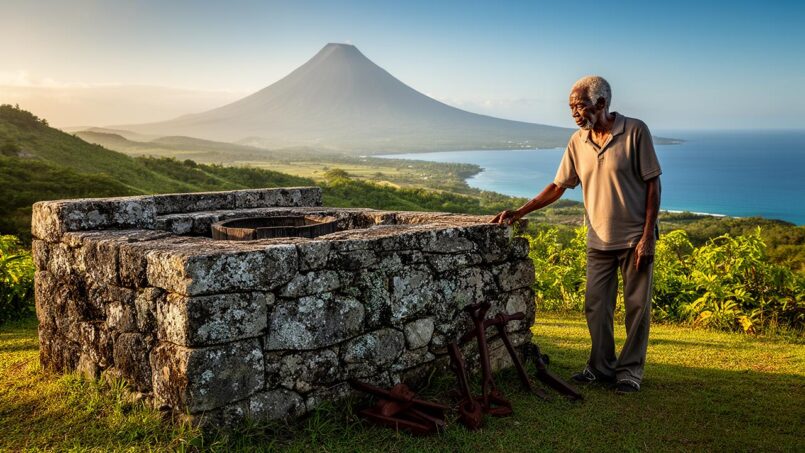
It is impossible to tell the history of Saint Vincent and the Grenadines without mentioning La Soufrière, the stratovolcano that occupies nearly a third of the island of Saint Vincent and is its highest point. For millennia, it has shaped not only the landscape but also the human destiny of the archipelago.
Number of people killed in the devastating eruption of La Soufrière in 1902.
The tragedy was not only human. By destroying plantations, dwellings, and infrastructure, the volcano contributed to the definitive collapse of the sugar economy, already weakened by world prices. The archipelago gradually turned to other crops: arrow-root, high-quality cotton, then bananas from the mid-20th century onward.
The eruptions of 1979 and 2021 required the evacuation of tens of thousands of people but avoided massive loss of life. The independent state now manages its own monitoring systems, via NEMO and cooperation with the University of the West Indies, and mobilizes international aid in times of crisis.
Thus, the volcano crystallizes, in a certain way, the particular relationship of Saint Vincent and the Grenadines to adversity: with each catastrophe, a reconstruction, often painful, but also an opportunity to reaffirm a capacity for collective resistance.
From Crown Colony to Parliamentary Democracy
Politically, the 19th and early 20th centuries saw a slow and cautious evolution of institutions. After the establishment of Crown Colony government in the late 1870s, Saint Vincent obtained a Legislative Council in 1925, but the right to vote remained narrowly reserved for a wealthy minority. Essential power remained in the hands of the governor and colonial administration.
After World War II, the introduction of universal adult suffrage in 1951 in Saint Vincent allowed for significant democratic advances. This reform facilitated the formation of local political parties and the emergence of an indigenous political elite. Figures such as Ebenezer Joshua, founder of the People’s Political Party, and later Milton Cato, with the Saint Vincent Labour Party, gradually structured the country’s political life.
The archipelago participated in the regional federations desired by London to manage decolonization: integration into the Federation of the West Indies in the late 1950s, then “Associated State” status in 1969, which gave it control over its internal affairs but left defense and foreign relations to Great Britain. These arrangements, meant to prepare for collective Caribbean independence, ultimately failed, with each island choosing its own path.
In the case of Saint Vincent and the Grenadines, this path would be later than for other neighboring territories.
Independence: A Late but Decisive Turning Point
By the late 1970s, the wind of decolonization had already blown over most of the British Antilles. Barbados, Grenada, Dominica, and others had become sovereign states. In Saint Vincent and the Grenadines, Prime Minister Milton Cato and his party, the Saint Vincent Labour Party, initiated their own negotiation process with London.
A referendum was held, and then, on October 27, 1979, the archipelago gained independence. This date was not chosen at random: it coincided with the tenth anniversary of Associated Statehood. The country officially adopted the name Saint Vincent and the Grenadines, thus enshrining in the very title of the state the importance of the small islands of the southern chain.
Independence was proclaimed in Kingstown by the Duke of Gloucester, representing Queen Elizabeth II, who handed over the constitutional instruments to Milton Cato. The new state adopted a flag (green, blue, gold), a constitution, and retained the status of a constitutional monarchy within the Commonwealth, with the Queen as symbolic head of state, represented by a Governor-General.
A few weeks later, in December 1979, the first elections of the independent era were held. Cato’s party won them, and the head of government became the first Prime Minister of the sovereign country. On the regional stage, he positioned himself as a pragmatic Caribbean nationalist, favoring close ties with moderate governments like those of Trinidad and Tobago or Barbados.
Barbados quickly joined CARICOM in 1973, and then the Organisation of Eastern Caribbean States. This approach aimed to pool political and economic resources to face the region’s common challenges.
Table – Some Institutional Milestones Toward Independence
| Approximate Year | Institutional Evolution | Main Political Impact |
|---|---|---|
| 1877 | Establishment of Crown Colony regime | Strengthening of direct British control |
| 1925 | Creation of a Legislative Council | First local representation, very limited |
| 1951 | Introduction of universal adult suffrage | Emergence of political parties and Vincentian leaders |
| 1958–1962 | Participation in the Federation of the West Indies | Aborted attempt at collective independence |
| 1969 | Associated State status with the United Kingdom | Internal autonomy, London retained defense and diplomacy |
| 1979 | Independence within the Commonwealth | Birth of the sovereign state Saint Vincent and the Grenadines |
Since that date, the country has maintained relatively stable democratic institutions, with regular and peaceful alternations of power. The posts of Prime Minister, the House of Assembly, and the Governor-General organize internal political life, while justice remains based on British law and linked to regional jurisdictions (Eastern Caribbean Supreme Court) and the London Privy Council.
A National Identity Forged by Memory and Diversity
In the aftermath of independence, the challenges were many: economic diversification, reducing unemployment, managing natural risks, but also constructing a national narrative capable of uniting a population of very diverse origins.
The history of Saint Vincent and the Grenadines offers, from this perspective, several symbolic pillars. Garifuna resistance, embodied by Joseph Chatoyer, provides a founding myth of struggle against colonial oppression. The deportation to Baliceaux and Roatán fuels a sense of solidarity with the Garifuna diasporas of Central America, who regularly return to the mother island for commemorations.
The collective memory of slavery, its abolition, and the difficult conditions of indentured labor for the Portuguese and Indians fuels current claims for reparations for the Atlantic slave trade, carried internationally by Saint Vincent’s leaders. At the same time, ties to the sea – through boats, fishing, traditional boatbuilding, and regattas – testify to the long maritime history of the Kalinago peoples and generations of Afro-Vincentian sailors and fishermen.
This historical density is found in contemporary cultural life: carnivals (Vincy Mas), festivals like Nine Mornings before Christmas, regattas in Bequia, Union Island, or Canouan, maroon ceremonies inherited from West African rites. Music (calypso, soca, steelpan, reggae), gastronomy (breadfruit and jackfish, callaloo, arrow-root dumplings), linguistic practices (official English, Vincentian Creole infused with French, Africanisms, and Garifuna elements) compose a cultural landscape that bears, in its own way, the trace of each historical phase.
Colonial Legacies and Economic Shifts
Economically, the history of Saint Vincent and the Grenadines after the abolition of slavery reads as a succession of adjustments imposed by external constraints. After the fall of sugar, arrow-root (of which the archipelago was long one of the world’s main producers) and high-quality cotton took over, without ever regaining past profitability.
Bananas, for us, are what automobiles are for Detroit.
A Caribbean political official
To this are added climate risks: hurricanes, floods, volcanic eruptions that regularly destroy crops. The 2021 eruption, for example, ravaged a good portion of the most fertile agricultural lands in the north of Saint Vincent. In this context, the country seeks to diversify its activities: tourism development, especially high-end in the Grenadines, valorization of agricultural niches (fair trade, organic production), financial services, etc.
This transition, however, remains marked by strong social inequalities, persistent unemployment, and a significant dependence on external markets and aid, in line with a “dependency culture” inherited from the plantation economy.
Conclusion: A Small Nation with a Long Memory
The history of Saint Vincent and the Grenadines is neither linear nor peaceful. It is made of brutal ruptures – wars, deportations, natural disasters – but also of less visible continuities: persistence of Garifuna language and practices, survival of agrarian structures inherited from the plantation, permanence of British references in institutions, and the central role of the sea in the collective imagination.
The history of society demonstrates a remarkable capacity to reinvent itself after major upheavals: the Carib Wars and Garifuna exile, the abolition of slavery and the decline of the sugar industry, the eruptions of La Soufrière and the impacts of globalization. Each time, the inhabitants have rebuilt a social, economic, and cultural fabric by reusing old elements in new forms.
Today, the country of Saint Vincent and the Grenadines, a modest-sized island state, a member of the Commonwealth and Caribbean regional organizations, bears in its landscapes, villages, and festivals the mark of this long history. Whether it’s a pilgrimage to Baliceaux, a Garifuna song, a cricket match in Kingstown, a dish of roasted breadfruit, or a soca tune during Vincy Mas, every daily gesture is, in essence, the heir to centuries of confrontations, exchanges, and blending that have made this archipelago a unique place in the Caribbean.
Disclaimer: The information provided on this website is for informational purposes only and does not constitute financial, legal, or professional advice. We encourage you to consult qualified experts before making any investment, real estate, or expatriation decisions. Although we strive to maintain up-to-date and accurate information, we do not guarantee the completeness, accuracy, or timeliness of the proposed content. As investment and expatriation involve risks, we disclaim any liability for potential losses or damages arising from the use of this site. Your use of this site confirms your acceptance of these terms and your understanding of the associated risks.

Cyril Jarnias is an independent expert in international wealth management with over 20 years of experience. As an expatriate himself, he is dedicated to helping individuals and business leaders build, protect, and pass on their wealth with complete peace of mind.
On his website, cyriljarnias.com, he shares his expertise on international real estate, offshore company formation, and expatriation.
Thanks to his expertise, he offers sound advice to optimize his clients' wealth management. Cyril Jarnias is also recognized for his appearances in many prestigious media outlets such as BFM Business, les Français de l’étranger, Le Figaro, Les Echos, and Mieux vivre votre argent, where he shares his knowledge and know-how in wealth management.





