
 Published on and written by Cyril Jarnias
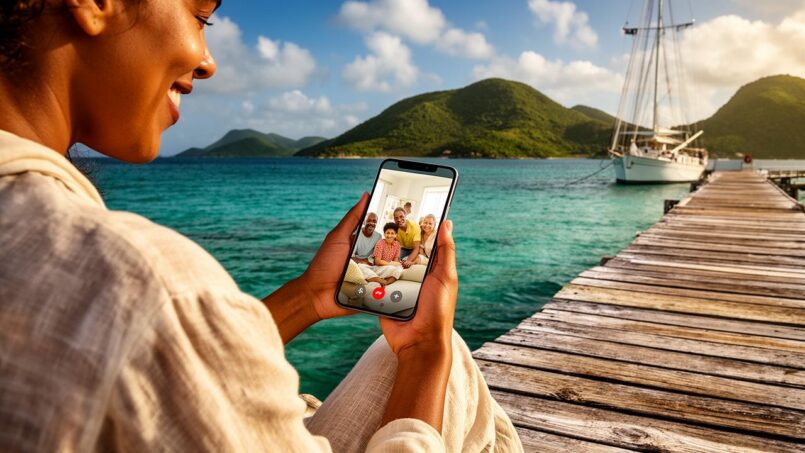
Traveling or settling in St. Vincent and the Grenadines should never mean cutting ties with those who matter. Between eSIMs, local carrier roaming, international calling apps, and public Wi-Fi, the options for staying reachable are now plentiful. The challenge is no longer finding a solution, but choosing the right one without blowing your budget or ending up without service on a small island.
This article provides a comprehensive, practical, and data-driven overview of the communication options available from St. Vincent and the Grenadines to maintain seamless contact abroad, whether with family, friends, or your business.
Understanding the Landscape: Coverage, Networks, and Signal Reality
Before discussing plans and apps, it’s essential to know what the country actually offers in terms of network.
Mobile connectivity in St. Vincent and the Grenadines primarily relies on two operators, Digicel and Flow. Both operate GSM networks</strong with 2G (voice/SMS), 3G, and especially 4G LTE. Over 95% of the population has 3G/4G coverage, allowing for smooth video calls or WhatsApp usage in most cases.
Around urban areas like Kingstown, Calliaqua, or Georgetown, 4G speeds (20-60 Mbps) allow for remote work and video conferencing. In rural or mountainous areas of the main island, the signal often drops to 3G (1-5 Mbps). On secondary islands like Bequia, Mustique, or Canouan, coverage exists but can be irregular due to terrain and remoteness.
For visitors and residents alike, this means that staying in touch often involves a flexible combination: 4G mobile data where coverage is solid, and reliance on public or hotel Wi-Fi where the mobile network is weak.
Public Wi-Fi and Free Internet Access: Local Good Deals
For those wanting to limit mobile expenses, free Wi-Fi is a valuable ally. The national regulator, the National Telecommunications Regulatory Commission (NTRC), has established a vast network of public hotspots, notably through resource centers, schools, and community points.
Thus, free Wi-Fi can be found in several towns and villages: Kingstown of course, but also Barrouallie, Brighton, Buccament, Layou, Georgetown, Chateaubelair, Calliaqua, Questelles, Sandy Bay, and even on some islands like Bequia, Mustique, Canouan, Union Island, or Mayreau via schools and access centers.
To locate free Wi-Fi access points, the NTRC Connect app is essential. It lists hotspots, shows photos of the locations, allows users to report outages and directly escalate issues to the NTRC. It functions as a live, interactive map of the public Wi-Fi network in the country.
Other global apps complement this system well. Wiman, WiFi Map, or Instabridge compile millions of access points shared by their user communities. Wiman, for example, can automatically connect a smartphone to the best free network nearby, and its map of Kingstown can be saved offline for viewing without data. Instabridge goes further by providing, when possible, passwords for protected networks, like some cafes or shops.
In practice, a visitor on a tight budget can easily combine a small data plan with a methodical hunt for hotspots: cafes (like Café Soleil in Kingstown), libraries, schools, community centers… Provided they keep in mind that public Wi-Fi can sometimes be slow or congested in the evening.
Local SIM, eSIM, Roaming: What to Choose to Stay Reachable?
Between buying a local SIM, activating roaming with your original carrier, or opting for an international eSIM, the options are numerous. Each has its strengths and weaknesses, depending on the length of stay and usage profile.
Local SIM Cards: Digicel and Flow
For long or repeated stays, a local SIM remains the most cost-effective option per gigabyte. In Kingstown, at the airport, or in certain shops, you can buy a Digicel or Flow SIM for about 10 to 20 EC$ (4 to 8 USD). A passport is required for registration.
To this are added prepaid data plans, generally priced between 20 and 50 EC$ (8 to 20 USD) depending on volume and duration. At Flow, for example, you can find daily, 3-day, or 7-day data packs, while on the voice side, calls to North America, Europe, or the rest of the world remain charged per minute.
For outgoing international calls, Flow typically charges over one US dollar per minute depending on the destination, while SMS abroad often cost around 0.5 EC$. Financially, it’s better to reserve the local SIM for data access and leave international voice calls to apps like WhatsApp, Viber, or Rebtel.
The main advantage is the quality of service, including better prioritization on the national network, in-store assistance available, and per MB rates generally lower than traditional roaming.
Roaming with Digicel: Practical for Traveling in the Region or Beyond
For those living in St. Vincent and the Grenadines and traveling frequently, Digicel offers a fairly structured range of roaming plans, designed to keep the same number while moving within the Caribbean, America, or Europe.
For the Caribbean region, Digicel markets 3, 7, or 14-day packs including data, calls, and free incoming calls. A 3-day plan, for example, includes 3 GB of data, free incoming calls, and included outgoing call minutes, which increases to 50 minutes for the 14-day plan with 14 GB. Activation is done by dialing *284# or via the MyDigicel app.
For America (North and South) and Europe, the structure is similar, but the data volumes and minutes vary. A 3-day America plan includes 1 GB and 10 minutes of outgoing calls, the 30-day one climbs to 10 GB and 25 minutes. In Europe, you also get 1 GB for 3 days, 3 GB for 7 days, and 10 GB for 30 days, with a few minutes included for outgoing calls.
Amount of mobile data included in the global 30-day pack offered by Digicel for travel outside the zone, with free incoming calls.
For a resident who frequently travels within the Caribbean or between America and Europe, these plans allow keeping a single number while controlling costs. However, for a tourist coming from Europe or Asia, it will generally be simpler to use an international eSIM or their own carrier’s roaming.
International Roaming Plans like Vi: A Useful Example of a Rate Grid
Even though Vi mainly targets customers based in India, its offers give a good idea of what some major operators propose for global roaming. They offer fixed-duration packs (5, 7, 14, 30, or 365 days) combining data, call minutes (local or to India), and free incoming calls in over 120 countries.
The rates are expressed in Indian rupees and range from 495 ₹ for 30 days with 50 minutes of calls and only voice, to nearly 3000 ₹ for one year with data and minutes included. Off-plan prices are also very structured: 10 ₹ per call minute, 10 ₹ per MB of data, 15 ₹ per SMS.
This type of offer illustrates two trends well: the desire to control the daily cost of roaming to avoid “bill shock”, and a fine segmentation between short trips (5 days), vacations (14 days), and frequent travel (365 days).
eSIM: The Top Solution for Data and Internet Calls
For many travelers, the best way to stay in touch from St. Vincent and the Grenadines today is to use a data eSIM, keeping their original SIM only for verification SMS and a few incoming calls.
An eSIM is a digital profile to install on a (compatible) phone by scanning a QR code. No physical card is needed, no need to look for a shop at the airport, and data rates are often lower than traditional roaming.
eSIM Offer for St. Vincent and the Grenadines: Abundant and Flexible
The eSIM market has literally exploded. No less than 334 data plans cover St. Vincent and the Grenadines, offered by a multitude of players: Ubigi, Breeze, Saily, Esimatic, GigSky, Roamify, Yoho Mobile, Flexiroam, AirHub, Maya Mobile, eSIM4Travel, Jetpac, Yesim, Sim Options, GoMoWorld, BNESIM, Airalo, and many others.
The average price per GB is around 9.57 USD, for an average plan price of about 68.19 USD. But there are more affordable offers, starting from 5.36 USD for small needs.
Discover our flexible range of internet plans for your travels, suited for all types of users, from short stays to long-term adventures.
Ideal for a weekend or a week: 1 GB valid for 7 days, or 3 to 5 GB valid for 15 days.
Perfect for a month of travel: generous volumes of 10 to 20 GB valid for 30 days.
For heavy users: massive volume of 50 GB valid for one month.
For cruises or road trips: packages covering multiple Caribbean or American countries.
Some Concrete Examples of Data eSIMs in the Region
To get an idea, we can look at the offers from three players that clearly target St. Vincent and the Grenadines and neighboring countries.
| Provider | Coverage Zone | Volume / Duration | Indicative Price |
|---|---|---|---|
| NextLink | Americas | 1 GB / 7 days | 5.49 USD |
| NextLink | Americas | 2 GB / 15 days | 9.99 USD |
| NextLink | Americas | 3 GB / 30 days | 14.99 USD |
| NextLink | Americas | 5 GB / 30 days | 22.99 USD |
| NextLink | Americas | 10 GB / 30 days | 44.99 USD |
| NextLink | Americas | 20 GB / 30 days | 84.99 USD |
| Sparks | Caribbean | 2 GB / 15 days | 13.49 USD |
| Sparks | Caribbean | 3 GB / 30 days | 19.99 USD |
| Sparks | Caribbean | 5 GB / 30 days | 29.49 USD |
| Sparks | Caribbean | 10 GB / 30 days | 56.49 USD |
| eSIMGo | Caribbean | 2 GB / 15 days | 14.99 USD |
| eSIMGo | Caribbean | 3 GB / 30 days | 19.99 USD |
| eSIMGo | Caribbean | 5 GB / 30 days | 30.99 USD |
| eSIMGo | Caribbean | 10 GB / 30 days | 43.99 USD |
| eSIMGo | Caribbean | 20 GB / 30 days | 74.99 USD |
All these offers are prepaid, provide access to reliable 4G/5G networks in the country, and generally support connection sharing (tethering), allowing you to connect a laptop or tablet for work or video calls.
eSIM Specifically for St. Vincent and the Grenadines: Data à la Carte
Other providers focus more on the destination itself. eSIMFOX, for example, offers per-GB rates with flexible validity:
| Provider | Total Volume | Validity | Approximate Price | Characteristics |
|---|---|---|---|---|
| eSIMFOX | 1 GB | 7 days | 8.99 € / GB | Data only, hotspot |
| eSIMFOX | 1 GB | 15 days | 7.66 € / GB | Data only, hotspot |
| eSIMFOX | 1 GB | 30 days | 7.00 € / GB | Data only, hotspot |
These plans are particularly interesting for travelers who consume little but want a reliable connection for messaging, maps, and a few video calls.
Others like Yesim, Airhub, Esimatic, or Maya Mobile offer very detailed packages, with or without a local number and regional options covering up to 20 or 30 Caribbean countries in a single eSIM.
eSIM with a Local Number: Useful or Not?
Several providers (Airalo, Airhub, Esimatic, Gigago, GlobaleSim, iRoamly, Maya Mobile, Mobimatter…) market eSIMs including a local number, allowing you to receive standard calls and sometimes SMS. This is interesting if you need to be reachable by local service providers (hotel, skipper, taxi) or if you make many calls to local numbers without wanting to rely solely on apps.
Before subscribing, however, you need to check precisely:
– whether the number is truly local to St. Vincent and the Grenadines or virtual in another country;
– what communications are included (incoming calls only, outgoing minutes, SMS…);
– whether calls go over the traditional GSM network or via a proprietary app.
For most travelers, especially those who mainly want to talk to their loved ones abroad, a simple data eSIM is largely sufficient. Calls then go through applications like WhatsApp, FaceTime, Viber, or Google Voice.
Beware of “Unlimited Data”: Common False Friends
Many eSIMs are presented as “unlimited“. In reality, almost all include a daily or overall cap beyond which speed drops significantly. Several providers state this clearly: Airalo, for example, limits some “unlimited” plans to 3 GB per day, Breeze to 1 GB/day, Esimatic to 1 or 2 GB/day, Maya Mobile to 10 GB/day, Ubigi to 2 GB/day. Others remain more vague.
Once the ‘unlimited’ data volume is consumed, the speed can drop to less than 1 Mbps (sometimes 512 kbps), making video calls and streaming nearly impossible. For intensive use (video conferencing, remote work, streaming), fixed-volume plans (e.g., 10, 20, or 50 GB) are often more transparent and cost-effective.
Roam eSIM and Roamless: Integrated Data + Calls
Some solutions go further than a simple data eSIM. Roam eSIM offers, for example, daily or volume-based plans, with unlimited options, and extended compatibility (Apple, Samsung, Google Pixel, Huawei, tablets, PCs). The model is based on prepaid plans, QR codes sent by email, and quick access to 3G/4G/5G networks, with no hidden fees.
Roamless, on the other hand, combines a travel eSIM covering over 200 countries with a built-in calling feature in the app, starting from 0.01 USD per minute, using data rather than traditional voice minutes. The user tops up a balance (RoamlessFlex) and calls are charged based on the called destination, regardless of where they are.
For those who want to continue calling landline or mobile numbers without the other person needing to install an app, this type of service fills a real gap.
Combining eSIM and Original SIM: Keeping Your Number and Limiting Costs
Most recent smartphones (iPhone XS and later, Google Pixel 3 and up, many Samsung Galaxy models) handle dual SIM very well, whether hybrid (nano-SIM + eSIM) or full eSIM.
The most effective strategy for staying in touch from St. Vincent and the Grenadines is often the following:
– keep your original SIM active, but with data roaming disabled;
– install a local or international eSIM for data;
– let WhatsApp, iMessage, FaceTime, and other apps continue to use the original number, which doesn’t change.
On iPhone, you can assign the “Home” line to calls and SMS, and the “Travel” line to mobile data, disabling automatic data switching to avoid any roaming consumption from your home country. On Android, you select the data SIM (usually an eSIM) in the settings, while leaving the original physical SIM to handle incoming calls and SMS.
Thus, your loved ones continue to write and call your usual number (via WhatsApp, Telegram, FaceTime, etc.), while the data bill is from your prepaid eSIM and not your home carrier.
The Best Apps for Calling and Messaging from St. Vincent and the Grenadines
Once the connection is secured (Wi-Fi, local SIM, or eSIM), everything hinges on the choice of calling app. The ecosystem is dense, but it can be summarized in two main families: free, user-to-user apps, and full VoIP services allowing calls to any number.
“Free” User-to-User Apps: Ideal for Family and Friends
To stay in touch with loved ones and friends, app-to-app services are unbeatable. They only cost data, and everyone already knows them.
WhatsApp is by far the most universal, with nearly 3 billion users. It offers voice calls, video, groups, file sharing, all for free between users. Both correspondents just need to have the app and an internet connection, whether on 4G in St. Vincent and the Grenadines or on a cafe Wi-Fi on the other side of the world.
FaceTime and iMessage play a similar role in the Apple ecosystem, especially for exchanges between iPhones, iPads, and Macs. Again, everything goes through data, with no roaming surcharge if you use a local eSIM.
In addition to common apps, others like WeChat, Viber, or Telegram are widely used, particularly for contacting people in specific regions. For example, WeChat is especially popular in China.
Complete VoIP Solutions: When You Need to Call “Real” Numbers
To call a landline or mobile whose user doesn’t have a messaging app installed, we move to another category of tools.
Google Voice is often cited as the most versatile solution for professional use. Its strengths: a clear interface, attractive international rates, the possibility of having a dedicated number, and even advanced features like voicemail transcription, call screening, or ring groups. In the US and Canada, calls to landlines are often free, making it an excellent choice for managing a business or remote work from St. Vincent and the Grenadines.
The monthly cost per user for a complete business phone system, depending on features.
For individuals looking for very low rates to certain countries, Rebtel, Talk360, Yolla, or KeepCalling stand out. Rebtel, for example, optimizes quality even on unstable mobile networks by relying on local numbers rather than pure VoIP. Its unlimited plan to 50 countries is around 12 USD per month, with per-minute rates often less than a few cents. BOSS Revolution displays specific rates to St. Vincent and the Grenadines (starting from about 0.28 USD/min depending on offers), which can be interesting for those who often call in that direction.
Finally, there are solutions like TextNow or Dingtone, which sometimes offer a free number and free calls to certain destinations (Canada and the United States, for example), complemented by moderate international rates.
Comparing Apps: Usage, Free Nature, and Pricing
The following table summarizes some major options for international calls with data from St. Vincent and the Grenadines:
| Application | App-to-App Calls | Calls to Landlines/Mobiles | Typical Pricing Model |
|---|---|---|---|
| Yes, free | No (except forwarding) | Free, data consumption | |
| FaceTime | Yes, free | No | Free, via data |
| Google Voice | No | Yes | From ~10 USD/month + minutes |
| Rebtel | No | Yes | Unlimited plans + per-minute rate |
| BOSS Revolution | No | Yes | Prepaid credit, country-specific rates |
| Viber | Yes, free | Yes (Viber Out) | Paid calls to standard numbers |
| Talk360 | No | Yes | Prepaid credit, no app needed for receiver |
| TextNow | Yes (USA/Canada) | Yes | Free in North America + options |
| Roamless | No | Yes (in the app) | From 0.01 USD/min via data |
The key point to remember is that these services do not replace your internet service provider: they overlay your connection (Wi-Fi, eSIM data, local SIM) and use it to transport voice and video.
How Much Data to Plan for Staying in Touch?
To properly size your eSIM or local plan, it’s useful to have some consumption benchmarks. Based on established averages, we can estimate that with 1 GB of data:
To illustrate the energy consumption of a smartphone battery, here are some equivalents for a full charge: about 1 to 1.5 hours of HD video calling, 4 to 5 hours of low-resolution video streaming, 20 hours of standard quality music streaming, up to 200 hours of light web browsing, or about a hundred hours of social media use without intensive video.
In practice, for a one-week stay in St. Vincent and the Grenadines, a “moderate” user who sends messages, checks email, does a bit of video calling, and watches a few short videos will need 3 to 5 GB. A heavy user (lots of video calls, remote work, connection sharing) will easily exceed 10 GB.
We can summarize these needs in a summary table:
| Duration of Stay | Low Usage (messages, email, GPS) | Medium Usage (social media, some videos) | Intensive Usage (video calls, remote work, streaming) |
|---|---|---|---|
| 7 days | 1–3 GB | 3–5 GB | 10 GB and more |
| 15 days | 2–5 GB | 5–10 GB | 15 GB and more |
| 30 days | 3–7 GB | 10–15 GB | 25 GB and more |
By combining this table with the eSIM or local SIM offers described above, you can fairly accurately size your data budget.
Managing Time Zones to Call at the Right Time
Staying in touch isn’t just about having a good network and the right app: it’s also about being reachable at reasonable hours. St. Vincent and the Grenadines is in Atlantic Standard Time (UTC-4) and does not observe daylight saving time. The country therefore remains stable all year, which is an asset for planning.
The time difference with North America is small: depending on the season, the country is either at the same time or one hour ahead of cities like New York, Toronto, or Miami. This facilitates phone communication with family or contacts in Canada or the United States, especially in the late local afternoon.
With Europe, the country is generally 4 to 5 hours behind London, Paris, or Berlin. Concretely, late morning in Paris corresponds to very early morning in St. Vincent and the Grenadines, but the late afternoon or early evening in Europe falls right in the local afternoon. This is often the best time slot for professional calls with Europe from Kingstown.
With Asia and Oceania, the time difference is significant: 12 to 13 hours behind Singapore or Tokyo, and up to 17 hours behind New Zealand. To chat with loved ones in these regions, like Australia or Japan, you need to plan ahead by scheduling video conferences early in the morning or late at night. It may be necessary to set aside specific days for these exchanges to preserve your own life rhythm.
Tools like World Time Buddy or timeanddate.com help visualize optimal time overlaps and avoid accidentally waking someone up in the middle of the night. A good practice is to send a message first (WhatsApp, email) to propose a time slot, especially when juggling three continents.
Mail and Packages: Keeping a More “Tangible” Link
Staying in touch isn’t just about talking. Sending a letter, card, or package from St. Vincent and the Grenadines remains perfectly possible via the local post (Saint Vincent & Grenadines Postal Corporation) and major international operators (USPS, Royal Mail, Canada Post, An Post, express carriers like DHL, UPS, FedEx through specialized providers).
Services range from standard international mail to express parcels, including registered mail and EMS-type services. Rates depend on weight, volume, and destination, with tiers for Europe, America, Asia, etc.
However, it’s important to keep in mind :
For an international shipment, it is imperative to comply with customs regulations. This includes checking lists of prohibited or restricted items (weapons, currency, dangerous goods), mandatory completion of a customs form with a detailed description, value, and use of the goods, as well as clear indication of the full address, the country in capital letters, and a return sender address.
For simple cards and letters, the cost remains limited, but delivery times can vary by country, time of year, and the combination of national postal networks. During holiday periods, it’s better to plan a safety margin of several days, even weeks, especially to Asia or Oceania.
Security, Resilience, and Network Reliability: Can You Rely on It?
Finally, it’s useful to ask whether the infrastructure in St. Vincent and the Grenadines is robust enough to guarantee regular communications abroad, especially in case of bad weather or natural disasters.
The country has invested heavily in recent years: regional submarine cables (ECFS, SCF), modernization of fixed and mobile networks (fiber optics, extended 4G LTE, fiber-to-the-home projects), deployment of Starlink as a backup solution, reinforcement of antennas and buried cables where possible. A universal service fund subsidizes less profitable areas and public Wi-Fi hotspots.
The overall score of a small island state is around 47–49/100, above the Caribbean average, with a good level of mobile network performance, but room for improvement remains on local data centers and internet exchange points.
Internet Society Resilience Indicators
In short, for the end user who wants to call their family in Europe or North America, the connection will be sufficiently stable in the vast majority of cases. Power or network outages are still possible in case of a hurricane or volcanic eruption, but operators and the government are multiplying redundancies (cables, satellites, generators, mobile units like “cell on wheels”) to restore communications quickly.
In Summary: How to Build Your Communication Strategy from St. Vincent and the Grenadines
By bringing all these elements together, we can sketch several typical scenarios.
A tourist on vacation for one or two weeks can get by with a 3 to 5 GB eSIM valid for 7–15 days, making the most of hotel Wi-Fi and public hotspots. Calls and messages will essentially go through WhatsApp and FaceTime.
A remote worker or digital nomad will rather opt for a 10 to 20 GB eSIM plan for 30 days, or even a local Digicel or Flow SIM coupled with a fiber subscription in their accommodation if staying long-term. They will combine Google Voice or a business VoIP solution with consumer apps.
A resident traveling frequently in the Caribbean can subscribe to Digicel’s roaming plans to keep their local number when traveling to neighboring islands. For calls to other continents, they can use apps like Rebtel or BOSS Revolution, which allow for low-cost communication.
In all cases, the foundation is the same: a good data connection (local SIM, eSIM, or Wi-Fi), an informed choice of applications according to needs (free app-to-app for family, paid VoIP for calling standard numbers), managed control of data volume, and minimal attention to time differences. With this, living or traveling in St. Vincent and the Grenadines no longer prevents you from staying, in practice, just seconds away from your loved ones, wherever they are in the world.
Disclaimer: The information provided on this website is for informational purposes only and does not constitute financial, legal, or professional advice. We encourage you to consult qualified experts before making any investment, real estate, or expatriation decisions. Although we strive to maintain up-to-date and accurate information, we do not guarantee the completeness, accuracy, or timeliness of the proposed content. As investment and expatriation involve risks, we disclaim any liability for potential losses or damages arising from the use of this site. Your use of this site confirms your acceptance of these terms and your understanding of the associated risks.

Cyril Jarnias is an independent expert in international wealth management with over 20 years of experience. As an expatriate himself, he is dedicated to helping individuals and business leaders build, protect, and pass on their wealth with complete peace of mind.
On his website, cyriljarnias.com, he shares his expertise on international real estate, offshore company formation, and expatriation.
Thanks to his expertise, he offers sound advice to optimize his clients' wealth management. Cyril Jarnias is also recognized for his appearances in many prestigious media outlets such as BFM Business, les Français de l’étranger, Le Figaro, Les Echos, and Mieux vivre votre argent, where he shares his knowledge and know-how in wealth management.





