
 Published on and written by Cyril Jarnias
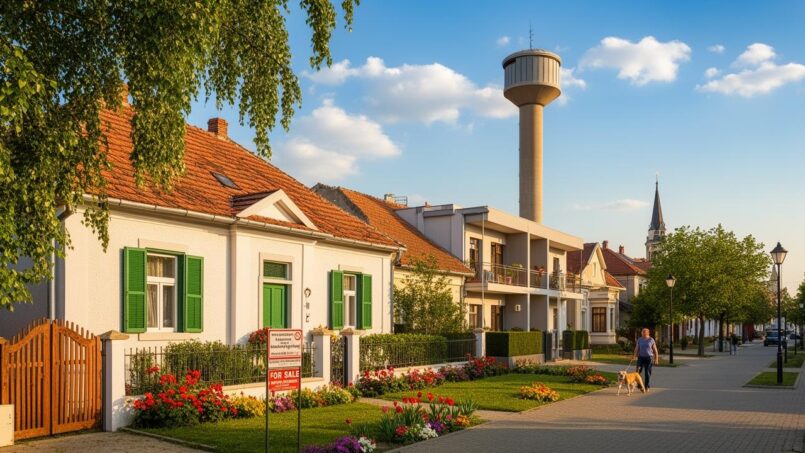
Nestled in the heart of the Hungarian Great Plain, Kiskunfélegyháza doesn’t make headlines like Budapest or Debrecen. Yet, for a patient and rational real estate investor, this midsize city checks more and more boxes: still reasonable prices, modernized infrastructure, a growing job market, and an extremely peaceful environment just an hour and a half by highway from the capital and the airport.
The Hungarian city of Kiskunfélegyháza is located in an area officially identified as “developing.” It benefits from significant industrial investments with companies like Daimler-Benz, Fornetti, Lidl, Purina, and Unilever present in the region. This economic momentum is beginning to translate into growth in the real estate sector.
A Still Affordable Local Market in a Sharply Rising Country
While the Hungarian residential market has seen soaring prices for several years, Kiskunfélegyháza remains significantly below the national average. According to the most recent data, property prices in the city are about 34% lower than the country’s average and 3% below the county average.
In other words, in a context where the Hungarian National Bank measures an annual increase in residential prices of over 15% nationally, Kiskunfélegyháza still offers a “discount” entry point compared to large cities and some sought-after regions.
The average housing price in Hungary has more than tripled since 2015.
How does Kiskunfélegyháza position itself relative to the rest of the country?
To situate the city, one must look at the regional benchmarks. In the first quarter of 2025, the average price per square meter for older apartments was over 1.1 million forints in Budapest, around 1 million in large provincial cities, and significantly less in the Southern Great Plain, where Kiskunfélegyháza is located.
Here is a reminder of the regional average prices for older apartments, to compare with local levels:
| Region (older apartments, Q1 2025) | Average price per m² (HUF) |
|---|---|
| Budapest | 1,162,000 |
| Pest | 553,000 |
| Central Transdanubia | 513,000 |
| Western Transdanubia | 503,000 |
| Southern Transdanubia | 403,000 |
| Northern Great Plain | 313,000 |
| Southern Great Plain | 331,000 |
Kiskunfélegyháza is located in Bács-Kiskun county, therefore in the Southern Great Plain, where average prices are still well below those of Budapest and tourist areas like Balaton. For a foreign investor used to Western European prices, the gap is significant.
Demographic and Economic Portrait of Kiskunfélegyháza
Investing outside major capitals requires understanding the local fabric: population, age, employment, companies, infrastructure. This is especially true for a city like Kiskunfélegyháza, which has experienced slow demographic erosion but compensates with a relatively solid economic base.
A Midsize City with Managed Demographic Decline
The municipality had just over 35,000 inhabitants in the 1980s; it now records fewer than 30,000 residents. Successive censuses show a gradual decline: approximately 35,414 inhabitants in 1980, 34,220 in 1990, 32,632 in 2001, 30,172 in 2011, and 28,872 in 2022. Estimates for 2025 range from around 28,400 to just over 30,000 inhabitants depending on the source.
Between 2016 and 2021, the population declined by an average of 0.37% per year, accelerating to nearly –0.8% during the 2018–2021 period. The population is also aging: the median age reaches 42.3 years, with a slight differential between men (39.2 years) and women (45 years). In 2022, there were about 4,100 children aged 0 to 14, over 18,000 residents of working age (15–64), and nearly 6,400 people aged 65 and over.
Although Hungary has been experiencing long-term demographic decline, the real estate market remains dynamic with rising prices, driven by increasing incomes, access to credit, and a strong cultural preference for investing in real estate.
With a density of about 114 to 121 inhabitants per km² over an area of 250.7 km², Kiskunfélegyháza remains a low-density city, with a lot of available space, which is also reflected in the supply of single-family homes and land.
An Economic Fabric More Solid Than It Appears
Behind this demographic erosion, several economic indicators are positive. Already in the 1990s, the local unemployment rate remained limited (around 3.6% in 1996), with a significant proportion of long-term unemployed, a sign of a hard core, but a base of working population relatively integrated.
The number of economic organizations increased by nearly 70% between 1992 and 1996.
This is complemented by the presence of major industrial names in the region. Daimler-Benz has invested in a nearby plant (the major site is in Kecskemét, a few dozen kilometers away). Lidl has established a significant logistics center there. Purina, Unilever, Fornetti, and other groups have strengthened their industrial or logistics capabilities in the Kiskunfélegyháza and Kecskemét area. An expansion of the Fornetti factory in the city represented an investment of about 1 billion forints, creating 50 direct jobs and several hundred indirect jobs.
These establishments constitute a base of rental demand for skilled and unskilled workers, particularly in the family home and mid-sized apartment segments.
A City in Transformation: Renovated Center, Activity Zones, Sports Facilities
One of Kiskunfélegyháza’s underestimated assets lies in the scale of recent urban works, largely co-financed by the European Union. For a real estate investor, this type of project is not anecdotal: it changes neighborhood attractiveness, secures property value, and improves the quality of life for future occupants.
A Fully Upgraded City Center
After decades without major renovation, the center of Kiskunfélegyháza underwent a profound transformation. In 2020, the city core was completely redeveloped over about 27 hectares, with a particular focus on green spaces and public squares.
The central square Béke tér was transformed to better showcase its historical heritage while meeting current needs. The works increased the area and quality of green spaces, improved accessibility for all, and created a more welcoming gathering place to invigorate local life. The market was notably modernized, offering local producers a more attractive and functional infrastructure.
The project, part of a European program (TOP-2.1.2-15-BK1-2016-00004), incorporated elements of sustainability: renovation of the stormwater network, more economical public lighting, installation of bicycle racks, revision of traffic and parking plans to better balance car and bicycle flows.
These investments do not directly create rental yield, but they enhance the residential desirability of the surrounding streets. In a midsize city, an apartment overlooking a renovated square, with shops and pedestrian spaces, rents and sells more easily than a property in a neglected neighborhood.
An Expanding Industrial Park
Another structuring project: the extension of the Kiskunfélegyháza Industrial Park. By the end of 2016, the fully developed plots in the existing industrial park were almost all occupied. To continue attracting companies and jobs, the municipality launched a second phase of development (Industrial Park Phase II), with the support of European funds (program TOP-1.1.1-16).
Phase II of the project, covering over 30 hectares, imposes strict criteria regarding renewable energy. It is mandatory that 30% of roof surfaces are suitable for installing solar panels and that at least 50% of thermal needs are covered by renewable energy. The works also include site preparation, roads, various networks, an electrical substation, and the renovation of an existing building.
For investors, the interest is twofold. On one hand, this park attracts or retains companies, hence jobs and local purchasing power, which supports rental demand. On the other hand, urbanization around the park generates long-term needs for affordable housing for employees, particularly family homes and moderately priced apartments.
A Large Sports and Leisure Park for Families
The renovation of the so-called “Vasas” track into a vast multifunctional sports park illustrates another dimension of the local strategy: making the city more attractive to families and young people. Thanks to European funding of 600 million forints via the TOP Plusz program, the municipality is transforming a former site into a park of nearly 5.6 hectares, of which about 2.6 hectares are built.
The park project includes a variety of sports, recreational, and wellness facilities, integrated into a modern, tree-filled green space.
400-meter running track, bike pumptrack, and an asphalt road safety education course.
Playground, zip line, streetball court with shock-absorbing surface, and vast lawns.
Street workout zone for adults and a dog park with agility equipment.
Drinking fountain, restroom facilities, and modern street furniture.
Planting of nearly 286 trees to complete the site landscaping.
In a city of this size, having such a facility near the center significantly strengthens the quality of life argument – an increasingly decisive criterion for young households and remote workers comparing several provincial cities.
Anatomy of the Local Real Estate Market: Prices, Property Types, Concrete Examples
Available data on Kiskunfélegyháza allows us to go beyond general impressions. We can analyze the price structure, typical sizes, and some recent listings to get a fairly precise idea of valuation levels.
The Big Picture: Residential, Houses, Apartments
Aggregate statistics first show that the residential market is dominated by relatively generous sizes. The average size of a residential property is about 101 m², with an average price per square meter close to 374,000 HUF. This leads to an average total price around 38.4 million forints, with a range from about 3.3 million for the most modest properties to 149 million forints for the most expensive ones.
For single-family houses (family homes), the average size even exceeds 120 m², with an average price per square meter of about 346,000 HUF. On average, a house costs around 44.4 million forints, again with a very wide range between small older houses and large properties.
Average square meterage of brick apartments in Hungary.
Finally, the townhouse segment remains more anecdotal in volume, with an average size of 91 m², but significantly higher prices per square meter (about 571,000 HUF), for an average price of about 43.5 million forints.
The table below summarizes these orders of magnitude:
| Property Type | Average Size (m²) | Average Price per m² (HUF) | Average Total Price (HUF) |
|---|---|---|---|
| Residential (all types) | 101 | 374,352 | 38,426,469 |
| Single-family houses | 120 | 346,385 | 44,410,397 |
| Brick apartments | 65 | 436,778 | 27,959,725 |
| Panel apartments | 55 | 382,141 | 21,028,823 |
| Townhouses | 91 | 571,428 | 43,500,000 |
For an investor, these figures suggest two things. On one hand, the supply is dominated by large sizes, which can reduce liquidity in certain price ranges but increases the potential for transformation (division, co-living, renting to large families, etc.). On the other hand, the price gap between single-family houses and apartments remains moderate, making family homes particularly attractive for those targeting long-term rental.
Concrete Listings: From 14 to 159 Million Forints
Recent listings show a great diversity of prices and profiles, but they illustrate the market structure well.
The price per square meter can reach 900,000 HUF for prestige properties, a level comparable to the country’s most expensive cities.
Here are some examples of listings with their prices and valuations per square meter (amounts converted to euros for indicative purposes):
| Asking Price (HUF) | Approx. Price (€) | Price per m² (HUF) |
|---|---|---|
| 14,000,000 | ~35,623 | 325,581 |
| 21,990,000 | ~55,954 | 343,594 |
| 29,500,000 | ~75,064 | 252,137 |
| 29,990,000 | ~76,310 | 468,594 |
| 33,000,000 | ~83,969 | 578,947 |
| 49,900,000 | ~126,972 | 262,632 |
| 53,900,000 | ~137,150 | 709,211 |
| 118,500,000 | ~301,527 | 904,580 |
| 124,900,000 | ~317,812 | 1,249,000 |
| 159,000,000 | ~404,580 | 697,368 |
We note the very wide range of prices per square meter: some properties remain below 300,000 HUF/m², while others exceed one million forints per m². This dispersion reflects differences in location (center or periphery), quality (renovated or not, amenities, insulation), size, and sometimes simple overestimation by sellers.
For an investor, it is precisely this type of heterogeneous market that allows one to “shop around” and buy below intrinsic value, provided each case is carefully analyzed.
Alongside these spectacular listings, there are also very modest properties, such as this portion of a house of 60 m² with two rooms and a private courtyard, offered for 8 million forints. This kind of opportunity can interest a hands-on investor or a buyer aiming for a first acquisition with a very low entry price.
Rental Yield: What Can Reasonably Be Expected
Specific data on rents in Kiskunfélegyháza are scarcer than for Budapest or large university cities. But we can rely on average yields observed in Hungary and in provincial cities to estimate an order of magnitude.
At the national level, the average gross rental yield is around 5 to 5.25%, with variations depending on the city and segment. In Budapest, it’s more around 4.5 to 5% gross, with well-located apartments of 25 to 45 m² potentially reaching 5.5 to 6.5% gross yield.
In Hungarian regional cities such as Debrecen, Pécs, or Nyíregyháza, average gross rental yields are typically between 4.9% and 5.5%. Studios and small apartments located near universities or employment areas can achieve yields slightly above this range.
Given the significantly lower prices in Kiskunfélegyháza, but also likely lower rents than in large cities, one can reasonably anticipate gross yields in a comparable range, or even slightly higher for very well-purchased properties (below 300,000 HUF/m²) and properly renovated ones.
However, it must be kept in mind that the net yield, after expenses, maintenance, vacancy, and taxes, will be 1.5 to 2 percentage points lower than these gross values, as everywhere in Hungary. A net yield around 3 to 4% remains a realistic target for a well-managed rental investment in a midsize city.
Taxation and Acquisition Costs: What an Investor Pays
The Hungarian tax framework applied to real estate is relatively simple and rather favorable to investors compared to some Western European countries. It applies identically to Kiskunfélegyháza and other cities.
Transfer Tax and VAT
When purchasing an existing property (resale), the buyer pays a transfer tax of 4% on the market value, up to one billion forints. Beyond this threshold, the rate drops to 2% on the portion exceeding one billion, capped at 200 million forints per property. In case of financial difficulties, it is possible to request a 12-month installment plan.
The transfer tax amounts to 1.6 million forints for a property valued at 40 million forints.
For new constructions, VAT applies, in principle included in the price. The standard rate is 27%, but a reduced rate of 5% is extended for certain new homes until the end of 2026 (and, under conditions, until the end of 2030 for projects already started). This reduced rate applies to the first 150 m² for an apartment and the first 300 m² for a new single-family house.
Ancillary Costs and Foreigners’ Rights
In addition to these taxes, there are administrative fees (land registry registration around 10,600 HUF, increased by about 16,000 HUF for an expedited procedure), notary fees (often between 0.01 and 0.05% of the property value), and lawyer fees, most often between 1 and 5% of the purchase price, with bilingual contracts slightly more expensive.
Persons who are not nationals of the European Union must obtain acquisition authorization from the local prefecture. The processing time is generally 2 to 4 weeks, at a cost of about 65,000 HUF (approx. €160). This is an administrative step and does not hinder acquisitions, except in special cases.
In total, combining taxes and fees, the acquisition cost is generally between 2.5 and 5.5% of the sale price, which remains reasonable.
Taxation During Ownership and Upon Resale
One of Hungary’s attractive points lies in the absence of a national property tax. The only possible recurring taxes are local taxes decided at the municipal level – and not all apply them.
Local Taxes, Charges, and Rental
Municipalities can establish a building tax and a land tax, with regulatory ceilings: for example, up to 1,100 HUF/m² or 3.6% of the adjusted market value for the building tax, and up to 200 HUF/m² or 3% of this same value for the land tax. In many cities, residences used exclusively for residential purposes are exempt from this building tax.
This is the indicative monthly amount for common charges for an 85 m² apartment in a Hungarian city.
Rental income received by an individual is subject to a flat tax of 15% on net income. The landlord can deduct documented actual expenses or, more simply, a 10% expense allowance, in which case 90% of the gross rent becomes the taxable base.
Capital Gains Tax
Upon resale, real estate capital gains are also taxed at 15%, but with a very advantageous degressive mechanism for long-term holdings. The taxable base is equal to the difference between the sale price and the acquisition cost increased by renovation costs and transaction-related fees.
The longer a property has been held, the smaller the portion of its gain that is actually subject to tax.
| Year of resale after purchase | Portion of gain subject to tax |
|---|---|
| 1st year | 100% |
| 2nd year | 90% |
| 3rd year | 60% |
| 4th year | 30% |
| From the 5th year onward | 0% (full exemption) |
For a long-term investor with a horizon of five years or more, this system therefore amounts to completely eliminating the capital gains tax, which significantly improves the overall return.
Financing: Subsidized Programs and Access for Foreigners
In recent years, Hungary has multiplied programs to support homeownership, which, in fact, also boost demand and push prices upward. Among these programs, Otthon Start now occupies a central place.
Otthon Start: A Lever for Resident Buyers
Announced in 2025 and open for applications from September of the same year, Otthon Start offers a fixed-rate mortgage loan at 3% for a term of up to 25 years, for a maximum amount of 50 million forints (approx. €125,000). The minimum down payment is 10% of the property price, reducing the barrier of the initial contribution.
The program primarily targets first-time buyers but also accepts people who have previously been owners, provided their previous ownership share did not exceed 50%. All applicants must have been affiliated with the Hungarian social security system for at least two years. For foreigners, this condition generally requires holding a Hungarian address card (lakcímkártya) and resident status, or, for EU citizens, local registration.
Eligible properties can be apartments or houses, new or old, in the city or countryside, subject to several ceilings: maximum purchase price of 100 million HUF for an apartment and 150 million HUF for a house, maximum price of 1.5 million HUF per m².
For a property in Kiskunfélegyháza, these ceilings are well above market reality. In practice, almost all residential properties in the city could fit within the limits, meaning the program can help support local demand, particularly from young households.
Conventional Financing for Non-Residents
For a foreign investor who does not meet the Otthon Start criteria, conventional bank financing remains. Market-rate mortgage loans are currently around 6.5 to 8.5% APR, with a required down payment of at least 20% (often more for non-residents).
Banks mainly grant loans in forints, but some also offer loans in euros or Swiss francs. Income earned abroad may be accepted for calculating borrowing capacity, but it is sometimes discounted to account for exchange rate risk and potential difficulties in recovery in case of default.
Loan-to-value ratios (LTV) are generally between 50 and 70% for foreigners, with stricter requirements for certain profiles (e.g., U.S. citizens, subject to FATCA regulation constraints). In practice, a serious foreign investor often needs to plan for a down payment of 30 to 40% of the purchase price.
An example of a typical loan illustrates the order of magnitude: for a loan of 20 million forints over 20 years at 6.5%, the monthly payment is around 149,000 HUF, for a total repayment cost approaching 35.8 million HUF.
Important: owning property in Hungary does not automatically grant the right to a residence permit. Hungary does offer a “Golden Visa”-type scheme via an investor residence permit, but this requires investing at least €250,000 in an approved real estate investment fund, not in a direct property.
Renting in Kiskunfélegyháza: Long-term, Seasonal, What Prospects?
Unlike Budapest or Balaton, Kiskunfélegyháza is not (yet) a major hub for tourist rentals like Airbnb. There are some seasonal rentals and vacation homes, but the rental market is primarily residential and linked to local employment.
Classic Rental: Employees, Families, Seniors
With the presence of factories, services, schools, and modernized infrastructure, the main rental demand comes from local households: young couples, families with children, retirees, employees of neighboring companies. The typical rental property profile will therefore be a modest single-family house, an apartment of 55 to 80 m², or a comfortable city-center apartment without ostentatious luxury.
This is the percentage increase in rents at the national level between 2021 and early 2026 in nominal terms.
We can expect Kiskunfélegyháza to follow this trend: the supply of “as-is” low-rent housing is shrinking, while demand for updated apartments remains strong, particularly from skilled workers attracted by the region’s industrial jobs.
Tourist and Short-Term Rentals: Limited but Real Potential
Kiskunfélegyháza has cultural assets (monuments, museums) and a pleasant natural environment, with renowned neighboring villages and peaceful countryside. The city is also well-connected by rail (Kiskunfélegyháza station) and highway, making it a possible stop on regional tourist routes.
Several points of interest are located within a 30 to 40 km radius, including the Ópusztaszer National Heritage Park, the Zoltán Benkő Amusement Park, the beaches of Tiszakécske, as well as wine cellars, baths, and zoos in Kecskemét. To meet demand for short-term rentals, prioritize properties equipped with a full kitchen, outdoor space, WiFi, free parking, and ideally, air conditioning.
However, comparison with hyper-touristic areas like Budapest or Balaton quickly highlights the limits of this model in Kiskunfélegyháza: seasonality is more pronounced, tourist volumes are much lower, and regulations on short-term rentals are tightening in large cities but remain more flexible elsewhere for now.
For an investor, seasonal rental could constitute an income supplement for some well-located properties, but the most robust strategy remains long-term rental to residents.
Why Kiskunfélegyháza Can Interest a Real Estate Investor
Overall, Kiskunfélegyháza will not suit all investor profiles. Those seeking short-term returns driven by explosive tourist demand will be better off looking elsewhere. On the other hand, for a patient investor, oriented toward wealth building and reasonable cash flow, the city presents several solid arguments.
Still Low Prices, with Catch-Up Potential
With an average level about one-third below the national average, Kiskunfélegyháza offers an affordable entry point, even for a foreign investor. The price gap with large cities is justified by the demographic and economic profile, but it also seems to reflect a lag in valuation compared to the national rise in recent years.
The city is investing heavily in its city center, sports facilities, schools, and industrial park, aiming to become an attractive regional hub in the Southern Great Plain. If this strategy succeeds, well-located properties (in the renovated center or near new infrastructure) could benefit from appreciation above the provincial average.
A More Diversified Economic Environment Than a Simple Rural Town
Between the region’s automotive plants, the Lidl logistics center, the Fornetti factory, and other agri-food or industrial companies, Kiskunfélegyháza benefits from a job market that far exceeds just administrative services. This is a key element for the stability of rental demand: when employees receive a regular income, they are able to pay decent rent, and vacancy remains limited.
Hungary is strengthening its attractiveness for international investors by supporting SMEs in particular through national programs, such as the Ányos Jedlik Energy Program which aims to improve the energy efficiency of companies outside Budapest.
A Quality of Life That Is Promoted
Finally, the municipality has clearly bet on quality of life to retain its population and attract new residents: large green spaces, a renovated center, bike paths, modernized public lighting, refurbished squares and markets, a family sports park, modernized kindergartens. In a Europe where remote work is becoming commonplace, more and more households are willing to live in quiet secondary cities, provided they have a good internet connection, basic services, and a pleasant environment.
Kiskunfélegyháza, well-connected to Budapest and the airport by highway, can be perceived as a “slow” alternative to life in the capital, while remaining at a reasonable distance from major centers.
Points of Vigilance for an Investment Project
Not everything is rosy, however, and a successful investment in Kiskunfélegyháza requires taking into account several specific risks.
Demographics, first: the population is declining, aging, and this can weigh on housing demand in certain segments, particularly large old apartments without renovation. The investor must therefore select properties suited to the real needs of the local market (intermediate sizes, energy-renovated homes, functional family houses rather than overly large spaces that are difficult to heat).
In Hungary, the sustained rise in prices is fueled by subsidized loan programs. Economists warn that this momentum could fade in the medium term, when these schemes end and interest rate declines cease. It is therefore crucial to avoid overpaying for a property by speculating solely on continuous market appreciation.
Finally, remote management: the majority of structured property management services are based in Budapest. For a property in Kiskunfélegyháza, the investor will have to either rely on local actors (agencies, property managers, craftsmen) or accept managing visits, maintenance, and tenant relations themselves, which is not insignificant for a foreign investor.
In Conclusion
Investing in real estate in Kiskunfélegyháza means betting on a midsize city in the Hungarian Great Plain that is reinventing itself with ambitious urban projects and industrial developments, in a country where real estate remains the preferred investment of households and where residential prices are rising rapidly.
Current valuation levels, significantly below the national average, offer room for maneuver for investors. To benefit from this, it is crucial to identify well-located properties, negotiate by leveraging price disparities per square meter, and offer housing that meets current expectations for comfort, energy efficiency, and modernity.
It is not a market for quick speculation or spectacular immediate returns, but rather a ground for patiently building a portfolio generating a decent net yield, backed by tangible assets in a city whose fundamentals – infrastructure, employment, quality of life – are strengthening year after year.
A wealth management project or a question? Contact us now to speak with a wealth management expert.
Disclaimer: The information provided on this website is for informational purposes only and does not constitute financial, legal, or professional advice. We encourage you to consult qualified experts before making any investment, real estate, or expatriation decisions. Although we strive to maintain up-to-date and accurate information, we do not guarantee the completeness, accuracy, or timeliness of the proposed content. As investment and expatriation involve risks, we disclaim any liability for potential losses or damages arising from the use of this site. Your use of this site confirms your acceptance of these terms and your understanding of the associated risks.

Cyril Jarnias is an independent expert in international wealth management with over 20 years of experience. As an expatriate himself, he is dedicated to helping individuals and business leaders build, protect, and pass on their wealth with complete peace of mind.
On his website, cyriljarnias.com, he shares his expertise on international real estate, offshore company formation, and expatriation.
Thanks to his expertise, he offers sound advice to optimize his clients' wealth management. Cyril Jarnias is also recognized for his appearances in many prestigious media outlets such as BFM Business, les Français de l’étranger, Le Figaro, Les Echos, and Mieux vivre votre argent, where he shares his knowledge and know-how in wealth management.





