
 Published on and written by Cyril Jarnias
The Hungarian real estate market is experiencing a paradoxical period. Prices have literally exploded since 2015, to the point where the Hungarian National Bank estimates they now exceed what economic fundamentals would justify by nearly 14%. Yet demand remains solid, driven by very generous public programs, still-limited supply, and the growing appeal of major regional cities.
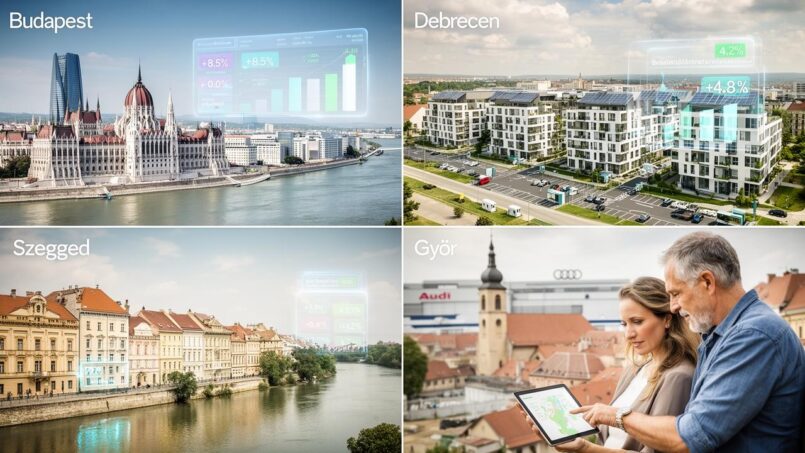
The 4 key cities of the Hungarian real estate market
Budapest and three major regional centers present distinct price profiles, rental yields, and prospects for buyers and investors.
Budapest
Capital and main attraction hub, with the highest prices in the country and strong rental demand.
Debrecen
Dynamic regional center in the east, offering moderate prices and attractive rental yields thanks to its economic boom.
Szeged
Southern university city, combining affordable prices and rental demand supported by students and local investments.
Győr
Industrial and logistics hub near Austria, with competitive prices and good appreciation prospects linked to jobs.
A Hungarian market overheated but stabilizing
Price trends across the country set the tone. Since 2010, housing values have risen by about 260%, the highest increase in the European Union. Since 2015, prices have multiplied by 2.5 while the European average sits around 1.5. Even adjusted for inflation, the rise remains exceptional: around +70% in seven years, compared to around +30% in the eurozone.
23.5
The nominal progression of real estate prices in Hungary reached nearly 23.5% over the year 2025, the strongest real gain in a quarter century.
This surge is largely fueled by structurally insufficient supply. In 2024, barely 13,300 new homes were delivered, a low since 2016, while building permits only began to pick up again in 2025. Over the first three quarters of 2025, housing starts even fell by about 14% even as demand continued to rise.
The turning point, however, is emerging in 2026. Authorities and major networks still forecast price increases, but at a less violent pace. Dominant predictions place the overall increase for the year at 6 to 10% nationally, with a market more oriented toward stabilization than a new surge. The MNB and major private players (OTP, RE/MAX) speak of a “slowing of dynamics” rather than a reversal.
Forecasts from authorities and major networks (MNB, OTP, RE/MAX)
The key role of the Otthon Start program in the price surge
It is impossible to understand current levels without mentioning the huge boost from the subsidized loan program Otthon Start. Launched in autumn 2025, this program grants first-time buyers a fixed-rate mortgage of 3% over 25 years, while market rates still hover around 6.5–7% for new loans.
The effect on purchasing power is spectacular: for the same income, an eligible household can borrow much more than with a conventional loan, while the monthly payment remains the same. Banks and the MNB estimate that a household with access to Otthon Start can support this loan with an income about 30% lower than that required for a market-rate loan.
Good to know:
The program’s caps now influence a large part of the market.
– maximum property price: 100 million HUF for an apartment, 150 million HUF for a single-family home
– maximum price per square meter: 1.5 million HUF/m²
– loan amount capped at 50 million HUF
– minimum down payment reduced to 10% instead of the usual 20%
81
The share of subsidized loans in mortgage production rose from 23% to 81% between end-2024 and the first quarter of 2026.
This massive influx of new buyers has pushed prices upward, especially in large cities. The central bank now assesses housing overvaluation at around 14% relative to fundamentals (and up to 20% in some scenarios). At the same time, homeownership has partially opened up for young households who, without subsidies, would have remained renters.
The mechanism also produces a significant effect on the rental market: many students or young workers who would have rented a home are now switching to buying, which reduces rental demand in some segments and puts slight downward pressure on rents, even as purchase prices continue to climb.
Budapest: an exceptional capital, between tension and micro-markets
Budapest remains by far the most expensive and most closely watched market in the country. At the beginning of 2026, the median price is around 1.4 million forints per square meter, or about 3,600–3,700 euros. The average for standard homes hovers around 1.45–1.5 million HUF/m², which, converted into currency, places the Hungarian capital in a range equivalent to 3,700–3,900 euros/m² – well below Prague or Vienna, but above most Central European cities.
A “standard” apartment (50–70 m²) typically ranges between 50 and 100 million forints, with an average budget of about 75 million HUF, roughly 193,000 euros. For a first-time buyer, the typical entry point is a two-room unit: around 65 million HUF for a one-bedroom, 94 million HUF for a two-bedroom, 123 million HUF for a three-bedroom, excluding additional costs.
Overall price ranges in Budapest
Across all transactions, approximately 80% of residential purchases fall within a band of 30 to 160 million forints (75,000 to 400,000 euros). The lower end of this range is dominated by condominium apartments, often in peripheral districts or older buildings. The upper end is occupied by family homes and high-end apartments in the most sought-after areas.
The Budapest market actually breaks down into a mosaic of micro-markets, where price differences are dizzying from one neighborhood to another.
Price differences by district
The most expensive neighborhoods are concentrated in the Buda hills (districts II and XII), the first district around the castle, and especially the historic heart of Pest (district V, Belváros-Lipótváros). In these areas, prices easily settle between 1.9 and 2.4 million HUF/m², sometimes more for very high-end new builds. In euros, this means levels roughly between 4,950 and 6,250 €/m².
850,000
The average price per square meter in the peripheral districts of Pest is about 850,000 forints in 2026.
The following table summarizes the orders of magnitude for some types of Budapest districts.
| Budapest Zone | Typical price level (HUF/m²) | Approximate equivalent (€/m²) |
|---|---|---|
| Hypercenter / Buda hills (V, I, II, XII) | 1,900,000 – 2,400,000 | 4,950 – 6,250 |
| Affluent districts like XIII, XI | 1,500,000 – 1,700,000 | 3,900 – 4,400 |
| Stressed central districts (VI, VII) | 1,500,000 – 1,630,000 | 3,700 – 4,100 |
| “Affordable” periphery (XXI, XXIII, XVII, XVIII) | 950,000 – 1,250,000 | 2,470 – 3,250 |
Some market data illustrate these contrasts. The 23rd district (Soroksár), for example, is the cheapest district in the city, with a median price around 901,000 HUF/m² and a median listing price of 89.7 million HUF. At the opposite end, the 13th district (Angyalföld–Újlipótváros) concentrates the largest number of properties for sale, with nearly 3,700 listings in mid-May, a median price around 1.65 million HUF/m², and a median total price around 99 million HUF.
1.67 million
The median price per square meter in the highly sought-after 11th district (Újbuda) exceeds this value.
New vs. old: a widening gap
The differential between new construction and existing stock is particularly pronounced in Budapest. In 2026, a new apartment costs on average around 1.77 to 1.85 million HUF/m², equivalent to 4,700–4,900 €/m², while a second-hand home trades more around 1.2 to 1.45 million HUF/m². Depending on the source, the gap ranges from +25% to +50% in favor of new builds.
In some upscale areas, such as the 6th district, new developments even exceed 3 million forints per square meter, a historic record. The Buda hills (I, II, XII) also concentrate many high-end projects, between 2 and 2.5 million HUF/m² for new construction, while well-maintained older properties there already often exceed 1.5 million HUF/m².
Attention:
The government has set, via Otthon Start, a cap of 1.5 million HUF/m² for properties eligible for the subsidized rate. As a result, developers are readjusting their products in outer districts and the agglomeration to stay under this threshold and tap into the client base enabled by the program, while very high-end products, above the per-square-meter caps or the overall cap of 100 to 150 million, slide into a narrower, less liquid market highly exposed to a potential correction.
Rental yields and holding costs in Budapest
On the rental front, Budapest has experienced significant catch-up. In 2025, rents had risen by about 9.6% year-on-year in the capital, before experiencing a slight lull. In March 2026, the nominal rent index for Budapest was 72% above its 2021 baseline (and 17% in real terms), while only increasing by about 6–7% year-on-year.
The average asking rent in the first half of 2025 was around 264,000 forints per month, a value just slightly below the Pest region. For a one- or two-bedroom apartment, charges excluding condominium fees typically range between 25,000 and 60,000 HUF per month (65 to 160 euros), which remains relatively moderate relative to the purchase cost.
In this context, observed gross yields for apartments hover around 5% in the capital (about 5.06% according to some studies), slightly down from 2024 levels. Note that net yields drop by 1.5 to 2 percentage points once management, maintenance, taxes, and vacancy periods are deducted.
Buyers must also factor in ancillary costs when acquiring. For an older property in good condition, the cumulative taxes/transfer duties/notary and agency fees generally represent 5 to 6% of the purchase price. If major renovations are planned, the total budget can easily increase by 15 to 35% relative to the acquisition price.
Debrecen: second city, but first regional engine
While Budapest remains the country’s showcase, Debrecen is increasingly attracting investor attention. With about 201,000 inhabitants, Hungary’s “second city” combines an internationally ranked university, advanced industrial hubs, and major infrastructure projects. Since 2015, over 12.5 billion euros in investments have been announced, including a BMW electric vehicle plant and numerous subcontracting and pharmaceutical production sites. Local authorities estimate that more than 25,000 new homes will need to be built by 2030 to absorb the influx of jobs—over 20,000 announced positions, about half already filled.
Price levels and dynamics in Debrecen
Recent figures place Debrecen at the top among provincial cities in terms of prices. In February 2026, several converging sources estimate the average price around 1.03 to 1.05 million forints per square meter, or about 2,200 €/m². That is roughly 40% less than Budapest, valued at 3,150 €/m² in the same reports. The price for existing stock is slightly lower, around 882,000 HUF/m², while new construction ranges between 1.4 and 1.5 million HUF/m² in the most sought-after areas.
2,800
The price per square meter in central districts or near the university can reach up to 2,800 euros.
A typical 65 m² in the city thus costs around 66 to 70 million HUF. In European terms, a 60 m² apartment costs about 132,000 euros, compared to 180,000 to 192,000 euros for a similar property in some highly demanded districts of Budapest (7th or 13th).
The following table compares the cost of a typical 60 m² between Debrecen and two sought-after districts of the capital.
| Location | Estimated price for 60 m² (HUF) | Estimated price for 60 m² (EUR) | Premium vs. Debrecen |
|---|---|---|---|
| Debrecen (city average) | ~53,300,000 | ~132,000 | — |
| Budapest, 13th district | ~72,000,000 | ~180,000 | +36% |
| Budapest, 7th district | ~76,800,000 | ~192,000 | +45% |
Since 2019, Debrecen has seen its prices increase by about 120%. In some neighborhoods near the BMW plant or in the western agglomeration, annual increases now oscillate between 14 and 20%, rates comparable to those recorded in some segments of Budapest at the peak of the cycle.
Rental yields and demand profile in Debrecen
One of Debrecen‘s major assets remains its rental profitability. Analyses report gross yields frequently exceeding 5%, around 5.29–5.30%, a notch above Budapest. This performance is explained by rents that, while 24% lower than in the capital in absolute terms, are proportionally high relative to still-lower purchase values.
In practice, average rents are around:
– 300–400 €/month for a one-bedroom (120,000–160,000 HUF)
– 350–500 €/month for a two-bedroom (140,000–200,000 HUF)
– 450–600 €/month for a three-bedroom (180,000–240,000 HUF)
A typical investment in the 100,000–160,000 € range thus generates 300 to 500 € in monthly rent, providing a solid gross base in an environment of double-digit price increases.
Rental demand is both diversified and remarkably predictable. The University of Debrecen, with over 32,000 students including more than 8,000 internationals, fuels a constant stream of highly solvent tenants, especially in medicine and health programs where many foreign students have family guarantors. Added to this are workers from the new factories, mobile executives, and young families seeking housing near employment zones.
For investors willing to accept lower absolute rents than in Budapest, Debrecen thus offers a rare combination in Europe: still-moderate price levels for a city with strong growth potential, gross yield above 5%, and annual appreciation that in recent years has approached 13–17% in the best neighborhoods.
Szeged: a student and provincial market catching up fast
Szeged, often described as Hungary’s “sunniest city,” combines an attractive historical heritage, a dynamic university, and a high quality of life. Its real estate market remains significantly cheaper than the capital’s, but has been experiencing rapid catch-up in recent years, notably driven by student demand and a housing stock that is expanding slowly.
Price levels and market structure in Szeged
Available sources estimate the average price per square meter in the city within a fairly wide range, depending on whether one considers listings or actual transactions. Data from Housiko indicates an average price around 959,000–1,011,000 HUF/m² for all properties in 2026, with a median price around 63.9 million HUF and a median area of about 95 m². Apartments average around 1.08 million HUF/m², while houses are around 887,000 HUF/m².
Example:
According to some studies in euros, the average price per square meter at the start of 2026 would be around 1,735 €/m² (i.e., 670,000 HUF/m²), a level 30% lower than Budapest. This difference is explained by varied methodologies: average vs. median, listings vs. transactions, or different geographic perimeters.
To clarify the landscape, we can retain the following orders of magnitude:
| Indicator | Approximate value in Szeged |
|---|---|
| Average price (all properties) | 1,000,000 HUF/m² |
| Average price – apartments | 1,080,000 HUF/m² |
| Average price – houses | 887,000 HUF/m² |
| Estimated average price in € | ~1,735 €/m² |
| Typical price for 60 m² | ~40–45 million HUF (≈104,000 €) |
The recent dynamic is clearly upward. In 2025, asking prices per m² for apartments rose by about 18.5% year-on-year, while those for houses increased by nearly 15%. In the six months preceding June 2026, average prices gained another 3%, extending a trend already very strong in 2024, when rents notably jumped by 20 to 25%.
Market structure, however, shows strong internal disparities. The city center (Belváros) or neighborhoods near the Danube and the cathedral (around Dóm tér) show levels above 1,000,000 HUF/m², sometimes more, while housing estate districts (Újrókus, Tarján, Északi város lakótelep) are more around 600,000 to 700,000 HUF/m². Popular residential areas like Felsőváros or Újszeged regularly exceed 1 million HUF/m².
Rental market and university demand
The University of Szeged, with some 23,000 students including over 1,200 additional international students recruited in 2023 alone, plays a key role in market vitality. The presence of medical and pharmacy students, often supported by foreign families, pushes up rents for well-located small units around the center and major campuses.
30
Rents for properties catering to student or tourist demand could increase by about 30% over the next two years if demand continues to grow at the current rate.
Compared to other major Hungarian cities, Szeged sits slightly above the national average in terms of prices (about +2%), and significantly above the average of its own county (+20%). In other words, the city already plays its role as a “regional capital” by positioning itself as a pricier hub than the smaller surrounding localities.
Győr: the automotive city with sharply rising prices
Located on the Budapest–Vienna axis, Győr is another major industrial hub, heavily marked by the automotive and logistics sectors. This position makes it a very specific real estate market: relatively more affordable than Budapest, but more expensive than the regional average, with stable demand driven by industrial and university employment.
Price levels and dynamics in Győr
Available statistics show that Győr operates on a high price plateau for a provincial city. In 2025, the average price per m² reached about 776,000 HUF according to some surveys, before continuing to rise. The latest data now place the average level around 940,000 to 976,000 HUF/m², close to 2,170 €/m² for new builds.
72,800,000
The median total price of a property, reflecting a stock of family houses and apartments.
Interestingly, the increase in price per square meter (+14.1% year-on-year in the first quarter of 2025) was significantly faster than the increase in average price per home (+7% approximately). This reflects a particularly marked rise in small units, which are more expensive per m², driven by strong demand for compact, easily rentable properties.
Within the county, Győr sits about 1.9% above the average of its district (Győri járás), and the county itself shows prices 25% higher than the regional average. The gap confirms the city’s status as an economic and residential hub.
Demand profile and yields in Győr
The Győr market combines three drivers: a solid industrial base with large employers, a growing university, and a booming logistics sector. This combination creates relatively stable residential demand, both for purchase and rental, with a notable preference for well-maintained apartments near employment zones and major thoroughfares.
1-2
Good-quality brick apartments trade with margins of only 1 to 2% below the asking price, indicating strong tension in this segment.
Rental yields are generally slightly lower than in Debrecen but remain competitive compared to Budapest for a lower entry ticket, especially when targeting small units near industrial zones or the campus.
Cross-sectional comparison: Budapest vs. Debrecen, Szeged, Győr
Beyond individual figures, the interest for a buyer or investor is to understand the relative orders of magnitude between the capital and major regional cities. Several indicators from available data allow for a comparative overview.
Average prices per m² and relative position
Using the ranges and averages provided in the reports, we can present the following overview.
| City | Approximate average price (HUF/m²) | Approximate average price (€/m²) | Difference vs. Budapest |
|---|---|---|---|
| Budapest | 1,400,000 – 1,500,000 | 3,600 – 3,900 | — |
| Debrecen | ~1,030,000 – 1,050,000 | ≈ 2,200 | –40% approx. |
| Szeged | ~950,000 – 1,000,000 | ≈ 1,700 – 1,800 | –30 to –35% |
| Győr | ~940,000 – 976,000 | ≈ 2,100 – 2,200 | –30% approx. |
These figures confirm several structural elements:
Tip:
Budapest exceeds major regional cities by 30 to 40%. Debrecen is the most expensive provincial city, closely followed by industrial stronghold Győr. Szeged, while slightly more affordable, has experienced very vigorous recent dynamics.
Price typology for a “standard” home
For a buyer considering a family apartment of 60–70 m², the budgets required vary greatly depending on the city. Incorporating the provided data (price per m², concrete examples of properties), we obtain the following orders of magnitude:
| City / property type | Typical price for 60–65 m² (HUF) | Typical price for 60–65 m² (EUR) |
|---|---|---|
| Budapest – average apartment | 70 – 90 M HUF | 180,000 – 235,000 |
| Debrecen – 65 m² in the city | ~67 M HUF | ~170,000 |
| Szeged – 60 m² well-located | 40 – 45 M HUF | ~104,000 |
| Győr – 60 m² new (estimate) | 55 – 60 M HUF | 140,000 – 150,000 |
The figures show that a household with a budget of 100,000 to 150,000 euros can hardly aim for anything but modest properties in Budapest, whereas they can access more comfortable properties in Debrecen, Győr, or Szeged, sometimes in central or highly demanded neighborhoods.
Comparative rental yields
In terms of yield, the available studies converge on a fairly clear observation:
Rental yields by Hungarian city
Summary of average gross yields observed in four major Hungarian cities, based on recent market data.
Budapest
Average gross yield around 5% for apartments. Trend toward compression as purchase prices rise faster than rents.
Debrecen
Gross yields on the order of 5.3% or slightly higher, supported by high rents relative to still-lower purchase prices than the capital.
Szeged
Few consolidated figures, but rents jumped 20–25% in 2024. The lower price per m² suggests yields close to 5% in some neighborhoods.
Győr
Intermediate profile: reasonable yields on small units near industrial zones, but upward pressure on per-m² prices that may reduce margins.
In practice, investors seeking pure yield are increasingly turning to Debrecen and Szeged, where the rent-to-price ratio remains more favorable, while Budapest is increasingly seen as a wealth investment, relying on supply scarcity and long-term liquidity.
Upcoming trends: stabilization, selectivity, and the role of regional cities
Projections for 2026 highlight an unprecedented configuration. On one hand, the furious rise of 2025 – sometimes up to 30% year-on-year in some segments – seems behind us. On the other hand, the combination of a very powerful subsidized loan program, supply that is only gradually being replenished, and demand supported by major university and industrial cities keeps prices on an upward trajectory.
Good to know:
The National Bank and major networks consider the probability of a significant price decline in the next 12 months low, as long as the Otthon Start program continues and market rates stay below 7-8%. A new surge like 2025 is unlikely, as household purchasing power is reaching its limits, especially in Budapest.
In this context, Debrecen, Szeged, and Győr are expected to play a growing role. These cities still combine per-m² prices significantly lower than the capital with:
– solid economic drivers (automotive, pharmaceutical, logistics industries)
– top-tier universities generating structural rental demand
– public and private investment plans that enhance their attractiveness and lead to price increases above the national average
Good to know:
Hungary’s real estate landscape is reshaping around Budapest, dominant but costly, and booming regional satellites offering a more favorable price/yield ratio, for both Hungarian households and foreign investors.
In the short term, the major unknown remains the duration and scale of public support programs, first and foremost Otthon Start. As long as these subsidies remain massive, the market – whether in Budapest or major regional cities like Debrecen, Szeged, or Győr – should continue to operate at high intensity, with elevated prices, supply struggling to keep up, and increased selectivity favoring quality properties in the best locations.
A wealth project or a question? Contact us now to speak with a wealth management expert.

Cyril Jarnias is an independent expert in international wealth management with over 20 years of experience. As an expatriate himself, he is dedicated to helping individuals and business leaders build, protect, and pass on their wealth with complete peace of mind.
On his website, cyriljarnias.com, he shares his expertise on international real estate, offshore company formation, and expatriation.
Thanks to his expertise, he offers sound advice to optimize his clients' wealth management. Cyril Jarnias is also recognized for his appearances in many prestigious media outlets such as BFM Business, les Français de l’étranger, Le Figaro, Les Echos, and Mieux vivre votre argent, where he shares his knowledge and know-how in wealth management.





