
 Published on and written by Cyril Jarnias
Located halfway between Budapest, Vienna, and Bratislava, the city of Győr is establishing itself as one of the most strategic regional real estate markets in Central Europe. Long considered an industrially-driven automotive city, Győr now boasts several advantages that are attracting a growing number of investors: steady price growth, a strong job market, an expanding university, a booming logistics sector, and constant rental demand, both residential and student-focused.
Real estate investment in Győr, Hungary, is now considered a full-fledged strategy and no longer a niche. This European market has the advantage of still being affordable while offering genuine appreciation potential.
A High-Growth Hungarian Market Where Győr Stands Out
Before focusing on Győr, it’s important to place the city in the national context. Since 2010, Hungary has been one of Europe’s real estate champions: residential prices have surged by approximately 230%, a rate of increase exceeding that of all other European Union countries over the period. Between 2019 and 2024, major Hungarian cities saw their prices rise by 50 to 100%, with some areas of Budapest even doubling in five years.
Year-over-year progression of the Hungarian house price index in the third quarter of 2025.
In this landscape, university and industrial cities like Győr, Debrecen, or Szeged are clearly identified as drivers of the price increase. They benefit from a dual trend: the concentration of skilled jobs and the scarcity of truly affordable new supply.
Győr: An Already Dynamic Local Market, But Still Below Budapest Levels
Győr is located in the county of Győr-Moson-Sopron, one of the most expensive territories in the Western Transdanubia region. Recent data shows that Győr’s prices are approximately 1.9% above the average of its district (Győri járás), and that the county as a whole displays prices per square meter 24.8% higher than the regional average.
From an investor’s perspective, the Hungarian real estate market exhibits two main characteristics. On one hand, its tightness indicates strong demand, which is a positive signal. On the other, prices remain significantly lower than those of benchmarks like Budapest or certain resort areas such as Lake Balaton, suggesting potential for catch-up in the medium term.
How Much Does Property Cost in Győr?
Recent figures give a fairly accurate picture of the market, for both new-build and existing properties.
Price Levels in Győr
A set of recent data on listings in Győr allows the market to be summarized as follows:
| Indicator | Value in Győr |
|---|---|
| Average listed price per m² (all properties) | 940,075 HUF/m² |
| Median price of a property listed for sale | 72,775,000 HUF |
| Average surface area of listed properties | 96 m² |
| Share of apartments in listings | 67.2 % |
| Share of brick-built properties | 63.6 % |
| Number of sales listings recorded | 162 |
These figures confirm that Győr is primarily a market for urban apartments, with a predominance of brick constructions – an important point for investors, as well-maintained brick apartments sell with very little discount in the western part of the country.
New vs. Existing: Detailed Prices
For new-build, the available data is clear:
| New-build Segment in Győr | Estimated Amount |
|---|---|
| Average price of a new home | 44.4 million HUF (~€109,400) |
| Average price per m² (new) | 900,000 HUF/m² (~€2,220/m²) |
| Price range per m² (new) | €1,900 – €2,300 /m² |
| Price range per m² (resale) | €1,600 – €2,000 /m² |
It’s clear that new-build commands a premium compared to existing properties, but remains below the levels of Budapest, where new homes average over 1.5 million HUF/m² (approx. €3,700/m²), and even some Lake Balaton resorts where new prices are also around 900,000 HUF/m², but with a “secondary residence” component that drives up entry costs.
In the first quarter of 2025, the average price per m² in the city of Győr reached 776,000 HUF, up 14.1% year-on-year. This strong appreciation per square meter, contrasting with a rise of only about 7% in the average price of a home (44.4 million HUF), indicates particularly sustained demand for smaller, more expensive per m² units. This local trend reflects the national preference for compact apartments in modern buildings.
An Active Rental Market, But With Moderate Yields
Investing in real estate in Győr is not just about betting on capital appreciation; rental yield remains a key criterion. Here too, the data is sufficiently detailed to get a clear picture.
Rental Levels in Győr
The observed average monthly rents in the city are as follows:
| Property Type and Location | Average Monthly Rent (HUF) | Typical Range (HUF) |
|---|---|---|
| 1-bedroom apartment – city center | 155,000 | 100,000 – 180,000 |
| 1-bedroom apartment – outside center | 124,375 | 95,000 – 160,000 |
| 3-bedroom apartment – city center | 292,857 | 250,000 – 350,000 |
| 3-bedroom apartment – outside center | 238,571 | 200,000 – 300,000 |
These are nominal rents that remain lower than in Budapest, where an apartment rents for an average of 235,000 to 322,000 HUF per month, but are consistent with local income levels: the average net after-tax salary in Győr is around 428,571 HUF per month.
In Győr, students from Széchenyi István University represent a key segment of the rental market. Their typical budgets are 70,000 to 120,000 HUF for a room in a shared apartment or a small shared dwelling, and 110,000 to 180,000 HUF for a private studio. These price ranges align with the average rents for one-bedroom apartments outside the city center, confirming that this student segment is a pillar of the local real estate market.
Gross Yield and Price-to-Rent Ratios
Gross yields calculated from standard prices and rents remain relatively modest, even if they are in line with the Hungarian average:
| Indicator | City Center | Outside Center |
|---|---|---|
| Average gross rental yield | 3.19 % | 3.40 % |
| Price-to-Rent Ratio | 31.33 | 29.41 |
This remains slightly below the yields observed nationwide (approximately 3.5% expected, with a range of 3.5 to 8% depending on segments). The flip side is that price growth in Győr is driven by powerful economic fundamentals, which enhances the market’s appeal for long-term investors willing to accept a modest immediate yield in exchange for potentially more robust appreciation.
Airbnb and Short-Term Rentals
Data on the performance of short-term rentals in Győr shows a functioning market, though not reaching the spectacular profits of some tourist districts in Budapest:
| Airbnb Performance Segment in Győr | Approximate Monthly Revenue (USD) |
|---|---|
| Top 10% of listings | ≥ 1,710 |
| Top 25% | ≥ 1,285 |
| Median | ~ 842 |
| Bottom 25% | ~ 458 |
The best properties are generally located in the center, near major cultural sites or the university, and employ dynamic pricing strategies. It should be noted, however, that the Hungarian regulatory framework is evolving: Budapest has already begun restricting short-term rentals in certain districts, and a national moratorium on new registrations is in place until the end of 2026. In Győr, the rules are less rigid than in the capital, but an investor must keep in mind that the Airbnb business model is not guaranteed for 15 years. In this context, favoring properties that remain profitable on the traditional rental market remains a prudent strategy.
Why Demand Remains Structurally Strong in Győr
The strength of a real estate market rarely depends on a single factor. In the case of Győr, three structuring drivers combine: industry, logistics, and university.
An Industrial Base Dominated by Audi, But Diversifying
Győr is the stronghold of AUDI Hungaria, a manufacturer that alone employed over 12,000 people in 2017 and indirectly supported nearly 10,000 additional jobs. Around this engine, about a hundred companies have developed in the city’s industrial park, covering automotive, textiles, logistics, electronics, and construction. This park, created in 1992, already covered 210 hectares in 2018, with approximately 7,000 employees.
The local strategy aims to transform Győr into an innovation and research hub, diversifying its economy beyond automotive towards health, sports, advanced services, and the environment. This diversification reduces the risk of a sector-specific shock for real estate investors and attracts a variety of tenants with stable incomes.
A Logistics Hub at the Crossroads of Three Capitals
The location of Győr between Budapest, Vienna, and Bratislava is not just a marketing cliché: it translates concretely into a bundle of transport infrastructure and logistics investments. The M1 motorway quickly connects the city to the Hungarian capital and Austria, while extension projects towards Sopron (M85), Szombathely (M86), or towards Slovakia (a planned link with Dunajská Streda) enhance regional connectivity.
A new 46,000 m² logistics park, VGP Park Győr Béta, is being developed, stimulating demand for housing for employees and itinerant managers.
New 46,000 m² logistics park intended for logistics activities, light production, and commerce.
The logistics company plans to establish a new logistics center on the site by 2026.
This expansion creates strong demand to house local employees as well as itinerant managers and technicians on extended assignments.
University, Students, and Mobile Middle Classes
Széchenyi István University plays a pivotal role in the local ecosystem. It participates in the “triple helix” promoted by the city, alongside public authorities and companies like Audi. It notably houses a dedicated Audi automotive engineering faculty, as well as industry-university cooperation center projects and technology parks.
Concretely, this means several thousand students each year, some of whom come from other regions or abroad and need housing. Data on student living costs shows that Győr attracts this audience with still relatively affordable but rising rents, reinforcing the relevance of small, well-located units near the university as a rental investment.
Where to Buy in Győr? Overview of Neighborhoods and Micro-Markets
One of the advantages of a city like Győr, compared to Budapest, is that price differences between neighborhoods remain reasonable, even though lifestyles and tenant profiles can vary significantly. To invest intelligently, one must therefore understand what each area can offer.
Belváros and City Center: The Historic Heart, Tourist and Cultural Showcase
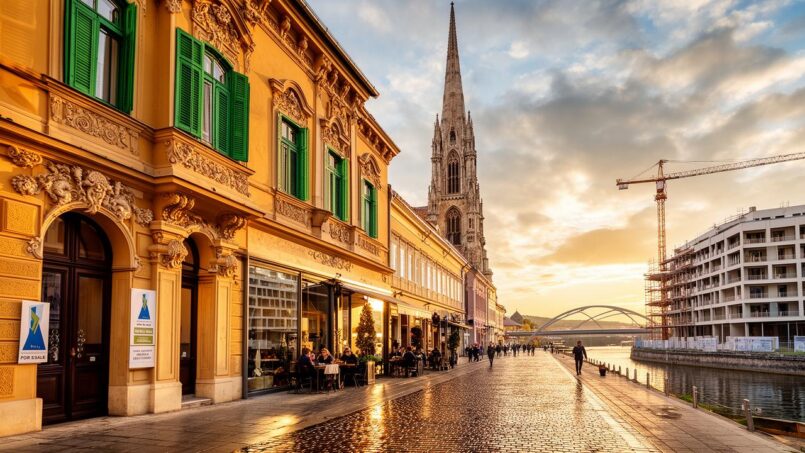
Belváros, the old town, together with the City Center, forms the dense heart of Győr. Here you find the main monuments, the cathedral, the Episcopal Castle, lively squares like Széchenyi tér, the Rába Quelle thermal baths, theaters, bars, cafes, and shops. Apartments here are mainly older, often brick, sometimes listed, with character and strong demand for short and medium-term rentals.
This sector is particularly interesting for:
– Studios and two-bedroom apartments intended for young professionals, consultants on assignment, or digital nomads.
– Premium properties that can target the high-end segment, with a business clientele linked to Audi or logistics.
– Flexible furnished rentals, between medium and long term, avoiding total dependence on Airbnb.
Rents here are logically in the local high range, and gross yields hover around 3 to 3.5%, but the heritage value and long-term appreciation potential are among the best in the city.
Révfalu: Between Nature, University, and Recent Housing
North of the center, the Révfalu neighborhood runs along the Mosoni-Duna. It combines modernity, greenery, and proximity to the university. You’ll find more recent residences, modern hotels, apartments with water views, and easy access to thermal baths and parks.
Révfalu attracts both families* seeking a calm environment close to the center, and many students or university staff. For an investor, this opens two strategies:
– Medium-sized apartments, well-suited for families or student shared flats, with solid demand.
– Comfortable furnished housing for professors, researchers, or foreign engineers on medium-term assignments.
A typical listing mentions, for example, a 79 m² apartment with a balcony in a condominium of six units, rented to families, showing that the supply is rather in the qualitative segment.
Sziget: Student Neighborhood in Transition
South of the center, Sziget is a riverside neighborhood, close to the university. A mix of old houses, brick buildings, and recent constructions, it is described as a lively area with a student vibe, featuring cafes, artistic events, and local festivals.
One can find varied investment opportunities here:
Overview of the different types of housing available for rent, suitable for various tenant profiles.
Small brick apartments, often near the university with limited charges. Perfect for student rentals.
New apartments with large terraces, in recent buildings. Aimed at families or couples with comfortable incomes.
Spacious houses or apartments, sometimes with included parking (rare in the city center). Ideal for shared housing or families.
Several recent listings mention renovated apartments, 65 m² penthouses in new buildings with elevators, garden-level apartments overlooking inner courtyards. Sziget clearly appears as one of the most active playing fields for those seeking a mix of yield and revaluation potential.
Nádorváros: The Practical and Family-Friendly Neighborhood
Nádorváros, often described as a “practical and family-friendly” neighborhood, is located near the train station and the center, and concentrates local shops, supermarkets, schools, restaurants. Listings frequently mention proximity to several schools, a hospital, a large shopping center.
One sees apartments ranging from 42 to 110 m², often renovated, brick-built, sometimes in small three-unit buildings with independent entrances. This profile makes it a preferred sector for:
– Families looking to settle long-term, thus stable tenants.
– Young working couples, attracted by proximity to transport.
For an investor, the interest lies in the solidity of long-term demand, with reduced vacancy risk, even if rents remain slightly lower than in Belváros or Révfalu. Negotiation is relatively limited for well-maintained brick apartments in the western part of the country – often only 1 to 2% discount – which underscores their attractiveness.
Marcalváros and Adyváros: More Affordable Segments, Yield Potential
Marcalváros, a residential neighborhood west of the center, and Adyváros, with its large panel buildings, offer lower entry prices. Listings cite, for example, 32 m² studios in buildings heated by a district heating system with individual meters, or 53 m² apartments in panel building renovation programs (insulation, system modernization).
These neighborhoods can suit investors:
– Looking for a lower entry ticket.
– Willing to accept a more “popular” environment and less prestigious real estate stock, but with often slightly better yields thanks to decent rents relative to moderate purchase prices.
Pér, Győrújbarát and the Suburban Ring
Around Győr, several localities complete the landscape. Pér, for example, is a calm area, popular with families, with parks and services, suitable for longer stays. Győrújbarát hosts villas like “Villa Corvina”, positioned in the leisure/relaxation segment.
Price comparisons for towns near Győr illustrate possible differentials:
| Town Near Győr | Average Price per m² (HUF) | Difference vs. Győr |
|---|---|---|
| Győrújbarát | 889,130 | -2.1 % |
| Nyúl | 1,033,217 | +13.8 % |
| Abda | 735,294 | -19 % |
| Koroncó | 650,000 | -28.4 % |
| Rábapatona | 512,987 | -43.5 % |
These figures show that one can find significantly cheaper properties a few kilometers from the city, at the cost of less obvious rental yield, as demand is less dense and more oriented towards primary residence. For a purely rental investor, it is generally more relevant to stay within Győr or in the well-connected immediate periphery.
Rules for Foreign Buyers: What to Know Before Getting Started
Investing in real estate in Győr remains accessible to non-residents, but requires compliance with a fairly structured legal framework.
Citizens of the European Union, the EEA, and Switzerland can freely purchase non-agricultural residential properties. Citizens of third countries, however, must obtain authorization from the competent government office via the land registry. This procedure is based on a 2014 decree, costs between 50,000 and 65,000 HUF and generally takes 30 to 60 days. It does not apply to agricultural or forestry properties, nor to listed monuments, which are subject to specific restrictions.
Ownership is only legally acquired upon registration in the land registry, not at the signing of the preliminary contract or payment. This registration, a non-negotiable step to secure the investment, must be carried out by a lawyer, who is also the only one authorized to obtain the necessary authorization for a foreign buyer and to retrieve the definitive title deeds.
Also note that owning property in Hungary does not automatically confer the right of residence. An investor wishing to settle must go through the classic residence permit procedures, even though having a local address is generally a prerequisite.
Taxation and Costs: What Does an Investment in Győr Really Cost?
To assess the net profitability of a purchase, one must factor in all taxes and fees related to acquisition, holding, and resale.
At Purchase: Transfer Tax, VAT, and Fees
The acquisition of real estate in Hungary is subject to a transfer tax (often called “stamp duty”) of 4% of the property value up to 1 billion HUF, then 2% beyond that, with a cap of 200 million HUF per property. This tax is payable within 90 days of purchase.
For new-build, a reduced VAT rate of 5% applies when criteria are met (limited-size residential housing). This 5% VAT has been extended until the end of 2026, with possible application until 2030 for projects already holding a building permit. The listed sale price generally includes VAT.
The total acquisition cost of a property, including lawyer fees and agency commissions, can reach nearly 10% of the price.
During Holding: Charges, Local Taxation, and Tax on Rents
Hungary does not levy a national property tax. Some tourist municipalities, such as around Lake Balaton or in Hévíz, impose a local tax calculated per m², on the order of €5 to €7 per m² per year. This is not the case, in practice, for most “ordinary” homes in Győr.
The regular charges for a standard home, including condominium fees, heating, and services, are estimated between €100 and €230 per month.
Rental income received is subject to a flat-rate income tax of 15%, with the possibility of deducting certain actual expenses. Under certain conditions, social contributions may also apply, but only up to a certain income ceiling (24 times the minimum wage).
At Resale: Capital Gains and Optimizing the Holding Period
Capital gains from sale are normally taxed at 15% for individuals, but the taxable base decreases over time. The longer the property is held, the smaller the portion of the gain subject to tax becomes:
| Property Holding Period | Taxable Portion of Gain |
|---|---|
| Less than 2 years | 100 % |
| 2 to 3 years | 90 % |
| 3 to 4 years | 60 % |
| 4 to 5 years | 30 % |
| More than 5 years | 0 % (exemption) |
For an investor targeting significant capital gains, it is therefore clearly rational to keep in mind a minimum holding horizon of at least five years, which, in any case, aligns quite well with Hungarian real estate cycles.
Financing a Purchase in Győr: Options for Residents and Foreigners
Most real estate purchases in Hungary are financed by forint-denominated loans. Local banks generally require a down payment of at least 20%, sometimes more for foreigners, with loan-to-value (LTV) ratios capped by the National Bank (MNB) at 80% under standard conditions.
Fixed rates for 20 years typically range around 8%, with a wide spread of 6.5% to 18%. The subsidized “Otthon Start” program allows eligible first-time buyers (criteria: first purchase, price ceiling, 10% down payment, affiliation to Hungarian social security) to obtain a reduced rate of 3% for a loan up to 50 million HUF. This support can stimulate demand and exert upward pressure on prices for properties in the “average family” range, particularly in Győr.
Non-residents, on the other hand, may sometimes be offered forint loans covering 50 to 70% of the property value, but each application is reviewed case by case. Hybrid solutions exist, using loans granted in the country of residence with the Hungarian property or another asset as collateral. Some specialized intermediaries, based in Győr itself, assist foreigners with these financing steps.
Borrowing in Hungarian forint (HUF) with euro income exposes one to the volatility of this currency. However, for a European investor, Hungarian real estate prices remain significantly lower than those in many EU capitals, even after currency conversion.
New or Existing: Which Strategy to Prioritize in Győr?
The question of new-build versus existing is particularly relevant in Győr, where one finds:
– new homes at around 900,000 HUF/m²,
– resale properties in a range of €1,600 to €2,000 /m².
New-build real estate offers superior energy performance and lower maintenance costs, making it attractive to tenants and potentially allowing for a higher rent. It benefits from reduced VAT and meets growing demand for modern apartments under 60 m².
Existing properties, conversely, often offer a better space/price ratio, ultra-central locations (Belváros, streets like Baross út or Széchenyi tér), and a margin for value creation through renovation. In Győr, for example, one observes 86 m² apartments fully renovated in historic buildings, or small units suitable for renovation in neighborhoods like Sziget or Nádorváros, which can benefit from neighborhood upgrading.
In the long term, a property’s value is mainly driven by the land and the quality of the location. Thus, a well-located, renovated older apartment can offer a more interesting yield-appreciation combination than a new-build home on the outskirts. Conversely, for an investor seeking a passive asset with minimal management and repairs, a new-build home in a developing neighborhood like Révfalu or a modern project on the Danube bank in Sziget is an attractive compromise.
Property Management and Services: Investing Without Living On-Site
Many investors in Győr do not necessarily reside in the city, or even in Hungary. A series of local players facilitate this situation. Property management companies based in the region offer full management services: tenant search, lease drafting, rent collection, work supervision, relations with the condominium, etc. Others, specialized in condominium management, handle common areas, fee calls, general meetings.
For a foreign investor, delegating the day-to-day management of an apartment in Győr to a local manager turns the investment into a passive asset. Fees are generally 8 to 12% of the rent, depending on services (standard long-term management or more intensive furnished management). For seasonal rentals, percentages may be higher, but gross rents are also higher.
The existence of these services is another argument in favor of investing in a regional city like Győr rather than in an isolated village, where management would be more burdensome.
How Does Győr Compare to Other Hungarian Cities?
To assess the opportunity of investing in Győr, it is useful to briefly compare it to other cities:
Comparison of the main price dynamics, liquidity, and attractiveness factors across different Hungarian real estate markets.
Most expensive and liquid market. Prices: often > €3,000-€5,000 /m² for new and ~€2,300 /m² for existing. Gross yields comparable to Győr, but strong competition and uncertain regulations on tourist rentals.
New-build prices around 1 million HUF/m². Dynamism driven by the establishment of a BMW plant, comparable to Győr but located in the east of the country.
Cities like Siófok or Veszprém benefit from a vacation clientele. Prices sometimes higher, but market more seasonal.
Nyíregyháza or Zalaegerszeg are significantly cheaper, but less driven by foreign investment and the presence of large international groups.
In this landscape, Győr occupies an interesting balanced position: a market more affordable than Budapest and some areas of Lake Balaton, but more dynamic and solvent than many provincial cities, with an industrial, university, and logistics ecosystem that gives it an economic depth rare at this scale.
Conclusion: For Which Investor Profile is Győr Relevant?
Investing in real estate in Győr appeals to several distinct profiles.
Discover the main real estate investment strategies suited to the city of Szeged, based on objectives and risk profile.
Seeks to benefit from price progression in a well-connected city, at the heart of a European industrial corridor. Expected yields: 3.2 to 3.5%. Perspective of solid appreciation over 10 years.
Interested in family apartments in neighborhoods like Nádorváros or Révfalu. Can be rented stably to middle-class households, with limited vacancy.
Focuses on Sziget, Révfalu, and the city center. Prioritizes well-designed, furnished small units, close to campuses and transport.
Benefits from prices in Hungary lower than in many EU capitals for geographical diversification. Tax advantages: 15% income tax, no national property tax, advantageous capital gains taxation after 5 years.
To fully leverage these advantages, it remains essential to:
To maximize the chances of success for a rental investment, several key factors must be rigorously evaluated. First, location choice is paramount: prioritize proximity to employment hubs and university infrastructure to ensure constant rental demand. Second, carefully examine building quality, paying particular attention to the property’s energy performance and the solidity of its structure (brick construction generally offers more durability than panels). Third, anticipate legislative changes, notably potential new regulations concerning short-term rentals (like Airbnb). Finally, build a trusted team by engaging a lawyer specialized in real estate and, if necessary, a local property manager to handle day-to-day follow-up.
In a Hungarian market that has already risen significantly, Győr is one of those cities where one can still enter at a reasonable price, while benefiting from an economic and urban environment that continues to strengthen. For a patient investor, capable of thinking in years rather than months, the city has serious arguments to offer.
A wealth management project or a question? Contact us now to speak with a wealth management expert.
Disclaimer: The information provided on this website is for informational purposes only and does not constitute financial, legal, or professional advice. We encourage you to consult qualified experts before making any investment, real estate, or expatriation decisions. Although we strive to maintain up-to-date and accurate information, we do not guarantee the completeness, accuracy, or timeliness of the proposed content. As investment and expatriation involve risks, we disclaim any liability for potential losses or damages arising from the use of this site. Your use of this site confirms your acceptance of these terms and your understanding of the associated risks.

Cyril Jarnias is an independent expert in international wealth management with over 20 years of experience. As an expatriate himself, he is dedicated to helping individuals and business leaders build, protect, and pass on their wealth with complete peace of mind.
On his website, cyriljarnias.com, he shares his expertise on international real estate, offshore company formation, and expatriation.
Thanks to his expertise, he offers sound advice to optimize his clients' wealth management. Cyril Jarnias is also recognized for his appearances in many prestigious media outlets such as BFM Business, les Français de l’étranger, Le Figaro, Les Echos, and Mieux vivre votre argent, where he shares his knowledge and know-how in wealth management.





