
 Published on and written by Cyril Jarnias
Nestled between the Aar River and the Gurten, Real Estate Investing in Wabern combines two qualities investors rarely find in the same location: a quintessentially Swiss, green, and friendly village setting, and a real estate market increasingly structured around urban development projects, modern infrastructure, and amenities. For both a primary residence buyer and a rental investor, this portfolio deserves a close look.
The analysis is based on data and projects from the research report, covering prices, recent trends, yields, the micro-location of the most expensive streets, urban projects around the train station, new developments like VOBERNOVA, and the applicable Swiss tax framework for a purchase.
Wabern, a strategic village at the gates of Bern
Wabern is part of the municipality of Köniz, in the canton of Bern. The village is nestled at the foot of the Gurten, with the Aar River and the Eichholz beach just minutes away by bike. It attracts residents seeking a very Swiss environment: omnipresent nature, hiking trails, bike paths, an outdoor pool, local festivals, and neighborhood life marked by strong social cohesion.
The number of minutes it takes tram line 9 to connect Wabern to Bern’s city center.
The municipality of Köniz and the canton of Bern have clearly identified this potential. Planning documents speak of an “inward-facing” development around the train station, with qualitative densification, social diversity, local shops, and better accessibility for pedestrians and cyclists. This is the guiding principle of the large “Areal Station Wabern” perimeter, which frames the evolution of this strategic sector.
A high price level, but below the Swiss average
Regarding prices, the figures show that Wabern is in the expensive part of the Swiss market, without reaching the peaks of major cities. The average price per square meter is slightly below the national average, which leaves room for long-term growth.
In 2025, the average price in Wabern (canton of Bern, postal code 3084) is around CHF 7,260/m² for apartments, according to one estimate, with an annual increase of approximately 4.71% compared to the previous year. Another source for September 2025 indicates an even higher average level of CHF 8,356/m², with a median listing price of CHF 9,994/m². The disparity is explained by methodologies (average vs. median, property types, periods).
To situate Wabern within the Swiss landscape, one can compare specific demographic, economic, or geographic data for this municipality with corresponding national averages. This provides perspective on its situation, for example in terms of population, income, or infrastructure, relative to the country as a whole.
Comparison of average prices per m²
| Area | Average Price per m² (CHF) | Property Type |
|---|---|---|
| Switzerland – Overall | 9,132 | All properties |
| Switzerland – Apartments | 7,822 | Apartments |
| Switzerland – Houses | 10,442 | Houses |
| Wabern (3084) – Overall | 8,356 | All properties |
| Wabern – Apartments | 7,281 | Apartments |
| Wabern – Houses | 9,431 | Houses |
These figures confirm that Wabern is slightly cheaper than the Swiss average, while remaining in the range of “tight” markets linked to major urban areas. The village is ranked around 940th among the most expensive localities in the country, illustrating an intermediate position: more affordable than a very central address in Zurich or Geneva, but significantly above many rural locations.
For an investor, this means that a premium is already capitalized in the prices, but the potential for appreciation remains solid as long as Bern retains its role as a public and private employment hub, and the housing supply in Wabern remains limited by topography and regulations.
A price structure highly sensitive to size and property type
An important market characteristic is the strong variation in price per m² depending on the apartment’s size. Smaller units are more expensive per m² than large family homes, a classic phenomenon in sought-after areas.
Available data for 2025 provides two telling comparison points:
– a 50 m² apartment listed at CHF 439,231,
– a 90 m² apartment listed at CHF 646,866.
Based on this, the small 2-room apartment is approximately 23% more expensive per m² than the more spacious 4-room apartment. This can be summarized in an indicative table.
Example of price per m² by surface area
| Apartment Surface Area | Total Price (CHF) | Estimated Price per m² (CHF) | Difference from 90 m² |
|---|---|---|---|
| 50 m² | 439,231 | ~8,785 | +23% |
| 90 m² | 646,866 | ~7,187 | Reference |
This market structure has clear implications for Real Estate Investing in Wabern. A rental investor looking to maximize gross yield might be tempted by small to medium-sized units (studios, 2–3 rooms), which are in high demand among young professionals and couples working in Bern. Conversely, a primary residence buyer prioritizing family comfort would be wise to target 4–5 room apartments, where the price per m² is softer, while still enjoying a high quality of life.
The median price figures by number of rooms illustrate the price gaps within the apartment segment.
Median price per m² of apartments in Wabern (3084)
| Apartment Type | Median Price/m² (CHF) |
|---|---|
| Studio | 5,820 |
| 2–2.5 rooms | 6,575 |
| 3–3.5 rooms | between 8,000 and 9,482 |
| 4–4.5 rooms | 8,113 |
| 5–5.5 rooms | 6,140 |
| 6 rooms and more | 8,029–9,032 |
For example, we see that 3–4 room apartments often command a higher price per m² than large 5-room apartments, a sign of strong demand for medium-sized units, which are highly sought after in the Bern market.
“Prime” streets driving prices upward
As in any municipality near a capital, Wabern features a micro-geography of values. Certain streets and sectors show prices significantly above average, particularly when they combine an open view, proximity to the Aar River, quick access to transportation, and a high-end residential status.
Revealing figures collected for a few iconic addresses
Over 7 million annual visitors, a global symbol of France.
Nearly 10 million entries per year, the world’s most visited art museum.
Approximately 8 million visitors each year, a jewel of classical architecture.
Before the fire, around 13 million annual visitors, a Gothic masterpiece.
Indicative prices per m² on Wabern’s most expensive streets
| Street / Sector | Price per m² (CHF) |
|---|---|
| Alpenstrasse | 10,570 |
| Eichholzstrasse | 10,364 |
| Viktoriastrasse | 10,310 |
| Bächtelenweg | 10,229 |
| Maygutstrasse | 10,158 |
| Eigenheimstrasse | 10,016 |
| Parkstrasse | 10,007 |
| Gurtenbrauerei (site) | 9,776 |
| Strandweg | 9,619 |
These values are well above the municipal average, sometimes by more than CHF 2,000/m². For an investor, this means that a well-located property on one of these streets benefits from solid patrimonial value and sustained demand. In return, the gross rental yield will often be more modest, unless targeting very high rents.
Recent trend: between a fundamental rise and short-term corrections
The price trend in Wabern shows an interesting contrast between the underlying trend and short-term movements. Over five years, growth remains marked, but some statistics show occasional corrections.
This is the percentage increase in house prices in Wabern over a 25-year period.
At the same time, specific data for Wabern (3084) shows, for certain segments, short-term declines: apartment prices would have fallen by approximately 8 to 15% over twelve months depending on the observed periods, while houses would sometimes have recorded double-digit increases over the same period (+31.2% in one market configuration). Other data series, conversely, mention a decline of around 4.9% for houses over twelve months.
Discrepancies in real estate statistics (like average versus median prices, limited samples, or distinct study periods) are not necessarily contradictory. They reflect different analysis methodologies. The market for single-family homes is particularly sensitive, where a small number of transactions in the high-end segment can significantly influence overall trends.
For an investor, two elements stand out:
– the long-term trajectory remains clearly upward, driven by land scarcity and proximity to Bern;
– in the short term, the market may experience correction phases, especially after several years of growth and in a context of more volatile interest rates.
Rather than aiming for perfect “market timing,” it is more relevant to think with a horizon of 10 to 20 years, betting on location quality and rental solidity.
Rental investment: high rents but yields to watch
Rents in Wabern are in the high part of the Bern market. The collected data allows us to outline average levels according to apartment size.
Indicative average rents
| Housing | Average Monthly Rent (CHF) |
|---|---|
| Studio | 849 |
| 2-room apartment | 1,446 |
| 3-room apartment | 1,938 |
| 4-room apartment | 2,421 |
| 5-room apartment | 2,911 |
| 4-room house | 3,266 |
| 5-room house | 3,439 |
| 6-room house | 3,756 |
| 7-room house | 4,219 |
| 8-room house | 4,561 |
Combining these rents with the average purchase prices recorded in Wabern gives an order of magnitude for the gross yield. As an illustration, take a 3-room apartment valued at CHF 765,000, with an average rent of CHF 1,938 per month, or CHF 23,256 per year.
The theoretical gross yield would be:
23,256 / 765,000 ≈ 3.0% per year
The typical gross rental yield in Switzerland is around 2.9% to 3%. In Wabern, for existing, well-located properties, some studies mention yields that can exceed 7%, particularly for older apartments in areas considered attractive in a federal comparison. It is important to note that these higher figures may relate to specific perimeters bearing the same name.
In any case, the investor must keep in mind that: risk assessment is essential for making informed decisions.
– Swiss gross yield is often modest in international comparison, but compensated by great market stability;
– expenses (maintenance, local taxes, fees, possible contributions to a district heating network) reduce the net yield by 1.5 to 2 percentage points on average;
– the true performance of an investment in Wabern rests on the combination of rental yield + capital appreciation, rather than on rental income alone.
Housing market: million-franc prices, but still competitive
Single-family homes in Wabern easily cross the million-franc threshold, especially for large surfaces and sought-after locations. The recorded averages give a fairly clear idea of the entry ticket.
Average house prices by number of rooms
| House | Average Price (CHF) |
|---|---|
| 4 rooms | 1.1 million |
| 5 rooms | 1.3 million |
| 6 rooms | 1.7 million |
| 7 rooms | 2.0 million |
| 8 rooms | 2.1 million |
Compared to Switzerland’s most expensive metropolitan areas, where a well-located detached house can cost over CHF 2.5 to 3 million, these levels remain relatively competitive, especially considering direct access to Bern, a highly sought-after environment, and the new infrastructure being deployed (extended tram, center renovation, district heating network).
This house segment is particularly exposed to interest rate cycles: rising financing costs can temporarily dampen demand, which explains some of the observed corrections over twelve months. But in the long term, the scarcity of supply, combined with controlled densification policies, supports the value of these patrimonial assets.
Structuring urban projects around the train station
One of the most important points for Real Estate Investing in Wabern lies in the profound transformation of the station area and Wabern’s central axis. Municipal and cantonal authorities have engaged since 2013 in a multi-step planning process aimed at:
– densifying buildings around the station,
– improving pedestrian and cyclist access,
– integrating shops and services on the ground floor,
– creating an urban neighborhood with a high quality of life.
The “Areal Station Wabern” perimeter is structured according to three planning levels: master plan, development and accessibility concept, and then modification of the regulatory framework. This last stage, effective in June 2024, makes the development guidelines legally binding for property owners.
At the same time, other projects have already set the tone:
– the conversion of the former Gurten brewery by the Steiner company, with a complex of 99 apartments (including duplexes) and two studios, as well as 99 indoor parking spaces;
– the “Quellfrisch” development, also on a former brewery site, which added about 100 new homes and over 15,000 m² of commercial space;
– the “Morillon” neighborhood, ultimately planned for about 2,000 inhabitants, which will also host the production center for the future district heating network.
BLS doubled the railway tracks between Kehrsatz Nord and Frischingweg (2018-2020) and modernized Wabern station with 220 m platforms, improved accessibility, and new technical facilities. The “Tram Kleinwabern” project will extend the tram line, redesign Seftigenstrasse while preserving its central lane, improve pedestrian crossings, create bike lanes, and establish a 30 km/h zone in the center.
These massive public investments have a direct impact on the real estate market: a modernized, more readable, better connected, and traffic-calmed station neighborhood makes the surrounding homes more attractive, particularly to urban households seeking a compromise between tranquility and accessibility.
District heating: a sustainable argument for future buildings
Another major project is the Bern–Wabern district heating network led by Energie Wasser Bern (ewb) with the support of the municipality of Köniz. The concept is simple: use surplus water from the Schönau pumping station as a renewable heat source to supply, in the long term, up to 5,000 homes, with at least 80% renewable energy.
The year when the first heat supply for the new network is planned, aiming to replace oil and gas heating systems in several neighborhoods of Bern.
For a real estate investor, this project is far from anecdotal. A building connected to a renewable district heating network:
– reduces its CO₂ emissions, anticipating future regulatory requirements;
– limits energy cost volatility;
– offers a strong commercial argument for tenants sensitive to environmental criteria.
In a Swiss market where energy-efficient buildings already benefit from price and rental premiums, the presence of such a network is an element to integrate into the long-term analysis of a purchase in Wabern.
VOBERNOVA: an illustration of new residential development
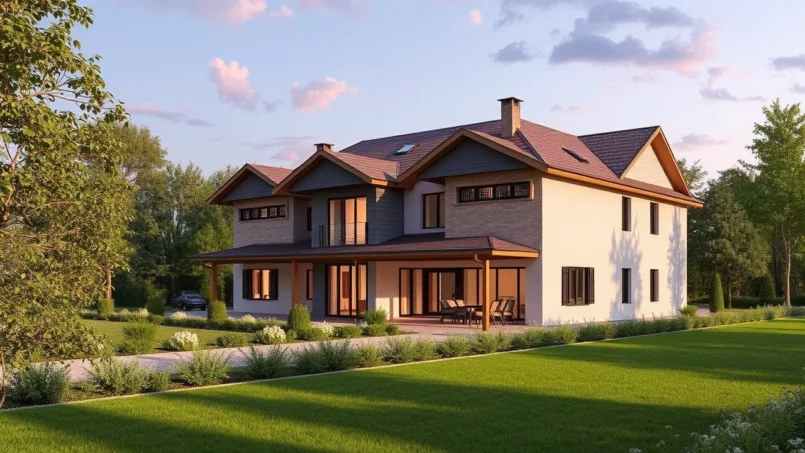
Among the concrete projects embodying this dynamic, the VOBERNOVA development, at Mattenweg 6, well represents the new generation of residences in Wabern. This project, led by Immo-Baukonzept Murten GmbH, plans for two small apartment buildings (condominiums) comprising a total of 12 homes:
– 3.5-room apartments,
– 4.5-room apartments,
distributed at a rate of three units of each type per building.
The location is in a sought-after villa neighborhood, between city and nature, a few minutes’ walk from a future tram stop at Bächtelenpark and an ALDI supermarket. The Eichholz river beach, the center of Wabern with Coop, post office, drugstore, as well as other stores like Migros “Chly Wabere” or Denner, are easily reached by bike.
Additional purchase price for an underground parking space for these apartments.
For an investor, this type of development shows that there are still well-positioned new products, likely to attract an affluent clientele seeking contemporary comfort close to Bern. The challenge then is to compare the offered price per m² with the levels observed in the neighborhood and the rental yield such a property could generate.
Value distribution: between “standard” segments and exceptional properties
Value distribution data in Wabern shows a bivariable market: a large majority of properties are concentrated in a relatively narrow price per m² range, while a minority of high-end properties far exceed this range.
For apartments:
– the intermediate 60% are valued between approximately CHF 6,377 and 9,482/m² depending on the observed periods;
– the cheapest 20% show a price below approximately CHF 6,000–6,300/m²;
– the most expensive 20% exceed CHF 8,443 to 9,482/m², or even more in the most prestigious streets.
For houses:
The median price per square meter in Geneva is CHF 13,235 for the top 20% of the most expensive apartments.
In other words, Real Estate Investing in Wabern is not the same thing depending on whether one targets a “standard” property in a normal residential neighborhood or an architect-designed house on Alpenstrasse. In the first case, the main objective will often be a reasonable yield and good liquidity upon resale. In the second, it’s more about a patrimonial investment, with a strong pleasure component and long-term capital gains potential.
Swiss context: an overall supportive market, but without overheating
To put Wabern in the national context, the main indicators for 2025–2026 show a Swiss market still supported by a structural imbalance between supply and demand. Housing construction remains well below demographic growth, with residential real estate playing the role of a safe haven in a very stable country.
Analysts still anticipate national price increases of around 2 to 4% per year in the coming years, with little risk of a short-term bubble. The Swiss National Bank maintains an accommodative monetary policy, and low key interest rates continue to support home ownership, even though household purchasing power is under pressure from past price increases.
Studies indicate a slowdown in price increases, with near-stagnation in some areas. Regional declines are possible, especially where prices had risen the most. A sharp nationwide correction is only anticipated in an unfavorable scenario combining a significant rise in interest rates, persistently high unemployment, and a marked decline in immigration.
In this framework, markets of the “capital belt” type like Wabern benefit from an interesting profile: they profit from the demand of the neighboring metropolis without being subject to the same price level as a hyper-center, which leaves room for maneuver for buyers and investors.
Taxation and Swiss framework: what an investor in Wabern must consider
Any acquisition project in Wabern is subject to Swiss and Bernese tax law. Even though the detailed report does not provide specific figures for Köniz, it recalls the main principles applicable in most cantons and useful to keep in mind.
Upon purchase, several items are added to the sale price:
– real estate transfer tax (or property transfer tax), typically between 1 and 3% of the price;
– notary fees, mandatory for authenticating the deed;
– land registry fees.
The real estate transfer tax (or property transfer tax) varies by Swiss canton: it can be the responsibility of the buyer, the seller, or shared. Some cantons, like Zurich or Schwyz, do not levy it. Furthermore, in the canton of Bern for example, an annual property tax, called the real estate tax, may be added. It is calculated on the fiscal value of the property.
During ownership, several taxes weigh on the owner:
– wealth tax, where the fiscal value of the property is included in the taxable wealth, net of the mortgage;
– tax on imputed rental value (or deemed rental income), until its effective abolition planned at the earliest in 2028, which taxes a theoretical rent as income for owner-occupiers;
– tax on rental income for leased properties, after deduction of eligible expenses (mortgage interest, maintenance, etc.);
– in some cantons, an additional annual real estate tax (0.02 to 0.3% of the value).
Upon the sale of a property, the capital gains tax is calculated on the difference between the sale price and the acquisition cost (including value-adding investments and fees). Its rate depends on the holding period: a quick sale with a high capital gain results in higher taxation. It is possible to defer all or part of this tax if the sale proceeds are reinvested in a new primary residence.
For Real Estate Investing in Wabern, these elements imply:
– carefully budgeting entry costs (3 to 6% of the price);
– optimizing the financing structure to benefit from the deductibility of mortgage interest, while considering the announced future tightening (reform approved in 2025);
– keeping all invoices for work and transaction fees carefully to reduce real estate gains tax when the time comes.
How to concretely approach a project in Wabern?
Faced with this mosaic of data, an investor should structure their approach around a few key questions, directly informed by the figures in the report.
The first concerns the type of property. Is one looking for a primary residence to live in daily, or a rental property? In the first case, the priority will be quality of life: proximity to transport (train station, tram line 9), quick access to schools and shops, a quiet environment (villa neighborhood, proximity to the Gurten, sufficient distance from major roads). In the second, the challenge will be to maximize the rent/price per m² ratio, which may lead to favoring well-served 2–3 room apartments or older apartments with higher gross yields.
The value of a property varies greatly depending on its street. Prestigious arteries like Alpenstrasse or Eichholzstrasse offer high patrimonial value, suitable for a long-term strategy, but not necessarily the best yields. Conversely, less prestigious but well-located sectors, especially near future infrastructure like the “Tram Kleinwabern” station or the center of Wabern with the “Areal Station Wabern” project, may offer a better compromise between yield and risk.
The third concerns timing. The coming years will see the implementation of many construction projects: renovation of Seftigenstrasse, tram extension, construction of the district heating network, progressive densification of the station perimeter. Buying before the full completion of these projects may allow capturing some of the future valuation, at the cost of a period of construction in the neighborhood. Conversely, waiting until the infrastructure is delivered reduces uncertainty, but already incorporates the additional accessibility premium into prices.
The choice of financing and tax preparation are strategic. Currently, a high mortgage allows for greater interest deductions, which is advantageous. However, a reform adopted for 2025 will limit these deductions, especially for primary residences. In the medium term, the property’s real performance must take precedence over the fiscal leverage effect.
Conclusion: Wabern, a “small major” real estate location
Based on all the data, Real Estate Investing in Wabern means positioning oneself in a market that combines several rarely united advantages:
– an exceptional natural setting at the foot of the Gurten and along the Aar River;
– impeccable accessibility to the federal capital, by train or tram;
– a clear public strategy for qualitative densification around the train station;
– structuring projects like the Bern–Wabern district heating network;
– a supply of new developments (VOBERNOVA, Morillon, conversion of industrial sites) that renew the real estate stock.
Prices, although high, remain below the Swiss national average. The long-term trend is upward, with possible consolidation phases in the short term. Gross rental yields are moderate, but the market benefits from great macroeconomic stability and a chronic housing shortage in attractive urban areas.
For the patient investor, capable of holding a property over a 15 to 20-year horizon, Wabern offers a measured risk profile and interesting appreciation potential, especially near major infrastructure projects. For the primary residence buyer, the village constitutes a rare compromise between green living and immediate proximity to the city, which, in itself, remains one of the best guarantees of lasting real estate value.
Disclaimer: The information provided on this website is for informational purposes only and does not constitute financial, legal, or professional advice. We encourage you to consult qualified experts before making any investment, real estate, or expatriation decisions. Although we strive to maintain up-to-date and accurate information, we do not guarantee the completeness, accuracy, or timeliness of the proposed content. As investment and expatriation involve risks, we disclaim any liability for potential losses or damages arising from the use of this site. Your use of this site confirms your acceptance of these terms and your understanding of the associated risks.

Cyril Jarnias is an independent expert in international wealth management with over 20 years of experience. As an expatriate himself, he is dedicated to helping individuals and business leaders build, protect, and pass on their wealth with complete peace of mind.
On his website, cyriljarnias.com, he shares his expertise on international real estate, offshore company formation, and expatriation.
Thanks to his expertise, he offers sound advice to optimize his clients' wealth management. Cyril Jarnias is also recognized for his appearances in many prestigious media outlets such as BFM Business, les Français de l’étranger, Le Figaro, Les Echos, and Mieux vivre votre argent, where he shares his knowledge and know-how in wealth management.





