
 Published on and written by Cyril Jarnias
Nestled at the gates of Bern, the municipality of Zollikofen is increasingly attracting investors seeking a compromise between Swiss stability, accessibility, advantageous taxation and long-term appreciation potential. Far from the stratospheric prices of Zurich or Geneva, this local market nonetheless benefits from high-level infrastructure, a robust economic fabric, and clearly growing demographics.
This article provides a comprehensive analysis of the Zollikofen real estate market, based on recent municipal and national data. It covers all property types: condominium apartments, single-family homes, rental apartment buildings, and commercial spaces, drawing on current trends and concrete local projects.
Zollikofen, a strategic residential municipality at the gates of Bern
Zollikofen is located in the canton of Bern, within the Bern-Mittelland administrative district. With an area of 5.39 km² and an altitude of approximately 557 meters, the municipality is set in a landscape of hills, meadows, forests, streams, and the banks of the Aare River. It is part of the “Energiestadt” network, a label awarded to municipalities committed to the energy transition – a far from trivial point for the value of recent buildings.
Nearly 44.3 % of the municipal area is dedicated to agriculture, contributing to a balance between urbanization and green spaces.
The municipality describes itself as an agglomeration community that is “neither city nor village”, yet attractive for living and working. Concretely, it benefits from all the advantages of proximity to Bern, while remaining quieter and less expensive than the federal capital.
Demographics: a growing and increasingly international population
For an investor, demographic trends are a key indicator. And in Zollikofen, the trend is clearly upward.
The data shows a clear population increase:
| Year / period | Population (approx.) | Comment |
|---|---|---|
| 2008 | 10,000 | 10,000 inhabitants threshold crossed in March |
| 2018 | 10,306 | Density of approx. 1,900 inhab./km² |
| 2020 | 10,640 – 10,798 | Continued slight growth |
| 2023 | 11,477 – 11,679 | Density of approx. 2,130.5 inhab./km² |
| Recent 3-year variation | +7.87 % | Approx. +2.56 % per year |
The municipality had set a target of 11,100 inhabitants for 2040; all indications are that this threshold is being reached much earlier than expected. This demographic growth exceeding the Swiss average, coupled with a limited municipal area, exerts constant pressure on the housing market and supports prices.
The population structure is also interesting:
– Average age: 43 years
– Distribution in 2010: approx. 19.1 % aged 0-19, 60.4 % aged 20-64, 20.5 % aged 65 and over
– Share of foreigners: 18.4 % in 2010, 25.1 % in 2023
This progressive internationalization of the population, combined with a significant proportion of working-age adults, supports a sustained rental demand, particularly for 2.5 to 4.5-room apartments near public transport.
A regional economic hub with a robust job market
Beyond demographics, Zollikofen positions itself as a regional economic hub close to Bern. It is home to approximately 9,200 jobs, a significant number for a municipality of its size. The municipality is even described as a net importer of labor: more people commute in to work each day than commute out.
In 2008, there were already 4,776 jobs recorded in the primary, secondary, and tertiary sectors within the territory.
Regarding the labor market, all indicators point to a healthy situation:
– Unemployment rate 2011: 3.17 %
– Current unemployment rate: approx. 1 %
Combined with average incomes ranging between 59,000 and 74,360 CHF depending on the source, this creates a solid financial foundation to absorb relatively high rents and secure income for landlords.
Accessibility and infrastructure: a major asset for investors
Accessibility is one of Zollikofen’s strong points. Within a limited territory, there are no fewer than four train stations: Zollikofen, Oberzollikofen, Unterzollikofen, and Steinibach. Rail connections to Bern are extremely frequent and fast, to the point that some journeys between Zollikofen and downtown Bern are faster than intra-urban trips within the capital.
The municipality is connected to the lines: Line 1, Line 2, Line 3.
– Zollikofen–Bern
– Solothurn–Worblaufen, with standard connections to Biel/Bienne and Thun
The construction of the Tiefenau Bridge and the Bernstrasse axis triggered significant growth as early as the 1960s. Today, the heavy traffic on Bernstrasse, a concern for residents, reflects the intense traffic linked to the area’s role as a regional crossroads.
Beyond rail, Zollikofen has schools (kindergarten, primary, secondary), daycare and after-school care places, a well-stocked retail offering, and numerous sports and cultural activities. Leisure areas along the Aare River, forests, and the Rütti area complete the picture for families, active seniors, and young couples, further enhancing its residential appeal.
A competitive tax environment on a cantonal scale
For an investor, local taxation heavily impacts net returns. From this perspective, Zollikofen ranks among the most attractive municipalities in the canton of Bern.
Zollikofen’s municipal tax multiplier is well below the cantonal average of 170.9, placing it among the most tax-advantageous municipalities.
Examples of average tax burden (as a percentage of gross income, excluding federal tax) give a concrete overview:
| Taxpayer profile | Average tax burden |
|---|---|
| Married retired couple (> 65 years) | 18.24 % |
| Married couple with two children | 9.92 % |
| Married couple without children | 13.89 % |
| Single person without children | 19.03 % |
For a property owner-landlord, these parameters translate into a relatively mild tax framework on income and wealth, compared to other municipalities in the canton or more heavily taxed cantons. This differential strengthens Zollikofen’s appeal as a place to hold rental properties long-term.
Housing stock structure and market tightness
Zollikofen’s housing stock comprises approximately 5,760 apartments, distributed across a wide range of sizes:
| Apartment size (rooms) | Number of existing units |
|---|---|
| 1 room | 231 |
| 2 rooms | 842 |
| 3 rooms | 1,830 |
| 4 rooms | 1,792 |
| 5 rooms | 753 |
| 6 rooms and more | 312 |
This structure shows a predominance of 3 and 4-room apartments, typical of medium-sized households, but also a significant supply of larger units, interesting for families or managed shared housing.
Over the last five years, 586 new apartments have been built, with the following distribution:
| Size (rooms) | New housing units (5 years) |
|---|---|
| 1 room | 40 |
| 2 rooms | 164 |
| 3 rooms | 171 |
| 4 rooms | 184 |
| 5 rooms | 22 |
| 6 rooms and + | 5 |
An additional 500 housing units are already planned for the coming years. Despite this construction effort, vacancy remains very low:
– Vacancy rate 2011: 1.25 %
– Current vacancy rate: 0.94 %
The example mentioned involves presenting information by segmenting it according to different sizes. This allows organizing data in a structured and comparative manner, for instance for clothing (S, M, L, XL), technical products, or any category requiring classification by dimensions.
| Apartment size | Current vacancy rate |
|---|---|
| 1 room | 0 % |
| 2 rooms | 0.83 % |
| 3 rooms | 0.98 % |
| 4 rooms | 1.12 % |
| 5 rooms | 0.93 % |
| > 5 rooms | 0.85 % |
A vacancy rate below 1% signals a tight market, close to full rental occupancy. For an investor, this translates in practice into a low risk of prolonged vacancy, provided the apartment is well-maintained, well-located, and priced realistically.
Rental levels: what income can be expected?
At the municipal level, the average rent is around 1,600 CHF per month. More precisely:
– 25 % of rents are at 1,395 CHF per month or less
– 75 % of rents are below 1,980 CHF per month
The median advertised rent for apartments available for rent on the online market is approximately 2,743 CHF per year.
Rents obviously vary based on size, building condition, proximity to train stations, the presence of a balcony or parking space, and the property’s energy performance. New projects with sustainable technologies (heat pump, photovoltaics, high-performance insulation) tend to rent for more per equivalent area, but with lower operating costs, appealing to an increasing number of tenants sensitive to energy costs.
Purchase prices: where does Zollikofen stand compared to the rest of Switzerland?
The most recent data indicates a price range per square meter that has risen sharply in recent years.
Trends and average levels
In 2025, the average price in Zollikofen was 6,647 CHF/m², up approximately 4.1 % year-on-year. In February 2026, several sources converge around a higher average level, around 8,000 CHF/m², with some variations depending on methodology:
| Source (February 2026) | Total average price | Apartments | Houses |
|---|---|---|---|
| Source A | 8,104 CHF/m² | 8,263 CHF/m² | 7,946 CHF/m² |
| Source B (Lookmove) | 7,932 CHF/m² | 8,870 CHF/m² | 7,043 CHF/m² |
| Other aggregated value | 7,957 CHF/m² | – | – |
Despite these discrepancies, the order of magnitude is clear: investing in Zollikofen remains significantly less costly than in major cities like Zurich (where the average apartment exceeds 14,000 CHF/m²) or Geneva (over 20,000 CHF/m² in some areas).
Zollikofen ranks around the 1,335th position among the most expensive localities in Switzerland, making it a market that is neither cheap nor premium. Its price offers interesting potential for appreciation, notably due to its proximity to Bern and the scarcity of available land.
Value distribution by segment
Statistics show that:
– 60 % of apartments are priced between 7,580 and 8,789 CHF/m²
– the cheapest 20 % are below 7,580 CHF/m²
– the most expensive 20 % exceed 8,789 CHF/m²
For houses:
– 60 % of properties are between 5,946 and 9,625 CHF/m²
– the cheapest 20 % are below 5,946 CHF/m²
– the most expensive 20 % are above 9,625 CHF/m²
By type and size, the average prices per square meter are approximately as follows:
| Property type | Size (rooms) | Indicative average price (CHF/m²) |
|---|---|---|
| House | 3–3.5 | 5,971 |
| House | 4–4.5 | 7,460 |
| House | 5–5.5 | 8,184 |
| House | 6–6.5 | 8,927 |
| House | > 7 | 6,475 |
| Apartment | 2–2.5 | 8,687 |
| Apartment | 3–3.5 | 9,604 |
| Apartment | 4–4.5 | 8,529 |
| Apartment | 5–5.5 | 6,779 |
Note that 3–3.5 room apartments are clearly at the high end of the range, reflecting their strong demand among couples and small families. Well-located 5–6 room houses also command high prices per square meter, reflecting the scarcity of this property type.
Typical budget examples
Based on the average price of 6,647 CHF/m² (2025 data), we get approximate figures:
– 50 m² apartment: approx. 402,000 CHF
– 90 m² apartment: approx. 592,000 CHF
Price in CHF allowing for a quick sale of a 70 m² apartment according to simulations.
Rental yield: what performance can be expected in Zollikofen?
At the Swiss level, gross yields remain generally moderate but stable. According to 2025 data, the average gross rental yield for apartments in the canton of Bern is around 2.98%. The most profitable cantons like Valais exceed 3.5%, while Zurich is around 2.4%.
For Zollikofen, exact yields by segment are not published in detail, but we can extrapolate from average rents and prices:
– average price around 8,000 CHF/m²
– annual rent of approximately 280 to 300 CHF/m² (24–25 CHF/m² per month) for a standard well-located property
Gross yield is calculated by dividing the annual rent by the property price. In Zollikofen, it typically ranges between 3% and 3.5% for standard apartments. It can reach slightly higher peaks for well-optimized 2.5 to 3.5-room apartments located near the train station and in energy-efficient buildings.
It should be kept in mind that net yields are generally 1.5 to 2 percentage points lower than gross yields, once maintenance costs, management, insurance, and taxation are accounted for.
Price dynamics: correction for apartments, surge for houses
2025–2026 data highlights a divergent evolution between apartments and houses in Zollikofen over the last 12 months:
– apartment prices: decrease of approx. 9.2 % year-on-year (–2.4 % over 3 months, –9.5 % over 6 months)
– house prices: spectacular increase of approx. 38.3 % year-on-year (+5.5 % over 3 months, +29.3 % over 6 months)
Several factors may explain this divergence:
1. demand shifting towards family houses, possibly in a context of more stable interest rates and a search for more space 2. correction in some apartment segments that may have overheated or where more abundant new supply (new projects) has played a moderating role 3. scarcity of well-located houses in a densely built municipality close to Bern
For an investor, this means that: risk and return are closely linked, and it is essential to assess both aspects to make informed decisions.
– houses have experienced strong recent appreciation, which limits the potential for very rapid capital gains in the short term, but confirms the solidity of this segment
– apartments may offer more attractive entry points after a correction phase, especially if considered with a 5–10 year horizon in a country where demographic pressure and housing shortage remain strong
At the Swiss level, forecasts anticipate growth of approximately 3 % per year in 2026, then a gradual slowdown to 2–3 % per year, with an expected cumulative increase of 10–16% over 5 years and 15–28% over 10 years. Apartments, especially condominiums, are expected to continue to show slightly better performance than single-family houses over time.
Major new developments: “Klee Zollikofen” and other projects
New neighborhoods play a key role in renewing the housing stock and in the municipality’s attractiveness, particularly for young households and international households.
The flagship project for the coming years is the “Im Klee” or “Klee Zollikofen” neighborhood, located right next to Oberzollikofen station, about a 10-minute train ride from the city of Bern. The project plans to build 175 rental apartments, ranging from 1.5 to 5.5 rooms, as well as 1,350 m² of commercial space primarily on the ground floor, with level access and barrier-free design.
This new neighborhood aims to be mixed-use, lively, and urban-inspired, yet integrated into the local fabric. It includes:
Discover the facilities and spaces that make this living project rich, combining housing, local services, and shared spaces.
Four distinct buildings of 4 to 9 floors, each benefiting from a unique architectural identity.
Vast shared outdoor spaces, including a large 600 m² play meadow and a playground.
A daycare center (Kita), a café, and a bakery for everyday life.
Dedicated coworking spaces to work close to home.
Announced businesses: a dental practice (Zahnarzt Praxis Schmid), a bike shop (Veloladen Leuthold), and a beauty salon (Beautiness by Cátia Gonçalves).
The whole is designed as a pioneering model of construction with no direct CO₂ emissions, with a significant portion of electricity produced on-site by photovoltaic panels installed on roofs and façades. For an investor, even if the apartments are offered for rent by an institutional developer, the existence of this type of project enhances the overall image of the municipality, particularly among a public sensitive to sustainability and new forms of work (coworking, soft mobility).
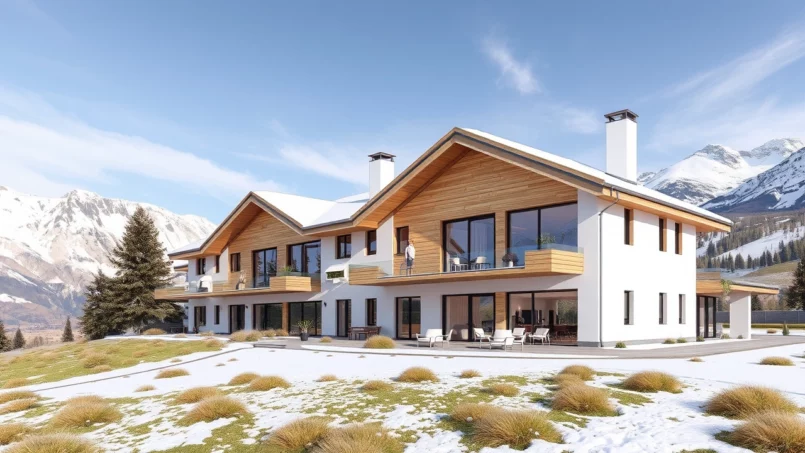
For a residential project of 11 condominium apartments offering a high standard of finish and views of the Alps, two investment strategies are possible. An investor can opt for a purchase followed by long-term rental to generate regular rental income. Alternatively, they can prioritize a medium-term resale, capitalizing on the scarcity of new high-end construction in this market segment to realize capital gains.
Finally, federal investments in the Meielen administrative campus, which is very demanding in terms of sustainability (Minergie-P-ECO, SNBS Platinum), contribute to anchoring a culture of high-performance construction in the municipality, which in turn influences the expectations of buyers and tenants, and thus the value of renovated or new properties meeting these standards.
Regulatory framework for foreign investors: Lex Koller and more
Investing in real estate in Switzerland, including in Zollikofen, involves understanding the specific restrictions on foreign buyers, particularly the famous “Lex Koller”, officially the Federal Act on the Acquisition of Real Estate by Persons Abroad (LFAIE).
This law primarily aims to prevent excessive concentration of land ownership in foreign hands, curb speculation, and preserve housing accessibility for Swiss residents. It applies throughout the territory, but with implementation modalities that can vary significantly from canton to canton.
The key points to know are as follows:
Real estate purchase rules in Switzerland vary based on nationality and residence permit. EU/EFTA citizens residing in Switzerland and holders of a C permit can purchase a home (primary residence) without authorization. Non-residents and non-EU/EFTA nationals without a C permit are subject to authorization, with very limited possibilities. Acquisition of properties for purely commercial use (offices, shops, hotels, commercial/artisanal spaces) is generally possible without specific authorization for foreigners, provided the use remains professional. Secondary residences and vacation homes are subject to strict national and cantonal quotas, especially in tourist municipalities, under the “Lex Weber” which limits their share to 20% of the housing stock in mountain resorts.
In a context like Zollikofen – a non-touristic agglomeration municipality, primarily residential – the practical rule for a foreign investor is therefore:
If you are a resident in Switzerland with a B (EU/EFTA) or C permit, purchasing a primary residence or a rental investment property is much more accessible. If you are a non-resident, the most realistic options are indirect investment (via Swiss real estate funds, real estate SICAVs, etc.) or acquisition of purely commercial spaces, provided a legally compliant structure is set up and cantonal authorities’ approval is obtained.
In any case, the complexity of the legal framework fully justifies seeking specialized advice (lawyer, notary, or fiduciary experienced with Lex Koller), to avoid any structure that could be challenged, with potentially serious penalties (transaction nullity, forced sale, fines, or even criminal sanctions in case of blatant fraud).
Macro context: a tight but relatively stable Swiss market
Understanding Zollikofen also requires placing the municipality within the Swiss real estate landscape. At the national level, several strong trends structure the market:
Summary of the main structural and cyclical indicators of the residential market in Switzerland, based on recent data.
A vacancy rate of about 1% nationally confirms a structural lack of housing on the market.
Annual price increases of 3 to 4% in recent years, with a projected slowdown but no scenario of a massive collapse.
Demand driven by a net growth of over 80,000 inhabitants in 2024 and a projection of +0.8 to 1% per year over the next 5 years.
Relatively low interest rates after the cuts in 2024-2025, with the SNB’s key rate now stabilized around 0%.
Medium-term projections suggest a cumulative appreciation of housing of 10–16% over 5 years, and 15–28% over 10 years, with slightly better performance for condominium apartments compared to single-family houses. The risk of a bubble is considered generally “moderate” at the Swiss level, with more marked imbalances in some vacation markets (Grisons resorts, etc.) or in the hyper-centers of Zurich.
Annual price progression for apartments in the Bern region.
In this context, a municipality like Zollikofen combines several advantages:
1. immediate proximity to a major urban center (Bern) 2. lower prices than the capital, but almost equivalent connectivity 3. marked rental tightness, with vacancy below 1 % 4. competitive local taxation
All arguments in favor of a wealth-building investment strategy, aiming more for security, value preservation, and progressive capital appreciation than explosive short-term returns.
Local players: agencies and intermediaries on site
To position oneself effectively on the market, relying on locally based professionals is often crucial. Zollikofen and its immediate surroundings host several real estate agencies and management companies, for example:
Presentation of the main real estate players in the Thun region, including traditional agents and innovative approaches like Properti.
Technology-based real estate agent located at Webergutstrasse 4A. Offers sales, rentals, property search, valuation, off-market offers, and investor support. Digital approach (virtual tours, alerts), pricing transparency, and up to 5-year rental guarantee for certain mandates.
Real estate agency located at Hessweg 9.
Real estate agency located at Augsburgerstrasse 11.
Real estate agency located at Häberlimatteweg 41.
Real estate agency located at Tannholzstrasse 1.
REMAX network agency located at Bernstrasse 131.
Several of these players have excellent online ratings (5/5 for Properti, Rothenbühler, or Stebler, based on a few reviews), which can help in selecting a trusted partner for property search, leasing, or management.
At a more regional level (Bern, agglomeration), other companies such as Luginbühl Liegenschaften GmbH or MGL Mössinger Gurtner Liechti Immobilien‑Verwaltungs AG are also active, particularly for larger property portfolios.
Investment typology: residential, rental apartment buildings, commercial
In Zollikofen, the range of possible investments is roughly divided into three main categories.
In residential, these are condominium apartments or single-family/terraced houses. 2.5 to 4.5-room apartments near train stations and amenities form the core of the market, with strong rental demand, including from international households working in Bern or the federal campus. Family houses, rarer, have experienced strong recent appreciation, making them interesting for long-term wealth-building strategies (owner-occupancy combined with a resale perspective).
Rental apartment buildings (entire rental properties) are suited for professional investors. In a market with gross yields often below 3.5%, net profitability depends on rent optimization, cost management (renovation, maintenance), and taxation, in a generally favorable context of low rental vacancy.
In the commercial segment, the presence of the federal campus, local shops, medical services, and offices generates a need for suitable spaces. Mixed-use projects like “Klee Zollikofen” illustrate this trend, with ground-floor commercial spaces intended for services deeply rooted in the neighborhood (dental practice, bike shop, beauty salon, café, etc.). For an investor, these neighborhood commercial spaces can offer yields higher than residential, at the cost of potentially longer vacancy between tenants and greater sensitivity to economic cycles.
Entry strategies and risk management
As in any Swiss market, investing in real estate in Zollikofen requires a structured approach, especially for investors not already familiar with the Swiss context.
Several strategic axes emerge:
For a successful rental investment in Zollikofen, prioritize properties located near train stations (Zollikofen, Oberzollikofen, Unterzollikofen, Steinibach) and soft mobility axes, where rental demand is strongest. Target housing already energy-efficient or with good renovation potential (insulation, renewable heating, solar), to meet demand and future regulations. Use online price evaluation and history tools to set a fair rent and avoid overpaying in a tight market. For foreign investors, focus on properties compatible with Lex Koller, favoring resident status, commercial spaces, or indirect investment via Swiss funds.
Regarding risks, the main points to watch concern: vulnerability factors, potential threats, and operational impact.
– dependence on the Bern market: a significant portion of jobs being linked to Bern and the federal administration, a major economic crisis could weigh on demand
– the possible increase in energy renovation costs in the medium term, if additional regulatory requirements are introduced
– the relative moderation of gross yields, typical of Switzerland, which implies aiming for a long-term holding horizon and not counting on rapid, high capital gains
In return, the combination of low vacancy, political and institutional stability, and sustained demographic growth gives the Zollikofen market a generally low-risk profile compared to many foreign markets.
Conclusion: a solid local market poised to gain strength
Investing in real estate in Zollikofen amounts, in a way, to betting on the continuation of the Bern agglomeration’s dynamism, but with a more affordable entry price and a more lenient local taxation than in many municipalities in the canton.
The key elements that emerge are as follows:
Summary of key demographic, economic, and real estate characteristics of the municipality of Zollikofen.
Population in net growth, increasingly international, with an average age around 43.
Unemployment rate close to 1%, role as an economic hub importing labor.
Four train stations and fast connections to Bern, often faster than some intra-urban trips.
Overall vacancy rate below 1% and housing stock dominated by 3–4 room apartments.
Prices rising sharply but still far from Zurich or Geneva peaks, with catch-up potential.
Ambitious new projects like “Klee Zollikofen” modernizing the image and attracting a young, mobile clientele, within a competitive municipal tax framework.
For an investor looking for a relatively accessible Swiss market, well-connected, and with reasonable room for progression, Zollikofen clearly deserves an in-depth analysis. The next step is to define a strategy suited to one’s profile: pied-à-terre rented out, rental apartment in a recent building, participation in a mixed-use project, or purchase of neighborhood commercial spaces.
Thorough preparation is key. It involves analyzing price and rental data, understanding regulations (like Lex Koller for non-residents), and enlisting experienced local professionals for search, negotiation, and management. With this approach, real estate in Zollikofen can become a solid pillar of a wealth-building strategy in Switzerland.
Disclaimer: The information provided on this website is for informational purposes only and does not constitute financial, legal, or professional advice. We encourage you to consult qualified experts before making any investment, real estate, or expatriation decisions. Although we strive to maintain up-to-date and accurate information, we do not guarantee the completeness, accuracy, or timeliness of the proposed content. As investment and expatriation involve risks, we disclaim any liability for potential losses or damages arising from the use of this site. Your use of this site confirms your acceptance of these terms and your understanding of the associated risks.

Cyril Jarnias is an independent expert in international wealth management with over 20 years of experience. As an expatriate himself, he is dedicated to helping individuals and business leaders build, protect, and pass on their wealth with complete peace of mind.
On his website, cyriljarnias.com, he shares his expertise on international real estate, offshore company formation, and expatriation.
Thanks to his expertise, he offers sound advice to optimize his clients' wealth management. Cyril Jarnias is also recognized for his appearances in many prestigious media outlets such as BFM Business, les Français de l’étranger, Le Figaro, Les Echos, and Mieux vivre votre argent, where he shares his knowledge and know-how in wealth management.





