
 Published on and written by Cyril Jarnias
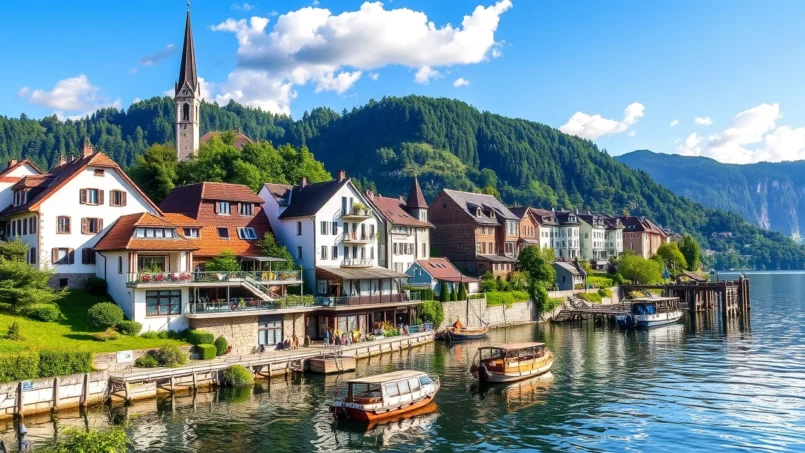
Situated about ten kilometers north of Bern, on the Bern–Biel/Bienne transit axis and on the shore of Lake Moossee, the municipality of Munchenbuchsee is attracting increasing attention from real estate investors. With a very green living environment, relatively moderate taxation for the canton of Bern, and a price market in full readjustment, it offers a very different profile from major Swiss cities while remaining extremely well-connected.
This article analyzes the relevance of investing in real estate in Munchenbuchsee, covering residential rental purchases, primary residences, and ‘land and development’ projects. It offers a comprehensive overview to assess the different possible investment strategies in this locality.
Munchenbuchsee, portrait of a municipality at a crossroads
Munchenbuchsee is a political municipality in the Bern-Mittelland district. It covers 8.81 km² on the Swiss Plateau, at an altitude of approximately 554–564 meters. About 38.8% of its territory is agricultural, 27.2% is forested, and 34.6% is already built-up. This dense mix of residential areas, employment, and green spaces strongly shapes the real estate supply.
The permanent population exceeds 10,700 inhabitants, with a density of around 1,150 inhabitants/km². The demographics are balanced: just over a fifth of the population is under 20, nearly two-thirds are of working age, and about 16% are over 64. This structure translates into varied demand for housing: family apartments, senior housing, small units for young professionals, etc.
Munchenbuchsee, nicknamed ‘Buchsi,’ possesses a rich historical heritage that extends beyond its residential function. It is the birthplace of painter Paul Klee and is home to several sites of national importance: the Hofwil estate (with its castle, former teacher training college, and swimming pool), the commandry of the Order of Saint John, Munchenbuchsee Castle, and a Reformed church with medieval origins. This heritage dimension directly influences construction and densification policies, particularly in the town center.
The local economy is strong for a municipality of this size: the unemployment rate was around 1.9%, with over 5,200 recorded jobs, mostly in the tertiary sector. However, Munchenbuchsee is a commuter territory: more workers leave the municipality each day than enter it, underscoring the key role of connections to Bern and other employment centers.
Accessibility and infrastructure: a major asset for investment
For an investor, the actual location is not just about the postcard view. Munchenbuchsee has a decisive argument: accessibility. It is located on the Bern–Biel/Bienne transport node, with excellent rail and road links.
The municipality is served by two train stations, connecting the Bern-Olten and Bern-Biel lines.
Soft mobility is also taken into account: the municipality plans to extend daily cycling routes, is working on reducing the number of mandatory parking spaces near the station and town center, and envisions a bike rental system as well as a future enhanced public transport “hub” around the station.
These investments in mobility infrastructure are important for real estate: they expand the pool of potential tenants (commuters to Bern and other municipalities), make car-free housing more attractive, and support real estate values in the medium term.
A rather favorable local tax environment for investment
Munchenbuchsee has a municipal tax coefficient (Steuerfuss) of 164, slightly below the cantonal average (170.9). For an owner, this means a tax burden on income and wealth that is generally moderate within the canton of Bern.
The specific multipliers for religious communities (Catholic and Reformed) also remain in line with, or even slightly below, the cantonal averages. The average declared income is around 58,000 CHF, a bit higher than the cantonal average (56,000 CHF), suggesting a base of solvent tenants.
For an investor, it is crucial to consider the specific taxes related to property ownership in the canton of Bern. These include the imputed rental value tax (taxed as income), the wealth tax, a possible real estate tax, and, most importantly, the property transfer tax. The latter amounts to 1.8% of the purchase price, typically borne by the buyer. Notary and land registry fees represent about an additional 3% of the price. This overall tax level remains within the Swiss average.
The residential market: a pivotal moment to enter
Recent data shows that the real estate market in Munchenbuchsee is undergoing a correction phase after long-term strong increases. As of December 2025, the average price per m² stood at 8,226 CHF, for all types combined, with a marked distinction between apartments and houses.
Price trends: a recent decline after 20 years of increase
Over a period of about 25 years, the price per m² for houses increased by over 65%, and for apartments by about 57%. This long-term trend confirms that Munchenbuchsee follows the upward dynamic observed in many well-connected municipalities on the Swiss Plateau.
However, in the 12 months leading up to the end of 2025, a clear decline is visible:
| Indicator (Munchenbuchsee) | Recent Value (Dec. 2025) | 12-Month Change |
|---|---|---|
| Average price per m² – all properties | 8,226 CHF/m² | -20.5% |
| Average price per m² – apartments | 7,495 CHF/m² | -15.2% |
| Average price per m² – houses | 8,957 CHF/m² | -24.5% |
This correction is far from erasing the long-term gains, but it changes the entry point for an investor. It reflects both the impact of the tightening of Swiss mortgage rates and an adjustment after years of almost continuous growth.
It is worth noting that other sources for 2026 indicate higher average levels (around 8,800 CHF/m²), proof that data varies depending on methodologies and exact time periods. But the recent trend of price “recalibration” is clear.
Price levels by type and size of housing
The Munchenbuchsee market presents a wide range of budgets, depending on the type of property and number of rooms. For an investor, knowing these order of magnitude figures is essential for sizing a rental project.
Average purchase prices by housing type
| Property Type | Estimated Average Price |
|---|---|
| 4-room house | 760,000 CHF |
| 5-room house | 1,100,000 CHF |
| 6-room house | 1,300,000 CHF |
| 7-room house | 1,400,000 CHF |
| 8-room house | 1,500,000 CHF |
| Studio (apartment) | 594,000 CHF |
| 2-room apartment | 614,000 CHF |
| 3-room apartment | 680,000 CHF |
| 4-room apartment | 804,000 CHF |
| 5-room apartment | 991,000 CHF |
These figures, combined with average rents, allow for calculating realistic gross yields.
Average price per m² by number of rooms
| Property Category | Average Price per m² |
|---|---|
| 4–4.5-room house | 8,023 CHF/m² |
| 5–5.5-room house | 13,124 CHF/m² |
| 6–6.5-room house | 7,815 CHF/m² |
| House > 7 rooms | 5,044 CHF/m² |
| 2–2.5-room apartment | 8,708 CHF/m² |
| 3–3.5-room apartment | 7,969 CHF/m² |
| 4–4.5-room apartment | 8,478 CHF/m² |
| 5–5.5-room apartment | 8,430 CHF/m² |
| Apartment > 6 rooms | 4,979 CHF/m² |
It is notable that 5-room houses fall within a particularly high price per m² range. This may be related to very high-quality properties or those located in the most sought-after segments. Conversely, large dwellings (houses with more than 7 rooms, apartments with more than 6 rooms) trade at a significantly lower price per m², reflecting a narrower market for these products.
Value dispersion: understanding the segments
To refine a strategy, it is useful to know the value distribution:
| Segment | Lower 20% | Central 60% | Upper 20% |
|---|---|---|---|
| Apartments (CHF/m²) | < 5,692 | 5,692 – 9,353 | > 9,353 |
| Houses (CHF/m²) | < 5,500 | 5,500 – 7,924 | > 7,924 |
This distribution shows that the “bulk” of the market is around 6,000–8,000 CHF/m², with a high-end segment exceeding 9,000 CHF/m², typically for sought-after locations or recent, high-energy-performance properties.
The rental market: sustained rents and diversified demand
For the investor, the key question is the rental market’s ability to absorb new housing and generate satisfactory yield.
Listings suggest a sufficiently active market: over thirty apartments are available for rent, with varied profiles (studios, 3.5-room, 4.5-room, townhouses, etc.). The median rent for an apartment is around 2,365 CHF per month, with 80% of rents between 1,251 and 4,408 CHF.
Data by typology is instructive:
| Property Type | Average Monthly Rent |
|---|---|
| 4-room house | 2,564 CHF |
| 5-room house | 2,732 CHF |
| 6-room house | 2,858 CHF |
| 7-room house | 2,946 CHF |
| 8-room house | 2,995 CHF |
| Studio | 845 CHF |
| 2-room apartment | 1,278 CHF |
| 3-room apartment | 1,605 CHF |
| 4-room apartment | 1,926 CHF |
| 5-room apartment | 2,311 CHF |
From these figures, an investor can get an idea of the gross yield: for example, a 4-room apartment purchased for around 804,000 CHF and rented for 1,926 CHF/month gives a gross yield of around 2.9% (1,926 × 12 / 804,000). This is moderate, but aligned with yields observed in attractive Swiss markets.
Comparative analysis of rental performance according to the size and typology of real estate properties.
Studios and 2-room apartments often exhibit slightly higher rental yields per square meter.
Serve more as long-term legacy assets, with lower current yield but significant appreciation potential.
Where to invest in Munchenbuchsee? Neighborhoods, streets, and projects
Munchenbuchsee is not a uniform market. Certain areas and streets concentrate the highest valuations, others offer lower entry points but good prospects.
Price differences by street
Data by street illustrates this internal hierarchy:
| Street | Average Price per m² (approx.) |
|---|---|
| Hohlenweg | 8,827 CHF/m² |
| Höheweg | 7,760 CHF/m² |
| Mühlestrasse | 7,753 CHF/m² |
| Eichgutweg | 7,328 CHF/m² |
| Ursprungstrasse | 7,227 CHF/m² |
| Hofwilstrasse | 7,143 CHF/m² |
| Waldeckweg | 6,601 CHF/m² |
| Seedorfweg | 6,326 CHF/m² |
| Bernstrasse | 5,904 CHF/m² |
Streets like Hohlenweg or Höheweg are in the upper price range, likely due to their more sought-after urban or landscape context. Streets such as Bernstrasse show lower prices per m², which may indicate nuisances (traffic, noise) but also opportunities for investors willing to bet on town center and road redevelopment projects (notably around the “Bären-Knoten” intersection and Bernstrasse).
Flagship projects: what they reveal about the center’s potential
Several recent or ongoing projects provide strong indications of the municipality’s development strategy.
Kirchgasse 7 – a condominium building in the heart of the village A new 8-apartment condominium building (2.5 to 4.5 rooms) was constructed at Kirchgasse 7, right in the center of Munchenbuchsee. The mix (2 garden apartments, 2 duplex/townhouses, 4 standard floors) targets different buyer profiles. The project was developed closely with the municipality and heritage protection services, with strict constraints on the facade. Result: all units were sold.
This case illustrates three important points for an investor: the importance of prior market analysis, the need to diversify one’s portfolio to mitigate risk, and the advantage of favoring long-term investments to benefit from the effects of capital appreciation.
– the demand for modern condominiums in the village center is real,
– heritage protection increases complexity, but also the scarcity of products,
– early collaboration with authorities is essential for any densification or reconstruction in the historic core.
Schöneggweg – controlled densification for around 74 apartments Another major project concerns the Schöneggweg area. It plans to replace obsolete buildings from the 1950s with four buildings, divided into six entry units, for a total of 74 dwellings, including 48 family apartments. A large central space, a playground to the east, and several relaxation areas are planned, with buildings in a hybrid structure (concrete basement, wood-facade floors), heating connected to the wood-fired district heating network (or heat pumps as an alternative), photovoltaic roofs, and electric vehicle charging stations.
The municipality accepted a revision of the building envelope, based on volume studies and the slope of the terrain. The operation will more than double the number of dwellings in the perimeter, while opening up the neighborhood to the ‘Klostermatte,’ an ecological recreation area, via a new pedestrian path.
The municipality
For an investor, this project is revealing:
– “inward” densification is a reality accepted by the municipality,
– energy standards and soft mobility are becoming central criteria,
– neighborhoods close to the center will gain attractiveness thanks to new pedestrian connections.
Town center and “Bären-Knoten” redevelopment The “Sanierung Zentrum” project plans the redevelopment of the Bernstrasse, Bielstrasse, and Oberdorfstrasse sections around the “Bären-Knoten” intersection. A mini-roundabout, a 30 km/h speed limit, better-secured pedestrian crossings, more greenery, and longitudinal parking are intended to reduce congestion, improve safety for pedestrians and cyclists, and strengthen the town square character of the center.
The real estate impact is twofold: improved quality of life and image of the center (positive effect on values), but also adaptation to calmer mobility, which can reduce the appeal of locations heavily dependent on cars while enhancing those within walking distance of the station and town core.
Urban planning: targeted densification until 2040
Investing in real estate requires understanding the municipality’s vision for the next 10–20 years. Munchenbuchsee has undertaken a comprehensive revision of its local planning (OPR 17+), based on a spatial development concept developed in 2017 with broad public participation.
The main lines are clear:
Number of additional residents targeted over 10 to 15 years within the framework of moderate demographic growth.
For an investor, this means that the creation of new raw buildable potential (new neighborhoods ex nihilo) will be limited in the medium term; the majority of opportunities will be in the transformation of already built plots, the restructuring of aging complexes, and participation in master-plan projects like Schöneggweg.
The municipality does not grant direct financial aid for renovations but offers advisory support for projects presenting public interest (e.g., energy renewal or creation of age-adapted housing). It also uses parking space regulations to promote less car-dependent projects in areas near the stations.
The large plot in “Arbeitszone 2”: potential for commercial real estate
Besides residential, Munchenbuchsee possesses a rare asset in the Bern agglomeration: a large plot of nearly 18,621 m², owned by the Burgergemeinde (citizens’ municipality), located on the edge of the town and zoned for commercial activity (Arbeitszone 2). The potential gross floor area is very broad, between 4,000 and 30,000 m², with a maximum height of 17.5 m.
This working zone, with few residents, offers excellent road connections (near the A6 highway), good public transport service, and soft mobility routes. The proposed concept is one of build-to-suit, design-to-cost buildings, fully adapted to the needs of a single tenant or multiple occupants. Accessibility via two levels, permitted by the slope of the terrain, allows for multiple configurations: separate logistics access, flexible floor plates, etc.
For an institutional investor or a commercial/industrial developer, this location offers a rare combination of:
– large-sized land,
– programmatic flexibility (single or multi-tenant),
– low-conflict environment (few immediate neighbors),
– stable macroeconomic context in the canton of Bern.
The terms of a building lease (bail à construction) can, however, influence the yield and must be analyzed in detail.
Quality of life: an argument for rental demand
The attractiveness of a rental market is not only about proximity to a large city, but also about daily quality of life.
Munchenbuchsee stands out for:
Discover the main assets and infrastructure that characterize this territory, combining a preserved environment, leisure activities, and educational services.
Benefits from significant forest cover (over a quarter of the territory) and vast preserved agricultural areas.
Enjoys direct access to Lake Moossee for water activities and relaxation.
Features multiple facilities: Hirzenfeld sports center, swimming pools, and various sports fields.
Offers a varied school system, including a gymnasium in Hofwil currently undergoing expansion.
Hosts dedicated institutions such as the center for pedagogy for hearing and language and other specialized educational institutions.
Ongoing projects – renovation of the Hofwil gymnasium, new triple hall, modernization of school infrastructure – show that the municipality is investing heavily in youth and education, which strengthens its attractiveness to families.
The temperate oceanic climate (Cfb) of the region, with cold but relatively mild winters and moderate summers, contributes to stable living comfort. Annual precipitation is around 960 mm, which, combined with restored forests and wetlands (renaturation of Kilchmattbach, Mühlebach), offers a quality natural environment.
Yields and profitability: what can an investor expect?
In the Swiss context, gross residential yields of 3 to 4.5% are often considered “decent” in sought-after markets. In Munchenbuchsee, indicative figures suggest gross yields are rather in the low to median range of this bracket, depending on the asset type.
By cross-referencing the prices and average rents already mentioned, we get, roughly:
– for a 3-room apartment: an average cost around 680,000 CHF for a rent of about 1,600 CHF → gross yield close to 2.8–3%,
– for a 4-room apartment (804,000 CHF, 1,926 CHF rent) → about 2.9%,
– for small units, gross yields can slightly exceed 3%, thanks to better rent valuation per m².
A yield of 4.5% is considered above the local average. To achieve it, specific efforts will likely be necessary.
– targeting products with an acquisition price below the median (e.g., properties needing targeted renovation but well-located),
– optimizing the typology (studios, 2–2.5 room apartments) where the rental market tolerates higher rents per m²,
– or positioning oneself in non-residential yield-generating real estate (craft, offices in commercial zones) which structurally offers higher yields.
Furthermore, one must factor in taxation (imputed rental value tax, wealth tax, maintenance charges, insurance) and acquisition costs (approx. 3% in the canton of Bern), which reduce the net yield by 0.5 to 1 percentage point.
Risks and points of caution
Even in a solid market, an investor must remain realistic about the risks:
Real estate investment in Munchenbuchsee has specificities: prices have seen a 15-25% correction over one year, highlighting volatility linked to interest rate cycles. Projects in the historic center are subject to strict rules (envelopes, facades) which can increase costs and delays. Rental yields are moderate, favoring a legacy approach and long-term security over high immediate cash flow. Finally, the market’s attractiveness strongly depends on transport links to Bern and Biel, making it sensitive to economic and mobility developments along this axis.
In return, the market benefits from robust fundamentals: proximity to a metropolitan center (Bern), decent income level, low unemployment, massive public investments (schools, mobility, renaturation), and coherent densification policy.
Possible investment strategies in Munchenbuchsee
Based on all these elements, several strategies emerge.
“Classic” residential rental purchase
Target: 2 to 4.5-room apartments in well-served neighborhoods (near station, center, schools), in the central price range (6,000–8,500 CHF/m²). Objective: gross yield around 3% with low rental risk (structurally low vacancy rate in the Bern agglomeration), gradual appreciation with infrastructure projects and land scarcity.
Repositioning of an old building
Target: Buildings from the 1950s–1970s, energetically obsolete, in quality locations (like the Schöneggweg case). Strategy: Major renovation or reconstruction, increase in number of dwellings, energy improvement, shared outdoor spaces. Interest: Capture the “inward” densification potential encouraged by the municipality, while meeting the need for family housing and age-adapted housing.
Commercial and industrial real estate
Target: Projects in the “Arbeitszone 2” zone (like the large 18,621 m² plot). Strategy: Develop tailor-made spaces for one or multiple tenants (light logistics, SMEs, technical offices, craft activities), leveraging excellent road and rail connections. Advantage: Gross yields generally higher than residential, portfolio diversification.
Mixed-use town center project
Target: Plots in or near the historic center (Kirchgasse, Oberdorfstrasse, Bernstrasse, etc.). Strategy: Creation of small mixed-use programs (commercial on ground floor, apartments upstairs), integrated into the historic fabric and future center developments. Interest: Actively participate in the center’s requalification and benefit from the gradual upscaling of this sector.
Conclusion: a core market for patient investors
Investing in real estate in Munchenbuchsee means betting on a municipality in the Bern periphery that has moved beyond playing a supporting role. It embraces moderate growth, bets on quality densification, invests in its school and mobility infrastructure, and preserves significant landscape and agricultural capital.
As prices have recently corrected after a long rising phase, this period of recalibration may constitute an entry opportunity for the medium- and long-term investor. This approach requires accepting moderate gross yields and adopting an investment horizon of 10 to 20 years, rather than focusing on a short 2 to 3-year cycle.
The key to success will be to:
– choose locations aligned with the municipal vision (proximity to public transport, center, neighborhoods undergoing renewal),
– integrate energy and environmental requirements from the design stage,
– engage in early dialogue with the municipality for transformation projects,
– and build a legacy strategy, more than a pure quick-yield strategy.
Within this framework, Munchenbuchsee appears as an interesting piece of the Swiss real estate puzzle: neither a speculative market, nor a declining one, but a core, stable, and transitioning territory where the savvy investor can find opportunities consistent with prudent capital management.
Disclaimer: The information provided on this website is for informational purposes only and does not constitute financial, legal, or professional advice. We encourage you to consult qualified experts before making any investment, real estate, or expatriation decisions. Although we strive to maintain up-to-date and accurate information, we do not guarantee the completeness, accuracy, or timeliness of the proposed content. As investment and expatriation involve risks, we disclaim any liability for potential losses or damages arising from the use of this site. Your use of this site confirms your acceptance of these terms and your understanding of the associated risks.

Cyril Jarnias is an independent expert in international wealth management with over 20 years of experience. As an expatriate himself, he is dedicated to helping individuals and business leaders build, protect, and pass on their wealth with complete peace of mind.
On his website, cyriljarnias.com, he shares his expertise on international real estate, offshore company formation, and expatriation.
Thanks to his expertise, he offers sound advice to optimize his clients' wealth management. Cyril Jarnias is also recognized for his appearances in many prestigious media outlets such as BFM Business, les Français de l’étranger, Le Figaro, Les Echos, and Mieux vivre votre argent, where he shares his knowledge and know-how in wealth management.





