
 Published on and written by Cyril Jarnias
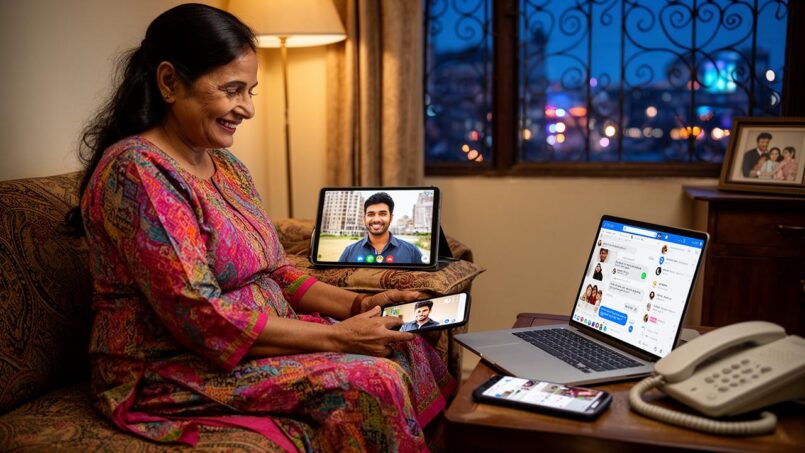
Moving to or traveling in Bangladesh does not at all mean cutting ties with your family and friends. Between the highly developed mobile network, ubiquitous messaging apps, the democratization of VoIP, money transfer services, and even gift delivery, everything is in place to maintain strong bonds, provided you know your way around and respect a few cultural codes.
To stay in touch with your loved ones from Bangladesh, it is essential to consider both the technical infrastructure available in the country and the local social habits. This article provides a practical and comprehensive guide to effectively navigate these two aspects.
Understanding the Digital Landscape in Bangladesh
Staying in touch first requires a reliable connection. And today, Bangladesh is one of the most dynamic digital markets in South Asia.
The country has more than 180 million active mobile connections, which is more than its total population. Almost the entire territory is covered by 4G, and the majority of internet users connect exclusively via their smartphones. Fixed lines exist, but it is mobile that dominates, especially for video calls and messaging.
Internet: Broad Coverage, Uneven Usage
Despite 3G/4G coverage announced at 100%, just under half of the population actually uses the Internet. In early 2025, there were about 77.7 million internet users, then 82.8 million by late 2025, representing a penetration rate of around 45–47%. In other words, the gap between connected and non-connected areas remains real, especially between cities and the countryside.
The recent evolution can be summarized as: adaptation to new technologies and consideration of environmental concerns.
| Indicator | Early 2025 | Late 2025 |
|---|---|---|
| Internet Users (millions) | 77.7 | 82.8 |
| Internet Penetration Rate (%) | 44.5 | 47.0 |
| Share of Offline Population (%) | 55.5 | 53.0 |
Speeds are increasing rapidly. At the beginning of 2025, the median mobile download speed was around 28 Mbps, and fixed-line was around 49 Mbps. One year later, an increase of more than 20% was already observed in both segments. For most family uses—video calls, messaging, photo sharing—these speeds are largely sufficient, especially in cities.
A Highly Mobile-Centric Country
To stay in touch from Bangladesh, the smartphone is the king tool. Almost all social and communication uses go through mobile apps, often on Android. More than 95% of social media access is via Android, while the iPhone remains concentrated among affluent urban users.
Average price in US dollars for one gigabyte of mobile data in Bangladesh, one of the cheapest in the world.
Choosing a Local SIM or eSIM to Stay Reachable
The first decision to make upon arriving in Bangladesh concerns connectivity: should you keep the roaming from your home carrier or use a local SIM (or eSIM)?
International Roaming: The Bad Idea That Costs a Fortune
The roaming rates charged by many foreign carriers in Bangladesh are often prohibitive. Without a specific option, you can end up with:
– Plans at 10–15 USD per day
– Pay-as-you-go data rates that can go up to 10–15 USD… per megabyte
Concretely, 1 GB of data on uncontrolled roaming can cost 10,000 to 15,000 USD. Many travelers leave with bills of 200, 500, or even 1,000 USD after a few days of careless use.
In this context, adopting a local SIM or a dedicated eSIM is almost essential to stay in touch affordably.
Major Carriers and SIM Prices
Four carriers dominate the market:
– Grameenphone
– Robi (and Airtel, integrated into the same group)
– Banglalink
– Teletalk (state-owned operator, more modest)
The price in BDT of a physical prepaid SIM in Bangladesh, varying by carrier, type of number, and place of purchase.
Often, the price of the SIM includes communication credit or a small data volume.
Tourist and Prepaid Plans: Comfortable Volumes for Cheap
To stay in intensive contact with your loved ones—video calls, daily exchanges, sending photos—local prepaid offers are more than enough.
A few representative examples:
| Offer | Approx. Price | Main Content | Duration |
|---|---|---|---|
| Grameenphone Tourist SIM | 549 BDT | 25 GB data + included SIM credit | 15 days |
| Robi/Airtel Tourist SIM | 250 BDT | 10 GB data | 30 days |
| Banglalink Prepaid (5 GB pack) | 198 BDT | 5 GB + 150 minutes of local calls | 7 days |
| Banglalink Prepaid (60 GB) | 998 BDT | 60 GB + 1500 minutes | 30 days |
For a monthly budget under 10 USD, it is thus possible to have dozens of GB of data, more than enough for near-daily video calls with family back home.
eSIM: Prepare Your Connection Before Even Landing
For those who prefer to avoid SIM formalities upon arrival, several international providers offer data eSIMs for Bangladesh, activatable remotely:
Comparison of the main eSIM providers for travelers to Bangladesh, with their offers and prices.
Flexible offers: from 1 GB/7 days for about 5.60 USD up to 20 GB/30 days for a little over 45 USD.
Multi-duration plans, some with unlimited data, working on Robi or Banglalink networks.
About 1.30 USD per day for a 7-day plan.
The major advantage of these solutions: you can keep your original number for bank validation SMS or professional contacts, while having cheap local data.
To stay in touch with loved ones, the most practical combination is often: data eSIM for connectivity, and apps (WhatsApp, Messenger, etc.) for all exchanges.
Messaging Apps and Social Media: Where Are Your Loved Ones?
Once connected, the question becomes: on which apps to communicate? In Bangladesh, as elsewhere, a small number of platforms concentrates most of the usage.
The Communication Champions in Bangladesh
On the Google Play Store, the “Communication” category is dominated by a few major international players:
| Rank (Play Store Communication) | Application | Main Use |
|---|---|---|
| 1 | WhatsApp Messenger | Messages, audio/video calls, sharing |
| 2 | Snapchat | Ephemeral messages, stories |
| 3 | Messenger (Meta) | Chat, calls, Facebook integration |
| 4 | imo | Popular for international calls |
| 5 | Telegram | Messaging, channels, file sharing |
WhatsApp and Messenger have become essential for cross-border family communication. Telegram and imo play an important role for voice/video calls, especially with relatives in countries where these apps are very established.
The Weight of Social Media in Family Ties
On the social media side, Facebook dominates widely. For many Bangladeshis, “the Internet” is almost synonymous with Facebook, which serves as a social network, messenger (via Messenger), news platform, and even a commercial channel.
The number of essential networks for maintaining social ties according to the article.
| Platform | Users (late 2025, approx.) | Share of Total Population | Main Remarks |
|---|---|---|---|
| 64 million | ~36% | Core hub for interactions | |
| TikTok | 56.2 million (18 years and older) | ~48% of adults | Short videos, viral content |
| YouTube | ~33.6 million | — | Long videos and Shorts |
| ~9.15 million | ~5% | Urban, more affluent audience | |
| Messenger | 28–35 million | ~30% of adults | Messaging linked to Facebook |
To stay in touch with your loved ones from Bangladesh, it is therefore very effective to combine:
– WhatsApp and Messenger for daily discussions and video calls
– Facebook, Instagram or TikTok to share life moments (photos, stories, Reels, videos) with a wider circle of family and friends
Calling Your Family Abroad Without Blowing Your Budget
Even in the age of WhatsApp, there are still situations where you need to call regular numbers—for example, an elderly parent who doesn’t use a smartphone, or a home landline. Here too, Bangladesh relies on a highly developed VoIP ecosystem.
VoIP from Bangladesh: Legal Framework and Local Offers
VoIP (Voice over IP) is legal in Bangladesh provided it goes through licensed operators. Many local and international companies provide IP telephony solutions, both for individuals (via apps) and for businesses.
Among the main providers:
Overview of the main VoIP and telecommunications service providers in Bangladesh, offering quality international calling solutions.
Often presented as one of the best IP calling solutions in the country, with high call quality and advanced features (recording, smart routing, CRM integrations).
Amber IT, ICC Communication, MetroNet, Link3, AKNET, Agni Systems, or Triangle Services Limited, which often combine Internet access and VoIP services.
Bangladesh Telecommunications Company Limited, the historic operator, which also offers international calling solutions.
For an individual, these solutions are mainly relevant if you have a massive use of international voice calls or if you run a business requiring a phone presence in several countries. For purely personal use, international consumer-oriented services are often simpler.
International Services for Calling Bangladesh (and Vice Versa)
Several specialized services allow you to call or be called internationally at rates much lower than those of traditional carriers:
– BOSS Revolution
– Rebtel
– Yolla
– Talk360
– KeepCalling
– ZenCall, ZippCall (via browser)
These platforms generally work in two ways:
1. Calls from a mobile app or website, via data or Wi‑Fi
2. Calls via a local access number (in the country where you are), which then switches to their international network
The advantage is twofold: costs are controlled, and it is possible to call regular numbers, even if the other person has neither a smartphone nor an Internet connection.
For calls to Bangladesh, the rates advertised by these services are often on the order of a few cents per minute. For example:
| Service | Typical Rate to Bangladesh | Example of Minutes with 10 USD |
|---|---|---|
| BOSS Revolution | ~3.2 cents/min | ~313 minutes |
| Rebtel | ~3.6 cents/min | ~277 minutes |
| Yolla | starting from ~2.6 cents/min | ~384 minutes (theoretical) |
| ZenCall | starting from ~4 cents/min | ~250 minutes |
| Standard Mobile Carriers (US, etc.) | 20 cents–1 USD/min | A few dozen minutes |
From Bangladesh, using this type of service via cheap local Internet allows you to call loved ones in any country without blowing up the bill.
VoIP “Virtual Numbers” to Stay Reachable as if You Were Home
Providers like AVOXI or Phonology offer virtual numbers (local or toll-free) for Bangladesh and other countries. The principle:
– You purchase a local number (for example, a French or Canadian number)
– Calls to that number are automatically redirected to your line in Bangladesh (mobile or VoIP)
– For your loved ones back home, the call is billed as a standard local or domestic call
This is a good solution if you have elderly parents, uncomfortable with apps, who prefer dialing a “real” number rather than using WhatsApp.
Managing Time Differences to Avoid Waking Everyone Up
Staying connected also means respecting each other’s rhythms. A traveler based in Bangladesh often has to juggle significant time differences: for example, +4 to +6 hours from Europe depending on the season, or even 8–12 hours from North America.
When “Time Distance” Complicates Daily Life
Studies on dispersed families show that the time zone difference is sometimes more difficult to manage than the geographical distance itself. You end up:
– Missing calls
– Waking someone up in the middle of the night
– Postponing conversations until later, until they become a chore rather than a pleasure
Families interviewed in this research report an average of three unsuccessful call attempts per week due to the time difference.
In Bangladesh, where social and family life is very structured around meals, prayers, and respect for elders, it is important to avoid calling at inappropriate times, as this can be particularly poorly perceived.
Organizing “Golden Windows” for Communication
The most effective solution is to ritualize exchanges:
– Identify the exact time difference between your city in Bangladesh (Dhaka, Chittagong, Sylhet) and your loved ones’ city
– Identify the “golden” slots when everyone is awake and relatively available (for example, your evening = their morning)
– Decide together on one or two weekly appointments for long conversations, and more flexible slots for quick messages
Digital tools can greatly help:
– World Time Buddy, TimeAndDate, Every Time Zone or Time Zone Ninja allow you to very simply visualize availability overlaps between several countries.
– Google Calendar or Outlook automatically manage time zones and daylight saving changes, sending reminders to each person at their local time.
It is useful to indicate the expected duration of a call from the start, for example by proposing: “Shall we talk for 15–20 minutes?” or “Shall we block an hour on Sunday?” This allows everyone to better organize themselves, especially when days are already very structured by work, family, and religious obligations.
Rely on Asynchronous Communication to Keep in Touch Daily
When time zones are completely offset—for example, 8–12 hours difference—asynchronous communication becomes valuable:
– Voice messages on WhatsApp or Telegram
– Short videos sent to the family (children learning a few Bengali words, a walk in Dhaka, a shared meal)
– Photos/comments posted on a family Facebook or Messenger group
Everyone can listen, watch, reply when they are available, without pressure. Some services or apps, mentioned in the research, go even further by offering scheduled messages to arrive at the right time in the recipient’s time zone.
Making Video Calls with a Sometimes Spotty Connection
Bangladeshi mobile networks have improved a lot, but depending on the carrier, neighborhood, and time of day, the quality can vary: during peak hours, some networks drop from 20–40 Mbps to 5–10 Mbps. However, it is perfectly possible to maintain excellent video exchanges with your family abroad, provided you set up your tools well.
How Much Bandwidth Do You Really Need for a Family Video Call?
The requirements of major video conferencing platforms (Zoom, Google Meet, etc.) are relatively modest for standard use:
| Approximate Video Quality | Typical Need (Upload + Download) |
|---|---|
| Audio only | ~0.06–0.1 Mbps |
| Low-quality video (240p) | ~0.3–0.5 Mbps |
| Standard (480p) | ~0.6–1 Mbps |
| HD (720p) | ~1.2–1.8 Mbps |
| Full HD (1080p) | ~2.5–3 Mbps |
Even a modest mobile connection (1–2 Mbps stable) is enough for a family call at 480p, or even 720p under favorable conditions.
Good Practices to Avoid “Laggy” Calls
In Bangladesh as elsewhere, problems often come less from the network itself than from how it is used at the time of the call. A few simple actions greatly improve quality:
To improve video call quality, move closer to the Wi-Fi router or use 4G with a good signal rather than a distant Wi-Fi. During the call, turn off Netflix, YouTube, or background downloads. Close other video conferencing apps (Skype, Teams, etc.) on your computer or phone. Disable HD in Zoom/Meet settings and settle for a 360p or 480p resolution. In a group, ask participants who are not speaking to turn off their camera and sometimes their microphone.
On more advanced platforms (Jitsi, TrueConf, etc.), adaptive bandwidth modes, limiting to a few active video streams, or using efficient codecs (Opus for audio, VP8 or H.264 for video) allow maintaining smooth conversations even around 256–512 kbps.
For family use, it is essential to prioritize sound quality over image quality. It’s better to see your loved ones with a slightly pixelated image but hear them well, rather than the opposite.
Sending Money and Gifts to Your Loved Ones Back Home
Staying in touch isn’t just about talking: it’s also about being able to help your family financially or marking important occasions from a distance. Bangladesh is at the heart of migrant remittance flows, and the infrastructure for receiving money or gifts is highly developed.
Sending Money to Bangladesh
Several major global services serve the country:
– Western Union
– MoneyGram
– Wise (ex‑TransferWise)
– Remitly
– Ria Money Transfer
– Xoom (a PayPal service)
– TerraPay and others
Recipients can receive funds in different ways:
– Cash withdrawal at an agency (for example at Dutch‑Bangla Bank, Sonali Bank, Prabhu…)
– Direct transfer to a bank account (Bank Asia, Standard Chartered, Bangladesh Commerce Bank, etc.)
– Credit to a very popular mobile wallet like bKash, Nagad, Rocket, Upay, iPAY
For family in Bangladesh, these services combine several advantages:
Mobile payments in China, via apps like Alipay or WeChat Pay, offer almost instant receipt of funds in many cases. Their success is also explained by their broad geographic coverage, which includes major cities and most districts. A key factor in their massive adoption is their seamless integration with mobile wallets already deeply embedded in users’ daily lives for various activities.
The Bangladeshi government even encourages these remittances by offering a 2.5% incentive on some official transfers. This is an element to consider when choosing a transfer channel.
Sending Money from Bangladesh to Your Loved Ones Abroad
An expatriate based in Bangladesh may also need to send money in the other direction (children studying abroad, supporting parents living elsewhere, etc.).
In this case, they can use:
– Their local bank account (via international options offered by some banks)
– Online services that accept payments by international card or bank transfer to then credit a foreign account
– Platforms like Wise, particularly competitive on rates and fees when transferring money from account to account
The typical procedure is often the same: create an account, enter the amount, choose the receipt method (bank account, wallet, cash pickup), payment (card, account, PayPal), then track with a tracking number.
Delivering Gifts to Your Family in Bangladesh
For many Bangladeshis in the diaspora, sending a gift on the occasion of a birthday, wedding, Eid, Pohela Boishakh, or other holidays is a very important symbolic gesture.
Platforms such as UpoharBD.com and BDGift.com have specialized in gift delivery across the entire territory. They stand out by offering a very wide product catalog, making it easy to send a gift.
– Cakes (birthday, wedding, special shapes)
– Bouquets of flowers
– Boxes of sweets, chocolates, ice cream
– Prepared dishes (samosa, fried chicken, rice…)
– Small appliances, perfumes, personalized baskets
– Religious items like prayer mats (Jaynamaz) or prayer beads (Tasbih)
These sites allow you to schedule delivery on the day, sometimes even at a specific time (including midnight for a birthday), add a personalized message, and often include free little touches (gift wrapping, card, rose).
Payment is made online in various currencies (BDT, USD, EUR, GBP, AUD, CAD…), which facilitates use from abroad. For an expatriate already in the country, it is also convenient for organizing a surprise at a distance in another city.
Staying in Touch While Respecting Bangladeshi Cultural Codes
Communicating from Bangladesh is not just about technical issues. Understanding a few local social codes helps maintain harmonious relationships, whether with family on the ground or when calling in-laws back home.
The Importance of Family and Respect for Elders
Bangladeshi society is deeply collectivist: the extended family is at the center of social life, and loyalty to loved ones comes before abstract rules. Multigenerational households are common, and important decisions are often made within the family.
When you are abroad and calling your family in Bangladesh, it is well-regarded to: prefer times when family members are available to avoid disturbing them.
In Bangladesh, it is important to greet the eldest people first using the phrase “As‑salamu alaykum,” to which the response is “Wa alaykumu s‑salam.” Use respectful titles like “Bhai” for a slightly older man, “Apu” or “Apa” for a woman, and “Uncle” or “Aunty” for older people, even without a family relation. Avoid calling an elder by their first name alone, as it can be perceived as impolite.
This respect is also reflected in the way of communicating: avoid raising your voice, direct public criticism (even in a group video call), and prefer soft formulations to express disagreement.
Indirect and Non‑Verbal Communication
Bangladeshis often have indirect communication: saying “no” categorically is uncommon; they prefer phrases like “we’ll try” or “it will be difficult.” Silence can also be a response.
During video calls with family abroad, a “yes” can sometimes mean “we have understood” rather than total agreement. Furthermore, prolonged silences do not necessarily indicate discomfort but can be part of the normal rhythm of a conversation.
Some gestures also have specific meanings, sometimes very different from Western codes. For example:
– Showing the soles of your feet is rude
– Pointing with a finger can be aggressive
– The “thumbs up” sign is perceived as obscene
– Whistling or winking is considered vulgar or extremely familiar
When you make a video call from Bangladesh to your family back home, keeping these elements in mind helps avoid misunderstandings, especially if members of the in‑laws, less exposed to other cultures, participate in the conversation.
Leveraging the Bangladeshi Digital Ecosystem to Stay Connected
Bangladesh has made digital transformation a political priority, notably under the banner “Digital Bangladesh.” The expansion of 4G, the gradual decrease in data prices, and the rise of social media are part of this vision.
For an expatriate, a long‑term traveler, or a digital nomad settled in Bangladesh, this translates concretely into:
Discover the key benefits of a modern connection for your professional and personal exchanges, integrating advanced features and easy access to major platforms.
For a few dollars a month, enjoy a reliable connection supporting video calls, intensive messaging, media sending, and more.
Easily access all major global communication platforms via a rich and integrated application ecosystem.
Benefit from VoIP, money transfer, and gift delivery services perfectly adapted to local financial and logistical systems.
Staying in touch with your loved ones is therefore not just “possible” from Bangladesh: it’s often simpler and more economical than in other regions of the world, provided you avoid the roaming trap, choose the right tools, and adapt to local rhythms.
By combining a local SIM or eSIM, major messaging services, controlled VoIP calls, good time zone management, and a bit of sensitivity to cultural codes, you can maintain very close family and friendly relationships, even from the other side of the world.
Disclaimer: The information provided on this website is for informational purposes only and does not constitute financial, legal, or professional advice. We encourage you to consult qualified experts before making any investment, real estate, or expatriation decisions. Although we strive to maintain up-to-date and accurate information, we do not guarantee the completeness, accuracy, or timeliness of the proposed content. As investment and expatriation involve risks, we disclaim any liability for potential losses or damages arising from the use of this site. Your use of this site confirms your acceptance of these terms and your understanding of the associated risks.

Cyril Jarnias is an independent expert in international wealth management with over 20 years of experience. As an expatriate himself, he is dedicated to helping individuals and business leaders build, protect, and pass on their wealth with complete peace of mind.
On his website, cyriljarnias.com, he shares his expertise on international real estate, offshore company formation, and expatriation.
Thanks to his expertise, he offers sound advice to optimize his clients' wealth management. Cyril Jarnias is also recognized for his appearances in many prestigious media outlets such as BFM Business, les Français de l’étranger, Le Figaro, Les Echos, and Mieux vivre votre argent, where he shares his knowledge and know-how in wealth management.





