
 Published on and written by Cyril Jarnias
In Bangladesh, sports are more than just entertainment: they are a social glue, a marker of identity and, increasingly, an openly embraced tool for youth development. From cricket played in alleyways to Kabaddi fights in village courtyards, from the pools of Dhaka to badminton tournaments in covered halls, the country offers a surprisingly wide range of disciplines accessible to all profiles, ages, and budgets.
This article provides an overview of the most popular sports to play in Bangladesh, with a practical perspective: where and how to play, the level of organization, and the benefits and hurdles for a participant, whether beginner or experienced.
A Thriving Sports Landscape Between Tradition and Modernity
Bangladesh has built a genuine sports culture. The National Sports Council, under the authority of the Ministry of Youth and Sports, oversees no fewer than 46 different federations. The country regularly participates in the Asian Games, Commonwealth Games, South Asian Games, and the Olympic Games (without a medal to date), but the core of the action happens daily: on school grounds, in municipal stadiums, within army or police units, and in a multitude of local clubs.
The authorities have integrated sports into their national strategy. This translates into mandatory physical education in schools, the organization of school sports festivals, the development of community clubs, and the implementation of talent scouting programs. The goal is to use popular and well-structured sports as tools for social inclusion, public health improvement, and international recognition.
In this landscape, some disciplines dominate very broadly—cricket, football, Kabaddi—while others are gaining strength, such as swimming, badminton, or martial arts. Others still, inherited from the countryside, like Boli Khela or Lathi Khela, retain a strong identity-bearing significance.
Cricket: The National Passion Within Reach on the Street
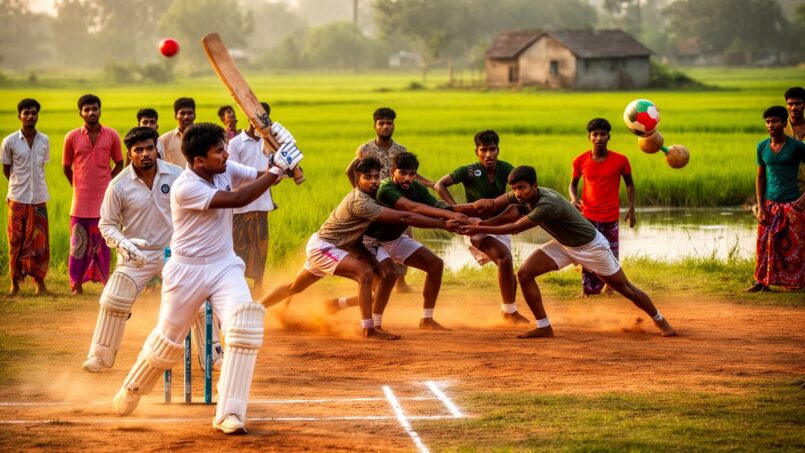
It’s impossible to talk about sports to play in Bangladesh without mentioning cricket. It is by far the most played and most followed sport in the country. The number of participants is estimated at around one million, from children playing with a rubber ball and a piece of wood to players in structured championships.
A Street Sport Become a Pillar of National Identity
Introduced during the British colonial era, cricket slowly took root before becoming, after independence, a symbol of resilience and pride. The creation of the Bangladesh Cricket Board (BCB) in 1972, full membership in the ICC in 2000, and regular participation in World Cups have propelled the sport to the heart of the collective imagination.
The passion for cricket in Bangladesh was reinforced by the successes of the national team, nicknamed the “Tigers.” Among its notable achievements are the ICC Trophy victory in 1997, the first qualification for the World Cup in 1999, achieving Test nation status in 2000, a World Cup quarter-final in 2015, and a remarkable run in the Champions Trophy in 2017. For the youth, the victory of the U19 team in the 2020 World Cup served as a huge catalyst for national enthusiasm.
Where and How to Play Cricket
One of cricket’s strengths is its accessibility. It can be played on almost any open surface: streets, vacant lots, parks, schoolyards, riverbanks.
In major cities, the practice is structured around several levels:
| Level of Play | Where to Play? | Coaching | Typical Cost |
|---|---|---|---|
| Informal / Recreational | Streets, parks, vacant lots | Unstructured, self-organized | Shared equipment, virtually free |
| School / University | School, college, university grounds | Physical Education teachers, guest coaches | Included in tuition fees |
| Amateur Clubs | Neighborhood clubs, local divisions | Club coaches, former players | Variable membership fees |
| High Performance | Academies, BCB structures, NCL / BPL division teams | Certified coaches, medical staff | Supported by clubs/BCB, sponsors |
The domestic nation-wide structure relies on several key competitions: the National Cricket League (the premier first-class championship), the Bangladesh Cricket League, and the Bangladesh Premier League (BPL) in the T20 format, the most televised and lucrative league which attracts foreign players. For an ambitious player, joining a division club and then being spotted by an academy or a BPL franchise is a typical pathway.
A Sport That Also Creates Opportunities
The BCB, considered one of the wealthiest sports organizations in the country, has heavily invested in stadiums, training centers, and academies. The flagship venues include the Sher‑e‑Bangla National Cricket Stadium in Dhaka, as well as the Zahur Ahmed Chowdhury Stadium in Chittagong.
The estimated economic impact of co-hosting the 2011 World Cup amounted to approximately 100 million dollars.
For a participant, this means a dynamic environment: an abundance of matches to watch, access to inspiring role models (led by Shakib Al Hasan), and a dense network of clubs to progress.
Football: The Game Making a Strong Comeback
While cricket is currently number one, football was long the top sport in the country, at least until the 1990s. It was only in the 2000s that cricket’s ascent relegated it to second place. But since the early 2020s, the round ball is clearly regaining ground.
A Rich History and Strong Urban Roots
Football arrived in Bangladesh in the late 19th century, under British influence. Dhaka was one of its major centers, with the creation of clubs like Abahani Limited Dhaka or Mohammedan Sporting Club, which later became giants of the championship and protagonists of the famous “Dhaka Derby,” long the country’s number one sporting event.
The most striking example of the political and symbolic use of football in Bangladesh is the “Shadhin Bangla” team. During the Liberation War in 1971, this team traveled across India playing football matches, using the sport as a tool for awareness-raising and fundraising for the cause of Bangladesh’s independence. This initiative preceded the subsequent sporting successes of the federation, such as qualifying for the 1980 Asian Cup or winning the 2003 SAFF Gold Cup.
Today, the strongest momentum comes from women’s football: the national team won the SAFF Women’s Championship 2022 and qualified for the first time for the final phase of the 2026 Women’s Asian Cup.
The Bangladesh Football League: Showcase and Outlet
The elite championship, managed by the BFF, is now called the Bangladesh Football League (BFL). It has undergone several rebrandings (B.League, Bangladesh League, Bangladesh Premier League) before taking its current name to avoid confusion with the cricket league.
The current format is fairly standard: 10 clubs, each playing 18 matches (home and away). A promotion-relegation system with the Bangladesh Championship League ensures some turnover. Abahani Limited Dhaka dominates the championship’s history, while Bashundhara Kings, a more recent club, quickly established itself as a powerhouse with several consecutive titles. Other clubs like Sheikh Jamal Dhanmondi Club or Mohammedan SC remain very influential.
For an ambitious player, this championship is a gateway to Asian competitions. The champion qualifies for the AFC Challenge League playoffs. The performances of Bangladeshi clubs in these competitions have allowed the country to reach 24th place in the AFC club rankings.
A Mass Participation Sport Easy to Access
The number of football players in Bangladesh is estimated at around 500,000, making it the second most played sport. Logistical ease works in its favor: a ball, an approximate field, and that’s it. More tournaments are organized in and outside Dhaka for football than for any other sport.
For young people, entry often comes through school, the street, or neighborhood leagues. There is a pyramidal system organized around:
| Level | Competition / Structure | Particularities |
|---|---|---|
| Elite | Bangladesh Football League | 10 clubs, promotion/relegation, AFC slots |
| 2nd Tier | Bangladesh Championship League | Gateway to the elite |
| 3rd Level and below | Dhaka Senior/Second/Third Division, regional leagues (Chittagong, Rajshahi, Cox’s Bazar…) | Strong local roots, youth breeding ground |
| Youth | BFF U‑18 League, school tournaments | Talent scouting and development |
For a recreational player, the possibilities are almost unlimited: informal matches in parks, neighborhood tournaments, small town clubs. Football’s main asset is its very low entry cost, which explains its deep roots in working-class communities.
Kabaddi / Ha‑du‑du: The National Sport Still Played in Villages
Officially, the national sport of Bangladesh is neither cricket nor football, but Kabaddi, known locally as “Ha‑du‑du.” This contact sport, with very ancient roots in South Asia, is deeply linked to rural life.
A Village Courtyard Game Turned Medal Sport
Kabaddi is traditionally played in house courtyards, on packed earth or mud, often at nightfall in winter or during festivals like Eid or Durga Puja. Matches pit groups from neighboring villages against each other, teams of bachelors against married men, with very concrete rewards at stake: a calf, a sack of rice, a radio.
There are two main versions of kabaddi. The traditional version, called Ha‑du‑du, has no uniform rules: the chants of the raiders can vary (like “ha‑du‑du‑du‑du” or “sikabaddi”), and the playing surface or raid duration are not standardized. In contrast, the international version is played on a rubber mat with strictly codified rules, and the raider must repeatedly chant the word “kabaddi” in a single breath during the raid.
Despite a lack of resources and media visibility, Bangladesh has accumulated an impressive record, notably at the Asian Games where the national team—often called the “Red-Green team”—has won several silver and bronze medals, for both men and women. The country has also shone in Asian Championships, South Asian Games, and the World Cup (3rd place for men in 2004 and 2007, 3rd place for women in 2012).
How and Where to Play Kabaddi Today
The practice of Kabaddi is structured around the Bangladesh Amateur Kabaddi Federation (BAKF), founded in 1973. It oversees national competitions, rules, and national teams. Alongside this, a professional league, the Bangladesh Kabaddi League (BKL), has been strengthening the spectacle aspect in recent years and offers an outlet for salaried players.
In practice, several distribution channels can be distinguished, each with its own characteristics.
The producer sells its products directly to the end consumer, without intermediaries.
Only one intermediary intervenes between the producer and the end consumer.
Several intermediaries (wholesaler, retailer) intervene in the distribution chain.
| Type of Practice | Place / Environment | Main Audience |
|---|---|---|
| Traditional (Ha‑du‑du) | Village courtyards, fields, informal grounds | Rural inhabitants, farmers, rural youth |
| School / Youth | District schools, BAKF programs | Teenagers, young adults |
| Service Teams | Army, navy, police, BGB | Semi-pro players employed as military/civil servants |
| Professional (BKL) | Indoor stadiums, major cities | High-level players |
A key element of the system remains employment offered by the armed or security forces: since the 1990s, a large part of the best kabaddi players have been recruited as soldiers, police officers, border guards, with the secondary mission of representing their unit in competition. This system offers some stability but also limits the possibility of making a living solely from the sport.
For a participant, Kabaddi is one of the most economical sports: no expensive facilities are needed, a simple plot of land is enough. The main hurdles come rather from the lack of qualified coaches (only a few certified coaches in the entire country) and low media coverage outside of major events.
Swimming: A Vital Necessity Become a Structured Sport
In a country crisscrossed by rivers, canals, ponds, and regularly facing floods, swimming is not just a leisure activity but a matter of survival. The figures from the Bangladesh Health and Injury Survey and other studies are brutal: drowning is the leading cause of death by injury among 1–17 year olds, ahead of infectious diseases. It is estimated that about 17,000 children drown each year, between 46 and 50 deaths per day.
Swimming to Live… Then for Pleasure
Traditionally, in the countryside, children learn to swim in ponds and rivers, with family or friends. This skill, called “Naturally Acquired Swimming Ability” (NASA), corresponds to the ability to cross 25 meters in depth greater than one’s height, using any stroke. A large proportion of rural children reach this level by mid-childhood.
But in urban areas, where bodies of water are scarce or polluted, this spontaneous transmission disappears. Pools then become essential, hence the central role of the Bangladesh Swimming Federation, created in 1972. The federation manages national competitions, trains coaches, and operates the Syed Nazrul Islam National Swimming Complex, the reference pool.
Swimming offers numerous health benefits: it improves cardiorespiratory capacity, reduces cardiovascular risk, increases muscular endurance, and alleviates joint or back pain. It also helps lower blood pressure and has a marked anti-stress effect. This activity is particularly recommended for overweight individuals, pregnant women, and those suffering from back pain.
From Public Pools to SwimSafe Survival Programs
Dhaka concentrates most of the modern swimming infrastructure, public or private.
| Pool / Complex | Type | Public / Access | Particularities |
|---|---|---|---|
| National Swimming Complex (Mirpur) | Governmental | Classes open to the public | Trained coaches, sometimes medalists at South Asian Games |
| Bangabandhu Stadium Pool | Governmental | General public | Teachers trained at BKSP |
| Dhaka University Pool | Institutional | Students, sometimes public | Only pool mentioned with an assigned lifeguard |
| Sultana Kamal Women’s Sports Complex (Dhanmondi) | Women-only complex | Exclusively female | Swimming, but also about twenty other sports |
| Hotel and private club pools (Sheraton, Sonargaon, Westin, Gold’s Gym, Gulshan Club, Uttara Club, etc.) | Private | Affluent clients, members | High prices, premium lessons |
| Bangladesh Rifles Pool (Pilkhana) | Military | Limited public access | Heated water, open in winter |
Prices vary greatly: often between 1,200 and 1,800 taka per month for standard lessons, 3,000 to 9,500 taka for certain specific subscriptions, and up to 10,000 to 12,000 taka in luxury hotel pools. Swimming thus remains affordable for part of the middle class but out of reach for many households.
To bridge this gap, aquatic survival programs have been deployed, like SwimSafe, co-financed by Comic Relief and implemented with the support of the British Council, UNICEF, the Bangladesh Swimming Federation, and the Centre for Injury Prevention and Research, Bangladesh (CIPRB). The principle: train community instructors, install temporary structures in ponds (submerged bamboo floors, floating bars) and offer thousands of children several dozen hours of learning.
The results are impressive:
Results
| Indicator | Data Recorded |
|---|---|
| Number of children trained in 7 flood-prone districts | more than 80,000 |
| Children trained in one year in one phase of the program | 130,000 (with 320 instructors) |
| Average cost per child | ~ 9 USD |
| Number of pond-based swimming centers built | 550 (unit cost ~ 80 USD) |
| Success criteria | Swim 25 m + tread water for 90 sec |
Beyond campaigns, CIPRB also offers free lessons for children from Dhaka slums. Early childhood development centers (“anchals”) complement the system for the very young, with mothers trained in supervision and prevention, to reduce daily drowning risks.
From Brojen Das to the “Bangla Channel”: The Allure of Performance
Bangladesh also has a tradition of endurance swimming. The most famous name remains Brojen Das, the first Asian to swim the English Channel, which he crossed four times, earning him the coveted title of “King of the Channel” from the dedicated association.
Following this long-distance culture, the “Bangla Channel” challenge involves covering 16 km in the Bay of Bengal, since 2006. Few swimmers—local or foreign—have completed it, making it one of the country’s most extreme sporting challenges.
For a participant, this means a wide spectrum of options: learning to swim for safety, physical training in a pool, or aiming for open water challenges. Facilities remain concentrated in major cities, but community programs are gradually extending access to basic swimming.
Badminton: An Urban Sport on the Rise
Long confined to schoolyards, urban clubs, and family gardens, badminton has established itself as one of the most practiced racket sports in urban areas of Bangladesh. The number of players is estimated at about 50,000, but the trend is clearly upward, driven by the availability of halls, relatively moderate equipment costs, and an image of a friendly, family sport.
A Structured Federation and a Dynamic National Scene
The Bangladesh Badminton Federation (BBF), founded in 1972, is the governing body of the sport. Affiliated with Badminton Asia, it is led by a president (Abdul Malek), a secretary general (Md. Alamgir Hossain), and an executive director (Moshiur Rahman). The headquarters is located at the Shaheed Tajuddin Ahmed National Indoor Stadium in Dhaka, which serves as the nerve center for major tournaments.
Gold medal won by Mohammad Arif Hossain in men’s singles at the 2019 South Asian Games
Alongside the federation, the Bangladesh Badminton Players Association brings together active or retired players, coaches, officials, and enthusiasts, with the aim of multiplying tournaments, training camps, coaching clinics, and promotional events.
Where to Play Badminton in Bangladesh
Badminton first developed in cities, thanks to the possibility of playing indoors, sheltered from the monsoon. Several types of spaces can be distinguished:
| Type of Site | Examples | Public / Use |
|---|---|---|
| Federation Halls | BBF courts in Dhaka (Shaheed Tajuddin Ahmed Indoor Stadium) | High level, national and international competitions |
| Private Multi-sports Complexes | Bashundhara Sports City (BSC) in Dhaka | Members, clubs, private events |
| Sports Clubs and Community Centers | Urban clubs, cultural centers, NGOs | Amateurs, youth, local leagues |
| Schools, Universities, Colleges | Dhaka University, other campuses | Students, sometimes external public |
| Improvised Spaces | Courtyards, parking lots, clear alleys | Family practice, leisure |
Bashundhara Sports City illustrates well the new face of urban sports: over 40 facilities on more than 50 acres, an indoor hall dedicated to badminton, squash courts, Padel tennis, futsal fields, combat sport rings (MMA, Muay Thai, Taekwondo, etc.), a large gym (Gold’s Gym), and an on-site hotel. The complex claims over 5,000 members, more than 100 coaches, and attracts national teams and professional athletes for their training camps.
For a recreational player, access to badminton is generally through a neighborhood club, a university, or a community center. Basic equipment (racket, shuttlecocks, shoes) is affordable. The main challenge, especially in Dhaka, can be the availability of time slots in the most popular halls.
A Simple, Social, and Promising Sport
The success of badminton stems from several factors: simple rules, possibility to play singles or doubles, men-women mixed play, moderate to high intensity adjustable according to level, and above all, a social character. A badminton doubles match in a neighborhood hall becomes a true community gathering.
The media also contributes to this rise, by covering major international events and local performances. Even though Bangladesh’s world ranking remains modest (best ranking around 70th, around 130th in 2024), the potential for progress is real, provided funding, coach training, and infrastructure quality are improved, especially outside Dhaka and major cities like Chittagong, Khulna, Sylhet, or Rajshahi.
Hockey: A Sleeping Giant, But Still Widely Played
Field hockey was long one of the flagship sports of Bangladesh, on par with football in some decades. Today, it generally ranks behind cricket and football in popularity but remains one of the most practiced sports, with about 150,000 players recorded.
An Old Tradition, a Well-Established Federal Framework
Introduced in the early 20th century in Dhaka, hockey developed first in aristocratic circles (notably around the family of the Nawab of Dhaka), then within clubs. The creation of the Bangladesh Hockey Federation (BHF) in 1972, and then its membership in the International Federation (FIH) and Asian Confederation in 1975, provided a solid framework for the sport.
The Maulana Bhasani Hockey Stadium, headquarters of the BHF, is a national stadium with a capacity of 10,000 seats.
Bangladesh regularly participates in the Asia Cup and other continental competitions. The men’s national team has won several bronze medals at the South Asian Games. There are also women’s, U21, indoor, and even a Masters team for veterans.
Playing Hockey: Between Lack of Fields and Intact Passion
The main handicap for the sport remains the lack of infrastructure. The country has only two high-level synthetic fields: the one at Maulana Bhasani Stadium and the one at the national sports institute BKSP. Some stadiums like the Shaheed Smriti Stadium in Rajshahi can host matches, but without artificial turf meeting international standards.
For a player, the typical path goes through:
| Stage | Place / Structure | How to Access |
|---|---|---|
| Introduction | Schools, small district clubs, neighborhood tournaments | School programs, local clubs |
| Structured Training | BKSP, major club academies (e.g., Abahani Krira Chakra) | Selection based on tests, scouting at tournaments |
| Domestic Competitions | Dhaka Premier Division, First/Second Division, National Hockey League | By joining a club affiliated with BHF |
| High Level | Senior/youth national team, foreign clubs (Germany, etc.) | Federal selection, club contracts |
A curious element of Bangladeshi hockey is its dependence on service clubs (army, navy, air force), which offer employment to the best players, similar to what happens in Kabaddi. Salaries, however, remain modest: a former captain of the national team noted that a football substitute sometimes earned more than the country’s best hockey players.
The development of football in Bangladesh is hampered by irregular championships, federal conflicts, and the decline of traditional talent pools. However, the passion of the supporters, especially in Dhaka where international matches sell out, remains very strong.
For an urban participant, hockey remains an attractive option for those seeking an intense team sport, requiring speed, coordination, and tactical sense. The main hurdle is not demand, but the supply of fields.
Martial Arts and Combat Sports: Between Traditions and Global Influences
Beyond team sports, Bangladesh has a rich palette of martial arts and combat sports, ranging from traditional practices like Boli Khela or Lathi Khela to modern imported systems (karate, kung‑fu, Muay Thai, MMA). These disciplines are popular both for self-defense and sporting performance.
Boli Khela: Wrestling as Popular Spectacle
Boli Khela is a traditional wrestling deeply rooted in the Chattogram region. Initiated in 1899 by the merchant Abdul Jabbar, this form of bare-handed combat mixes throws, pins, joint locks, and ground control. Every year, the Lal Dighi Moidan ground hosts a major tournament where wrestlers of all ages compete in front of thousands of spectators, including from abroad.
For a participant, integrating Boli Khela means entering a tradition that is both sporting and cultural, where the spectacle and festive dimension are very marked. Training often takes place in akharas (wrestling halls or courtyards) on soft ground.
Lathi Khela: The Art of the Staff on the Path to Revival
Lathi Khela is a Bengali martial art based on staff fighting, practiced both in Bangladesh and India. Historically, lathial bahini (groups of staff fighters) served as private militias, sometimes in the service of zamindars (landowners) for forced tax collection, sometimes for village defense. The bamboo staff, sometimes reinforced with iron, is the main weapon, but fake or real bladed weapons (machetes, swords) are also part of demonstrations.
Today, Lathi Khela, a traditional martial art, occurs mainly during festivals like Pohela Boishakh or harvest festivals. Its practice is declining due to urbanization and modern leisure activities. Initiatives, like those of the Shadhona Cultural Circle, attempt to preserve it. The Bharat Sevashram Sangha is one of the few institutions teaching it in a structured manner, sometimes even to women, notably in the Narail district.
Butthan: A Contemporary Martial Art Born in Bangladesh
Butthan is perhaps the most unique example of the Bangladeshi martial landscape: a modern combat system, of national origin, recognized as a combat sport by the National Sports Council. Founded by Grandmaster Mak Yuree Vajramunee, it combines self-defense, personal development, and a holistic approach (physical, mental, emotional, spiritual).
Inspired by Bangladeshi traditions (Lathi Khela) and systems from South and Southeast Asia (Varma Kalai, Burmese Bando, Vajra‑mushti, Tibetan arts), Butthan is structured internationally by the International Butthan Federation. It is distinguished by its concept of “co-competition,” a form of confrontation that is both controlled and cooperative. For a participant seeking a complete and identity-bearing martial art, it represents an original option.
Karate, Kung‑fu, MMA: The Modern Offer in Full Expansion
In parallel, international martial arts have found fertile ground in Bangladesh. Among the most visible:
– Karate, overseen by the Bangladesh Karate Federation, which has brought several gold medals to the South Asian Games (notably 4 gold in 2010, 3 in 2019).
– Chinese wushu / kung‑fu, structured around the Bangladesh Wushu Federation and private schools, including the “Chinese Kung Fu & Wushu School” in Dhaka, very active and present in many neighborhoods (Dhanmondi, Uttara, Gulshan, Mirpur, etc.).
– Modern combat disciplines like Muay Thai, Krav Maga, or MMA, often hosted in urban fitness centers or complexes like Bashundhara Sports City.
For a participant, these martial arts offer varied possibilities: physical conditioning, learning self-defense, local or regional competitive practice. Costs vary depending on the hall’s standing but are often comparable to those of a classic fitness club.
A Diversity of Sports for All Profiles
Beyond the detailed disciplines above, Bangladesh offers a very wide range of other sports to play:
Bangladesh has a varied sports landscape, ranging from traditionally entrenched sports like volleyball and table tennis—both structured by active national federations since 1972 and strongly embedded in the education system—to more recent disciplines. Volleyball is very present in schools and national competitions. Table tennis is propelled by figures like Zobera Rahman Linu, holder of 16 national titles. Athletics forms the basis of many school programs and youth talent scouting strategies. Sports like shooting, boxing, weightlifting, wrestling, and archery are all overseen by specific federations and feature in the South Asian Games. Golf, long elitist, is gaining visibility thanks to players like Siddikur Rahman. Finally, emerging disciplines such as climbing, competitive cycling, and e-sports are developing.
Participant estimates give an idea of this diversity:
| Sport | Estimated Number of Participants |
|---|---|
| Cricket | ~ 1,000,000 |
| Football | ~ 500,000 |
| Kabaddi | ~ 100,000 |
| Hockey | ~ 150,000 |
| Volleyball | ~ 100,000 |
| Badminton | ~ 50,000 |
| Table Tennis | ~ 75,000 |
| Athletics | ~ 100,000 (enthusiasts) |
| Swimming | ~ 40,000 (structured core, excluding rural NASA) |
| Chess | ~ 50,000 |
| Shooting | ~ 2,000 |
These figures, even approximate, show a very vibrant sports landscape, where cricket certainly dominates, but without completely crushing other disciplines.
The Central Role of Public Policies and Infrastructure
If so many sports are played in Bangladesh, it is largely thanks to the coordinated efforts of the Ministry of Youth and Sports, the National Sports Council, and the federations. The government has relied on several levers:
To structure and promote sports at the national level, several key actions are recommended: generalize sports practice in schools through a mandatory curriculum; create a network of youth training centers in major cities and regional capitals; invest in infrastructure by building and renovating stadiums, pools, and multi-sports complexes; professionalize coaching through certification programs and international exchanges for coaches; support inclusion by developing dedicated structures, leagues, and awareness campaigns for girls and women; and finally, actively promote adapted sports for people with disabilities.
Challenges remain real: lack of synthetic fields for hockey, shortage of qualified coaches in Kabaddi and other disciplines, under-funding of some sports in favor of cricket, inequalities of access between cities and countryside. But the trend is clearly towards strengthening infrastructure and diversifying the sports offer.
Choosing a Sport to Play in Bangladesh: Some Guidelines
For a resident of Bangladesh—or an expatriate living in the country—choosing a sport will depend on several criteria: budget, proximity of facilities, desired level of competition, objective (health, leisure, performance), cultural affinities.
The main strengths of some major disciplines can be summarized:
| Sport | Key Points for the Participant |
|---|---|
| Cricket | Extreme accessibility, cultural roots, multitude of clubs, opportunities for sporting career or coaching |
| Football | Very low cost, strong presence of local tournaments, unmatched match atmosphere |
| Kabaddi | National sport, physical intensity, almost zero equipment, strong community dimension in villages |
| Swimming | Vital benefits (drowning prevention), overall health, possible practice at any age, subsidized programs for children |
| Badminton | Indoor practice, suited to urban environments, friendly, mixed, rapid technical progression |
| Hockey | Complete sport (speed, coordination), strong tradition, solid federal structure despite lulls |
| Martial Arts (Butthan, karate, kung‑fu…) | Physical and mental development, self-defense, wide offer of clubs, cultural identity for local arts |
Bangladesh is at a pivotal moment in its sporting history: while cricket and football massively occupy the media space, public policies and private initiatives are opening more and more doors to other disciplines. For those who want to play a sport in the country, this mainly means one thing: the choice is vast, and there is almost always, on one scale or another, a field, a hall, or a body of water ready to welcome new participants.
Disclaimer: The information provided on this website is for informational purposes only and does not constitute financial, legal, or professional advice. We encourage you to consult qualified experts before making any investment, real estate, or expatriation decisions. Although we strive to maintain up-to-date and accurate information, we do not guarantee the completeness, accuracy, or timeliness of the proposed content. As investment and expatriation involve risks, we disclaim any liability for potential losses or damages arising from the use of this site. Your use of this site confirms your acceptance of these terms and your understanding of the associated risks.

Cyril Jarnias is an independent expert in international wealth management with over 20 years of experience. As an expatriate himself, he is dedicated to helping individuals and business leaders build, protect, and pass on their wealth with complete peace of mind.
On his website, cyriljarnias.com, he shares his expertise on international real estate, offshore company formation, and expatriation.
Thanks to his expertise, he offers sound advice to optimize his clients' wealth management. Cyril Jarnias is also recognized for his appearances in many prestigious media outlets such as BFM Business, les Français de l’étranger, Le Figaro, Les Echos, and Mieux vivre votre argent, where he shares his knowledge and know-how in wealth management.





