
 Published on and written by Cyril Jarnias
Traveling in Saint Vincent and the Grenadines without a rental car is not only possible, but often more economical and immersive. Between packed and colorful minibuses, unmetered taxis, inter-island ferries, and small speedboats, the transportation system relies on a mix of public services, private initiatives, and very local solutions. This practical guide brings together essential information for getting around with peace of mind, taking into account the real constraints on the ground, accessibility issues, and new digital tools.
Understanding the Transportation Ecosystem
Transportation in Saint Vincent and the Grenadines revolves around a few pillars: minibuses (also called public vans), taxis, ferries and water taxis, car rentals, and, to a lesser extent, domestic flights. The system is coordinated in a flexible rather than strictly planned manner: schedules exist but are often indicative, and the famous “island time” is felt everywhere.
This is the total length, in kilometers, of the country’s road network, of which about 70% is paved.
On the maritime side, ferries form a real backbone between the islands: they transport not only passengers, but also goods, mail, and a good part of daily logistics. To this are added water taxis, which are fast and flexible, taking over between islands or to beaches not served by regular lines.
Finally, short flights in small planes complete the offering, mainly to connect the more distant Grenadines and for travelers who want to save time – or avoid seasickness during rough crossings.
Minibuses: The Heart of Popular Transport
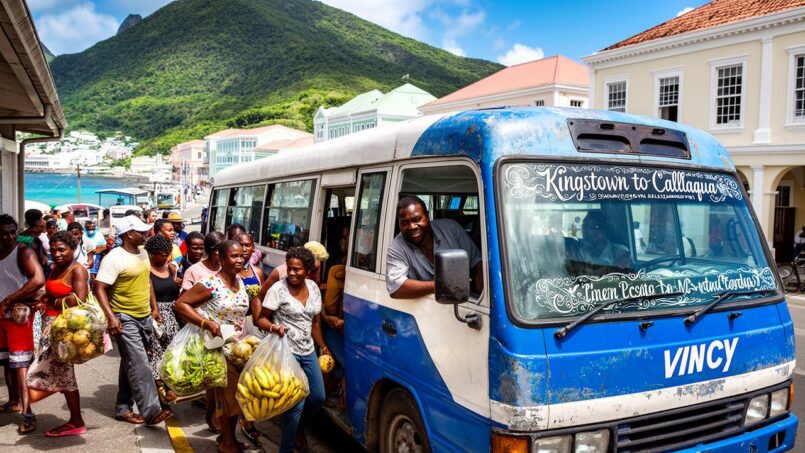
On the main island, minibuses – often painted in bright colors, decorated, and equipped with sound systems – are the most used form of public transportation by the local population. They provide the link between Kingstown and most villages and localities.
How Minibuses Work
These private vehicles are regulated by the government but operated by individuals. They are easily recognizable by the letter “H” on the license plate. They follow defined routes, but stops are not formalized like in a European urban network: you get on and off on request, by the side of the road.
To use them, you generally just need to stand on the shoulder of a main road and signal to the driver. Drivers often honk to signal their approach; inside, there may be a “conductor” who handles payments and drop-offs. The fare is paid directly to the driver or conductor, in cash.
Bus frequency is high on main routes (e.g., Kingstown – Indian Bay/Villa), but reduced towards the north and remote areas. Service is very limited on Sundays and holidays, with sometimes only a few departures for remote areas.
Fares and Example Routes
Minibuses are by far the most economical solution for getting around. Fares, set within a narrow range, remain very affordable for visitors.
| Type of Trip | Indicative Fare | Details |
|---|---|---|
| Short distance in town | 1 EC$ to 2 EC$ | Urban or very short trips |
| Standard inter-village trip | 1 EC$ to 6 EC$ | Approx. 0.40 to 2.20 US$ |
| Kingstown – Mesopotamia (Mespo) | 2.50 EC$ | Recommended “day trip by bus” |
| Georgetown – Fancy | 10 EC$ | One of the longest trips to the north |
| Kingstown – Chateaubelair | 6 EC$ | Northwest coast |
These numbers illustrate how competitive the bus is compared to a taxi, where a simple trip from Indian Bay to Kingstown costs around 25 EC$.
Key Routes and Usage Tips
The main bus terminal on Saint Vincent is located at the New Kingstown Fish Market, often also called the Tokyo Fish Market. This is where most lines to the villages depart from.
For travelers wishing to explore the north of the island, a few strategies are useful:
To get to Fancy in the north, take the first bus in the morning to Georgetown, then one of the two daily vans to Fancy, which requires careful planning. For Richmond in the northwest, one option is to take a direct bus to Chateaubelair and then a second vehicle; an alternative is to get off at Barrouallie and find a connection there.
Generally, the bus allows you to both reach a hiking trail and do small excursions, like a day trip to Mesopotamia (Mespo), often cited as a particularly pleasant and inexpensive minibus outing.
Atmosphere, Safety, and Limitations
Public vans are known to be relatively safe but sometimes overcrowded, with lively, even fast driving, especially on winding roads. The atmosphere is often noisy, musical, very local. For those wanting to immerse themselves in daily life, it’s an excellent vantage point.
The main drawbacks are comfort (crowds, heat), the lack of reliable schedules, and reduced service early in the morning, late at night, on Sundays, and holidays. It’s wise not to rely on a late last bus to return from an isolated spot, especially in the low season.
Taxis: Flexible but with Negotiated Fares
The taxi is the natural complement to minibuses in the transportation system. They are easily found at Argyle International Airport, at ferry terminals, and in major towns, particularly in Kingstown, as well as on some islands like Bequia.
Pricing System
Taxis are not equipped with meters. However, fares are governed by an official rate schedule set by the government. This means that, in practice, prices are relatively standardized for main routes, but it remains essential to agree on the amount before departure.
Prices increase for trips made late at night or very early in the morning, and a tip of about 10% of the fare is considered appropriate.
A few examples give an idea of the costs:
| Trip (mainland) | Indicative Fare |
|---|---|
| Indian Bay – Kingstown | Around 25 EC$ |
| Indian Bay or Villa – Airport (E.T. Joshua or Argyle) | 15 to 20 EC$ |
| Argyle International Airport – Kingstown (structured private transfer) | About 40 US$ for 1–3 people |
| Taxi rental by the hour (2 to 4 passengers) | 40 to 50 EC$ per hour |
For transfers from the airport via specialized services like Trubb Taxi Tours SVG, rates are often quoted in US dollars, with a base price for 1 to 3 people and an extra charge per additional passenger. For example, an Argyle – Villa transfer can start around 30 US$, while more distant destinations like Chateaubelair go up to around 150 US$.
Where to Find and How to Choose a Taxi
Taxis are present in strategic locations: airport exits, ferry terminals, main squares in Kingstown. Many can also be booked through hotels or by phone. Some services are clearly geared towards tourism, combining transfer and guided tours.
For the main islands, transportation companies or specific drivers are mentioned as references.
| Island / Area | Service / Company | Contact / Particulars |
|---|---|---|
| Saint Vincent | Sam’s Taxi and Tours | +1 784-456-4233 |
| Bequia | Jump in Taxi Service | +1 784-458-3782 |
| Argyle & region | Trubb Taxi Tours SVG, Layne’s, Topdawg, etc. | Private transfers, sometimes Wi-Fi, water, flight tracking |
It is advisable to prioritize clearly identified taxis, ideally with a “tourism approved” logo, rather than accepting a ride informally offered by a stranger.
Tourist Taxis and Private Tours
Many taxi drivers also act as guides: they know the roads, viewpoints, less frequented beaches, and swimming spots. Renting a taxi by the hour or day to discover the island is a common practice, especially for travelers who do not wish to drive on narrow and sometimes confusing roads.
Transfer agencies typically offer a full service including: a driver waiting for the client at the arrivals exit with a sign bearing their name, proactive monitoring of flight delays to adjust pickup time, free waiting time upon arrival. They often provide amenities like bottled water and Wi-Fi access in the vehicle. Furthermore, a flexible cancellation policy, usually free up to 24 hours before the trip begins, is common.
Ferries: The Inter-Island Backbone
To connect the islands, ferries are essential. They transport tourists, residents, goods, materials, and constitute a veritable “maritime highway” for the archipelago.
Main Lines and Destinations
From Kingstown, several regular lines serve the main Grenadine islands:
– Bequia (Port Elizabeth)
– Mustique
– Canouan
– Union Island
From Union Island, it is then possible to continue to Mayreau or go on an excursion to the Tobago Cays. Other regional connections exist (for example to Carriacou to the south, outside the country) thanks to specific operators.
Among the most cited companies for domestic connections are:
| Company / Boat | Main Routes |
|---|---|
| Bequia Express | Kingstown – Bequia, some days further south |
| Admiralty Transport | Kingstown – Bequia |
| Bequia Fast Ferry | Fast version Kingstown – Bequia |
| MV Barracouda | Kingstown – Canouan – Union Island |
| MV Gem Star | Kingstown – Union Island (via other islands) |
| Mustique Ferry | Kingstown – Mustique |
| MV Guidance | Kingstown – Lower Grenadines (freight + passengers) |
Schedules vary by day of the week, with several daily rotations between Kingstown and Bequia, compared to a much more limited frequency to the islands further south.
Crossing Times and Onboard Experience
Travel times give a good idea of the distances:
| Route | Approximate Duration |
|---|---|
| Kingstown – Bequia (classic ferry) | About 1 hour |
| Kingstown – Bequia (Bequia Fast Ferry) | About 35 minutes |
| Kingstown – Union Island (Jaden Sun, when it operated) | 2.5 to 3 hours |
| Kingstown – Lower Grenadines (MV Gem Star) | A little over 4 hours |
| Canouan – Union Island (water taxi) | About 45 minutes |
| Union Island – Mayreau (water taxi) | About 10 minutes |
Crossings are often described as “scenic”, with superb views of the islands, but can be long and choppy in rough seas. For those prone to seasickness, appropriate medication (like Dramamine) is highly recommended.
Fares and Ticketing
Tickets for inter-island ferries are usually paid on board, in cash. Prices remain relatively affordable for maritime connections.
| Route and Company | Indicative Fare (one-way) |
|---|---|
| Kingstown – Bequia (Bequia Express / Admiralty) | 25 EC$ per passenger |
| Kingstown – Bequia (return) | 45 EC$ |
| Kingstown – Canouan (MV Barracouda) | 50 EC$ |
| Kingstown – Union Island (MV Barracouda) | 80 EC$ |
| Kingstown – Union Island (MV Gem Star) | 70 EC$ |
| Kingstown – Union Island (Jaden Sun, active period) | About 110 EC$ |
The ferry’s value for money is excellent, especially compared to a regional flight or private connection. But the trade-off is the less frequent schedules to some islands: some lines do not run every day, and sometimes only one rotation per day is operated.
Planning and Reliability
Companies maintain generally reliable schedules, but several factors can disrupt rotations: weather, technical problems, holidays, low season. Therefore, it is highly recommended to:
Essential recommendations for organizing your ferry travel in the Caribbean and avoiding surprises.
Confirm departure times directly with the companies, by phone, email, or via their social media.
Organize your hotel nights based on ferry days, especially for connections to the Lower Grenadines.
Get to the terminal at least 30 minutes before departure, especially for very busy routes.
On a practical level, the Kingstown terminal is located near the cruise ship dock. For those transiting via the old E.T. Joshua airport or Argyle International Airport, a short taxi ride (about 15 to 25 minutes) should be planned to reach the port.
Water Taxis: The Fast, Customizable Option
Water taxis are fast boats operated by private individuals, which complement the ferry network. They are particularly useful for:
– reaching islets or beaches without regular service;
– making a quick round trip to sites like the Tobago Cays;
– saving time when ferries don’t offer a suitable schedule;
– getting from beach to beach on Bequia or other islands.
This is the price in US dollars per person for a round-trip water taxi between Bequia and Mustique.
Between the Grenadines, travel times are short: only about ten minutes between Union Island and Mayreau. Here too, prices are set freely, hence the importance of clearly discussing the fare before boarding, ensuring the price covers the entire one-way trip, or even round trip.
A very common special case: access to Young Island is mainly by water taxi from Saint Vincent, organized most of the time by the accommodation itself.
Accessibility: A System Still Difficult for People with Reduced Mobility
Despite the existence of a comprehensive action plan to improve transportation accessibility, the reality remains complicated for people in wheelchairs, with walking difficulties, or with specific needs.
A Structured Strategy but a Demanding Terrain
The authorities have defined five main priorities to make transportation more inclusive:
1. A customer service that is respectful, fair, and attentive to people with disabilities. 2. Better access to different modes (bus, taxis, ferries, etc.), including notably faster information in case of disruption. 3. Procedures and systems designed from the outset to be inclusive. 4. The integration of universal design into new transportation buildings and infrastructure. 5. The promotion of accessible working conditions for employees themselves.
The goal is for accessibility and inclusion to become reflexes for all sector personnel.
Concrete Obstacles on the Ground
On the ground, constraints remain significant:
The urban environment and transportation present multiple obstacles for people with reduced mobility: uneven sidewalks with few ramps, rare and poorly marked crosswalks, public transportation (buses, taxis) without adapted equipment (ramp, dedicated space), and difficult access to public buildings and maritime terminals.
Some occasional solutions exist, such as more accessible commercial transport vehicles, designed to ensure the “first and last mile” (connection between home/hotel and main transport points). Nevertheless, these services remain modest compared to potential needs.
In practice, a person with reduced mobility must plan their trips very carefully, inquire with their accommodation for transfers, and sometimes rely almost systematically on taxis or pre-booked private transfers.
Car Rental and Driving: Between Freedom and Constraints
For those who wish to explore the main island at their own pace, car rental remains an option. Driving is on the left, which may surprise some visitors, but it’s especially the condition and configuration of the roads that require real adaptation.
Driving Conditions
The roads are often narrow, winding, with steep gradients, especially towards sites like Owia Salt Pond or the mountainous interior regions. Many stretches are not lit at night, road markings may be absent or faded, and signs remain rare. Common obstacles include:
– potholes;
– unmarked speed bumps;
– stray animals;
– slow vehicles or sudden stops;
On these roads, it is highly recommended to honk when approaching sharp bends to signal your presence to other users. This practice, common among locals, helps prevent collision risks.
A 4×4 or SUV – frequently called “jeeps” locally – is often recommended, especially if you plan to venture off the main roads.
Permits and Formalities
To drive, a valid driver’s license from your home country is required, but it must be supplemented by a temporary local permit. The latter can cost between 50 and 100 EC$ and can be obtained:
– from police stations or offices (for example in Kingstown);
– at the Licensing Authority;
– or directly through the rental agency, which often handles the procedures.
An international driver’s license is accepted, provided it is endorsed by the local authorities. The legal driving age is 17, but most rental agencies require you to be 21, or even 25, to rent a vehicle.
When Is a Car Worth It?
Renting makes full sense if:
– you are traveling in a small group or with family, which allows sharing the cost;
– you want to visit remote sites poorly served by buses;
– or if you want maximum flexibility, without depending on minibus or ferry schedules.
On the other hand, for a stay focused on Kingstown and a few standard trips to the beaches, minibuses and taxis are more than sufficient, with an overall lower budget and less stress behind the wheel.
Domestic Flights: Fast but Expensive
The archipelago has several airports: Argyle International Airport (on Saint Vincent) as the main gateway, J.F. Mitchell Airport on Bequia, as well as airstrips on Union Island and Canouan. Domestic flights are operated by small aircraft, notably via SVG Air or Mustique Airways.
These flights are the fastest way to get from one island to another, especially to the more southerly Grenadines, but they involve:
– significantly higher costs than a ferry;
– baggage limitations, with a preference for soft bags;
– the need to book well in advance during high season.
There are also possibilities for private charter for custom itineraries, but prices can exceed 1,000 US$ for a simple exclusive-use Saint Vincent – Union Island flight, which reserves this mode of transport for a very specific clientele.
Apps and Digital Tools: The Beginning of Connected Mobility
While major international ride-hailing players are not officially established, some local initiatives are emerging to modernize travel.
BeamX: A “Ride-Hailing” Made in SVG
BeamX is an app developed specifically for Saint Vincent and the Grenadines. Its operation resembles ride-hailing platforms:
– booking a ride via smartphone;
– real-time vehicle geolocation;
– network of verified drivers.
The app, published by a local developer, is positioned in the “travel” category and would allow easy travel to key points like Kingstown, avoiding having to hail a taxi on the street. It is accompanied by a social media presence to inform and interact with users.
Route: A Platform in Preparation
Another project, called Route, is led by a team of young Vincentian entrepreneurs. It aims to connect passengers and drivers through two separate apps: Route Customer for users, Route Driver for drivers. Among the planned features:
Discover the essential tools integrated into the app to ensure your safety before and during your trip.
Clear display of the final fare before any booking confirmation, for an informed decision.
Register up to three trusted contacts to be alerted if needed.
In case of emergency, a button simultaneously alerts the platform, the police, and your contacts by sharing your exact location.
Signing up as a driver requires providing basic documents (license, vehicle registration, insurance, recent photo). The app should eventually be available on iOS and Android.
Control Tools for Law Enforcement
In parallel, the Royal Saint Vincent and the Grenadines Police Force has developed, in partnership with a local company, a mobile app allowing officers to check, in the field, driver’s licenses and registrations via visual recognition and artificial intelligence, even without an Internet connection. This contributes to the formalization of the sector, by facilitating the control of drivers and vehicles.
Practical Advice and Daily Safety
Getting around by public transportation in the archipelago requires some adaptability, but a few basic principles allow for more peaceful travel.
Planning Your Trips
It is useful to: make lists to organize your thoughts, prioritize tasks to manage your time effectively, and set goals to stay motivated.
– plan the main stages of your stay according to ferry days and times, especially for the Lower Grenadines;
– allow safety margins for connections between plane, ferry, and taxi;
– always keep some cash (in Eastern Caribbean Dollars) to pay for minibuses, water taxis, and small purchases;
– get the WhatsApp contact of reliable taxi drivers to organize future trips.
For isolated areas or hikes in the north of Saint Vincent, it is recommended to use a local guide, especially due to the low police presence and sometimes difficult terrain.
Attitude and Vigilance
Usual safety guidelines apply:
For your safety, it is recommended to avoid moving around alone at night, especially on beaches or in poorly lit areas. Do not display your jewelry, large sums of money, or valuable electronic equipment. In crowded public transportation, keep your belongings close to you. Stay vigilant about your drinks in bars and lively places. Finally, prefer using official taxis at night rather than long walks in unfamiliar areas.
In case of a minor road accident in an isolated spot, it is advised to go directly to the nearest police station rather than staying on site if you feel unsafe.
Urban Planning and Pedestrians
The pedestrian infrastructure is, for now, not very “Euro-compatible”:
– degraded, discontinuous sidewalks, with high curbs;
– rare crosswalks and sometimes not very visible;
– sometimes fast minibus traffic.
Therefore, it is preferable to walk during the day, on the most frequented roads, and be extra cautious when crossing.
Taxis, Buses, or Rental Car: What to Choose Based on Your Profile?
There is no single solution: the best mode of transport depends on the type of trip, length of stay, budget, and desired comfort level.
For a solo traveler on a small budget, the minibus and ferry combo is the most economical, with a few taxis for late travel. A couple on vacation will prioritize bus and ferry for main trips, supplemented by taxis for the airport and excursions. A family or seniors will rather opt for a rental car or private transfers for more convenience, using ferries to change islands. Hikers will use the bus for immersion, but a car or taxi will be necessary to access remote trails. Finally, people with reduced mobility will need to rely on accessible taxis and private transfers, as public transport is poorly adapted.
Towards a More Integrated and Resilient System
Beyond the current offering, several investment projects aim to strengthen transportation infrastructure: road rehabilitation, port modernization, improvement of ferry terminals, and increased use of management tools (online ferry booking systems, partial GPS tracking of vessels, weather alerts).
The islands face major challenges: climate vulnerability, strong tourist seasonality, budgetary constraints, and difficult topography. To address these, public initiatives (accessibility plan, modernization of roads and ports) and private innovations (mobility apps, organized transfer services, diversification of water taxis) combine to create a transportation system that is more readable for visitors and more reliable for residents.
In this context, using public transportation in Saint Vincent and the Grenadines requires a bit of flexibility and anticipation, but in return offers an authentic experience of the archipelago, close to its rhythms, landscapes, and inhabitants. With this guide, the goal is precisely to transform what might seem like a constraint into one of the pleasures of travel: letting yourself be carried by a colorful bus, a windy ferry deck, or a small speedboat, always keeping in mind a few simple rules of caution and organization.
Disclaimer: The information provided on this website is for informational purposes only and does not constitute financial, legal, or professional advice. We encourage you to consult qualified experts before making any investment, real estate, or expatriation decisions. Although we strive to maintain up-to-date and accurate information, we do not guarantee the completeness, accuracy, or timeliness of the proposed content. As investment and expatriation involve risks, we disclaim any liability for potential losses or damages arising from the use of this site. Your use of this site confirms your acceptance of these terms and your understanding of the associated risks.

Cyril Jarnias is an independent expert in international wealth management with over 20 years of experience. As an expatriate himself, he is dedicated to helping individuals and business leaders build, protect, and pass on their wealth with complete peace of mind.
On his website, cyriljarnias.com, he shares his expertise on international real estate, offshore company formation, and expatriation.
Thanks to his expertise, he offers sound advice to optimize his clients' wealth management. Cyril Jarnias is also recognized for his appearances in many prestigious media outlets such as BFM Business, les Français de l’étranger, Le Figaro, Les Echos, and Mieux vivre votre argent, where he shares his knowledge and know-how in wealth management.





