
 Published on and written by Cyril Jarnias
Expatriating to Saint Vincent and the Grenadines is not just about changing climate and scenery. It also means entering an island society with its own implicit rules, taboos, and perspectives on time, religion, family, work, and the environment. Understanding these cultural codes upfront avoids many misunderstandings, facilitates integration, and, concretely, makes daily life smoother.
This Caribbean archipelago is English-speaking, known for being safe and welcoming. Its unique culture is a blend of African heritage, European influences, and Garifuna traditions. It is important to note that the territory is highly exposed to natural hazards. This combination of factors can be disorienting for a newcomer.
A Caribbean, Island Country… with Strong Social Codes
Saint Vincent and the Grenadines is a small state of 389 km² with approximately 111,000 inhabitants, with Kingstown as its capital. English is the official language, the Eastern Caribbean dollar is the currency, and driving is on the left. On a regional scale, the country boasts a high level of education (95% literacy rate) and a GDP per capita (PPP) above the Caribbean average.
This economic and institutional backdrop doesn’t tell the whole story. Social reality rests on a few essential pillars for anyone settling long-term: respect, Christian faith, community, national pride, and a particular relationship with time.
Warm but Codified Sociability
The image of a “welcoming and easygoing” population is not a marketing cliché: most expats report great ease of contact, kind curiosity, and genuine hospitality. However, this friendliness is built on implicit rules.
In Saint Vincent and the Grenadines, it is essential and almost mandatory to greet someone before any interaction. Whether entering a shop, approaching a neighbor, or asking for information, you must always start with a polite greeting such as “Good morning,” “Good afternoon,” or “Good evening.” Omitting this greeting is seen as rude and aggressive behavior. The form, meaning how you approach someone, matters as much as the substance of the conversation.
Respect for elders is a strong marker. Calling an older person by their first name, without a title, can be seen as excessive familiarity. “Sir,” “Ma’am,” or even “Aunty” and “Uncle” are preferred, even for non-relatives, as a sign of consideration.
Society strives to be egalitarian, and Vincentians are described as proud and assertive. This translates to low tolerance for public humiliation or a condescending tone. Raising your voice, calling out to someone by shouting their name in the street, or acting disdainfully towards local services are all poorly received behaviors.
A Largely Harmonious Ethnic Mosaic
The population is multi-ethnic: a majority of African descent, with minority groups of European, Indian, Amerindian, Middle Eastern, and Chinese origin coexisting. The dominant discourse emphasizes harmony between these groups and a strong sensitivity to issues of racial respect.
For an expat, it is imperative to avoid any ambiguous remarks about skin color or the history of slavery. An awkward joke on these subjects can seriously harm a professional or neighborly relationship. Openly racist remarks, especially towards Black people, are not tolerated and can lead to radical social exclusion.
A Predominantly Christian and Conservative Culture
The Christian faith structures the social space: Anglican, Methodist, Catholic, and other churches punctuate neighborhood life. Major religious holidays are widely celebrated, and religious practice remains very visible.
This religious predominance fosters a marked conservatism on certain moral and social issues. The law still criminalizes homosexual acts, with penalties of up to several years in prison. In practice, prosecutions are rare, but homosexuality remains a very sensitive topic. LGBTQ+ individuals should remain discreet in public displays of affection to avoid stares, comments, or informal discrimination.
More broadly, attire considered “decent,” moderate public behavior, and reserve on intimate topics are the norm. Society remains significantly more conservative than in many Western metropolises.
Communicating Without Faux Pas: Politeness, Language, and Unspoken Rules
For a newcomer, it’s often in the realm of communication that the first cultural gaps appear. In Saint Vincent and the Grenadines, the form of the exchange is as important as the content.
Greetings and the Use of Titles
Interactions always begin with a greeting. Omitting this preamble to get straight to the point can be interpreted as a form of contempt. In an administrative office, a medical practice, a shop, or an office, take the time for the polite formula: a “Good morning, how are you?” opens many more doors than a blunt question.
In a professional context, the use of titles remains very present. Use “Mr.,” “Mrs.,” “Ms.,” followed by the surname until the person invites you to use their first name. Hierarchy is recognized and displayed: position and status are reflected in how one addresses someone.
Physical Distance, Eye Contact, and Gestures
A handshake is still the norm in formal meetings, especially between men. Between women or between men and women, the gesture may be lighter, even limited to a polite nod. A man should avoid touching a woman, even for a friendly hug, until she has initiated the contact.
Direct eye contact is generally interpreted as a sign of sincerity. However, if it is prolonged excessively, it can be perceived as aggressive. The impact of eye contact therefore depends mainly on its duration and the restraint with which it is used.
To get someone’s attention on the street or in a public space, it’s better to approach them or use indirect terms like “boss,” “sister,” “uncle,” rather than shouting their first name from a distance.
The Role of English and Vincentian Creole
English is the official language, used in procedures, administration, school, and contracts. But in daily life, many informal conversations take place in Vincentian Creole, or patois, a mix of English with African and Caribbean influences.
An English-speaking expat might understand the written language but be surprised by the local spoken language, which can seem obscure. It’s therefore useful to learn a few basic expressions in Vincentian Creole to show genuine interest. In professional settings, Vincentians usually switch to a more standard English, but it’s advisable to politely ask for rephrasing if the accent or local expressions are disorienting.
Often Indirect Communication
To preserve harmony and avoid open confrontation, many Vincentians adopt an indirect style of communication, particularly to express disagreement or criticism. They avoid conflict, soften phrasing, and remain polite even when giving a refusal.
An expat accustomed to brutal frankness might interpret this attitude as a lack of clarity or transparency. In reality, it’s a cultural marker. A “we will see” or a repeated “maybe” might mean a polite “no.” Learning to read these nuances is crucial to avoid pushing a lost cause or misinterpreting a commitment.
Time, Pace, and the Famous “Island Time”
One of the most frequent cultural shocks comes from the relationship with time. Saint Vincent and the Grenadines shares with other Caribbean islands what’s called “island time”: a more flexible, sometimes disorienting approach to schedules and deadlines.
In daily life—restaurants, bars, small shops, non-essential services—slowness is frequent. Restaurant service can take time, responses to a professional or administrative email may be delayed, a delivery or repair scheduled for a specific date might slip by a few days without much fuss.
For the expat, the key is to anticipate and distinguish contexts. In formal business meetings, punctuality is better respected, especially with institutional or international counterparts. However, in more informal dealings, a certain temporal elasticity is part of the landscape.
The worst reflex is to react to this gap with aggression or mockery. Being patient, following up calmly, allowing time buffers, and not mechanically applying “Northern European” or “North American” standards helps avoid constant frustration.
Dress Code: Between Tropical Relaxation and Conservatism
The climate calls for light clothing, but social norms remain more conservative than one might imagine. This gap is often the source of misunderstandings with newcomers.
What’s Acceptable… and What’s Not
On the beach, by the pool, or in some resorts, bathing suits, bikinis, and going shirtless are obviously fine. But as soon as you leave these spaces, proper clothing is expected. Walking around town or a village in beachwear is seen as disrespectful.
In urban centers (shops, administrations, restaurants…), “smart casual” attire is appreciated: light trousers, decent shorts, a dress or skirt of reasonable length with shoulders covered. Places of worship often require knees and shoulders to be covered; avoid tank tops, mini-skirts, ripped jeans, and low-cut tops.
For men, in professional meetings or official events, long-sleeved shirts and trousers are the norm. A full suit isn’t mandatory, but neat attire remains a sign of respect.
An Absolutely Crucial Prohibition: Camouflage
A point often unknown to visitors and expats alike: any type of camouflage clothing is illegal for civilians, including children. Whether it’s shorts, t-shirts, bags, or hats, these patterns are reserved for the armed forces. Wearing camouflage can lead to serious trouble with the authorities, confiscation of the clothing, or even a fine.
At Home: Removing Shoes and Respecting Private Space
Entering someone’s home often involves removing your shoes, especially in houses with impeccably clean tiled floors. It’s best to wait for a sign from the host, but keep in mind that this gesture of respect is common.
Private space is very important. You ring the bell, you call out, but you never enter without being invited, even in neighborhoods where everyone knows each other.
A Principle of Social Life
Religion, Traditions, and Major Cultural Events
The cultural life of Saint Vincent and the Grenadines is rich, blending religious holidays, carnivals, and traditions from Garifuna and African communities.
The Weight of Religion in Daily Life
Although the state is secular, Christianity permeates society. Prayer before some public events, the importance of Sunday, moral discourse inspired by the Bible: all elements that can surprise an expat from more secularized societies.
To integrate well, it’s not necessary to be a practitioner, but it is essential to respect local beliefs. This means avoiding scornful remarks about religion, adapting to the slower pace of Sundays and holy days, and understanding that many community events are organized by parishes.
Iconic Festivals and Traditions
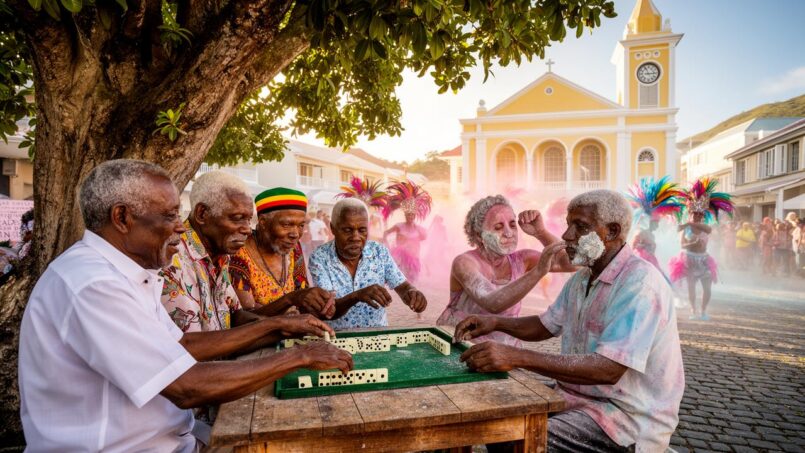
Among the major highlights are the carnival, called Vincy Mas, where music, costumes, and parades take over the streets, and the “Nine Mornings” festival in December, featuring concerts and morning celebrations in the days leading up to Christmas.
The Garifunas, descendants of Africans and indigenous Caribs, preserve specific rituals like the Dugu ceremony, centered on ancestor worship, and spectacular practices like “mock hangings.” As an expat, it’s essential to be discreet, always ask for permission before filming or taking photos, and scrupulously respect moments of solemnity during these cultural events.
Photography and Respect for Privacy
In the age of social media, the temptation to document everything is strong. Yet, in the archipelago, photographing people—especially children—without consent is frowned upon. Imposing yourself with your lens at religious ceremonies, Garifuna rituals, or scenes of rural life can be perceived as objectifying the local population.
Politely asking for permission, accepting a refusal without insisting, and avoiding turning residents into a backdrop for Instagram are matters of fundamental respect.
Family Life, Relationships, and the Place of Community
Expatriates who imagine living in an isolated bubble risk missing a central aspect of local culture: the importance of the extended family and the community, in the broadest sense.
Extended Family and the Role of Elders
Family is not limited to the parents-children nucleus. Uncles, aunts, grandparents, cousins, and close neighbors form a supportive community. Elders play a key role in regulating relationships, whether concerning couples’ lives, education, or financial help.
In this context, mocking someone’s mother or making disrespectful comments about her is considered extremely offensive, as the maternal figure is almost sacred. Such an insult can directly trigger an open conflict.
Romantic Relationships and Marriage
Relationships with foreigners are generally well-received but are not disconnected from the family’s gaze. Obtaining the blessing of parents and elders remains an important step when considering a life together. Intercultural marriages are accepted, but differences in faith, standard of living, or migration plans can lead to intense discussions.
For an expat in a relationship with a Vincentian, understanding the role of family in decisions—housing, children, financial management—is crucial. Ostensibly ignoring in-laws and neighbors often means cutting oneself off from the main local support networks.
Work, Business, and Relationship to Authority
The professional world in Saint Vincent and the Grenadines mixes formalism inherited from the British model and the importance of personal relationships, characteristic of Caribbean societies.
Formalism of First Encounters
First contacts—business meetings, interviews, institutional meetings—are generally marked by a polite tone, formal use of titles, and a certain distance. People shake hands, exchange pleasantries, and emphasize the pleasure of meeting their counterpart.
Decisions are not always made immediately. Hierarchy is clear, and it is often the higher-ups who make the final call. Trying to force a decision with an intermediate manager who lacks the authority is ineffective and leads nowhere.
Building Trust Over Time
Trust is earned. Vincentians place great importance on reputation, keeping one’s word, and consistent behavior. Keeping commitments, respecting announced deadlines, and being honest about what one can or cannot provide are essential for building a reliable professional network.
Informal activities like lunches, after-work drinks, or participation in local events are crucial for strengthening professional relationships. To fully benefit from them, it’s recommended to get involved in and show interest in local life, rather than staying confined to an expat circle. This openness facilitates integration and creates opportunities.
Politics, Money, and Public Criticism: Slippery Slopes
Politics is a serious, often divisive subject. Diving into it head-on, especially when newly arrived, is risky. It’s better to let local counterparts broach the topic and remain cautious in your own positions. Mocking the country’s infrastructure, institutions, or leaders can be perceived as a form of postcolonial arrogance.
Very direct discussions about income, wealth, or people’s financial situations are also not appreciated, even if the issue of the cost of living is omnipresent in daily concerns.
Relationship with the Environment and Awareness of Natural Hazards
Local culture is also shaped by a fundamental reality: vulnerability to natural hazards. Hurricanes, torrential rains, landslides, droughts, volcanic activity… all these phenomena mark the country’s recent history and the lives of its inhabitants.
Living with Disasters: A Collective Memory
The last few decades have been marked by violent episodes: repeated eruptions of the La Soufrière volcano, major hurricanes, sudden floods, prolonged droughts. Economic damage amounts to hundreds of millions of dollars and regularly represents significant portions of GDP.
For an expat, it is essential to understand that the risks (weather, volcanic) and emergency plans are not theoretical. Ignoring safety instructions or NEMO alerts is very poorly received, as it constitutes both a personal danger and a lack of respect for the traumas experienced by the local population.
Respect for Nature and Expected Behaviors
The sea, coral reefs, forests, and volcanic landscapes are at the heart of the country’s identity… but they are fragile. Authorities and local communities increasingly emphasize responsible behavior: not littering, respecting protected areas, not touching corals or marine animals, using reef-compatible sunscreen, staying on marked trails during hikes.
In the Tobago Cays Marine Park, a surveillance system protects the sea and reefs. It is forbidden to drop anchor freely or to collect shells or corals, under penalty of seriously violating local regulations.
Small gestures—picking up picnic trash, limiting noise on beaches, respecting distances with other bathers—are all signs of consideration for shared space.
Transport, Mobility, and Informal Codes
Getting around the archipelago also means encountering a road culture, collective transport, and tacit negotiations.
Minibuses: Vital Network and Cultural Experience
The colorful minibuses are the backbone of public transport. They run on fixed routes but can be hailed anywhere. The atmosphere on board is often lively: music, animated conversations, humor. Vehicles are sometimes packed, drivers may drive fast, and the notion of comfort is relative.
For a taxi ride, expect to pay the driver directly in cash, ideally with exact change in Eastern Caribbean dollars (XCD). Accept that the organization may seem chaotic; it’s a local reality. Avoid openly complaining about the heat, noise, or driving style, as this could be perceived as disdainful of the country’s habits.
Taxis, Tips, and Negotiation
Taxis, not equipped with meters, operate on a basis of negotiated or pre-established fares. The golden rule: agree on the price before getting in. The custom is to leave a tip of about 10% if satisfied with the service.
Again, politeness and respect pay off. Most drivers are happy to share information about the island, daily life, or good addresses, provided they are treated as partners, not as interchangeable service providers.
Driving Yourself: Caution and Local Codes
Driving requires a temporary local license purchased on-site, as well as adaptation to often narrow, steep, sometimes poorly maintained roads. Driving at night, especially in mountainous areas, requires great caution.
In some areas, it’s common to honk before a sharp bend to signal your presence to other road users. This practice is not an act of road aggression but a well-established local safety reflex to prevent accidents.
Keeping car doors locked, avoiding stopping in isolated areas to pick up unknown hitchhikers, and leaving nothing visible in a parked car are part of shared common sense. This safety concern coexists with genuine friendliness: many residents are happy to give directions to foreigners.
Safety, Laws, and Lines Not to Cross
The archipelago enjoys a reputation as a relatively safe destination, confirmed by moderate crime indices. Most stays—including for expats—proceed without major incident. But this context should not obscure some firm rules and realities to be aware of.
Crime and Common Sense
Violent crimes exist but mostly concern local disputes, gang conflicts, or domestic violence. Tourists and expats are much more exposed to petty opportunistic theft: unattended bags, valuables visible in a car, equipment on yachts, wallets in crowded areas.
The recommended attitude for a foreigner is to exercise discreet prudence. It’s advisable to avoid showing off with flashy jewelry, large wads of cash, or the latest electronic gear, especially in popular areas. Also, be extra vigilant during major festive events, where pickpockets and petty thieves take advantage of the crowds.
Strict Legal Framework on Certain Subjects
Two points of law are particularly important for an expat:
1. The prohibition of drug use and trafficking, with severe penalties. 2. The ban on camouflage clothing, already mentioned, which frequently surprises newcomers.
To these are added laws criminalizing homosexual acts and severely punishing offenses involving weapons. The archipelago remains, in this regard, apart from legislative evolutions seen in some other countries.
School, Health, Work: How Cultural Norms Are Reflected
Even if your goal isn’t to analyze school or healthcare systems in detail, understanding their logic sheds light on local values and constraints.
Education: British Model, Discipline, and Religion
The education system draws very directly from the British tradition: primary, secondary, standardized exams (CPEA, CSEC), school uniforms, strong emphasis on discipline. Instruction is mostly in English, but Creole is spoken in the hallways.
Religion remains present, even though public schools are not inherently religious institutions. More affluent families may opt for private or international schools, often expensive, sometimes geared towards expat children, with international curricula.
For an expat parent, it’s necessary to anticipate a school environment that is often stricter, sometimes more crowded classrooms, and a real emphasis on academic effort.
Health: Local Basic System, Evacuations for Serious Cases
The healthcare system is designed primarily to provide basic care to the greatest number, then evacuate complex cases to other Caribbean countries (Barbados, Trinidad and Tobago) or North America. Infrastructure is being strengthened, with a network of modernized health centers and a major hospital project in Arnos Vale, but the archipelago lacks neurosurgery or advanced cardiac surgery, for example.
The local pragmatic mindset involves handling what’s possible on-site and being prepared to leave for the rest. For an expat, having international health insurance including medical evacuation is not a luxury but an essential prerequisite.
Work and Immigration: Formal Legal Framework, Relational Practices
Working legally involves obtaining a work permit, almost always sponsored by a local employer who must prove no Vincentian can fill the position. This requirement reflects a political will to protect national employment.
In practice, this reinforces the importance of networks, contacts, and social acceptance: an expat perceived as arrogant, disrespectful of cultural norms, or disconnected from local reality will have much more difficulty integrating professionally than a technically equivalent but socially well-integrated profile.
Eating, Drinking, Sharing: Culinary Culture as a Key to Integration
Local cuisine is not just about taste; it’s also a social language. Accepting a dish, praising the flavor of a stew, or showing curiosity about traditional recipes often creates an immediate bond.
The Table as a Meeting Place
Vincentians are proud of their cuisine: roasted breadfruit and fried jackfish, callaloo soup, dishes based on root vegetables (yam, cassava, sweet potatoes), chicken pelau, saltfish and “ground provisions,” arrowroot dumplings… so many dishes that tell the country’s history.
Accepting a meal prepared by a neighbor, colleague, or in-laws, tasting it without being fussy, and sincerely complimenting the dish are highly appreciated gestures that foster integration. Conversely, systematically rejecting local cuisine in favor of “international” options can give the image of a foreigner unwilling to integrate.
Alcohol, Parties, and Moderation
Rum, local beer, and festive evenings are part of the landscape. However, ostentatious drunkenness, repeated excess, and uninhibited behavior in public are frowned upon, especially since the country remains conservative and some celebrations retain a strong religious or community dimension.
An expat who drinks moderately, knows when to stop before losing control, and avoids excesses in public spaces conforms to an implicit social norm that carries more weight than one might think.
Conclusion: Learning to Inhabit an Island Culture
Expatriating to Saint Vincent and the Grenadines means accepting to confront a culture where:
– politeness and respect for elders are at the heart of interactions;
– faith and traditions still largely structure social life;
– the community often takes precedence over the isolated individual;
– vulnerability to natural disasters shapes the relationship with time, infrastructure, and the state;
– national pride and sensitivity to colonial legacies require delicacy in criticism.
To succeed in settling in, the expat must prioritize adaptation over seeking identical comfort. This involves listening, observing, and acknowledging the legitimacy of local norms. In return, this attitude is generally rewarded with genuine inclusion, the creation of lasting bonds, and access to a unique quality of life, characterized by human warmth, spectacular landscapes, and a rich culture.
Learning these codes before leaving, then refining them on-site through contact with residents, is undoubtedly the most profitable investment for turning a simple expatriation into true rootedness.
Disclaimer: The information provided on this website is for informational purposes only and does not constitute financial, legal, or professional advice. We encourage you to consult qualified experts before making any investment, real estate, or expatriation decisions. Although we strive to maintain up-to-date and accurate information, we do not guarantee the completeness, accuracy, or timeliness of the proposed content. As investment and expatriation involve risks, we disclaim any liability for potential losses or damages arising from the use of this site. Your use of this site confirms your acceptance of these terms and your understanding of the associated risks.

Cyril Jarnias is an independent expert in international wealth management with over 20 years of experience. As an expatriate himself, he is dedicated to helping individuals and business leaders build, protect, and pass on their wealth with complete peace of mind.
On his website, cyriljarnias.com, he shares his expertise on international real estate, offshore company formation, and expatriation.
Thanks to his expertise, he offers sound advice to optimize his clients' wealth management. Cyril Jarnias is also recognized for his appearances in many prestigious media outlets such as BFM Business, les Français de l’étranger, Le Figaro, Les Echos, and Mieux vivre votre argent, where he shares his knowledge and know-how in wealth management.





