
 Published on and written by Cyril Jarnias
Settling in Saint Vincent and the Grenadines means accepting that food becomes part of your daily life as much as the sun and the sea. Here, almost everything starts with the local land and sea: vegetables come from small farms, fish comes from the nets just a few hours before it lands on your plate, and the recipes tell the story of slavery, African, Indian, and European migrations, as well as the inventiveness of today’s Vincentians.
For an expat, mastering the local gastronomy, knowing where to shop (markets, supermarkets), the dishes to try, the prices, and the differences between stores and restaurants is essential. This guide offers a concrete overview of daily practices and the budget to plan for.
Understanding the “country on the plate”: foundations of Vincentian cuisine
In Saint Vincent and the Grenadines, the majority of what is consumed comes from the territory itself. A vegetable grown on the slopes of Saint Vincent can end up the same evening on a plate in Bequia or Mustique. Fish follows the same ultra-short circuit: fishermen land early in the morning and chefs buy their catch directly for lunch or dinner service.
Over 25 varieties of breadfruit are grown in the country, forming a pillar of the local gastronomy.
The influences are multiple. Africa left its mark on the stews, the callaloo preparations, the rich root soups, and the saltfish dishes. India brought curries, roti, and the use of spices. Europe – notably France and the United Kingdom – can be found in some desserts, the presence of “black cake” during holidays, or even the very idea of pudding. The result: a forthright, well-seasoned cuisine where chili pepper (notably the Scotch Bonnet) and “green seasoning” (a mix of herbs and peppers) play a central role.
The national dish: roasted breadfruit and fried jackfish
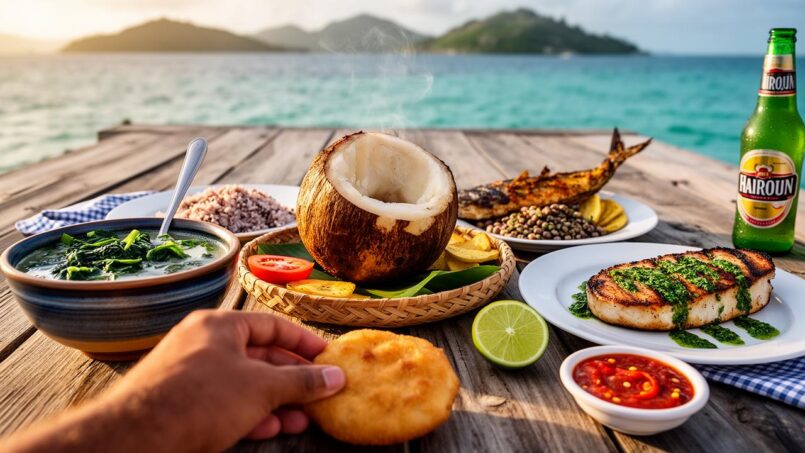
To start your life as an expat well, you must get to know the country’s iconic dish: roasted breadfruit served with fried jackfish. It’s more than a recipe; it’s a history.
Introduced in the late 18th century as cheap food for slaves, breadfruit became a pillar of culinary identity. It is traditionally roasted whole over a wood fire until its skin blackens and the inside becomes soft. It can be prepared in multiple ways: sliced and oven-roasted, mashed, cooked in a gratin, sweetened, or transformed into innovative dishes like lasagna or ‘breadfruit pizza’ during the Breadfruit Festival.
Jackfish, a very common reef fish, is typically marinated in lemon or lime juice, rolled in seasoned flour (garlic, paprika, pepper) and then fried until the skin becomes crispy. It is often served with a sauce cooked from onion, tomato, garlic, thyme, and other local herbs. Together they form a hearty meal, both rustic and extremely flavorful, found on menus from small restaurants to more refined tables.
For an expat, knowing how to recognize this dish, spotting places where it is homemade, and cooking it at home from a breadfruit bought at the market is a very concrete way to anchor oneself in the local culture.
Markets, supermarkets, fresh fish: where to do your daily shopping
The key to eating well in Saint Vincent and the Grenadines, without blowing your budget, is learning how to intelligently combine markets, supermarkets, and street stands.
Kingstown: the archipelago’s food heart
In the capital, several markets structure culinary life. The market complex along the waterfront is the nerve center for trade in fruits, vegetables, spices, and fish. There is a large two-story hall: on the ground floor, a profusion of fresh produce and seasonings; upstairs, clothing and household items. Outside, huts shelter small food stalls and a bar, while the Kingstown Fish Market, directly on the water, concentrates the sale of the day’s catch: jackfish, snapper, “strawberry grouper,” Caribbean lobster, tuna, robin, robbin…
The New Central Market in Kingstown opens at 6 a.m. and brings together farmers, artisans, and food vendors. It’s the ideal place to enjoy fried fish or callaloo soup on the go while doing your weekly shopping. The atmosphere is liveliest on Friday and Saturday, when producers and fishermen from all over the island converge there.
The markets offer a wide range of local products: avocados, plantains, sweet potatoes, bananas, “ground provisions,” breadfruit, pumpkin, limes, cabbages, broccoli, green and red peppers, “orange peppers,” fresh herbs, spices (nutmeg, clove, cinnamon, ginger, turmeric, “guinea pepper”), coconuts for drinking or cooking, as well as clothing and crafts. A vendor might offer three avocados for 9 EC$, a large loaf of bread for 4 EC$, bags of plantains for 5 EC$.
The Kingstown Fish Market, open Monday to Saturday until late afternoon, is the ideal place to buy very fresh fish. It is advisable to arrive early to get the best pieces and observe the activity at its peak. Sellers often offer to clean the fish for free.
Reference charts for Kingstown markets
| Place | Main Products | Typical Hours | Practical Tips |
|---|---|---|---|
| Kingstown Fish Market | Fish, shellfish, seafood | Mon–Sat, approx. 8 a.m.–4:15 p.m. | Come early, ask for fish to be cleaned |
| New Central Market | Fruits, vegetables, snacks, crafts, dishes | Mon–Sat, approx. 6 a.m.–6 p.m. | Bring cash, try fried fish and callaloo |
| Central Market (waterfront) | Fresh produce, spices, fish, small food stalls | Most lively Fri–Sat morning | Compare prices, observe spice stalls |
In this type of market, it is common to bargain slightly, especially for bulk purchases. Payment in cash (EC$) is the norm, although some stalls sometimes accept US dollars. It is wise to keep small bills in local and US currency.
Supermarkets: complementing fresh with imported goods
The markets don’t cover everything. For imported products, specific groceries, or the “Western” range (cereals, imported cheeses, UHT milk from major brands, breakfast items, snacks, wines), several chains structure the supply.
Presentation of the main food and general merchandise retailers in the archipelago, from Kingstown to the Grenadine islands.
Network including a logistics center in Diamond, a Coreas Food Mart opposite the ‘Little Tokyo’ bus terminal in Kingstown, as well as stores in Mustique and Canouan.
Family business present in Kingstown (Lower Bay Street), Arnos Vale, Diamond, and in Canouan (Sandy Lane Yacht Club).
Provides a hypermarket-style offering in the archipelago.
Key store located opposite the commercial port of Kingstown.
On the island of Bequia, known for its imported products and wines.
For an expat, the typical combination is to buy fresh produce, “ground provisions”, fish, and spices at the market, then turn to supermarkets for dairy, cereals, processed foods, frozen goods, specific oils, or branded products. It should be kept in mind that on average, food in supermarkets is about 18% more expensive than in the United States, while the overall cost of groceries is slightly lower (about 1.06 times cheaper). In contrast, fruits are relatively expensive compared to the global average, reflected in a high fruit price index.
How much to budget for food?
An estimate for the minimum daily food budget per person ranges between 33.37 and 46.83 EC$. Over a month, the recommended amount is between approximately 1,034 and 1,451 EC$, if one cooks mostly at home with a mix of market and supermarket shopping.
Some useful indicative prices for your first shopping list.
| Product | Average Price (EC$) | Comment |
|---|---|---|
| Milk 1 L | ≈ 8.67 | Local or imported brand (e.g., Dutch Lady) |
| White bread (1 lb loaf) | ≈ 5.22 | Large loaf sometimes at 4 EC$ at market |
| White rice (1 lb) | ≈ 1.79 | Essential staple, useful for pelau, curries |
| Eggs (12 large) | ≈ 12.13 | Varies by seller |
| Chicken (white, 1 lb) | ≈ 4.86 | Boneless: 1.98–5.36 EC$/lb |
| Beef (1 lb round piece) | ≈ 14.80 | More expensive than chicken |
| Apples (1 lb) | ≈ 11.67 | Imported, so high price |
| Bananas (1 lb) | ≈ 4.31 | Local, easy to find |
| Tomatoes (1 lb) | ≈ 7.18 | Very common in markets |
| Potatoes (1 lb) | ≈ 4.72 | Complement “ground provisions” |
| Bottled water (50 oz) | ≈ 6.00 | A smaller size runs around 4–5 EC$ |
Alcohol and beverages follow the same logic: local beer (draft) is affordable, around 5 EC$ a pint, a bottle of a well-known brand beer costs around 7.70 EC$, while a bottle of mid-range wine is generally between 40 and 50 EC$. Specialty coffee (cappuccino) averages 12–13 EC$, often more in high-end cafes.
Eating out: street food, small restaurants, and beachside tables
The archipelago offers a range of places to eat, from market snacks to high-end beach restaurants. Financially, restaurant meals are, on average, about 30% cheaper than in the United States, although some establishments in the Grenadines can reach very luxury destination prices.
A simple meal in an inexpensive restaurant costs around 17.50 EC$ (often between 10 and 20 EC$). A full three-course meal for two at a mid-range restaurant hovers around 165 EC$. International fast-food chains come in at a range close to 30 EC$ for a combo meal.
Bequia: a small island, an impressive density of restaurants
Bequia alone boasts around thirty restaurants, not counting a multitude of bars that also serve food. For an expat based on the island, it’s easy to go from an ultra-local beach barbecue to Mediterranean or Italian cuisine at a chic hotel.
This lineup of iconic addresses along Admiralty Bay includes Jack’s Beach Bar, regularly cited among the best beach bars in the Caribbean for its Creole, West Indian, and international-influenced cuisine, and Mac’s Pizza & Kitchen, renowned for its seafood pizzas and conch fritters, offering a comfort food alternative.
The Belmont Walkway
The Fig Tree, waterfront in Port Elizabeth, stands out for its “Fish Fridays”, its goat curry, rotis, and sometimes musical evenings. Green Boley, a beach bar on the Belmont Walkway, is known as much for its infused rums as for its musical improvisations. De Reef, on Lower Bay, combines a relaxed vibe, burgers, lobster salads, toasted sandwiches, and occasional festivals like its “Lots of Lobster Festival”. Keegan’s, also in Lower Bay, is famous for its Saturday barbecues, its seafood festival in August, and its simple atmosphere, much appreciated by residents and visitors alike.
Restaurants like Fernando’s Hideaway, perched above Lower Bay, embody a more intimate style: the chef catches his own fish in the morning and cooks a few homemade dishes in an informal setting, by reservation only. Firefly Bequia Estate highlights produce grown on the property or surrounding farms, in a “modern Caribbean cuisine” style akin to a high-end plantation.
Mustique: gastronomy in luxury mode
On Mustique, dining is calibrated for a clientele seeking exclusivity. There are mainly high-end addresses, like Cotton House Beach Café or the restaurant at the Cotton House hotel, where menus play between ultra-fresh seafood, Caribbean fusion cuisine, and international classics (roti, jerk chicken, lobster dishes). Basil’s Bar, an island institution for nearly half a century, serves cocktails, Caribbean dishes, and themed evenings (Sunset Sessions on Sunday, tacos & tequila nights on Thursday). For an expat based on another island, a visit to Mustique will often be a more expensive parenthesis than average.
Breakdown of price ranges by meal type
| Meal type / Place | Indicative Range (USD) | Culinary Comment |
|---|---|---|
| “Budget” traveler – breakfast | 6–12 | Bakes, fritters, eggs, fruit |
| “Budget” traveler – lunch | 10–18 | Roti, fried chicken, daily special |
| “Budget” traveler – dinner | 14–28 | Grilled fish, national dish, curry |
| “Mid-range” traveler – breakfast | 12–22 | Hotel buffet, à la carte dishes |
| “Mid-range” traveler – lunch | 18–32 | Beach restaurant, salad + fish |
| “Mid-range” traveler – dinner | 45–95 | Appetizer, main course, dessert, cocktails |
| “Luxury” traveler – breakfast | 22–40 | 4–5* hotels or private villas |
| “Luxury” traveler – lunch | 35–70 | Beach clubs, fine dining restaurants |
| “Luxury” traveler – dinner | 120–280+ | Tasting menus, lobster, champagne |
For an expat working locally with an average local salary (approximately 2,833 EC$ net monthly), eating out every day in the “mid-range” category is a luxury. On the other hand, alternating home cooking, street food, and a few restaurant outings is quite doable, especially if you frequent Saint Vincent more than the most exclusive Grenadine islands.
Must-know classics: from pelau to callaloo
Immersing yourself in the local gastronomy means putting names to the recurring dishes on menus, understanding what they contain, and how to order them your way.
Pelau: the one-pot meal for large gatherings
Pelau is a stew of rice, meat, and vegetables widely shared in the Caribbean, but with very distinct Vincentian variations. In Saint Vincent and the Grenadines, this dish typically mixes chicken (wings, thighs) and sometimes pigtail (salted pork tail), rice, pigeon peas, pumpkin, coconut milk, and spices. Sugar is caramelized at the bottom of the pot to “brown” the meat, a technique inherited from the region, and everything cooks together until the rice is tender and the juice has transformed into a thick sauce.
The preparation lends itself well to large quantities: for celebrations, whole pots are made, with enough leftovers for the next day. For an expat, it’s an ideal dish to learn if you want to invite friends, local or foreign, around a large, convivial table.
Callaloo soup: the meal-soup for big occasions
Callaloo is a green leafy plant (often taro or dasheen leaves) which, cooked into a soup with coconut milk, potatoes, yams, cassava, dumplings, sometimes salted meat or crab, makes a complete meal. In Saint Vincent, this soup is so hearty it is eaten as a meal in itself, at weddings, family gatherings, or even daily.
Callaloo, a traditional dish, has many variations: some add beef or crab, while others opt for a vegetarian version enriched with roots. In Bequia, several restaurants are known for their preparation, notably Green Boley, Coco’s Place, and The Fig Tree.
Roti, jerk chicken, saltfish: other essentials
Roti, an Indo-Caribbean legacy, is a kind of flatbread or pancake wrapped around a curry of vegetables, chicken, goat, or fish. It is an extremely common lunch, easy to take away, found both in town and on the beaches.
Jerk chicken is among the favorite grilled dishes of “jump-ups” (street parties, barbecues) and “seafood festivals”. The chicken is marinated with a mix of spices, herbs, garlic, and chili pepper, then grilled slowly. In Barrouallie, on the west coast of Saint Vincent, a fish festival is held on the first Friday of every month, with multiple stalls highlighting grilled items and fish prepared in a thousand ways.
Alongside main dishes, an ancient culinary tradition persists with saltfish like saltfish and salted pigtail. Stewed saltfish, often served with dumplings, sweet potatoes, yams, or green bananas (called “green fig”), is a typical dish for breakfast or lunch in many Vincentian households.
Desserts, snacks, and daily sweets
Sweets are not forgotten. Ducana, for example, mixes grated sweet potato, coconut, raisins, spices like nutmeg and ginger, before being wrapped in banana leaves and boiled. It is sometimes eaten with saltfish, sometimes simply as a treat, especially during holidays.
Madongo dumplings, made from arrowroot flour (grown almost exclusively in Saint Vincent and the Grenadines), coconut, and spices, represent one of the country’s most specific markers. They are often prepared at home or served in small family-run establishments rather than in large hotels.
You can also find banana fritters, a sort of sweet banana doughnut; coconut drops, bites of grated coconut caramelized with spices; cassava bread (a dense, gluten-free bread made from cassava) and sweet potato pudding, a compact dessert flavored with cinnamon and nutmeg. Tamarind balls – balls of tamarind pulp coated in sugar – complete this array of street sweets.
Fish and seafood: the art of choosing and enjoying
The advantage of living on-site, rather than just visiting, is being able to truly enjoy the abundance of fish and seafood. Besides the ever-present jackfish and snapper, Vincentians consume mahi-mahi, tuna, octopus, squid, conch, lobster, crabs and even more unusual species like kingfish or bonito.
Common cooking methods in Caribbean cuisine include frying, spicy stews, and spiced court-bouillon (like ‘blaff’ fish, where the fish is marinated then poached in a mixture of wine, chili pepper, garlic, thyme, onion, and other spices). An ingredient like conch (or lambi) is often prepared in curry, stew, or ceviche, the latter involving a lime marinade and the addition of crunchy vegetables.
The Friday gathering in Barrouallie illustrates this culture well: this monthly “fish festival” concentrates stalls, music, and tastings around fish, sometimes with rarer products like pilot whale, consumed here but more controversial elsewhere, which may raise questions for some expats.
In daily life, expats quickly learn which species to favor, which markets or street vendors are the most reliable, and how to avoid certain reef fish potentially carrying ciguatera. The basic rule remains to ask locals and favor recognized sellers, especially around the Kingstown Fish Market.
Vegetarians and vegans: living here without (too much) difficulty
Even though meat and fish consumption is high in the region, it is far from impossible to live as a vegetarian or even vegan in Saint Vincent and the Grenadines – especially with a bit of organization.
There are many naturally suitable dishes: callaloo soup without meat, vegetable roti, rice and peas, vegetarian pelau, assortments of “ground provisions” with coconut sauce, vegetable curries, tostones (twice-fried plantains), pholourie (fried spicy dough balls), sautéed vegetables. On the mainland, some restaurants play along by offering lentil burgers, vegetable rotis, vegan curries, or adapted menus upon request.
At the Beachcombers Hotel in Villa, the Ada Restaurant allows vegan travelers to compose meals with water-based oatmeal, fruit, roasted sweet potato, and salads, which they can complement with their own protein sources. The French Verandah, at Mariners Hotel, offers a vegetable roti, vegetarian curries, sautéed vegetables, and vegetarian burgers that can be adjusted (without cheese or mayonnaise). Finally, the Mangoz Restaurant and Bar, also in Villa, offers a lentil burger with fries and a selection of fruity smoothies.
At the market, the diversity of vegetables, legumes, and tropical fruits makes it easy to imagine 100% plant-based home cooking, playing on coconut milk, spices, and herbs to add depth. The real difficulty lies more in the sometimes high price of certain imported products typical of Western vegan diets (tofu, special plant milks, meat substitutes) and in the fact that these products are not always continuously available.
Gastronomy doesn’t stop at restaurants and markets. In Saint Vincent and the Grenadines, major cultural events are also food festivals.
During Vincy Mas, the summer carnival, the streets of Kingstown fill with grilling stands, tubs of ice with local beer (Hairoun), roti vendors, grilled corn, fried snacks, and sweet drinks. The parades, soca, calypso, and steel pan competitions naturally accompany these street foods that feed party-goers until late at night.
The Breadfruit Festival takes place each weekend in August in various communities. It celebrates culinary creativity around breadfruit (gratins, pizzas, candies, drinks…). The free event aims to promote local production and encourage professionals to integrate it into their menus. The atmosphere is festive with music, dancing, and calypsonian performances.
The month of December, with the Nine Mornings Festival, is another highlight. During the nine mornings before Christmas, dawn sea baths, concerts, street parties, competitions, and storytelling follow one another. Everywhere, you can find vendors of cocoa tea, bakes, banana fritters, rum-soaked “black cake,” sorrel drinks, grilled corn, and traditional Christmas treats.
For an expat, these events are ideal opportunities to discover gastronomy in its social context: you eat standing up, comment, compare recipes, get explanations of dishes from strangers who quickly become acquaintances.
Drinks, rum, and the art of moderation
It’s impossible to talk about Vincentian gastronomy without mentioning drinks. Hairoun beer, produced locally, is omnipresent in bars, beach parties, and restaurants. Rum reigns supreme, to the point that many sweet preparations (black cake, punches, desserts) feature it.
St. Vincent Distillers, in Georgetown, has produced Sunset rum since the 1960s, famous for tonic punches and celebrations, as well as Captain Bligh. Typical Vincentian punches are potent, generously combining this rum with tropical fruit juices (soursop, tamarind, lime, green mango, or coconut water), a few drops of bitters, and lots of ice.
Expatriates must keep in mind, however, that culturally, it is frowned upon to appear drunk in public or to flaunt one’s wealth ostentatiously in bars. The implicit recommendation is to blend into local behavior: enjoy rum, yes, but with restraint, especially during the first months of settling in, while learning the social nuances.
Cost of living, housing, and culinary trade-offs
The cost of living in Saint Vincent and the Grenadines is slightly below the global average, but with disparities between spending categories. The food price index exceeds the overall average, while housing remains about 16% cheaper than in a country like the United States. Restaurants cost, on average, 30% less than there, but supermarkets are, paradoxically, nearly 18% more expensive.
To maintain a reasonable budget without sacrificing quality, it is advisable to cook with local products and frequent the markets. Renting a small apartment (around 800 to 1,100 EC$ for a studio/1-bedroom) allows you to have your own kitchen, experiment with local recipes, invite neighbors, and significantly reduce meal costs.
A typical weekly budget breakdown, for someone sharing accommodation and alternating home cooking with a few outings, could be divided as follows: approximately 250 to 400 USD for food (eating rather well), 900 to 1,200 USD for housing (for two people), 200 to 450 USD for transportation (inter-island ferries, taxi, gas) and 150 to 350 USD for activities and excursions (guided hikes, snorkeling trips, visits). Living year-round, it is of course possible to optimize these amounts, especially regarding transport and leisure.
Integrating through the table: a few reflexes to adopt
In the Vincentian cultural context, food is often a vector of hospitality. Accepting a dish, tasting a piece of roasted breadfruit, commenting on the texture of a callaloo, asking for a madongo dumplings recipe—these are all small gestures that facilitate integration. Conversely, showing marked disgust for a local dish, loudly judging the use of chili pepper or offal can create distance.
To facilitate your integration, adopt certain behavioral guidelines. Dress simply, avoid topics of money or politics during first meals with new acquaintances, and don’t speak loudly in public places. It is also advisable not to flaunt your wealth or appear drunk. To build connections, don’t hesitate to ask for explanations about customs, warmly thank for an invitation to a family meal, and in turn offer a homemade dish.
The other useful reflex is to participate in the small scenes of daily life: regularly buying from the same market vendors, learning their first names, greeting the fisherman who sells you your Saturday tuna, leaving a discreet tip for the server who patiently explains the composition of a dish… Gradually, the status of “foreigner” transforms into that of a regular, then a neighbor.
As a gourmet conclusion
Living in Saint Vincent and the Grenadines isn’t just getting used to a new climate or new administrative formalities. It’s also changing your culinary landscape: replacing a mountain of pasta with a plate of “ground provisions,” letting the aroma of coconut, roasted breadfruit, Scotch Bonnet pepper, and freshly landed fish into your kitchen.
For an expat, exploring the local gastronomy is an effective way to make your new territory your own. This involves learning the best places to source ingredients (markets, stands), discovering typical dishes (like callaloo or vegetarian roti), and participating in cultural events (neighborhood festivals). These culinary experiences create a common language and transform food into a real playground for integration.
Saint Vincent and the Grenadines is not a destination where you eat like everywhere else. It is a small archipelago that, through its cuisine, tells a complex story made of suffering, resistance, blending, and permanent creativity. Opening up to it is already understanding much about the society that welcomes you.
Disclaimer: The information provided on this website is for informational purposes only and does not constitute financial, legal, or professional advice. We encourage you to consult qualified experts before making any investment, real estate, or expatriation decisions. Although we strive to maintain up-to-date and accurate information, we do not guarantee the completeness, accuracy, or timeliness of the proposed content. As investment and expatriation involve risks, we disclaim any liability for potential losses or damages arising from the use of this site. Your use of this site confirms your acceptance of these terms and your understanding of the associated risks.

Cyril Jarnias is an independent expert in international wealth management with over 20 years of experience. As an expatriate himself, he is dedicated to helping individuals and business leaders build, protect, and pass on their wealth with complete peace of mind.
On his website, cyriljarnias.com, he shares his expertise on international real estate, offshore company formation, and expatriation.
Thanks to his expertise, he offers sound advice to optimize his clients' wealth management. Cyril Jarnias is also recognized for his appearances in many prestigious media outlets such as BFM Business, les Français de l’étranger, Le Figaro, Les Echos, and Mieux vivre votre argent, where he shares his knowledge and know-how in wealth management.





