
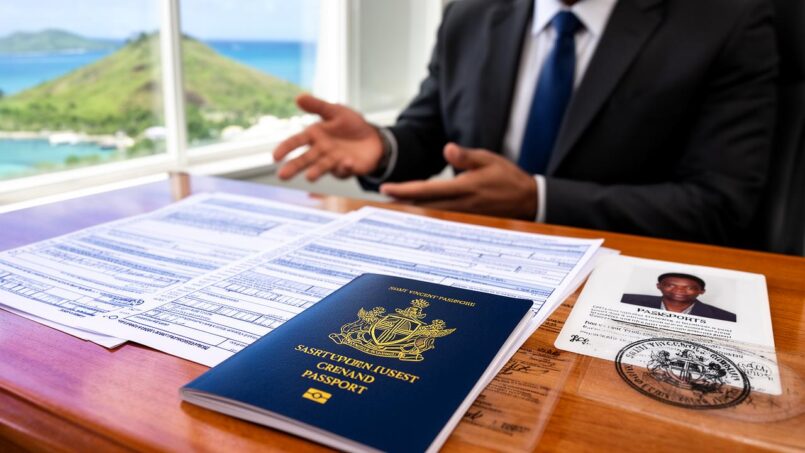
 Published on and written by Cyril Jarnias
Obtaining a passport from the country of Saint Vincent and the Grenadines means gaining access to one of the most interesting travel documents in the Caribbean, offering extensive freedom of movement, a light tax framework, and extensive rights within CARICOM and the OECS. But between citizenship requirements, forms, proofs to provide, fees, and sometimes very long processing times for a first application, the process can quickly become opaque without a clear overall view.
This practical guide is intended for several profiles: persons born in Saint Vincent and the Grenadines, descendants of the Vincentian diaspora, residents living abroad, and candidates for naturalization.
Understanding the Saint Vincent and the Grenadines Passport
The passport of the country of Saint Vincent and the Grenadines is a biometric passport issued centrally in Kingstown. Since 2014, all new documents are electronic, equipped with a chip, and are valid for 10 years for holders aged 16 and over, and 5 years for children under 16. It is no longer possible to have a spouse or children listed on a parent’s passport: each person, including babies, must have their own document.
Number of destinations accessible without a prior visa with this Caribbean passport, placing it among the highest-performing in the region.
Beyond travel facilities, it grants access to the rights associated with citizenship of Saint Vincent and the Grenadines: the possibility to live and work in other OECS member states, potential benefits in education and healthcare, and an anchor in a politically stable country, a member of the Commonwealth, with a particularly attractive tax system (no worldwide income tax, no taxes on wealth, inheritance, or capital gains).
Who is Eligible to Apply for a Saint Vincent and the Grenadines Passport?
The key question, even before thinking about forms and photos, is that of citizenship. The passport of the country of Saint Vincent and the Grenadines is reserved for citizens of the country. The law of nationality is governed by the 1979 Constitution and the Citizenship Act of 1984, amended several times, with a system mixing jus soli (right of the soil) and jus sanguinis (right of blood).
Main Cases of Eligibility for Citizenship
Those who can claim citizenship, and therefore a Saint Vincent and the Grenadines passport, include:
Citizenship in Saint Vincent and the Grenadines can be acquired in several ways: by birthright (birth on the territory, except for children of diplomats or nationals of a country at war), by descent (birth abroad with at least one parent who is a citizen), or through administrative procedures (naturalization, registration via marriage, long-term residence, or adoption). A recent reform has also extended this right to grandchildren of citizens (second generation born abroad), subject to demonstrating a family link and good character.
Foreign spouses of citizens can apply for registration as citizens by marriage. Commonwealth nationals residing for at least seven years ordinarily may also apply for citizenship by registration. “Classic” naturalization remains open to foreigners residing in the territory for several years, provided they are of good character, have a sufficient level of English, and intend to settle permanently.
Once citizenship is acquired or recognized, obtaining the passport is an administrative step. This procedure, while formal, is simplified compared to acquiring nationality. It nevertheless remains demanding in terms of required documents to complete the file.
Role of Diplomatic Missions
All passport applications are processed centrally in Kingstown, but citizens living abroad are not required to travel there. They must go through the nearest diplomatic or consular mission: the High Commission in London for the United Kingdom and Europe, the Consulate General in New York or Ontario for North America, embassies or regional missions elsewhere.
These posts collect applications, check documents (including civil status certificates and proof of citizenship), oversee payments, and then forward the applications to Kingstown.
The Legal Framework and Key Principles of Nationality
Even though this guide focuses on the passport, a quick overview of nationality law helps understand why some cases are simple and others significantly longer.
Nationality can be obtained in Saint Vincent and the Grenadines through three main avenues: birth, registration, and naturalization. A specific avenue for grandchildren of citizens abroad has been added, designed to meet the expectations of the diaspora.
French law establishes a distinction between legitimate and illegitimate situations for certain older acquisitions of nationality. It also takes into account factors like parentage and marriage in complex cases. Finally, it provides for the possibility of loss of nationality in cases of fraud, treason, or prolonged residence abroad without effective ties to France. (Note: This paragraph appears to be a direct translation of a note specific to French law, which might be contextually misplaced here but is translated as per source.)
A crucial point for citizenship and passport candidates: the country fully accepts dual, even triple nationality. Vincentians can keep their other passports, and conversely, naturalized persons are not in principle forced to renounce their original nationality, although the law allows this possibility in some cases. In practice, it is mainly the law of the other country that may pose an obstacle.
The Different Types of Passport Forms
The administration uses a series of standardized forms, essential for assembling a compliant application.
Adult and Child Forms
Two main forms structure the procedure:
– Form A – Adult Passport Form A: “Application for a St. Vincent and the Grenadines Passport for Persons Sixteen Years of Age and Over“. It is for all persons aged 16 and over.
– Form B – Child Passport Form B: reserved for children under 16. It must be signed by a parent or legal guardian.
In addition to these forms, there is a specific document in case of loss, theft, or damage: a two-page “Lost/Stolen Report” to be attached to any replacement application.
The forms collect personal data, travel history, civil status, security information, and a sworn declaration. An entry error, omission, or contradiction in this information can result in the application being returned.
Partial Digitalization of Forms
The authorities have gradually moved away from handwritten forms. In some channels (particularly via the High Commission in London), it is required to fill out forms online via a dedicated tool, then print them on single-sided paper. Double-sided versions are rejected.
Signatures must only be placed in the presence of the application accepting officer, allowing verification of the signatory’s identity.
Where and How to Obtain Passport Forms
Obtaining the form is a simple but regulated step.
The most common options are as follows:
Several methods are available to obtain the official form required for a Saint Vincent and the Grenadines passport application.
Download the form from an official government website, usually in PDF format.
Visit a passport office or competent administration in Saint Vincent or the Grenadines to obtain a printed copy.
Request the form by postal mail by contacting the diplomatic mission nearest to your place of residence.
A photo ID may be required to receive a form in person. For a mail request, modest postage fees and a delay of several days to several weeks are to be expected. Some regional sites (such as OECS portals) also host the forms or detailed instructions.
Required Documents: What You Absolutely Must Prepare
The success of a passport application relies largely on the quality and consistency of the documents provided. The country is very strict on the authenticity of documents and no longer accepts old handwritten formats.
Proof of Citizenship and Identity
At the heart of the file are: the essential elements.
– An original birth certificate or a certified copy issued by the Registrar General, on computerized security paper (old handwritten versions are rejected).
– If applicable, a certificate of citizenship if nationality was acquired by registration or naturalization.
– An official photo ID: national identity card, driver’s license, voter’s card, or other equivalent document.
For first passports, the original and a copy of the birth certificate are required. For renewals, the old passport must always accompany the application.
Civil Status Documents
Changes in civil status must be justified:
Married women must provide their original marriage certificate. Divorced women must produce both the original marriage certificate and divorce decree. Children born abroad must present their birth certificate showing the parent’s name, accompanied by the birth certificate of the parent born in Saint Vincent and the Grenadines.
All documents from other Caribbean countries must now be presented in their computerized “new format”. Old or handwritten diplomas, judgments, or certificates must be replaced by modern copies.
Case of Dual Nationals and the Diaspora
Dual nationals are asked to include:
– Their valid foreign passport.
– In some cases, a driver’s license from the country of residence (for example, a British license for UK residents).
Foreign civil status documents (birth, marriage, adoption, naturalization) that do not originate from Saint Vincent and the Grenadines or the United Kingdom must be certified by the competent High Commission or embassy of the issuing country.
Specific Requirements for Children
Passport applications for those under 16 follow several strict rules:
– Mandatory use of Form B.
– Signature of the application by a parent or legal guardian.
– Obligation to provide the written consent of the father for the passport issuance, with exceptions: if the father is deceased, or if the child was born out of wedlock (in which case the mother alone can consent), unless the child is already married.
– Potential provision of a court order if legal custody is shared or contested.
The authorities also require, for some applications, photos showing the child’s evolution since the previous passport issuance, to clearly establish continuity of identity.
Photographs: Very Specific Specifications
Identity photos are one of the most frequent causes of rejection or delay. The country imposes detailed technical standards:
For procedures, three professional high-resolution photos are needed (or two identical ones in some cases). The standard format is 45 mm x 35 mm. The face should occupy 70 to 80% of the image, be centered, facing forward, with eyes open and a neutral expression (mouth closed). Colors should be natural, with good brightness, no excessive glare or shadows. The background should be plain and light (preferably white, or light tones accepted). No hats, sunglasses, or items obscuring the face are allowed. Corrective glasses are accepted if eyes are visible, and religious/cultural head coverings are tolerated if they do not obscure facial features. Wear neutral-colored clothing that contrasts with the background.
One of the photos must be signed on the back by the guarantor listed on the form. The accepting officer glues or staples the photos themselves: it is expressly requested not to attach them to the form in advance.
The Role of the Guarantor, Recommender, or Certifier
Another key piece of the application is the certification by a guarantor. This person must:
– Know the applicant personally for at least two years.
– Be a recognized professional or hold a position allowing them to authenticate the applicant’s identity (the precise lists are defined by the administration, at least since 2014).
– Certify the photo and, if applicable, sign a specific section of the form.
The guarantor does not need to be a citizen of Saint Vincent and the Grenadines. If they do not have an official stamp, they can provide a letter on their organization’s letterhead attesting that they have certified the documents.
How and Where to Submit Your Passport Application
Several submission channels exist, depending on whether you live locally or abroad.
Within the National Territory
Residents of the country of Saint Vincent and the Grenadines generally submit their application to the passport service or the competent department (often attached to the Ministry of National Security or Immigration). All applications, including those from Grenadines residents, are then centralized in Kingstown.
The application must include: 1. The applicant’s name and contact details 2. A detailed description of the application 3. Supporting documents 4. The submission date
– Completed form.
– Original documents and, if required, certified copies.
– Compliant photos.
– Old passport (for a renewal).
– Proof of payment of fees.
In London, New York, Toronto, and Other Posts
Citizens residing abroad must go through the following missions according to their place of residence:
Contact details and procedures for the main foreign representations for nationals and consular procedures.
Competent for the United Kingdom and Europe. Address: 10 Kensington Court, London W8 5DL. Submissions by appointment (Tuesday, Wednesday, Thursday) during reduced slots (e.g., 11am-12pm and 3pm-4pm). Contact: phone or [email protected]
Competent for the United States. Address: 801 Second Avenue, New York. Contact by phone and email (specific details).
Competent for Canada. Address: 55 Town Centre Court, Scarborough, Ontario.
Applications can be submitted in person (by appointment) or sent by secure mail. The service generally recommends using “Special Delivery” rather than “Recorded Delivery” for important documents. Sending passports by mail is still discouraged when it can be avoided, as responsibility for any loss in transit lies with the holder.
In-Person, Postal, or Online Submission
Three submission modes are mentioned:
Submitting a passport application varies depending on the situation. In-person submission is often mandatory for a first application, a lost, stolen, or damaged passport, or for an emergency document. Postal submission is possible for some renewals or for residents who have difficulty traveling, provided administrative instructions are strictly followed. Finally, online submission may be available in some countries to fill out the form and upload copies, but the physical file with originals must then be sent to Kingstown for final processing.
Processing Times: Between Fast Renewal and Long First Application
Processing times vary significantly depending on the type of application and the channel used.
The most frequently mentioned indications are as follows:
| Type of Application | Minimum Indicative Time | Observations |
|---|---|---|
| Renewal (internal) | 7 business days | Theoretical time for simple local applications |
| First Application (internal) | 14 days to 1 month | Can be longer depending on case complexity |
| Renewal (via London/Consulates) | 4 to 8 weeks | From receipt of all documents |
| First Adult Passport (diaspora) | 6 months to 1 year (or more) | Lengthy checks and exchanges with civil registry |
| First Child Passport (diaspora) | About 6 months or more | Enhanced verifications |
| Lost/Stolen Replacement | Up to 12 months or more | Mandatory waiting period of 6 months to 1 year after police report |
Peak demand seasons (holidays, major events) can further extend these times. Expedited services (“express” or “expedited”) exist in some contexts for an additional fee, but they are not always offered abroad and do not apply to sensitive cases (first application, theft, potential fraud).
Passport Fees: Amounts and Variations by Country
Fees are non-refundable and must accompany each application. They vary according to the applicant’s age, place of submission, and type of service (standard, express, replacement).
Fees in Eastern Caribbean Dollars (EC$) – On-Site
Within the national territory, the following amounts are mentioned:
| Type of Fee | Amount (EC$) |
|---|---|
| Passport 16 years and over | 200.00 |
| Passport under 16 years | 100.00 |
| Application Form (16+) – Revenue Stamps | 15.00 |
| Application Form (<16) – Revenue Stamps | 10.00 |
| Passport Replacement (lost/stolen) | 300.00 (in addition to new passport cost) |
| Express Service 1 day | 90.00 |
| Express Service 2–3 days | 60.00 |
| Express Service 4–5 days | 40.00 |
Additional costs may be added: birth certificate extracts (15 EC$), police certificates (10 EC$), other certificates.
Fees for the Diaspora – Examples in Pounds, Canadian and US Dollars
For residents in the United Kingdom, Canada, or the United States, amounts are adapted to local currencies:
| Location / Currency | Adults – New or Renewal | Children (<16 years) | Replacement (Lost/Stolen) |
|---|---|---|---|
| United Kingdom (London mission fees) | £75 (base) or £95 depending on source | £40 or £70 depending on source | £110 + new passport fee |
| Canada | 185 CAD | 95 CAD | 225 CAD |
| United States | 200 USD | 100 USD | 225 USD |
To these amounts are often added processing fees (e.g., £10 for an adult and £7 for a child in London), secure international postal fees (about £25 per leg), and sometimes specific consular fees (e.g., in Canada: 102 CAD for passport, 150 CAD for replacement, 40 CAD for a travel document).
Cash and personal check payments are generally refused by the missions. Payments are made by bank card (over the phone), postal order, or other secure means. Each consular post specifies its procedures.
Managing Lost, Stolen, or Damaged Passports
The loss, theft, or damage of a passport is taken very seriously. The procedure includes several steps:
1. Immediate reporting to the passport service and local police. 2. Filing an official police report, forwarded to the Consulate General or competent mission. 3. Completing a specific form for lost/stolen/damaged passport, attached to the replacement application. 4. Payment of increased replacement fees (e.g., 300 EC$ in addition to the new passport price on-site; or an additional £110 in the UK).
In some cases, processing a passport after a loss or theft abroad can exceed 12 months.
Emergency Travel Documents
For situations of urgent travel (death, medical emergency, etc.), temporary travel documents can be issued:
– Emergency Passport or Emergency Certificate, accepted for travel to some OECS countries.
– Issuance conditioned on simultaneous submission of a new passport application and payment of associated fees.
These documents are issued only in person, after close examination of the situation by the diplomatic post or passport service.
The Concrete Benefits of the Saint Vincent and the Grenadines Passport
Beyond proof of national identity, this passport is a tool for mobility and opportunities.
Freedom of Movement and Accessible Destinations
Citizens holding this passport can travel without a prior visa or with a visa on arrival to a large number of countries. Exact durations and conditions vary, but the broad trends are clear:
The French passport offers great travel freedom, allowing stays without a visa or with simplified formalities in many regions of the world. (Note: The heading seems contextually misplaced but is translated as per source. It likely refers to an example or comparison.)
Stays of 90 days within any 180-day period in most member states (France, Germany, Spain, Italy, etc.).
Visa-free stay for up to 6 months.
Facilitated access to most Caribbean, Central, and South American territories (Argentina, Brazil, Colombia, Chile, etc.).
Visa-free stays or with e-visa in several key countries (Hong Kong, Singapore, Malaysia, South Korea, Israel via electronic authorization, etc.).
Entry without visa or visa on arrival in many states (Ghana, Rwanda, Mauritius, Seychelles, etc.).
Official destination tables evolve over time, but the order of magnitude is around 150–156 countries or territories accessible without a classic visa, according to rankings like the Henley Index. It is essential to check, before each trip, the rules in force (duration, visa type, vaccination certificates, minimum passport validity).
Rights within the OECS and CARICOM
As a member of the Organization of Eastern Caribbean States (OECS) and CARICOM, the country of Saint Vincent and the Grenadines grants its citizens additional facilities:
Citizens of certain OECS member states (like Antigua and Barbuda, Dominica, or Saint Lucia) have the right to live, work, study, or retire in other member states without a visa or work permit. Furthermore, the Caricom Certificate of Skills can offer, in countries like Barbados or Jamaica, a possibility for nearly unlimited settlement.
The passport, combined with these regional agreements, becomes a true lever for professional and social mobility.
Tax Framework and Economic Attractiveness
Citizenship accompanied by the passport also fits into a very light tax environment. The country does not tax worldwide income, does not apply wealth tax, inheritance tax, or capital gains tax. Corporate tax rates are also quite low, attracting investors and entrepreneurs, particularly in tourism, agriculture, or renewable energy sectors.
For a Vincentian living abroad, these characteristics can weigh in the balance when structuring their activities or planning a return.
Obtaining a Passport When You Are Not Yet a Citizen
For those who do not have (or not yet have) citizenship, several paths exist. The passport then comes at the end of a long process.
Residence and “Classic” Naturalization
Foreigners can apply for temporary, then permanent residence, by settling in the country (work, economic activity, property purchase, etc.). After 7 to 10 years of continuous residence (depending on the case), they can apply for citizenship by naturalization, under conditions:
– Residence or work for the government for a cumulative period of about nine years.
– Legal capacity (be of age and sound mind).
– Good character, verified by police certificates.
– Intention to settle permanently.
– Sufficient level of English language.
– Stable financial situation and good health.
Once naturalization is obtained and after taking the oath of allegiance, the procedure to apply for a passport is identical to that followed by birthright citizens.
Residence by Investment (Outside an Official Citizenship Program)
The country of Saint Vincent and the Grenadines does not currently have a formal citizenship by investment program. It is the only sovereign OECS state in this situation; its neighbors like Antigua and Barbuda or Saint Kitts and Nevis have such programs.
However, it is possible to obtain residence through a significant economic contribution, even though no precise legal threshold is set: significant real estate purchase ($100,000 to $200,000 suggested for access to residence), investment in a local business, participation in government-approved projects. The residence thus obtained, after several years, can open the door to naturalization, and then to a passport.
Related Documents: Civil Status Records and Police Certificate
To build a solid file, it is often necessary to start by regularizing civil status records and criminal record certificates.
Mandatory Modern Civil Status Records
The Registrar General in Kingstown has been issuing computerized documents on security paper since 2013 (birth, marriage, death certificates, adoption certificate). These documents have a blue border, parrot image, watermarks, and an embossed seal with a serial number.
Old handwritten or plain paper records are no longer accepted in official procedures (including passport). Therefore, new copies must be requested, for modest fees (15 EC$ per record). For the diaspora, these steps can be done remotely, with the help of diplomatic missions.
Police Certificate (Certificate of Character)
In some cases (naturalization, citizenship by descent files, etc.), a Certificate of Character is required. It is issued by the Criminal Records Office on a white document with typed text, embossed seal, blue wet stamp, and the applicant’s photo.
To obtain it, you must:
– Fill out an application form.
– Present a photo ID.
– Provide two or three ID photos (one certified by a notary for non-residents).
– Include fingerprints for applicants abroad, stamped by local police.
– Pay a fee of about 10 EC$.
Some convictions can be expunged from the record after a legal period and will no longer appear on this certificate.
Best Practices to Avoid Delays
Several elements emerge from official instructions and feedback:
Before submitting a passport application, always consult the latest instructions on official websites, as rules (formats, forms, schedules) evolve. Ensure all fields on the forms are filled; incomplete files are systematically returned. Have the entire file reviewed (names, dates, numbers) before sending; some service providers offer a 24-hour review to limit errors. Choose a reliable and available guarantor, capable of certifying photos and responding to any verification requests. For any mailing of original documents, prioritize secure postal services with tracking. Finally, anticipate long processing times, especially for first applications or diaspora replacements, and avoid booking any travel before receiving the new document.
What the Saint Vincent and the Grenadines Passport Does Not (Yet) Allow
It is important to recall what this passport does not automatically offer:
Citizenship does not come from an official investment program and does not exempt from travel formalities (like ETIAS or visas) or from compliance with local laws (duration of stay, work, health, customs). The investment amounts mentioned are based on prospective analysis, not an existing regime. (Note: This paragraph appears to contain text originally meant for a different context, such as for an EU passport, but is translated as per source.)
Conclusion: A Powerful Passport, But a Journey to Prepare Well
The passport of the country of Saint Vincent and the Grenadines is clearly more than a simple Caribbean travel booklet. It is part of a solid legal framework, offers great freedom of movement, and comes with appreciable regional and tax advantages, while leaving the door open to dual nationality.
Obtaining a first passport or the procedure for the diaspora often requires reconstructing a chain of documents over several generations. Strict requirements (ID documents, modern civil status certificates, certification by a guarantor, control of losses and thefts) aim to protect the country’s reputation and the integrity of its travel document.
It is therefore better to consider the passport application as a multi-step project: verify or establish your citizen status, obtain all civil status records in the new format, gather the necessary ID documents and police certificates, choose the right submission channel (on-site or via a diplomatic mission), and anticipate processing times ranging from a few weeks to over a year.
By relying on these guidelines, you can structure your approach, minimize back-and-forth with the administration and, at the end of the process, hold in your hand a passport that widely opens borders, in a world where mobility remains a valuable asset.
Disclaimer: The information provided on this website is for informational purposes only and does not constitute financial, legal, or professional advice. We encourage you to consult qualified experts before making any investment, real estate, or expatriation decisions. Although we strive to maintain up-to-date and accurate information, we do not guarantee the completeness, accuracy, or timeliness of the proposed content. As investment and expatriation involve risks, we disclaim any liability for potential losses or damages arising from the use of this site. Your use of this site confirms your acceptance of these terms and your understanding of the associated risks.

Cyril Jarnias is an independent expert in international wealth management with over 20 years of experience. As an expatriate himself, he is dedicated to helping individuals and business leaders build, protect, and pass on their wealth with complete peace of mind.
On his website, cyriljarnias.com, he shares his expertise on international real estate, offshore company formation, and expatriation.
Thanks to his expertise, he offers sound advice to optimize his clients' wealth management. Cyril Jarnias is also recognized for his appearances in many prestigious media outlets such as BFM Business, les Français de l’étranger, Le Figaro, Les Echos, and Mieux vivre votre argent, where he shares his knowledge and know-how in wealth management.





