
 Published on and written by Cyril Jarnias
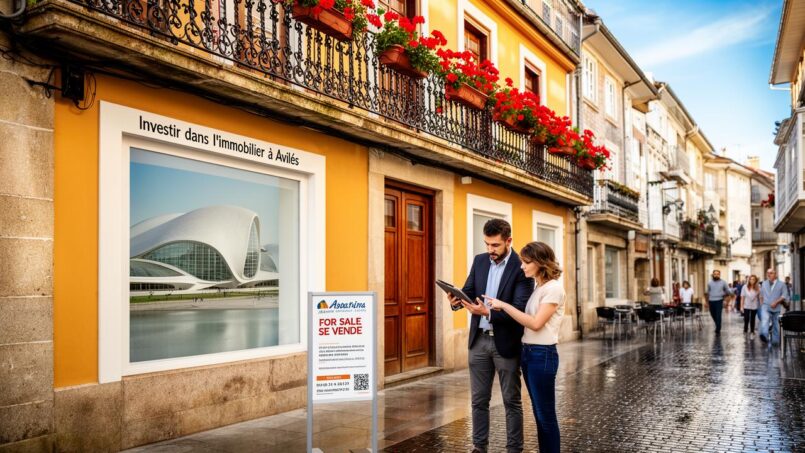
Avilés has long carried the image of a small industrial town in crisis, stuck between its port and factories. However, recent figures tell a completely different story. The real estate market is accelerating there, prices are rising fast but remain affordable, rents are following the same trajectory, and gross yields are around 5 to 6%. Against the backdrop of the Spanish economic recovery and a regional boom in Asturias, investing in real estate in Avilés is becoming a serious option for investors looking for yield without paying Madrid, Barcelona, or Costa del Sol prices.
A Local Market Heating Up in a Supportive National Context
To understand what is happening in Avilés, we must first place the city within the broader Spanish context. At the country level, real estate is experiencing a robust expansion cycle. Residential prices have seen 42 consecutive quarters of increase through 2025, with national growth of 12.8% in 2025 and still positive forecasts for 2026, generally between +5% and +7% according to major banks and analysis firms.
600000
Spain has been suffering from a deficit estimated at 600,000 homes since 2021, while the country only delivers about 100,000 per year.
In this context, real estate investment surpassed €18.4 billion in 2025, up +31% year-on-year, and is expected to grow another 5 to 10% in 2026. Capital is primarily targeting residential, but also hotels, logistics, and new segments like healthcare or data centers. Buyers themselves are becoming more strategic, better informed, with a long-term approach.
Within this landscape, Asturias stands out. While some ultra-high-profile coastal markets flirt with overvaluation, this northwestern region is among the country’s most dynamic markets, while still far from the price peaks of the Mediterranean.
Asturias Booming, Avilés Catching Up
The provincial data is telling. In 2024, real estate transactions in Asturias jumped by 12% compared to the previous year, above the Spanish average and even the European average. In the third quarter of 2024, 4,207 sales were recorded in the province, and forecasts were for a further increase of about 10% by 2025. In the first eight months of 2025, home sales in Asturias increased by 16% year-on-year, while housing starts rose by over 32% in the first half of the year.
Example:
Within the context of regional growth, the municipality of Avilés recorded a 10% increase in its real estate sales. This pace is slower than that of Gijón (+15%) but higher than Oviedo (+8%). Its market, although gaining volume, remains more accessible than its more expensive coastal neighbors, with price per m² lower than Llanes (€3,066/m²) or Gijón (€2,979/m²).
Avilés, from Steel Town to Residential and Tourist Destination
For a long time, Avilés’s economy was dominated by heavy industry, structured around its natural port on the Ría and giants like Ensidesa. Deindustrialization, partial factory closures, pollution, and an aging productive base put the city in difficulty. The population has declined by about 9% since 2013, a loss of over 7,000 inhabitants, to stand at 77,791 residents today.
Good to know:
Since the late 1990s, Avilés has undertaken a profound transformation to diversify its economy and redevelop its urban space. This strategy includes converting industrial brownfields, improving the environmental quality of the estuary, developing iconic cultural infrastructures like the Niemeyer Center, and promoting niche cultural tourism. Efforts also focus on improving the hotel and commercial offerings, as well as renovating old neighborhoods.
The result: Avilés is now cited as an example of the successful conversion of an old industrial city. After three decades of demographic decline, signs of stabilization are being observed. For an investor, this means an urban environment that has already absorbed its major crisis and is now capitalizing on a new image, more focused on culture, services, and a certain art of living, but with prices still far from having integrated all this potential.
Real Estate Prices in Avilés: A Market in Full Acceleration
Price figures confirm this catching up. At the municipal level, the average asking price for homes for sale reached €1,543/m² in July 2025, up 14.47% year-on-year (€1,348/m² in July 2024). Over the previous two years, the low point was €1,279/m² in September 2023, illustrating the strength of the rebound.
On the rental side, the progression is of the same order. In July 2025, the average asking rent rose to €8.21/m² per month, a +13.71% increase compared to July 2024 (€7.22/m²). The peak in the recent period was even slightly higher in December 2024, at €8.24/m².
Attention:
The local real estate market is showing double-digit growth in both sales and rentals. However, its prices remain significantly lower than the Spanish average for major cities, which is expected to exceed €2,600/m² by the end of 2025.
The following table summarizes this recent evolution of average prices in Avilés.
| Indicator | Most Recent Value | Annual Change | 2-Year Low | 2-Year High |
|---|---|---|---|---|
| Avg. Sales Price (Jul. 2025) | €1,543/m² | +14.47% | €1,279/m² (09/2023) | €1,543/m² (07/2025) |
| Avg. Rent (Jul. 2025) | €8.21/m²/month | +13.71% | €6.90/m² (09/2023) | €8.24/m² (12/2024) |
These average values mask strong nuances depending on the type of property. Data from the EV Data Warehouse (Engel & Völkers) shows that apartments and houses have seen rapid increases.
For apartments, the average price per square meter evolves as follows:
| Year | Apt. Price (€/m²) | Annual Change |
|---|---|---|
| 2022 | 1,510.18 | — |
| 2023 | 1,532.76 | +1.50% |
| 2024 | 1,664.44 | +8.59% |
| 2025 | 1,841.72 (est.) | +10.65% |
For single-family homes, the trajectory is comparable:
| Year | House Price (€/m²) | Annual Change |
|---|---|---|
| 2022 | 1,364.72 | — |
| 2023 | 1,412.56 | +3.51% |
| 2024 | 1,548.25 | +9.61% |
| 2025 | 1,712.75 (est.) | +10.62% |
As we can see, since 2023, Avilés has entered a phase of accelerated price increases, at a pace higher than the average of previous years. For an investor, this validates both the idea of a market in catch-up mode and the need to enter early if one wants to still benefit from reasonable prices.
A Market Divided by Neighborhoods: Where to Invest in Avilés?
One of Avilés’s assets is the significant price disparity between neighborhoods, which allows for deploying very different investment strategies depending on budget and target tenant profile.
In July 2025, data by zone clearly showed this hierarchy.
Comparison of Main Neighborhoods
| Neighborhood | Sales Price (€/m²) | Rent (€/m²/month) |
|---|---|---|
| Centro | 1,746 | 8.78 |
| El Carbayedo-El Quirinal | 1,738 | 8.17 |
| La Magdalena-Versalles | 1,588 | 8.10 |
| Jardín de Cantos-El Nodo | 1,404 | 7.52 |
| Villalegre-La Luz | 1,208 | 7.91 |
| Llaranes | 1,104 | 6.94 |
The Historic and Commercial Center concentrates the highest values, both for purchase and rent. This is logical: it offers services, cultural life, shops, more refined architecture, and better accessibility. It is also a recommended area for tourist rentals like Airbnb, as confirmed by short-term market analyses.
Tip:
For a rental or property investment in Avilés, consider the price hierarchy by neighborhood. El Carbayedo-El Quirinal positions itself just behind the Centro, with similar sales prices but slightly more affordable rents. The areas of La Magdalena-Versalles and Jardín de Cantos-El Nodo represent an interesting compromise, offering intermediate market values between the center and peripheral neighborhoods.
Conversely, Llaranes shows the lowest prices, both for sale and rent. It’s a natural playground for yield strategies, provided locations and building quality are well selected. Villalegre-La Luz remains affordable to buy but with relatively strong rents, which can mechanically improve the gross yield.
More recent data confirms these trends. In February 2026, the Centro was around €1,984/m² (+20.4% year-on-year), El Carbayedo-El Quirinal at €1,834/m² (+6.9%), while the El Pozón – Villalegre – La Luz zone climbed to €1,137/m² with an annual increase of over 23%. These figures show that some historically cheaper neighborhoods are quickly catching up, which is typical of markets in a revaluation phase.
Rental Yields: Avilés in the Good Spanish Average
For an investor, the key question remains yield. According to aggregated data, the average gross rental yield in Avilés is around 5.44%, a figure consistent with Spanish averages for secondary cities, often between 5.5% and 7% for residential. Nationally, a gross yield of about 6% is now considered “good” for a classic long-term rental property.
Analysis by housing typology in Avilés allows us to further refine the picture.
A first dataset provides the following elements:
| Apartment Type | Avg. Sales Price | Avg. Monthly Rent | Gross Yield |
|---|---|---|---|
| 1 Bedroom | €127,130 | €650 | 6.14% |
| 2 Bedrooms | €160,000 | €710 | 5.33% |
| 3 Bedrooms | €153,500 | €630 | 4.93% |
| 4+ Bedrooms | €210,000 | €930 | 5.29% |
An alternative source proposes slightly different price and rent levels, but with comparable orders of magnitude:
| Apartment Type | Avg. Sales Price | Avg. Monthly Rent | Gross Yield |
|---|---|---|---|
| 1 Bedroom | €125,000 | €550 | 5.28% |
| 2 Bedrooms | €146,000 | €720 | 5.92% |
| 3 Bedrooms | €152,000 | €600 | 4.74% |
| 4+ Bedrooms | €215,000 | €1,000 | 5.58% |
We find a well-known constant in Spain: smaller units (studios, 1-bed, 2-bed) tend to offer the best yields, as they are affordable to buy and in high demand for rent. In Avilés, 1 and 2-bedroom apartments seem particularly interesting, with yields between 5.3% and a little over 6% depending on the case.
Rental Listings Distribution
Distribution of homes available for rent by number of rooms, reflecting the market structure.
Studios (T1)
Represent about 29% of rental listings, suitable for students or single young professionals.
2-Room Apartments (T2)
Make up about 29% of offers, matching the demand from couples or young professionals.
3-Room Apartments (T3)
Account for about 29% of listings, meeting the needs of small families.
4+ Room Homes

Cyril Jarnias is an independent expert in international wealth management with over 20 years of experience. As an expatriate himself, he is dedicated to helping individuals and business leaders build, protect, and pass on their wealth with complete peace of mind.
On his website, cyriljarnias.com, he shares his expertise on international real estate, offshore company formation, and expatriation.
Thanks to his expertise, he offers sound advice to optimize his clients' wealth management. Cyril Jarnias is also recognized for his appearances in many prestigious media outlets such as BFM Business, les Français de l’étranger, Le Figaro, Les Echos, and Mieux vivre votre argent, where he shares his knowledge and know-how in wealth management.





