
 Published on and written by Cyril Jarnias
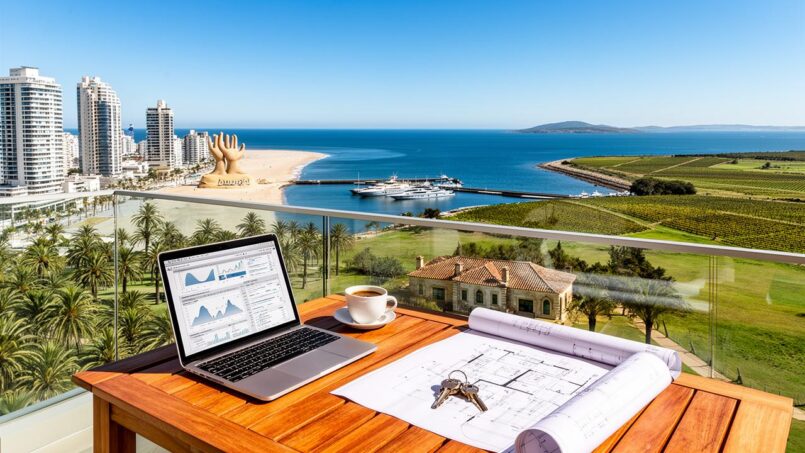
In eastern Uruguay, between the Atlantic and the countryside, the Maldonado department now concentrates a large portion of the country’s real estate projects. Long reduced, in the international imagination, to the postcard image of Punta del Este, the territory has become a true laboratory: price correction after several years of increase, explosion of seasonal rentals, major infrastructure projects, favorable taxation, and an influx of permanent residents.
For an investor, the opportunity in Maldonado no longer needs to be proven. The main challenge now is to determine the precise sectors (where), the suitable investment vehicles (how), and to define a tactical approach (with what strategy) to penetrate this market.
One of Uruguay’s Most Dynamic Markets
The Maldonado department is now the country’s second real estate market behind Montevideo, with nearly 18% of national transactions recorded in the first months of 2025. Over the year, more than 3,400 sales were concluded there, representing an increase of about 16% compared to 2024. Purchase agreements surged by 34%, mortgages by 32%. In short, buyers are signing, banks are financing, and demand remains strong.
Monthly drop in real estate prices observed in April, interpreted as a market breather.
For investors, this adjustment phase opens an interesting window: somewhat more reasonable prices, still strong demand, and access to credit facilitated by the Central Bank’s benchmark rate cut (lowered to 7.5% at the end of 2025).
Prices That Remain High on the Coast, But Competitive Regionally
At the scale of Uruguay, the average residential price is around $2,400 USD/m², for an average housing price close to $235,000 USD. Maldonado sits above this average as soon as you get closer to the coast: the department’s coastal strip shows about $2,900 USD/m², and Punta del Este climbs to an average of $4,000 USD/m², or even more on the waterfront.
The figures in Uruguayan pesos well illustrate the gap between the more financially accessible departmental capital, Montevideo, and prestigious beach resorts like Punta del Este, where costs are significantly higher.
| Area (Maldonado department) | Property Type | Median Price (UYU/m²) |
|---|---|---|
| Maldonado (city) | Apartment | 165,860 |
| Maldonado (city) | House | 110,023 |
| Punta del Este | Apartment | 153,502 |
| Punta del Este | House | 96,230 |
| Manantiales | Apartment | 293,154 |
| Punta Ballena | Apartment | 176,077 |
| Punta Ballena | House | 112,580 |
In dollars, this translates, in Punta del Este, to a very wide spectrum: standard apartments trade around $4,000 USD/m² on average, sea-view buildings easily climb between $7,000 and $10,000 USD/m², and villas directly on the beach start around 2 million dollars and reach 20 million in the ultra-luxury segment.
Conversely, the city of Maldonado offers a much softer entry ticket, with apartments generally between $1,500 and $2,200 USD/m². It is this differential that makes Maldonado a “residential back-office” for Punta del Este: the same job and service pool, but significantly lower real estate costs.
Why Maldonado Has Become a Strategic Destination for Investing
Several factors converge to explain the department’s current appeal.
First, its position: Maldonado provides access to one of South America’s most sought-after coastlines – Punta del Este, La Barra, José Ignacio, Manantiales – while offering, in its central city and suburban neighborhoods like Pinares, options suitable for year-round living.
Second, the Uruguayan macroeconomic context plays in its favor: stable growth, contained inflation, gradual rate decreases, and a particularly protective legal framework. Uruguay does not limit real estate purchases by foreigners, has no restricted zones, and applies a principle of equal treatment between nationals and non-residents.
Cooperation between the Office of Planning and Budget (OPP) and the Maldonado municipality has enabled major road projects, like the Aparicio Saravia Avenue (1+ km, 18,000 m² of asphalt), improving accessibility between the city, rural areas, and tourist complexes for more than 20,000 vehicles/day. Other works connect factories, tourist farms, and Route 60.
On the water and sanitation front, an $83.2 million dollar project, partly financed by the CAF development bank, aims to strengthen sewage and treatment systems for the city of Maldonado and the tourist area of Punta del Este. The explicit goal: securing environmental quality and long-term tourism capacity, two elements that heavily impact real estate value.
A Territory of Many Faces: From Maldonado’s Center to José Ignacio
Investing in Maldonado does not mean the same thing whether you are targeting seasonal rental income, long-term holding, or capital appreciation. The department is a patchwork of micro-markets.
The Punta del Este – Maldonado Duo: One Basin, Two Logics
Punta del Este remains the international showcase. Often compared to Monaco or Saint-Tropez, the resort has seen its prices rise by about 10% in one year recently, with luxury niches where the annual increase oscillates between 8% and 12%. It is the privileged playground for two strategies: high-end seasonal rental and seeking capital appreciation on the waterfront.
Data from short-term rental platforms confirms the weight of this tourist demand. During the 2024–2025 period, Punta del Este has more than 3,100 active properties on Airbnb, with an average monthly revenue of about $1,079 USD, an average daily rate of $178 USD, and an occupancy rate around 37%. In the peak summer season, occupancy in the best locations can reach 90–95%, with gross yields up to 12% for very well-managed properties in the luxury segment.
A few kilometers inland, the city of Maldonado displays a radically different face. It is an urban grid of about 12 × 12 blocks around the San Fernando square, with year-round life, shops, schools, and a growing number of modern buildings. Expatriates seeking a “normal” city ambiance – and to escape Punta’s seasonal cycles – find an interesting compromise here: being able to do everything on foot, living among permanent residents, and accessing the sea in minutes.
This is the average monthly rent in US dollars for an apartment in the city of Maldonado, Uruguay.
Pinares – Las Delicias: The Coveted Residential Suburb
Pinares, southwest of the city, embodies the family-oriented suburban neighborhood. Mostly composed of single-family homes, with more year-round residents than other beach neighborhoods, it has acquired a solid reputation among expatriates. Proximity to the beach, a sense of community, and the possibility of targeting permanent tenants make it an interesting area for a long-term rental yield strategy.
In the short-term rental market, Pinares – Las Delicias ranked among the top-performing zones in 2025, with about 633 properties, a slightly higher average monthly revenue than Punta del Este ($1,101 USD), a higher ADR ($201 USD) but a somewhat lower occupancy rate (35%). This reflects a more residential positioning, which still benefits from the beach appeal.
La Barra, Manantiales, El Chorro: The Booming “Boho-Chic” Coast
East of Punta del Este, the coast takes on another tone. La Barra, a former fishing village now a center for fashion, art, and surfing, has become the symbol of a “boho-chic” style. Its designer homes, trendy boutiques, and nightlife attract a young, creative, and affluent crowd, as well as an international clientele of celebrities. The seasonal rental market is very active there, with vacation properties boasting strong design.
Average monthly revenue exceeding $1,700 USD projected for Airbnb rentals in La Barra in 2025.
Further east, Manantiales and El Chorro extend this ambiance, but in an even more “design” register. We see the flourishing of secure residential complexes, seafront buildings, and beach clubs. Real estate projects target a very affluent international clientele, and seasonal yields can be particularly high in mid-summer, with villas displaying impressive daily rents.
Manantiales presents, for example, in 2026, a median monthly revenue around $1,079 USD, with an ADR exceeding $320 USD and an occupancy rate close to 28%. Prices per square meter are logically higher than in the city of Maldonado, around 293,000 UYU/m² for apartments.
José Ignacio and its Satellites: Discreet Ultra-Luxury
Another notch above, José Ignacio is described as the most desirable place in the territory – and the most expensive. A beach village turned rendezvous for the global jet-set, it is synonymous with quiet exclusivity, architect-designed villas scattered between countryside and sea, and a culture of “being seen without being seen.”
In the high-end Marbella real estate market, prices often exceed $4,000 USD/m², with estimated rental yields between 4% and 6%. The investment logic is more about capital preservation and prestige than seeking immediate cash flow. The example of Club de Mar, the only gated community with direct beach access, illustrates this positioning: properties there are offered for over 7 million dollars and benefit from full services (clubhouse, kids club, tennis and paddle courts, gym, 24/7 security).
In the same sector, the hamlet of Buenos Aires, still little-known, offers preserved beaches a few minutes from José Ignacio. This emerging market attracts those who want the same nature and views, but in a more intimate atmosphere, often with modern, eco-friendly houses integrated into the landscape.
Other Pockets of Value: El Tesoro, Punta Colorada, Piriápolis
The department is not limited to this golden triangle. Just before La Barra, the El Tesoro neighborhood, with its colorful houses and relaxed vibe, has gained popularity. It attracts a young, creative clientele that likes being close to the hustle of La Barra while remaining in a more intimate setting. The rental market there is very dynamic with excellent turnover.
Further west, Punta Colorada is a refuge for nature lovers, known for its reddish rocky beaches and spectacular sunsets. The residential market there attracts those who want to escape the noise and immerse themselves in a pure maritime environment. Rentals there focus on large bay windows, gardens, and a family atmosphere. Profitability is solid, driven by tourism seeking tranquility and local wildlife.
Piriápolis, finally, combines historic charm, a seaside promenade, and surrounding hills. It is also there that one of the first approved real estate projects in the package of 17 developments intended to revive construction activity is located, with a four-story building for more than 2,400 m².
Numerical Overview of Rental Yields in Maldonado
One of the department’s assets is the depth of its rental market, both long-term and seasonal. Two logics complement each other: families and workers who rent year-round in the city of Maldonado and its residential neighborhoods, and a tourist clientele that flocks to the coast in summer.
Long-Term Rental: Balance Between Rents and Acquisition Prices
Rent data for Maldonado city show a relatively affordable market for tenants, but offering decent yields for landlords.
| Housing Type | Location | Average Monthly Rent (UYU) | Usual Range (UYU) |
|---|---|---|---|
| 1 bedroom | Downtown | 15,700 | 14,000 – 18,000 |
| 1 bedroom | Outside downtown | 11,167 | 10,000 – 13,500 |
| 3 bedrooms | Downtown | 36,667 | 25,000 – 60,000 |
| 3 bedrooms | Outside downtown | 22,500 | 15,000 – 30,000 |
The price-to-rent ratio exceeds 21 downtown and 27 in the periphery, translating to moderate but stable gross yields: about 4.6% downtown and 3.7% outside. For investors targeting long-term security and capital appreciation, this profile is consistent with an expanding urban market.
Seasonal Rental and Airbnb: Significant But Cyclical Potential
Short-term rental is another pillar, particularly in beach areas. Aggregated data for the Maldonado department highlight the market’s marked seasonality.
Summary of key indicators for the entire department during the period from June 2024 to May 2025.
Performance study covering the period from June 2024 to May 2025.
Analysis covering the entire departmental territory.
Structured presentation of observed results and trends.
| Period | Average Monthly Revenue | Average Occupancy Rate | Average Daily Rate (ADR) |
|---|---|---|---|
| High Season | $3,235 USD | 44.7% | $222 USD |
| Mid Season | $1,585 USD | 22.5% | $197 USD |
| Low Season | $1,136 USD | 20.2% | $202 USD |
For the city of Maldonado alone, more focused on urban short stays and weekend getaways, the picture is slightly different:
| Period | Average Monthly Revenue | Average Occupancy Rate | Average ADR |
|---|---|---|---|
| High Season | $2,317 USD | 37.8% | $253 USD |
| Mid Season | $1,305 USD | 24.8% | $218 USD |
| Low Season | $723 USD | 16.7% | $229 USD |
The absolute peak for a high-performing host in Maldonado can reach about $2,576 USD in the best month, with occupancy a little over 40% and a daily rate around $275 USD. At the other extreme, the slowest month falls to around $700 USD in revenue, 13–14% occupancy, and an ADR of $200 USD.
This is the average monthly revenue, in US dollars, for the bottom quartile of properties in Maldonado, illustrating a strong market polarization.
On the regulation side, the framework is described as not very restrictive, with still limited control (only 2% of properties identified as “licensed” in some databases). This leaves room for initiative, but also implies that the regulatory landscape could tighten in the future, as in other tourist destinations.
Investment Types: Seasonal Yield vs. Capital Appreciation
Two main strategies emerge in Maldonado, often combined by seasoned investors.
Betting on Seasonal Yield
In established tourist zones – Punta del Este, La Barra, Manantiales, José Ignacio – the game consists of capturing maximum income during a few peak season months, accepting lower occupancy the rest of the year. Announced gross yields for well-managed properties in high-end vacation rentals can reach 8–12% in the best locations.
A synthetic comparison of a few sub-markets gives an idea of the profiles:
| Zone | Estimated Average Price ($/m²) | Indicative Seasonal Yield | Positioning |
|---|---|---|---|
| Punta del Este (average) | ≈ 4,000 | 6–7% | Second homes, seaside luxury |
| La Barra / Manantiales | 2,500–3,000+ | 6–10% | Capital appreciation, “chic” seasonal rental |
| José Ignacio | > 4,000 | 4–6% | Ultra-luxury, patient capital |
The logic is clear: the higher you go in terms of luxury and exclusivity (José Ignacio), the more the “prestige” and capital preservation component outweighs immediate yield. Conversely, areas like La Barra or Manantiales, while still expensive, offer a better compromise between potential increase and rental income.
Aiming for Capital Appreciation and Medium-Term Liquidity
For those targeting a five- to ten-year horizon, market studies point particularly toward two segments:
Projected total return over five years for recent 1 to 2-bedroom apartments in Maldonado’s year-round living areas.
In the Uruguayan context, overall forecasts anticipate a price increase nationwide on the order of 3–6% in dollars for 2026, with a bit more (4–7%) for the Maldonado coast. Over ten years, reasonable scenarios envision a cumulative 45–70% increase, or even more in the most optimistic cases.
The Boom (and Regulation) of Major Real Estate Projects
Maldonado experienced a real construction boom starting in 2005, before a clear slowdown from 2012 that heavily impacted employment in construction (from 12,000 workers in 2010 to just over 4,000). To revive activity, departmental authorities approved a package of 17 projects along the coast, representing about $400 million dollars in investment and 240,000 m² of potential built area.
This is the amount, in millions of dollars, of the planned investment to build four seafront apartment blocks in Manantiales.
These projects are not left unchecked. A municipal decree requires that 70% of the workforce employed on new developments reside in the department, with specific quotas for women (skilled and unskilled) and people with disabilities. Construction sites cannot remain “dormant”: below 50% of the planned workforce for a given stage, a project can lose its tax benefits. The stated goal is twofold: combat speculation on vacant land and guarantee local social benefit (employment, regulation of internal migration).
For the investor, this policy imposes strict deadlines on projects: permit application within 60 days after feasibility approval, start of work within two months of the permit, and a fixed end date set in advance. This framework acts as a filter on the market, weeding out undercapitalized or overly speculative developers. Only players, often Argentine or international, with significant resources and prior experience in the region, can thus position themselves.
Legal and Tax Framework: A Welcoming Environment for Foreigners
One of Maldonado’s major assets lies in the fact that it falls within the Uruguayan system, regularly cited as one of the continent’s most favorable for investors.
Access to Property Without Restriction
Whether it’s an apartment in downtown Maldonado, agricultural land in the north of the department, or a villa on the front line in José Ignacio, a foreigner can buy with the same rights as a Uruguayan citizen. There are no restricted zones, no foreign ownership caps per building, nor the need to set up a specific legal vehicle (like a fideicomiso) as in other Latin countries.
The only formal requirements are standard: valid passport, proof of funds origin, Uruguayan tax number (RUT) for registration procedures. A notary (escribano) handles the title verification, drafting of the deed, and its registration in the property registry.
Transaction Costs: Count 8 to 11% on Top of the Price
Upon purchase, total fees (commissions, notary, taxes) in the Punta del Este/Maldonado sector typically revolve around 8 to 12% of the price, with a “core range” between 9 and 11%:
During a real estate transaction in Spain, three main types of fees must be anticipated. The real estate agent commission is typically 3% + VAT, borne by the seller but influencing market dynamics. Notary fees amount to around 3% + VAT and include registration fees and stamps. Finally, the transfer tax (ITP) is 4% of the cadastral value, normally shared equally (2% each) between the buyer and seller. It is important to note that this cadastral value is generally 30 to 40% lower than the market price.
For typical transactions, notary, registration, and legal fees represent between 3 and 5% of the amount, or about $6,000 to $15,000 USD for a mid-range property.
Recurring Taxation: Measured Pressure
Annual holding taxes mainly consist of the municipal real estate contribution (Contribución Inmobiliaria) and the national primary education tax. They are calculated based on the cadastral value, not the price paid.
In the Maldonado department, the municipality offers attractive discounts for early and regular payments, which can reach 8% of the total amount. Owners can pay in several installments throughout the year (up to five installments).
For a mid-range apartment in Punta del Este, annual taxes typically represent 0.2 to 0.4% of the acquisition price, or between $500 and $2,000 USD. For high-net-worth individuals, a wealth tax (Impuesto al Patrimonio) applies to non-residents whose net assets in Uruguay exceed approximately $157,000 USD, with a rate that can reach 1.5%. The primary residence benefits from a deduction: only half of its cadastral value is taken into account for the calculation of this tax.
Rental Income and Capital Gains
Non-residents are taxed only on their Uruguayan-source income, again under relatively clear rules.
– Rental income received is subject either to a flat-rate withholding on the gross amount (around 10.5%), or, more commonly, to the non-resident income tax (IRNR) at 12% on the net profit, with the possibility to deduct local taxes, management fees, agency commissions, certain repairs, etc.
– Real estate capital gains, upon resale, are taxed at 12% on the difference between the sale price and the inflation-adjusted acquisition cost, net of certain expenses and improvements. For structures resident in low-tax jurisdictions, the rate can climb to 25%.
In practice, the existence of this clear and moderately demanding framework, combined with the absence of exchange controls or inheritance taxes on real estate, contributes to the country’s appeal for wealth investors.
Financing, New Developments, and “Promoted” Housing
Mortgage credit exists for foreigners, but with stricter constraints than for residents. Banks generally accept financing ratios of 50 to 70% of the price, at dollar interest rates between 6 and 10% over 15–20 years. The best-documented applications can aim for the lower range (6–7%). The requirement for proof of income, banking documents, and pre-existing relationships with the local financial system is higher for a non-resident.
The Uruguayan state established Law 18.795, known as “Vivienda Promovida,” to steer new construction toward specific areas. This policy grants substantial tax benefits to certified projects, including temporary exemptions on rental income taxes, wealth tax, and sometimes on transfer tax and VAT upon the first sale.
In practice, this translates, in Maldonado, into recent programs like Torres Cardinal or Newland, which combine strategic location (between the tranquility of Maldonado and proximity to Punta del Este), contemporary design, services (gym, 24/7 security, common areas), and often a targeted positioning for families. This type of product, in 1 to 3 bedrooms, in year-round living neighborhoods, is part of the segments analysts see progressing the most, with anticipated appreciation of 5–7% in 2026 and the best overall yield/risk ratio over five years.
Structural Trends: Wellness, Telework, Sustainable Tourism
Beyond the numbers, Maldonado aligns with several major trends reshaping Uruguayan real estate.
The Rise of “Wellness Real Estate”
The Punta del Este – José Ignacio region has become an epicenter of wellness real estate. The combination of a lightly industrialized coastline, a growing offer of yoga retreats, organic markets, high-end spas, and medical complexes dedicated to aesthetic and preventive health attracts an international clientele with high purchasing power.
Real estate projects integrating spas, meditation, and sports spaces (e.g., SLS Punta del Este, Alive Health Spa Resort) create stable rental demand for long stays (treatments, wellness, telework). For the investor, this diversification reduces seasonality and improves annual occupancy rates.
The Rise of Year-Round Living on the Coast
Another major evolution: Punta del Este is no longer just a summer beach resort. Complementing the city of Maldonado, it now forms a conurbation of about 170,000 inhabitants, which has welcomed nearly 15,000 new residents since the pandemic, benefiting from telework and its status as a safe, well-equipped urban “oasis.”
Real estate demand is evolving toward housing suitable for year-round occupancy. Buyers, often families, now prioritize neighborhoods offering schools, high-speed internet, medical services, and nearby amenities. Sectors like Beverly Hills in Punta del Este, Pinares, or the city of Maldonado are thus particularly sought after by those who wish to settle permanently, and not just for the summer season.
Diversified and Rural Tourism
Finally, Uruguay is pushing a strategy of tourist diversification, betting on sustainable development and rural stays. Around Maldonado, this translates into the enhancement of “chacras” – large rural properties converted into self-sufficient estates, sometimes vineyards, often combined with charming accommodations – and improved road axes that more easily connect the city to interior roads, tourist farms, and circuits like La Nativa.
These movements open a playing field beyond the simple seafront, with possible investments in rural properties for mixed use (residential + agritourism), particularly for investors looking to diversify their real estate assets.
How to Position Yourself: Some Strategic Benchmarks
Facing the diversity of the territory and market niches, the investor looking at Maldonado must clarify their profile and objectives.
For an approach centered on seasonal yield, the axes are clear: target well-located properties in Punta del Este, La Barra, Manantiales or José Ignacio, anticipating a strong concentration of income over 8 to 10 weeks and professional concierge-type management. The main lever lies in the quality of the product (view, beach access, design, services) and its marketing (presence on the right platforms, photos, price management).
For a secure, capital-appreciation investment, it is advisable to combine a recent 1 to 2-bedroom apartment in a residential neighborhood of Maldonado or Pinares for stable annual rental, with a more “emotional” property on the coast, intended for seasonal rental and personal use.
For those with significant capital and a long horizon, the ultra-luxury of José Ignacio or design chacras near the coast represents a wealth preservation vehicle in a politically stable country, with a clear tax framework and non-negligible appreciation prospects over ten years.
In all cases, the key element remains the ability to buy at the right price in a market that, while remaining bullish in the medium term, is going through a phase of more realistic prices. Recent data shows that well-priced properties sell quickly: this means that a serious investor, well-advised locally, can take advantage of occasional corrections without giving up on Maldonado’s solid fundamentals.
Disclaimer: The information provided on this website is for informational purposes only and does not constitute financial, legal, or professional advice. We encourage you to consult qualified experts before making any investment, real estate, or expatriation decisions. Although we strive to maintain up-to-date and accurate information, we do not guarantee the completeness, accuracy, or timeliness of the proposed content. As investment and expatriation involve risks, we disclaim any liability for potential losses or damages arising from the use of this site. Your use of this site confirms your acceptance of these terms and your understanding of the associated risks.

Cyril Jarnias is an independent expert in international wealth management with over 20 years of experience. As an expatriate himself, he is dedicated to helping individuals and business leaders build, protect, and pass on their wealth with complete peace of mind.
On his website, cyriljarnias.com, he shares his expertise on international real estate, offshore company formation, and expatriation.
Thanks to his expertise, he offers sound advice to optimize his clients' wealth management. Cyril Jarnias is also recognized for his appearances in many prestigious media outlets such as BFM Business, les Français de l’étranger, Le Figaro, Les Echos, and Mieux vivre votre argent, where he shares his knowledge and know-how in wealth management.





